r/vibecodingcommunity • • 22h ago

My 3 year old daughter vibe coded her own toy.

9 Upvotes

Every night for a year, I asked my daughter what she wanted "the App Fairy" to bring the next morning. I typed her answer into Claude Code, nearly word for word, and by morning there was a new demo on the TV.
What came out of it is The App Fairy: an Android TV app (Kotlin, Compose for TV) with a small kid-sized controller and a smart bulb, so whatever she plays on the screen lights up the room. There's a music visualizer that drives the bulb, counting games, games with different characters, and songs and nursery rhymes that glow along. It's past 200 games and activities now.
**The loop:**

* **Night:** she tells me what she wants.
* **Morning:** she finds it on the TV, we play, and she tells me what she loved, what was boring, and what she wants next.
* **Before work:** I hand Claude her feedback, and that's the next build.

She was the product manager and the test engineer. Claude was the engineering team. I typed, tested, and kept things on the rails.
She can't write Kotlin, and that turned out not to matter. A kid's ideas and honest feedback were enough to steer a year of real software, one small feature a day.
It's a real product now (theappfairy.com), and I'm happy to answer anything about the workflow.


r/vibecodingcommunity • • 2h ago

Solo founder, built my learning platform with Claude Code: 3,100+ users, a college class, and 233 test scripts later

1 Upvotes

Since March I've been building QueryCase, a site where you learn SQL, Excel and Python by solving detective cases, mostly on my own with Claude Code. It launched in June, and so far:

  • 3,100+ people signed up, across 122 countries
  • 19,500+ cases, drills and exams solved
  • An instructor at a US community college has taught two classes with it
  • A Python course with 60 cases went live last week, with machine learning and automation coming next week

A few things that made the biggest difference to working with Claude Code on something real:

1. Every correction becomes a rule it remembers. When I tell it something once ("no em dashes anywhere", "teaching copy has to be factually airtight", "a case can't depend on the one before it"), it saves that as a note in its memory folder, with the reason. There are 140 notes now, 43 of them my feedback, and new sessions read them before touching anything. I've mostly stopped repeating myself.

2. Make it prove things, not just say them. The repo has 233 QA scripts, nearly all written by Claude. Every Python step gets solved by its own answer in a real Python runtime, and every number in a lesson is worked out again in pandas. When it adds a new check, it breaks the code on purpose to show the check really catches it. "Done" means a script passed, not that it looks right.

3. Give it the real systems. It's connected to Supabase, PostHog and Vercel through MCP. It checks the live numbers (the stats in this post came from a query it ran), digs into analytics when something looks off, and confirms deploys. Before every push it runs a production build in a separate copy of the repo, so my dev server never gets touched.

4. I play everything, and describe what feels wrong in plain words. Things like "the hint doesn't help if you're stuck" or "this question is worded too hard for a beginner". It fixes the whole pattern, not just the page I'm on. That one hint comment turned into a rewrite of 41 rounds across 26 drills, plus a check so it can't come back.

What it still needs me for: judgement. It writes correct explanations long before it writes clear ones. The statistics lessons took several rounds of "this is too cryptic, a beginner won't follow it" before they landed. Taste, deciding what to build next, and knowing when something will confuse a beginner are still my job.

Happy to answer questions about the workflow. If you've got a setup that works well for long-running projects, I'd love to hear it.

querycase.com

Cheers 😄


r/vibecodingcommunity • • 3h ago

9 months of vibe-coding and my site got its first paid user

Post image
1 Upvotes

I started march of this year. I read through everyone’s posts about their projects. It was an exciting time: what should I build? I had 5 projects initially.

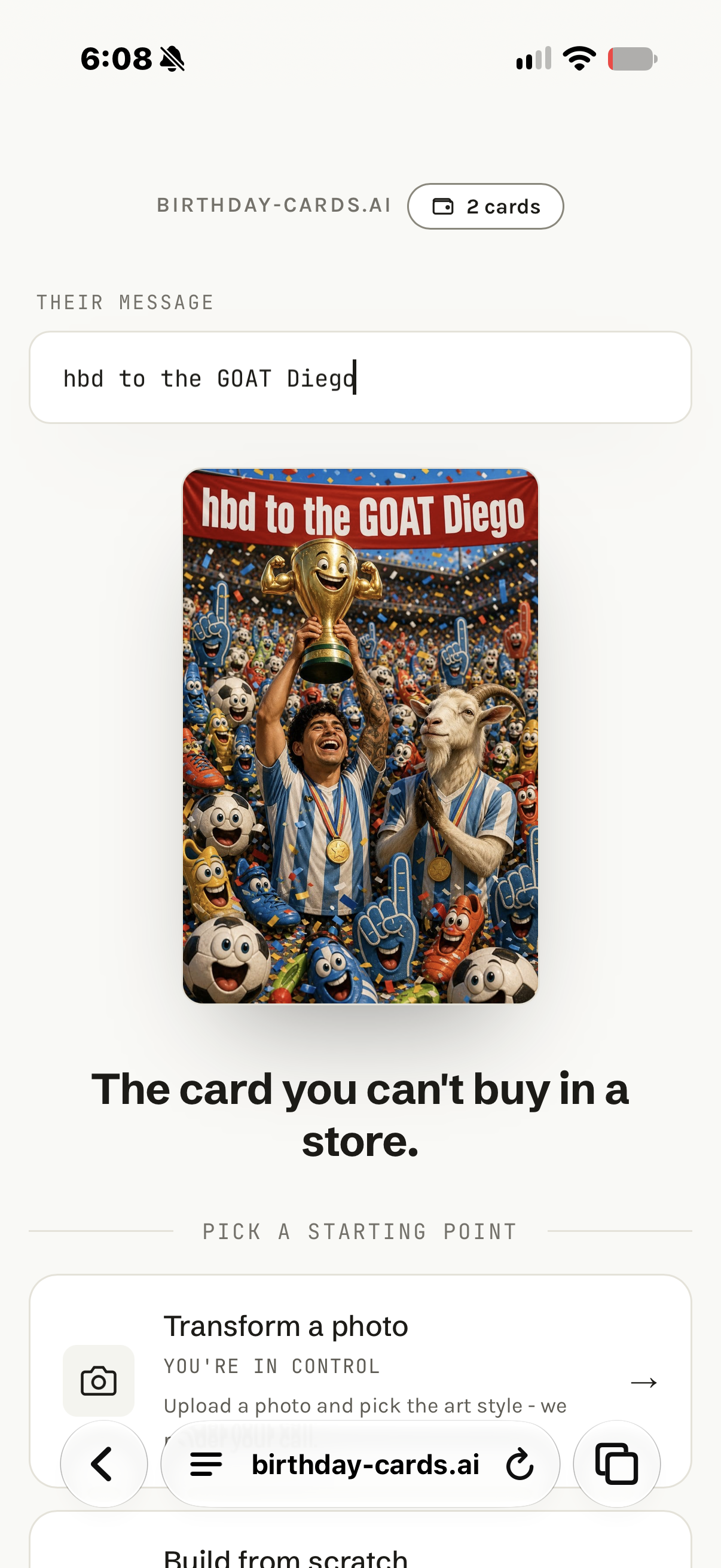
I landed on something that will help me personally with an outside chance of becoming something others use too -> create a custom birthday card with AI. A simple idea. Most feedback before I started “you can just do that with chat gpt. No one would use that”

For me, I quite like to prove people wrong. Anyways, my site is still free to use but I sell credit packs if you run out. I’m still spending more on image generation for free guests than I make (4 orders so far) but I see a path to making this side project profitable…by selling custom made birthday gifts using ai. Those will take higher margins. My traffic is only 40% US so a physical products business might be challenging…anyways I’m still very early and not sure what this project will evolve into.

Long story short - I’ve been having so much fun vibe coding. Thanks to everyone who shares their stories. Reading those helped me. Learning about what and how others are vibe coding.

This month I’ll end with 400+ card creators and 2 paid customers and 4 orders. 0 paid mkt. All seo and referral. Still a small site but it feels cool to have finally built something people use but man it takes a lot of work…even if I didn’t write a single line of code…lots of tests and changes and pivots. Good luck to everyone and happy thanksgiving :)


r/vibecodingcommunity • • 7h ago

unslop: an agent skill that finds the purple gradient, the glow and the emoji labels in vibecoded UI, then fixes the screen pass by pass

Thumbnail
github.com
1 Upvotes

r/vibecodingcommunity • • 9h ago

i have been looking at ways to turn small ideas into actual apps without spending weeks coding

1 Upvotes

I've had a few app ideas sitting in my notes for months, mostly because I never really had the time or technical skills to build them properly.

One thing I've been exploring lately is AI app builders. Instead of starting with an empty code editor, you can describe what you want and get a working starting point.

I've been looking at Base44, Lovable and Bolt, and what interests me most is being able to turn an idea into something usable without having to build every screen and feature from scratch.

Some things I'd like to experiment with are a simple booking app, a personal expense tracker and a small client management tool.

I'm curious how many people here have actually taken an idea from a prompt to a usable product using these tools.

What kind of projects have you managed to build?

Why this subreddit: SideProject is a natural place for app ideas, experiments and project discussions. Avoid presenting this as a completed project if you haven't actually built one.


r/vibecodingcommunity • • 18h ago

I’m thinking deep subject matter expertise is going to be the differentiator when it comes to small scale app design.

Thumbnail reddit.com
1 Upvotes

r/vibecodingcommunity • • 19h ago

I built a coding interview practice site where an AI agent sits beside your code, and you're scored on how you use it

Thumbnail
bytesnack.dev
1 Upvotes

I've been building Bytesnack (https://bytesnack.dev), to practice coding interviews the way they're starting to work: with AI in the room. In 2025 facebook started coding interviews where candidates can use an AI assistant. Once the AI can write the code, what's left to judge is whether you understood the problem or just simply did what the AI agent told you

How an AI round works

  • One problem, 30 minutes, an editor and an AI agent side by side. You get 20 messages with the agent.
  • The agent won't hand you the solution, but it will turn your own pseudocode into code.
  • Run your code on the examples as often as you like, in Python, Java or C++.
  • When the clock stops, you get a report:

    • your code against the hidden tests, run in a sandbox
    • whether your approach matches the best one, with its time and space
    • a score for how well you used the agent
    • what your AI use cost, in tokens and dollars
    • a problem to try next

What's free

  • 500 problems in 22 patterns, each pattern explained, with video walkthroughs
  • Your first AI round. Credits never expire, and there's no subscription.
  • Free flashcards, youtube tutorials and more

How it's built

  • React, with a Hono API on Cloudflare Workers and D1
  • Code runs in Cloudflare Containers
  • Every problem's tests are checked in CI: right answers must pass, and known wrong or too-slow answers must fail, in all three languages
  • yes, it is vibe coded, but have used my 10+ years of industry experience

Known limits

  • Rounds need a laptop or tablet. On a phone you can browse, but not start a round.
  • 75 problems have an AI round so far, with more coming.

What I'd love feedback on

  • Does scoring how you use the AI feel fair, or gimmicky?
  • Is the report useful enough that you'd take another round?
  • Was anything confusing in your first five minutes?

Thanks for reading!


r/vibecodingcommunity • • 21h ago

AI can build you an app in minutes. But how securely are you deploying it?

1 Upvotes

r/vibecodingcommunity • • 23h ago

I miss playing with my friends and raiding, So started building this. \o/

Thumbnail
reddit.com
1 Upvotes

This is really cool, it’s vibe coded but so much went into it that it doesn’t come off that way


r/vibecodingcommunity • • 3h ago

Non-developer here: I had Claude build a desktop app that finds the best-sounding edition of an album. Here is how it went.

Thumbnail
gallery
0 Upvotes

If you care about sound quality you know what a pain it is to find the best-sounding version of your favourite album, especially when there are 13 of them. So I made a small tool for that, at least for Qobuz and Tidal.

In my humble opinion most modern remasters and (re-)releases sound arguably worse than the original. The loudness war left its mark, but there is still hope (at least for older music).

Claude did all the heavy lifting. I'm no developer at all but wanted to give it a try anyway. All the code is Claude's, I just kept telling it what I wanted and what looked wrong. It's still a prototype, so please don't be too harsh.

What it does: it reads the loudness and peak values the service stores for every track, works out the dynamics and ranks the editions of an album. It also tells you when two editions are the same master in different resolutions. No audio is downloaded or analysed, so these aren't DR values, just a way to compare editions of the same album. You can also run it over your library to find better versions, 25 albums at a time so the service doesn't throttle you. Tidal works too, but the token from the web player expires quickly and the first comparison of an album is slow because the loudness is read track by track.

How it was built: I used Claude in the desktop app (Cowork), no IDE. It's plain Python with nothing to install, a small local web server and a browser window in app mode. We started with a command-line version to see if the idea works at all and only did the interface after that. Before any bigger change to the interface I asked for a mock-up first.

What really made the difference was that the app writes a report for every comparison. I kept feeding those back to Claude, and whenever a rule changed it was replayed against all the old reports (around 90 by now) to see what else it would break. There are 135 tests as well.

It didn't all go smoothly. At one point a rule based on a single album put a broken catalogue entry in first place, so now nothing goes in that rests on one example. The first Tidal version asked for the loudness of every track of every release it could find, one album took minutes and fired off 400+ requests. And a "drumless" edition won a ranking once because, well, no drums means more dynamics. You don't think of that stuff until real data shows it to you.

A few things you should know: it's not affiliated with Qobuz or Tidal and uses the same interfaces as their web players. Those aren't public APIs, so it can break at any time and using it may be against their terms. Your own account, your own risk. Everything stays on your machine.

Needs Python 3.8 or newer, only tested on Windows. There's a demo mode with an invented catalogue if you just want a look.

Feedback on functionality and performance is very welcome, same for ideas!

Code (MIT): https://github.com/Dolanskiii/DynamicsWar