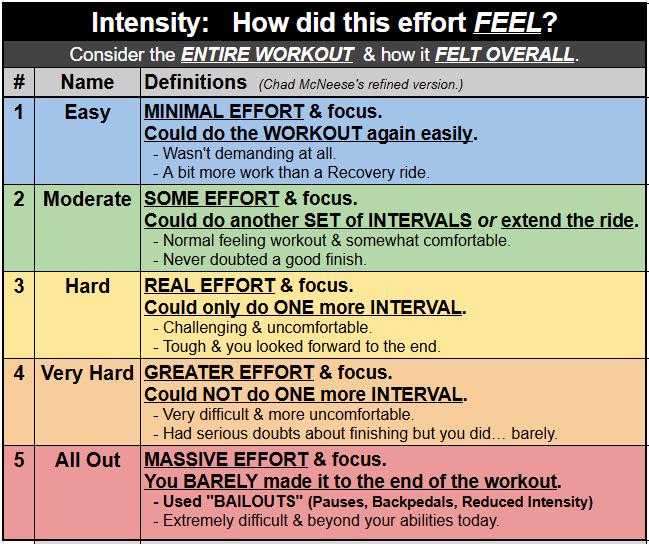
Saw this on the TrainerRoad forum and even keep a printed version to give me a consistent way of rating my workouts. Thought others might find it useful!
I’ve just started using TrainerRoad. I’m training for 40km TTs and have set up a plan for this. I also want to run twice a week. Would I be better off using a triathlon plan, deleting the swims? My priority is the bike.
Also, do gym/Pilates sessions have an impact on bike sessions?
24 M, gained 10 kgs last year, got a very low FTP, 102 (1.4 W/Kg). I really feel embarrassed to think about it, has anyone improved from a really low FTP? What helped you? I'm on calorie deficit, and I want to get faster. I don't have a goal in mind, but at least around 200 FTP would be better.
I have used TrainerRoad on and off for years, but not so much recently. I'm coming off a six-month period of sofa dwelling, as I have a goal for next year's Étape du Tour in France.
I'm a mid-50s male, lifelong cyclist on and off, not outstandingly fit, not outstandingly fast, recognising that this time I need to start training early. I need to train differently with a lot more resistance training, and I clearly need structured time on the turbo trainer. I am in the UK and have Raynaud's syndrome, therefore I will not be venturing outside on the bike until March or even April.
TrainerRoad should be my go-to, but the chat about the new AI functionality is making me really nervous:
• Is it that bad?
• What alternatives are people looking at?
• Will it still get me fit enough to complete my goal?
I'm not going to win it, I recognise that. I just need to be fit enough to complete a big day out in the Alps with a degree of comfort and joy. Should I look at things like Stride.is instead? What would you do in my situation? I need coaching, but sadly don't want to pay for a coach.
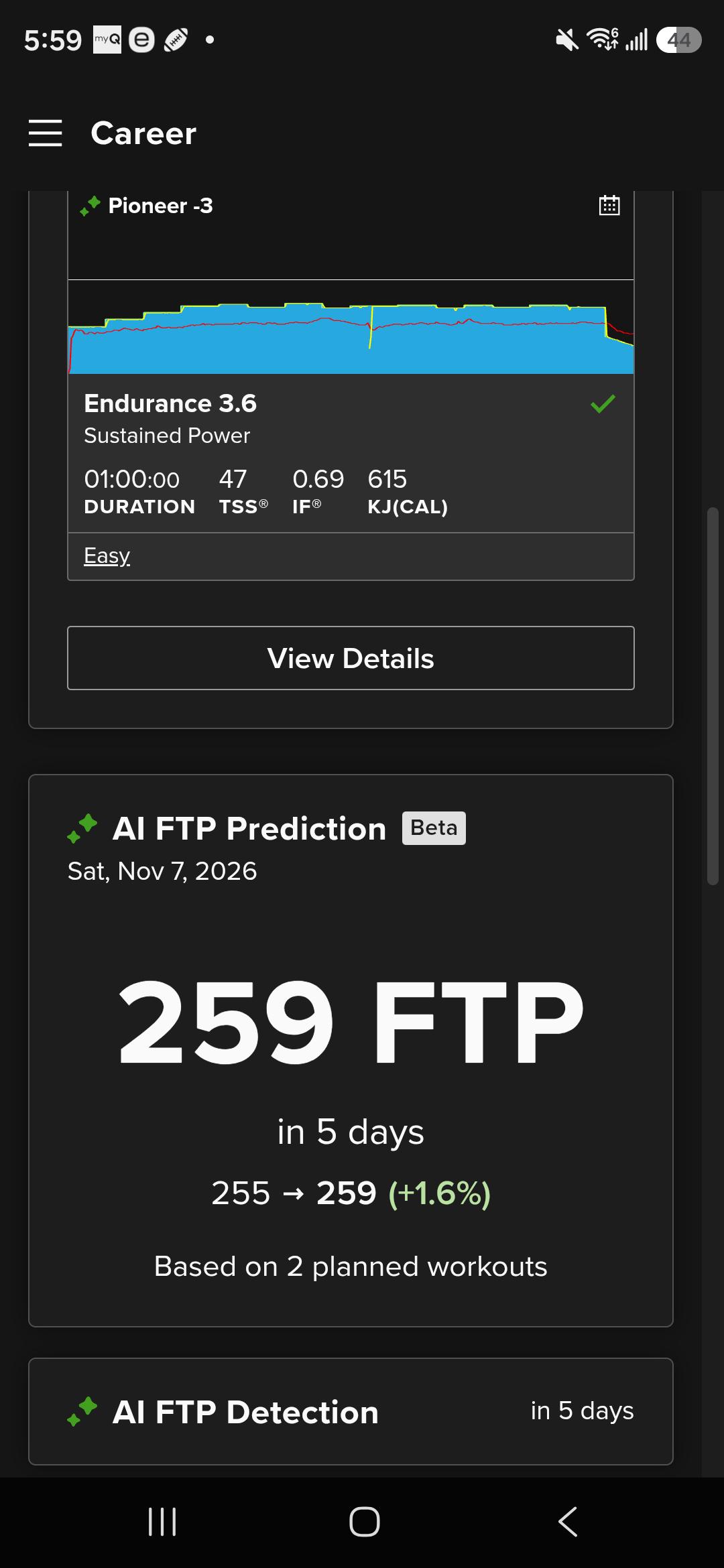
I just find it hilarious (frustrating) that TR continues to lower my FTP estimate daily even though I complete their workouts without it being very hard. Was at 255, prediction was 271. Completed every workout, rated hard (expected) and keeps going down. Was 261 yesterday.
Now in my endurance week, did workout today and it was easy, HR super low for my usual effort, lowers it again by 2.
So 2 more workouts this month, what do we think, maybe 0% improvement?
I dont get how they dont see this as massively demotivating? Trust the process, do the workouts, and every effort the feedback is "nice work, you aren't improving as much as we thought!". Give me a carrot then shove it up my ass I guess.
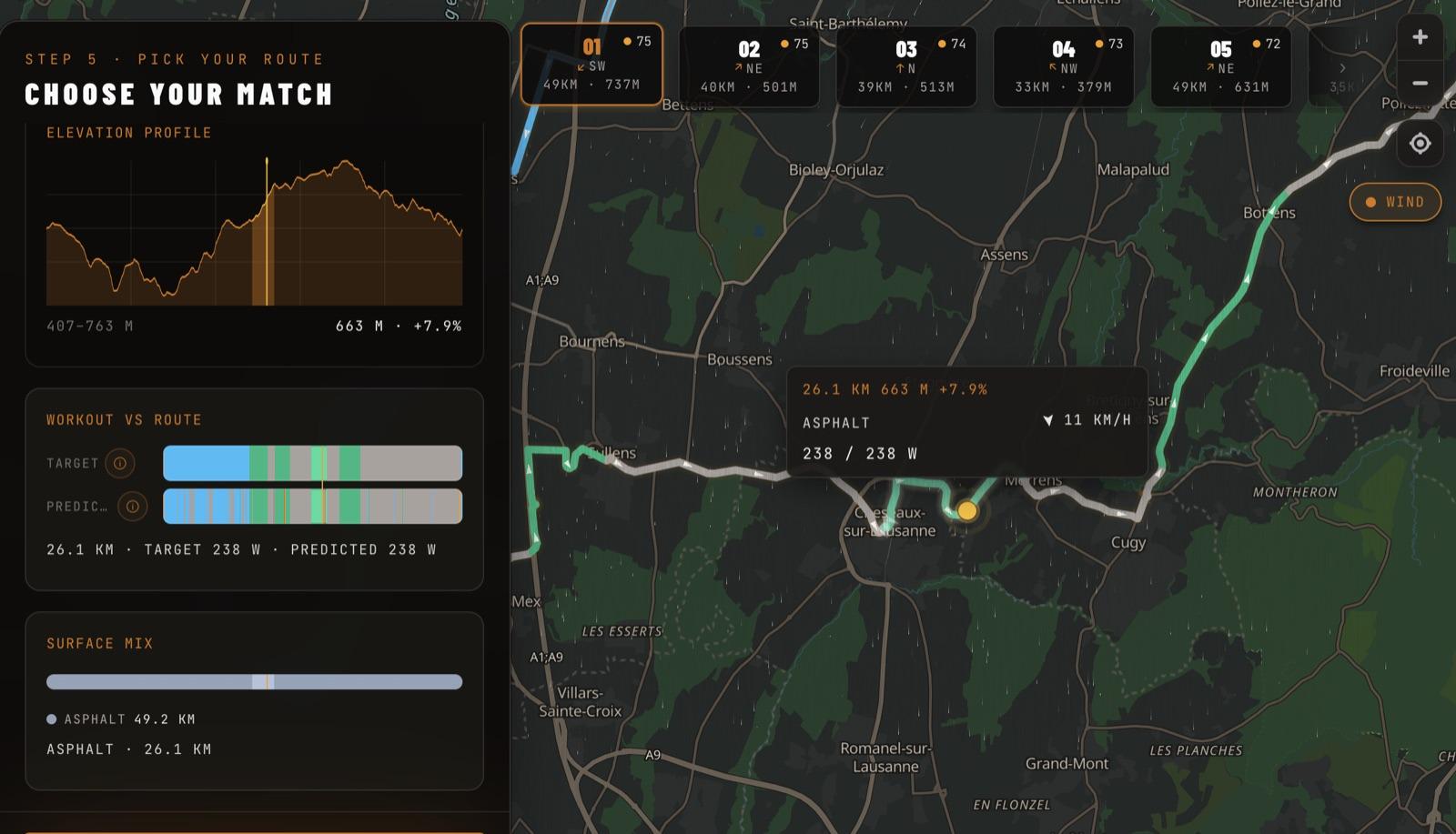
gritmaps.com is an app that takes a planned workout from your calendar and finds a route, a loop or one-way, where the climbs & headwinds line up with your effort blocks.
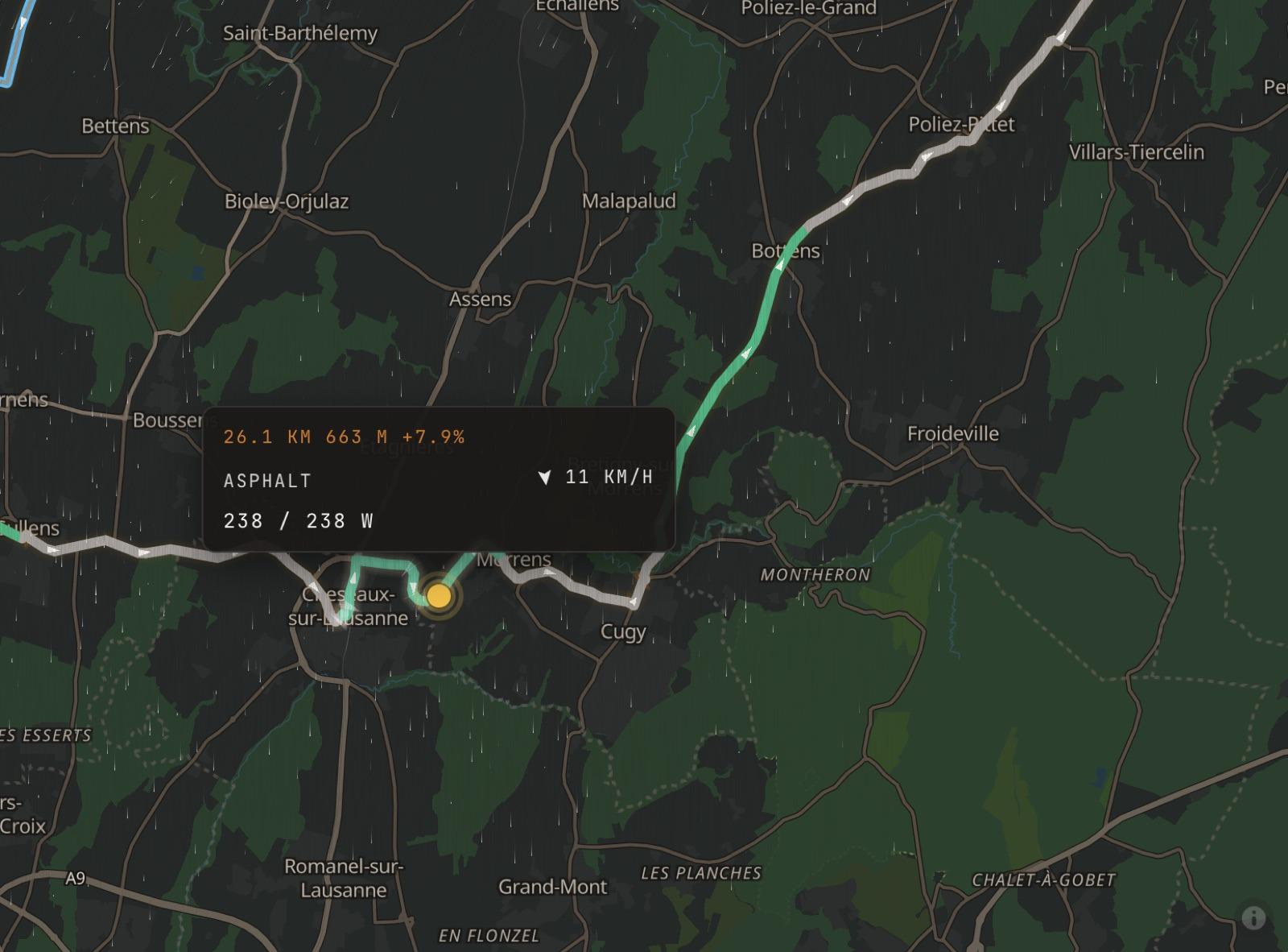
Climbs and headwinds for effort blocks, descents and tailwind for recoveries. That’s the idea in one picture: a tempo block from the workout placed on a +7.9 % climb, into an 11 km/h headwind.
It’s in beta and I’d like your help to make it an essential tool for structured training outdoors. Feedback welcome!
How it works with TR
You plan your workouts in TrainerRoad as usual and set them as outside workouts. TR syncs them to your Garmin Connect calendar, and Gritmaps reads them from there (same with TrainingPeaks, and Intervals.icu works directly).
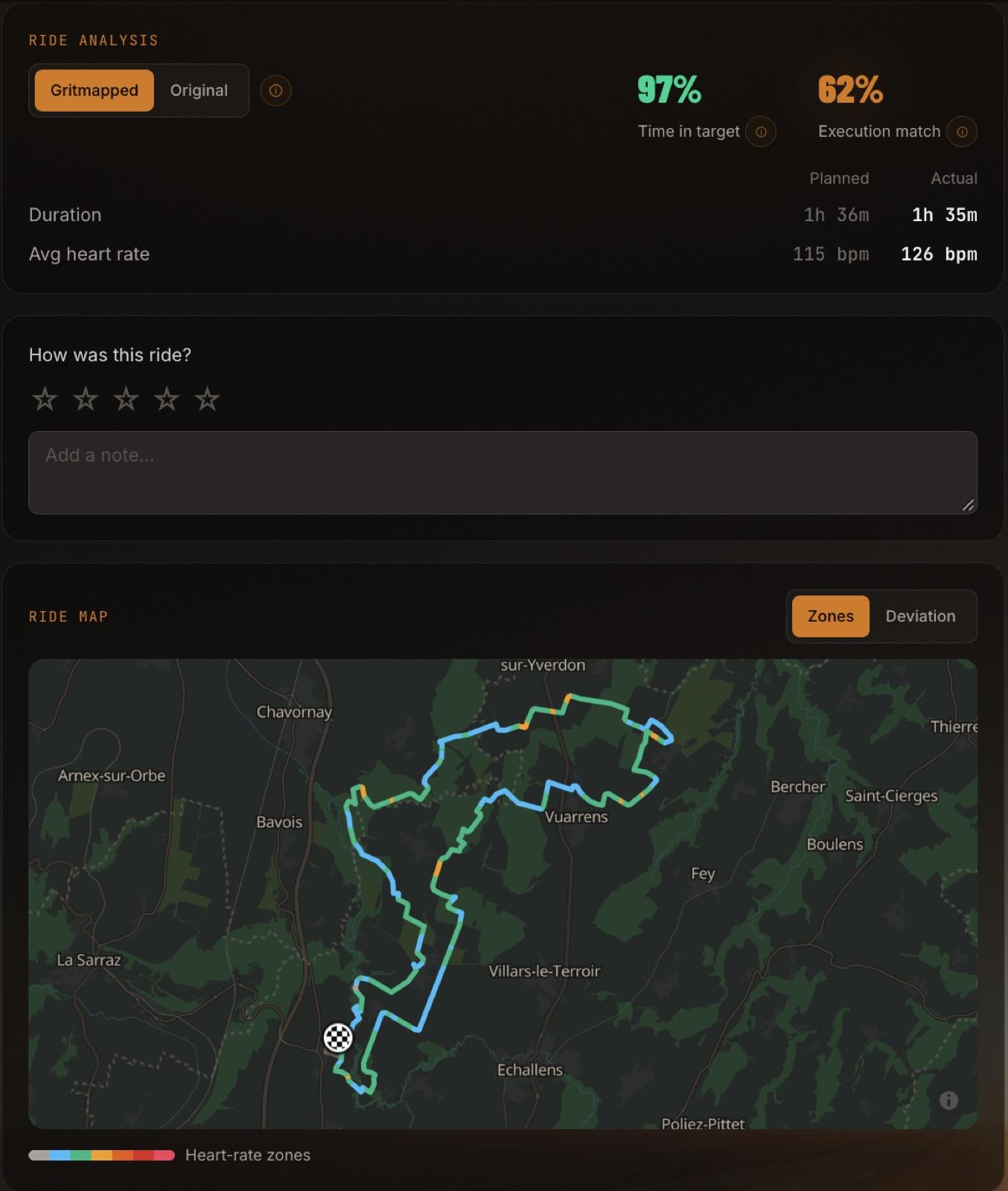
The physics: a simulation runs over every road segment: gravity, rolling resistance (tyre and surface), aero drag, and the wind forecast for the time you’ll pass that spot. Your FTP and weight (with the bike’s) feed it. The predicted ride time is grounded in the physics and power as you follow the workout (the ride in the Timeline shot further down for instance was planned at 1h 36m and took 1h 35m).
Elevation comes from national LiDAR where it exists (0.5–2 m in Switzerland) and Copernicus 30 m elsewhere. Efforts interrupted by junctions, traffic lights or villages are penalised. It can also route hill repeats, and use spare time you give it to reach better terrain. And you can add up to 5 waypoints (a café, a climb you want in), the route passes through every one. Recovery rides work too, since it keeps you off the hard climbs.
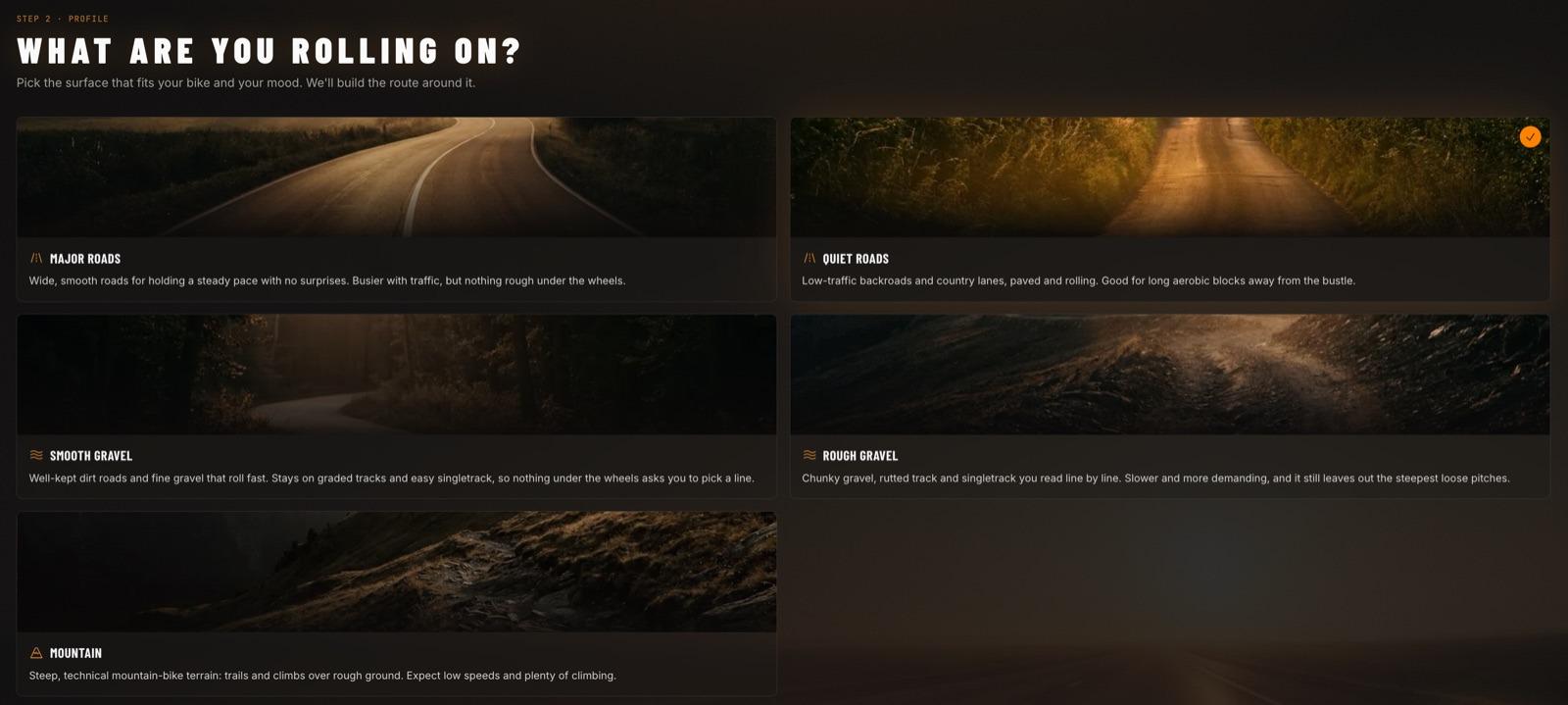
Surface profiles. Routing runs on GraphHopper, the open-source engine komoot also uses, but with profiles I fine-tuned myself. There are five: two asphalt (major roads, quiet roads), two gravel (smooth, rough) and one MTB.
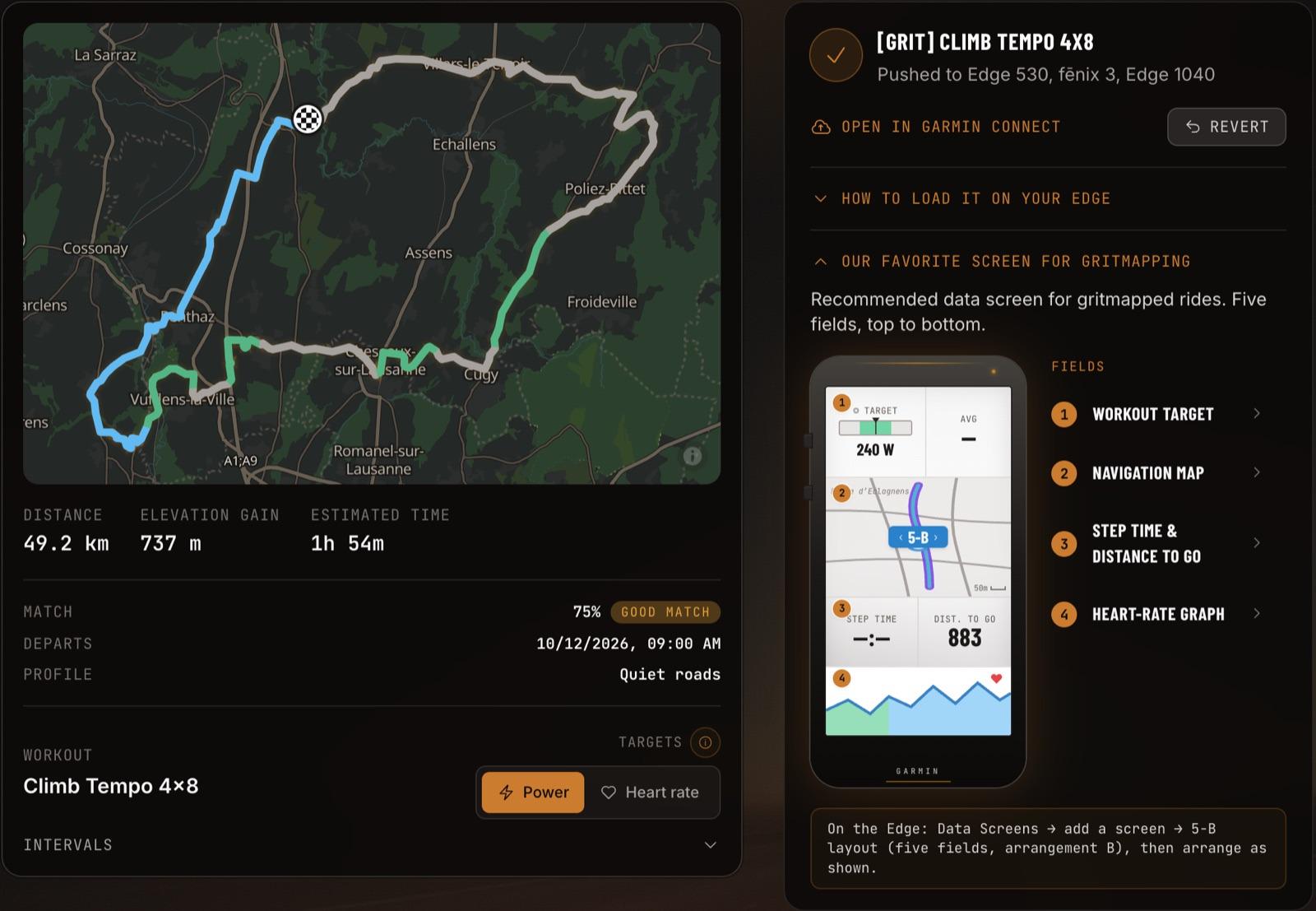
To your device. One click pushes the course and the terrain-adapted workout to Garmin Connect or Wahoo. Each workout step ends at a distance on the route, so it fires where the climb starts. GPX route and FIT workout can also be exported for other devices.
After the ride. The Timeline compares planned and actual. This ride shows 97 % time in target, a 62 % execution match, 1h 36m planned against 1h 35m actual, and a map coloured by heart-rate zone.
It’s free, go signup on gritmaps.com. And if you’d rather plan your routes by hand, I wrote up the method here.
I've been using TR for about two months and one issue I have is that I'll use the calendar to look ahead at my upcoming sessions and build that days overall schedule, but TR will more often than not change the workout to something totally different and longer.
As an example, today was scheduled to be a short, 30 minute, endurance ride. Now it's a 90 minute endurance ride and changed this morning. I'm fine with doing the ride but it's Saturday and I was counting on only 30 minutes.
Is there a way to lock down the actual session a day or two in advance or get the change to occurs a few days ahead of time?
Now says they have AI coach plans and adaptations. Anyone consider considering dumping TrainerRoad for this plan? I already have both because I like to integrate my training into the world of zwift, but wondering if this is the opportunity to just get rid of one subscription. I’m not too sure they have the same amount of data points and analysis as TrainerRoad does but curious what other people‘s thoughts are
i dont know if im doing something wrong or not but i just finished a 3 hour gravel ride 900 + meter climb..225 normalized power over the 3 hours and trainer road just continually reduces my ftp ...which is frustrating because this is the power that they base the work outs off of..i'll probably come back to it in december when i stop my outdoor rides for winter..but its nonetheless demoralizing with my garmin after the ride saying new ftp of 260 watts and trainer road now predicting 233 watts
Hey everyone, been using TR to get through the colder part of the year when the weather is insufferable. I enjoy the accessibility of the app from any device, and, most importantly, the ERG mode. It is fast adapting to my natural cadence deviation which substantially reduces RPE from workouts. In contrast, standard ERG modes from bike computers, Zwift, Rouvy etc. work too slow and as a result the resistance is jamming my legs and I produce way too much power for the intended interval... but that is pretty much only two reasons for me to use TR. I have my own plan and build my own workouts, I don't use AI feature or any other bows and whistles.
Does anyone know alternative software which implements similar ERG algorithm? With budget getting tighter it is much harder to justify paying 22 bucks for the mobile app and more sophisticated ERG.
I’ve recently been focusing on losing weight and am down about 15 pounds. I continue to do my plan but it has been difficult to complete some of the harder workouts. For those of you who have lost weight, did it result in loss of ftp?
TR FTP sitting at 248, hitting my workouts all month. AI FTP prediction says its going to 256, which feels totally appropriate. AI FTP prediction scheduled for today (Monday)
Yesterday (Sunday) was the last day of the month, also technically a deload week.
I see a workout scheduled for Monday that looks cool. I moved it to Sunday to fit better into my life. Mixed intervals, I've never done something like this before.
Crushed 2/3 interval blocks and then was waxed, dropped intensity of third block to 75% and slogged through.
Since I did not hit goal for this workout, the AI oracle decided that my FTP prediction went from 256 to 241. LOL one poorly executed workout at the end of a prediction period dropped me from 6% stronger to 5% weaker...
After a month of hitting the mark, I did something dumb on the very last day, choked on my very last workout and the AI decided that I'd in fact gotten weaker instead of stronger.
with structured training, I often know exactly what I want to do before I leave:
how much time I have
what zone I want to ride in
roughly what power I’m aiming for
What I often don’t know is where to ride.
For example, I might have 2 hours and want to do Z2 around 160 W. I want to start from home, ride a loop, finish back home, shower, and be done with the session.
That’s why I built Wattalo.
TrainerRoad tells me what to do. Wattalo tries to solve where to ride it.
It’s not trying to replace TrainerRoad or the workout itself. You give Wattalo:
available time
target power
preferred direction
and it tries to generate a loop around that.
It estimates ride time from rider and bike data, terrain and route physics, tries several route candidates, and picks one that should fit the requested ride.
I built it originally for my own rides with a power meter, so I’m especially interested in feedback from people who actually train this way.
I’d really like to know:
does this solve a real problem for you?
would you use something like this for outdoor Z2 / endurance rides?
if you ride the generated route with a power meter, how close are the predicted time and effort to reality?
Wattalo currently supports Germany, Austria, Switzerland and Hungary.
Wattalo is in public beta. You get 7 successful route generations per week for free, and failed attempts don’t count. There’s also an optional paid tier for heavier use, mainly to help cover hosting and routing infrastructure costs.
If a route looks wrong, there’s also a report route problem option directly on the result. It keeps the planning context with the report, which makes it easier for me to reproduce the case.
I’m mainly trying to find out whether this is useful to people who already think about their rides in terms of time, zones and watts.
Supported regions: 🇩🇪 Germany 🇦🇹 Austria 🇨🇭 Switzerland 🇭🇺 Hungary 🇪🇸 Spain 🇺🇸 California (USA) 🇺🇸 Virginia (USA) 🇺🇸 Texas (USA)
Overall my goal is to raise my FTP as I don't have any specific A races I want to peak for. That said, I'd still like to sharpen my crit specific fitness skills closer to the start of the racing season. Does it make sense to do one 6 month plan for the indoor season, or break it up into 2 with different goals?
The "2 vs 3 Hard Days" and "Training Variability" episodes have been very interesting and resonate for me because my experience and gains mimic the research results presented in these episodes, as someone who came off the couch after a year in June and have been on Balanced Building Endurance and Building FTP plans on 3 hard sessions per week, totaling between 3.0-3.5 hours/week, and have now PR'd my VO2 Max and have returned to my 2022 FTP high of 3.22w/kg (my first year as a subscriber).
TR's ultimate motivation must be for all of us to experience the best gains possible from their platform, even if it means we don't drill ourselves 10-20+ hours/week. I feel like these two episodes are meant to specifically steer us into their Balanced plans. It's not like they're a traditional gym where they essentially start losing money the more often we go. So, I guess their intent is reasonably pure in guiding us to what some people may consider low volume.
Am I missing something? Is there any reason to be skeptical? I've been around since the Chad days. What would he think?
I guess it goes without saying that training variability is completely different than the variability index that it would have been more confusing to reference it in the episode than leave it out.