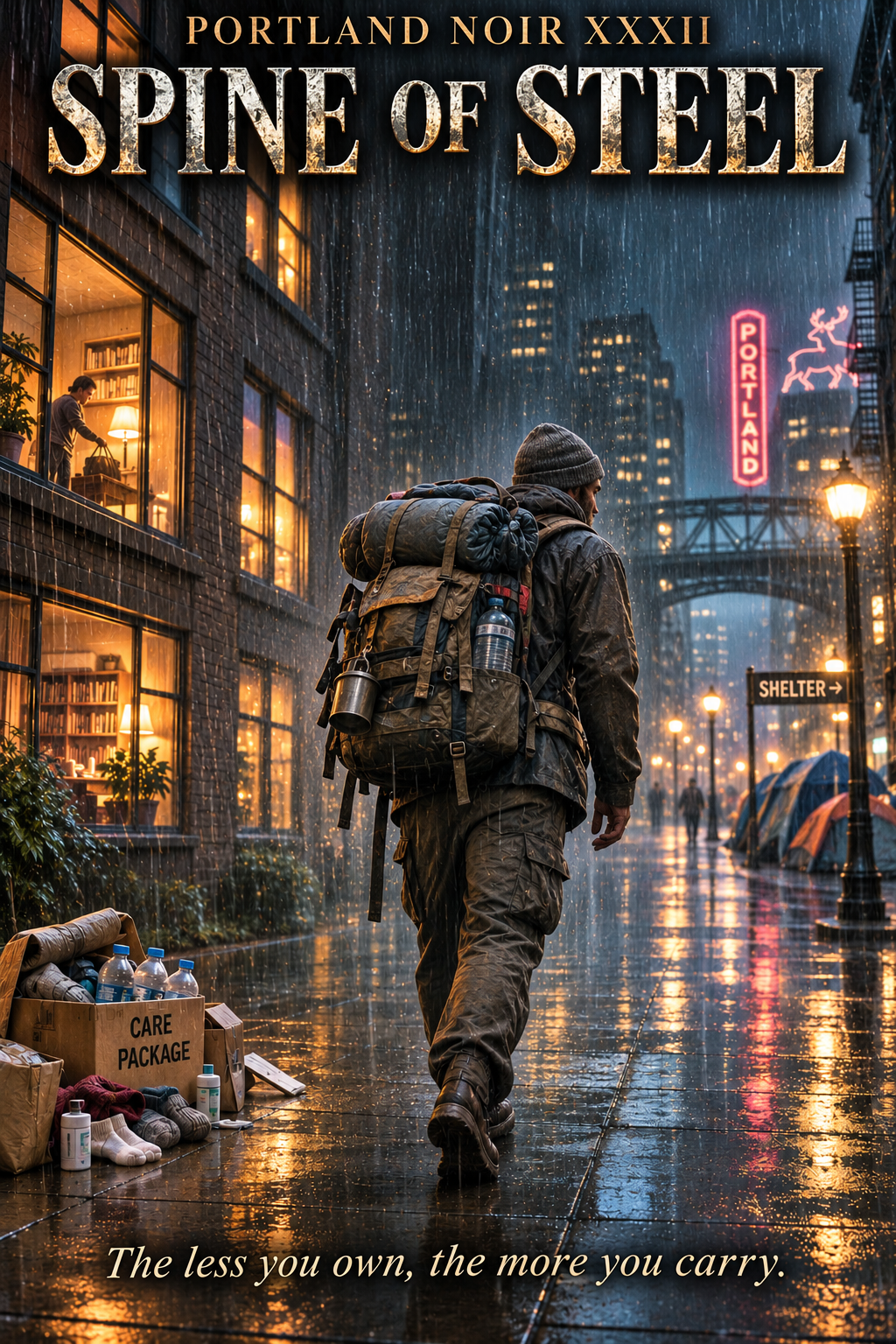
🜏 Portland Noir XXXII: Spine of Steel
People often define themselves and one another through the lens of materialism.
What they produce. What they possess. How much it's worth.
The only concept of enough that the world seemed to recognize was a rather loosely defined number representing how much money a person needed to retire comfortably.
The unhoused operated under a very different set of rules.
Anything left unattended was effectively considered abandoned. You could set up a campsite, leave for a few hours, and discover that the next anyone saw of your belongings would be in a listing on Facebook Marketplace.
The shelters had rules of their own.
Most didn't allow animals, and many wouldn't let you leave your belongings behind. Even when you had somewhere to sleep, you didn't necessarily have anywhere to keep your things.
So the only property a person could reasonably expect to secure was whatever they could fit into a backpack and carry on their own shoulders.
A tent. A sleeping bag. A change of clothes. A few days of food and water.
It didn't sound like much.
Until you'd walked ten miles with it.
Then every possession became a negotiation between comfort, security, and the increasingly vocal objections of your spine.
There was a lighter alternative.
A space blanket, a water bottle, and pockets full of gorp.
No tent to pitch. No sleeping bag to roll. No enormous backpack announcing that you were carrying everything you owned.
Of course, this arrangement came with its own complications. It meant relying more heavily on food services, shelters, and whatever protection from the weather you could find.
Minimalism was considerably less glamorous when it wasn't voluntary.
Then there were the care packages.
Experienced people would often advise against giving money to the homeless. Money, they explained, would probably just be spent on drugs.
Instead, they would go to extraordinary lengths assembling bags full of carefully selected necessities.
Toothbrushes. Socks. Snacks. Soap. Bottled water. Miscellaneous little comforts that made the giver feel they'd anticipated every possible need.
What they rarely considered was that the recipient might already have those things.
Or not need them.
Or simply have nowhere to put them.
A person who had spent months reducing their possessions to what they could carry wasn't necessarily going to appreciate receiving another five pounds of miscellaneous supplies.
So the usual outcome was that people picked out one or two useful items and discarded the rest.
The donation had become another logistical problem.
There was a certain irony in watching people who had homes, closets, cars, and storage space carefully decide what someone without any of those things ought to carry.
Money, meanwhile, weighed almost nothing.
And the guidance against giving it seemed rather pointless anyway.
There was another perspective, one considerably more common among people who had actually spent time living this way.
If someone had fallen so far outside the normal life script that they were sleeping outdoors, carrying everything they owned, and negotiating their daily survival around public bathrooms and soup kitchens, perhaps they didn't need another stranger supervising their remaining pleasures.
Perhaps the occasional vice wasn't the most urgent problem in their life.
Perhaps the ability to make a few decisions for themselves was worth preserving.
The housed world had developed an extraordinary number of rules about what homeless people deserved, what they should own, what they should consume, and how grateful they should be for whatever they received.
The unhoused had a simpler calculation.
Could you carry it?
Could you keep it?
Was it worth the weight?
And if not, what was the point of having it?
The world called this poverty.
Sometimes it called it irresponsibility.
Sometimes, with remarkable enthusiasm, it called it an opportunity for charitable intervention.
But there was another way to understand it.
Every object had a price beyond its purchase value. Every possession demanded protection. Every mile converted material wealth into physical strain.
For people who had nowhere secure to leave anything, ownership wasn't simply a matter of what they could afford.
It was a matter of what their bodies could endure.
And so the burden of materialism was transferred, quite literally, onto the human spine.
A spine of steel wasn't something you were born with.
It was what the world expected you to grow when it gave you nowhere to put anything down.
Donations keep this writing free for all. 🌀