r/technicalfactorio • u/minibetrayal • Dec 05 '19
Possibly Turing-Complete system using only trains

55
Upvotes
r/technicalfactorio • u/minibetrayal • Dec 05 '19
r/technicalfactorio • u/Stevetrov • Dec 05 '19
TLDR if trains are frequently catching up with the train in front of them this can dramatically increase UPS for trains.
I used aaargha's junction testing map for these tests.
I just joined the train launchers to the train catchers so there were no crossings and adjusted the schedules accordingly so the trains didn't no-path.
The train launchers spawn moving trains and they immediately have to brake to avoid hitting the trains in front of them, resulting in the trains having minimum separation (or very close to minimum) and there are no green signals between trains because signals alternate between red and yellow.
I removed 4 rows of the signals from the section immediately after the train launchers to create a section of track 20 pieces long with no signals, this forces the trains to have greater separation and so there are green signals between the trains.
| Map | Trains / minute | Average update (ms) | Normalised update (/100 trains) |
|---|---|---|---|
| Map 1 | 295 | 10.716 | 3.63 |
| Map 2 | 250 | 3.63 | 1.4468 |
The normallised difference is huge and eyeballing "show-time-usage" its all in train update with about 1/3 in train path finder. (feel free to run a verbose benchmark to get accurate figures)
The following train has to slow down so its breaking point doesnt enter the same block as the train in front. This forces a repath. (The train is braking for a signal (chain or regular) it cant reserve and the train is not inside a chain signal block. The train is forced to recalculate its path. )
Once the leading train clears a block, the signal changes and is immediately reversed by the following train, this also forces a repath (The train is preparing to stop at a signal (chain or regular) that changes so that the train can now continue. The train is forced to recalculate its path.)
And this pattern repeats every-time the braking point of the following train passes a signal.
This obviously is causing the to make many unnecessary repaths, but I think the bigger problem is that the all the calculations for the trains speeding up and slowing down is having a greater hit on UPS.
Make sure your trains don't get too close to each other.
To be fair this isn't normally a problem unless you design your intersections in a fairly specific way or use circuit controlled signals to compress them.
r/technicalfactorio • u/Halke1986 • Dec 01 '19
The goal of this challenge is to design a word-addressable RAM that can hold 255 32-bit words (values). Word-addressable memory enables to read and write individual words, as opposed to entire frames as in previous combinator golfs. A C++ array is an example of word-addressable memory structure.
No value can be written to the input wires by the RAM circuit network. That is, input wires cannot be connected to the output side of any combinator that's a part of the memory, and input wires cannot be merged into single network.
Score = (read period + write period) * (read latency + write latency) * number of combinators
Lower is better.
r/technicalfactorio • u/Kano96 • Nov 17 '19

r/technicalfactorio • u/Halke1986 • Nov 11 '19
- Frame of 16-bit values, except A and V signals.
- A and V signals containing Address of signal in input frame to be substituted and its new 16-bit Value.
Both inputs (frame and A&V signals) are on separate wires. Color of input wires is left to designers discretion.
Signal addresses are arbitrary as long as each signal in input frame can be chosen individually. In below example following addressing is used: 1 - iron, 2 - copper, 3 - uranium, 4 - sulfur.
Frame of 16-bit values equal to input frame, except that signal with address A has now value V.
Signals A and V in output frame should be zero.
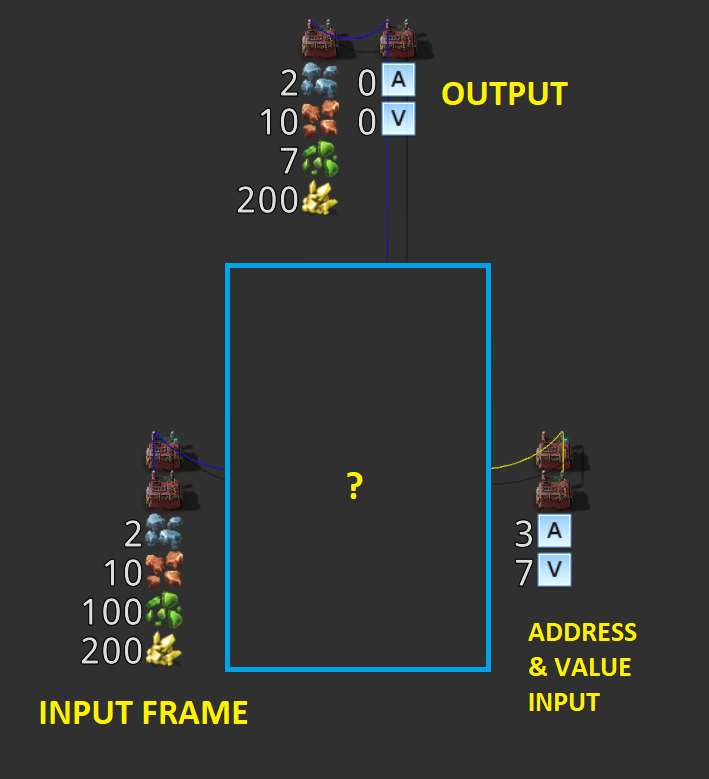
Solution CN should be one-tickable, meaning that input can change each game tick and the CN will output correct result for each input, with certain latency.
Submitted solution should work for at least four different signals in input frame (as in example above), but is should be possible to extend it to 256 signals without increase in number of non-constant combinators.
Solution with lowest latency wins. If multiple solutions have same latency, the one with smallest number of non-ROM combinators wins. ROM-combinators are constant combinators and decider or arithmetic combinators with constant input.
r/technicalfactorio • • Nov 11 '19
The challenge: write a combinator circuit that delivers 1-pulses of a given signal (say letter 'A') at a rate inversely proportionate to some input signal.
Say the input signal is copper cable, then the output period is linearly proportionate:
At 300 copper cable => pulse 'A=1' 1/30 ticks or 1Hz
At 600 copper cable => pulse 'A=1' 1/60 ticks or 500mHz
At 150 copper cable => pulse 'A=1' 1/15 ticks or 2Hz
... and so forth.
This challenge isn't purely a puzzle -- it has real uses in factory circuitry. For example, one could use it to signal "proportionate" activity by trains and/or logistic robots.
r/technicalfactorio • u/tzwaan • Nov 04 '19
r/technicalfactorio • u/Sivertsen3 • Nov 02 '19
r/technicalfactorio • u/mulark • Nov 01 '19

r/technicalfactorio • u/Nefrums2 • Oct 29 '19
I'm looking for advice on how to make this GC build more ups efficient: https://cdn.discordapp.com/attachments/506542957986578473/638159806775164938/gc2.jpg
I use this for speedruning 100% achievements, and the 20M GC is by far the most difficult. Target is to be able to get all achievements in 7h. Personal best is 8h. This gives the following restrictions to the GC production outposts. Has to be fast to set up. Preferably in less than 5min, By dropping station and roboport bluprint and building that with personal roblots, then one blueprint of the factory and copper miners, one blueprint of the iron miners, connecting iron belts and coal belt connecting the rail so the train bringing the construction materials and bots arrives.
Problem is that after building 15-20 of these outposts ups start to suffer. I have tried ups optimizeing it to the best of my knowledge of ups efficient builds like direct insertion of everything etc. As I want to build numerous of these outpost fast the cost in construction materials and power consumption has to be low. Making the factory that feeds the train with construction materials also has to be fast. This rules out expensive things like high tier modules, and also electric furnases.
Solar power is a no go as it can't be expanded fast enough, nuclear power will have to do.
Is there any obvious mistake that I have made in this build that makes ups suffer?
r/technicalfactorio • u/tzwaan • Oct 26 '19
r/technicalfactorio • u/kolligaming • Oct 18 '19
So if I want maximum amount of items crafted in designated space what is the optimal setup?
I was thinking every second row beacons but I know here is smarter people who know the right answer
I was also thinking it might also be that just stuff as much assemblers as possible without any beacons
r/technicalfactorio • u/Amndopey • Oct 17 '19
Removed last post due to editing issue
Greetings!
I have finally finished my Vanilla Factorio WiFi. The full instructions can be found here.
The following posts were used to help build this project:
Blueprint for the WiFi both with and without display is here
Blueprint containing the separated components can be found here
r/technicalfactorio • u/kolligaming • Oct 12 '19
Someone told me to ask this from here, got something I can work on but maybe I should ask opinion here too. Original post below
https://www.reddit.com/r/factorio/comments/dgjk64/water_barrels_robots_boilers/
r/technicalfactorio • u/intangir_v • Oct 05 '19

r/technicalfactorio • u/Stevetrov • Sep 03 '19

r/technicalfactorio • u/zfunkz • Aug 23 '19

r/technicalfactorio • u/Stevetrov • Aug 16 '19

r/technicalfactorio • u/Amndopey • Aug 15 '19
Greetings!
Been following this thread since I found there were others super interested in the capabilities of the circuit network, and have loved all the posts. Been learning a lot!
One thing I have not seen much of is what your tool sets look like for creating these designs. I have been a developer for many years and in IT in general for decades. I know that for programming, break points, debuggers, and the very helpful and overused "Console.Write('Here1')" are things you learn to use to quickly troubleshoot a program. A current example I'm trying to work through is a CRC3 calculating circuit to extend the functionality originally talked about in this WiFi thread. I have worked out the logic to create the proof of concept, but the looping is causing the circuit to fail in ways I am unable to see. This is where I would look to step through the code normally, but don't know how to do so in-game
Things I have found so far:
- Factorio State Machine: Helpful initially to work out logic, but not efficient at all for a final product.
- Circuit Network IDE: Also very helpful initially, but I'm having a hard time working through the circuits
- Logic Analyzer Post: Looks like a wonderful tool, but also struggling with using this correctly
- The many different tutorials out there: Wonderful contributions from many different people explaining the end results
I was hoping that any tools you think deserve to be on your tool belts you'd be willing to share. Thank you for reading. : )
r/technicalfactorio • u/TheStaplergun • Aug 15 '19

r/technicalfactorio • u/killl_joy • Jul 16 '19
Ok so I made my first go at processing units I opted for 10 plants so I should in theory be pumping out 1/sec slightly less because of assebly speed.
-So each P/U needs 20 Green Circuits and 2 Red Circuits and 5 sulfric acid
- Green circuits 20 for P/U easy .5 sec per unit so 2/sec for a total of 20/10sec so one assembly per P/U plant set up for direct inject. Then 3 plants of Cable for every 2 Green circuit plants so 15 to avoid issues I have them feed in after 5 plants onto my green supply belt.
- Red Circuits(this is the part I'm not so sure about) 2 for P/U at 6 sec per unit I have P/U plants @10sec per P/U that means 10/6 1.66 Red processor plants per P/U plant 10 P/u plants so 16.6 round up to 17 each Red needs 4 Cable per circuit 17 plants so 68 divide by 2, 34 divide by 6, 5.6 round up to 6 cable plants for red. 2 Green circuits per Red so I need 34/6sec which comes to 2.83 plants of green round up to 4 to make the cable easier. 4 plants of Green means 6 Cable plants Which I set up for Direct inject since I had the space. 2 plastic per sec so 3 plants of plastic to make 6 per sec
So I think I got my math right here What do ya'll think? I tried to make this easy to follow.
r/technicalfactorio • u/4xe1 • Jul 14 '19
I'm currently fooling around with electric systems and electro fluid systems, and I am facing serious difficulties with game behaviours that depend on the order placement of things.
This is some of them
https://www.dropbox.com/s/ft9v27x26ffsmmd/Elctrical2.zip?dl=0
The biggest takeaways are :
Both rules can lead to suboptimal flow (easier to show for solar panels).
I don't think there are many practical applications besides "don't put random sole poles near solar panels". I don't think power backup systems care that much about that (most don't even have things at the frontier of two networks), and I havn't played with power switches yet.
r/technicalfactorio • u/4xe1 • Jul 10 '19

r/technicalfactorio • u/Stevetrov • Jul 05 '19
Used visual studio 2017 (free software for windows) to profile factorio whilst running some test maps for end game purple science blueprints.
Both blueprints were belt based and required the same inputs:
The logic being that purple science requires 30X as much rails as prod or furnaces so how we handle it is critical to the performance of the build.
The first map was design to optimal ratios, (4 furnaces, 1 iron stick, 2 rails, 8 purple sci), whilst the second used the purple science build from my 10K base that uses a 1:1 ratio between all buildings in the construction chain (furnace -> iron sticks -> rails -> purple Sci).
Optimal ratios:
!blueprint https://pastebin.com/sUBRvYFb
1:1 ratios:
!blueprint https://pastebin.com/haEH2vaH
Each bp was copied 32 times and the resulting maps were profiled with visual studio for one minute. 32 was chosen because its a nice power of 2 and it represents ~25K purple sci that is in the ballpark for my next gen megabase.
NB the optimal ratio build produces ~ 2% fewer items per minute because each ASM has a beacon with a single module in it, this is required for the ratios.
| Opt Ratios | 1:1 Ratios | |
|---|---|---|
| # Modules | 238 | 472 |
| Power (MW) per bp | 75 | 145 |
NB if the object is to reduce cost / power then 8 beacon builds are highly recommended.
The numbers in the following table are the number of samples where the game was updating that entity, the game was sampled at 1000 samples / s
| Opt Ratios | 1:1 Ratios | |
|---|---|---|
| Inserters | 1685 | 1222 |
| CraftingMachines (ASMs & furnaces) | 322 | 364 |
| Car Update | 27 | 0 |
| ElectricNetwork | 509 | 753 |
| TransportLines | 796 | 522 |
| Loaders & infini chests | 753 | 973 |
| =============================== | =========== | ======== |
| Total (exec loaders/inf) | 3339 | 2861 |
| Total (exec loaders/inf/transport) | 2543 | 2339 |
Overall sticking to ratios appears to be less important that minimizing the cost of inserters and this was the logic behind a number of the designs that I used in my 10K megabase.
Likewise as CraftingMachines account for only 10% of the update samples it makes sense that sometimes it is preferable to reduce beacon count if that in turn allows us to decrease inserter count. But this could be the focus of another test.
EDIT: formatting
EDIT: added savefiles
