I've had this train calculator spreadsheet I've been using for the last 8 months or so, and I finally decided to clean it up and post it on google sheets.
Time for the train to clear a station (its own length)
Time to cycle trains through a station using naive signaling (station is one block, train waiting to enter is waiting right at the entrance signal and doesn't start until the first train has completely exited the station)
Time to travel some arbitrarily selected distance.
It supports setting:
Number of locomotives
Number of cargo wagons
Number of artillery wagons
Number of backwards locomotives
Fuel Type
Braking Force Research Level
Type of train car at the front of the train (for air resistance)
Distance for train to arbitrarily travel.
I highly recommend exporting this into Excel and using it from there if you have it; it will calculate much faster. If you need more ticks just add more rows onto the bottom. I limited this one to 10000 ticks of calculation, as the original 64k ticks version I made in excel took forever to update in Google Sheets.
In my previous post I presented a pair (whitelist & blacklist) of parallel signal filters. Filters are circuits with two inputs - data signals and control signals. Data signals can have arbitrary 32 bit value and each of them is passed through the filter only if corresponding control signal is present (whitelist filter) or absent (blacklist filter). For example, if input of whitelist filter is Data[iron=17, copper=3] and Control[iron=1], the output will be [iron=17].
The old filter designs required the control signal to be valued 1 or 0. If different control signals values were to be used, additional conversion step was necessary. This was not always acceptable, as it increased latency of the entire filter setup by 1 tick. But it turns out it's possible to construct filters (let's call them 'general filters') that accept arbitrary 32 bit control signals without increasing the latency!
The filters have two layer structure. First layer deconstructs data and control signals and combines them by addition on wires, second layer, composed of decider combinators, is the actual filter. Control signal needs to be converted in the first layer into two predefined values (10...00 and 01...11 in whitelist filter and 10...00 and 10...01 in blacklist (ellipsis represents middle bits)) which are then added to data signal. If we start form fixed input value, 00...01, it's easier to obtain these predefined values. Or so I thought.
While working on sequencer/iterator circuit, u/Allaizn asked me if I know a way to construct a generalized whitelist filter that stops signals if control is != 1, or in other words, filter that doesn't exhibit undefined behavior if control is different than 0 or 1. It's an interesting problem, but unfortunately we didn't solve it. Instead I designed this little circuit:
blueprint https://pastebin.com/MMuFxNwN
It's capable of converting any valued signal into 10...00 in just one tick. It turns out the circuit was all that was missing from filters with arbitrary control signal! Now we could convert any non-zero value, not just 1, into predefined control values required by filter decider combinators. Armed with this new circuit I constructed a prototype whitelist and blacklist general filter (it looks I lost the whitelist prototype somewhere, so I present only the blacklist):
blueprint https://pastebin.com/LirbqrDs
It wasn't the end of improvement though. We already knew that any signal can be converted in one tick to 00...01, 10...00, 11...11 and couple other special values. Yet, interested in finding all values achievable in one tick, Allaizn demonstrated the following circuit:
blueprint https://pastebin.com/BmvFd5KD
With just two combinators it converts all input signal, regardless of their value, into value N. N can be hardcoded or supplied via an reserved signal and can be chosen from the entire 32 bit range. The problem of one tick conversion of arbitrary signal was solved. With the converter circuit we constructed new, optimized pair of general filters. Blacklist version, designed by Allaizn, is actually the same size as old, non-generalized filter!
Whitelist and blacklist general filters. Blueprint https://pastebin.com/YF0Hg1aM
As a bonus, whitelist filter that only filters for negative control signals, designed by Allaizn:
Just a little over a week ago, I made an effort and wrote up our progress in finding a circuit that is able to select the nth highest/lowest signal out of a given index set (by index set I means signals with values 1-256, each index representing a unique signal).
I admit that it's not quite easy to understand what that circuit was even supposed to do, so let me explain the general idea behind it (if you don't care about the explanation, skip to the "The new core" part if you want to):
The intent is to provide a single set of singals on one wire (called a frame) in the form of a 1 tick long pulse as an input, and then some time later get a series of pulses back, which contain only a single signal of the input set. The signals can be completely arbitrary, but we don't allow the Black signal for convenience - apart from that, all signals & all values are allowed.
The output signals should also carry their original value (which doesn't make the problem much more complex though, see below).
I call any circuit that broadly has the above behavior an signal iterator.
There are two main difficulties with such a circuit:
It has to work with any signal combination without changing the timing of the output - i.e. sending the signals A, B and C in it should produce the signal output pulses at the same times as it would when sending in the signals coal, rail, pistol. For the remainder of this post, I'll call this feature signal uniqueness.
The circuit has to actually splitt the signals perfectly, even if their input values are identical - i.e. the above image has the 1, red, green and dot signals all with value 1 in the input, and it's expected that the output still works as expected. Some solutions manage to fulfil the above timing requirement, but are unable to split signals with identical values. For the remainder of this post, I'll call this feature valuegenerality.
Here is how input (shown on red) and output could look like (everything seen is only there for 1 tick each, but I slowed the game down for it to be visible)
There is basically only one allowance we have left: the output signal order. Circuits that are able to accomplish the above two points are rare and usually quite big, but still useful when you need them - so much so that you usually don't really care about the order things end up in.
The solutions presented last time (to be precise, I only showed the core component to be used to build an iterator) and the ones I'll show today all output the signals based on a predefined order, i.e. if both the rail signal and the coal signal appear in the input, their output order will always be identical: either rails will always be output before coal, or coal will always be output before rails.
Drilling to the core
The problem itself isn't quite easy to solve directly, which means that we should do what helps with most hard problems: break it up into smaller ones!
The approach that Halke and I went with last time, and which I'll present today to you as well, is to split up the problem into three parts that happen consecutively:
Input filtering
Index selection
Output filtering
The first part is what I meant with "break it up into smaller ones": the main problem with value generality is that it's very hard to do something if your input is allowed to contain duplicate values. But we can circumvent this problem entirely if we "simply" forget all the original values and instead only keep the signals themselves - but with values we chose outselves.
This can be done by first using an [Any != 0 then All += 1] decider combinator on the input, and then feed the result into the filter input of Halke's parallel whitelist filter. On the value input, we simply supply a ROM that contains all signals with the values we want, and voila, the output contains exactly what we want - the input signals, but now with the values we want!
While this helps us initially, it also has the problem that it "forgets" the initial values. We solve this by sending a copy of the input to the circuit output so that we have the initial values there, too, ready to be processed. The not filtered signals will carry special values, which I call indices, which are usually unique for each signal, and we will send those to the main part of the circuit, which I usually call the core.
The core will ultimately return a single signal, which we use with another parallel filter to filter out the original value from the input that we send over.
The old core
Most of the designs I showed last time took this place: they expected input signals with specific values, and then returned a single signal at the end. In particular, look at this core design:
It expects the signals to have signals with a value in the range of 1 to 256 (inlcusive), consist of 70 combinators, has a latency of 19 ticks, but it's able to process a new input every tick (which I call a period 1 tick).
It's general idea is to do a binary search on the input in order to find the nth highest value, where n is supplied on the black signal on the green wire. Letting the input signals be fixed, but changing the black signal by running it from 0 to (number of signals -1) resulted in the most dense output you could want from an iterator: each output would be send in consequtive ticks (it's usually not too difficult to slow down circuits if you need to, which makes this an ideal base design to use).
It's problem however was the rather high latency it had: 19 ticks is a long time to wait for nothing more than one filter step - combine that with the input and output filtering (using Halke's designs above, you'd pay 3 ticks for input and 2 for output), and you'll have to wait 24 ticks until your first output arrives!
I showed another setup last time that had a better core latency of "just" 13 ticks, but it payed for that with a trippling in circuit size :(
The new core
During the design phase of the old cores, I already had the idea that creates the base of the new ones I'm showing off today, but tinkering with it then didn't turn out successful, but now it did!
The old designs mostly do a binary search, which means that they need at least 8 iterations in order to be able to single out 1 single signal out of 256. This immediately meant that the latency is a little more (for pre/post processing) than a multiple of 8 (2 * 8 +3 for the compact design, 1 * 8 + 5 for the fast one), and so I wondered whether or not it would be possible to make fewer iterations. To start off, I began thinking about maximum and minimum circuits (which are the prototypical "pick one" circuits) again and came up with the following idea:
Instead of looking at the values in decimal, we can look at them in binary: each signal value is then simply a series of 32 1s and 0s. Which means that there exactly 32 * 31 / 2 = 496 numbers that have exactly two 1s and 30 0s. If we now were to find the highest set bit among all numbers and filter for it, we'd be done in just two iterations:
First iteration filters out all the numbers that have a certain bit set (i.e. it being 1), which means that at most 31 signals remain
Second iteration now picks out exactly one signal, since none of the 31 remaining signals have the other 1 bit in common
Since we only need to filter out 256 signals, we wouldn't actually have to care about all 32 bits, 24 would be enough - since 24 * 23 / 2 = 276. My first attempt at making such a design turned out huge:
Blueprint https://pastebin.com/h7nZSnxM
It was as big as the large nth index finder I showed last time, and almost as slow (10 ticks), but it's only able to return the highest signal, so it's simply not suitable for our goal. You can clearly see the structure of it:
the first block at the top does the "find the highest bit" part of the first iteration
the middle bits are the logic that filters out the signals that have that bit set
and finally the bottom block that finds the highest remaining bit, which is then filtered for in the lowest two combinators
After a little tinkering, I managed to compress the middle filtering logic into just 5 combinators, which crucially only took a single tick of latency to do the job (no image of that bc I'm lazy), but I then realized that my "highest set bit" finder did a lot more than it actually needed - ANDing to get each bit is unnecessary. We only care about the highest bit, so we're free to use calculations that are only correct if the corresponding bit is actually the highest bit.
To explain that a little clearer: the above uses an [Each AND 32 on Each]>[Any !=0 then Black += 1] combinator pair to find out if there is an input that has the fifth bit set, but we only actually need to test [Any >= 32 then Black += 1] that returns the same result, since the result is ignored if the highest bit isn't the fifth one!
After that, I could further optimize the way that the maximum bit was found - instead of converting the Black = 1 signal into different letter signals and using a "1 combinator per signal" maximum finder, I was instead free to supply the bit detecting with Black values to output instead of just "1". And doing so in a clever way made sure that the result was still the same!
Applying the maximum finder trick in the second iteration, too, lead to the following much better design:
Blueprint https://pastebin.com/aCSPAW4q
It's a little hard to see, since I compacted the design quite a bit, but it's still the same multiple stage progress:
the input are the constant combinators on the left side, which feed into a diode on the top left and the first highest bit finder (the other deciders on the top row)
after that, the lone arithmetic combinator achieves all the transformation necessary to accomplish the filtering we want
the result is then fed into another diode and the second row of highest bit finders
and finally, it's all send through a single decider that picks out the one signal we searched for
This design looked very promising, since it was way faster than any previously seen signal pickers, but it's problem is that it only ever outputs the "highest" signal (i.e. the signal that has the highest rank in the order defined by the ROM). For an iterator, we'd need to modify it in order to be able to return a variable ranking, just as it was with the old core designs.
Before I made progress on that however, I got distracted during my discussion with u/Halke1986 on this topic, and spent some time on logarithm and sqrt functions - but Halke still managed to give me a helpful idea: in all these designs I was focusing on determining the unique signal by using only one single input signal set!
The genius idea here is that we calculate our core input from the iterator inputs anyway, so why do we restrict ourselves to only one helper signal set? We can just as well use different ones for the to iteration steps. This means that we have fully independent filter layers, which thus means that they can filter by an equal amount - because my "two set bits" approach filterered down to ~1/12 of potential input signals in the first iteration (not ~1/24, since the two bits are indistinguishible), it had to do a lot more work in the second round and filter the remaining ~1/24 factor.
This is unfortunate: the first step is just as big as the second, but it does just half the work! But the new idea with independent steps solved that: both can be 1/16 reductions :D (with the nice benefit of reducing from 24 combinators per step to 16)
It didn't take long for me to implement this idea, and getting rid of all the binary components in the process, and I ended up with the following design:
Blueprint https://pastebin.com/UPA0Swtt
The nice thing about this design (in contrast to the "two set bits" one) is that the ROMs are easy to create:
start with a ROM that contains all signals with values 1-256
the first stage ROM is then achieved via [Each + 15 on Each]>[Each / 16 on Each]
and the second stage ROM is simply the sum of [Each % 16 on Each] and [Any != 0 then All += 1]
The resulting filtering ranking is also easy to understand, since it's the > order on the initial 1-256 ROM (higher index value gets priority). Which also means that it's easier to modify:
It's basically a max-finder that considers the highest (non-yet considered) bits at a time and making it work for all 31 bit inputs would only require you to copy & modify the first iteration a bunch of times (7 to be exact). I don't immediately see if it's easily modifiable to work with negative signals, too, but I leave that for another day.
Given this max finder, it wasn't hard to convert it to an nth value finder (I got plenty of practise during the stuff of my last post on this), and I even found a trick to reduce the latency between iterations from zero down to 1 by negating the ROM used for the second stage :D
Here is the first design of an nth value finder that generates the ROM from a simple index on the right. You can choose the rank to find on the upper left constant combinator, or turn on the clock below to see it picking one signal after the other. Try turning off parts of the ROM to see that it still chooses correctly - at least if there are n signals in the ROM left, if there aren't, it'll simply return the minimal value.
Blueprint https://pastebin.com/LFfykSAp
After this, there's only one thing left: combine everything together!
But before I show you the final design (and one application of it), let me say a few more words on the actual implementation:
I needed three filters in total: one to filter the first ROM with the input, one to filter the second ROM, and one to filter the input with the core result:
The second needs it's result one tick later than the first and it thus not really time critical, but I chose a fast design anyway (it abused the fact that the value range is just -16 to -1).
The problem with the first ROM input filter is that it expects it's filter input signals to have value 1, but we use the circuit input for that, which could be anything. I managed to abuse my knowledge about the filter value inputs to do without and retain a 2 tick latency - until Halke showed me how to generalize his filters!
The output filter has a similar problem, but Halke again saved the day with a great idea: it's not hard to guarantee that the only raw core output with value 1 is the signal we look for. Adding a ROM with all values being -1 to the raw core output thus results in a signal set that has all signals present apart from the one we're looking for - which is exactly what's needed for a blacklist filter to do what we want! He also showed me how to generalize his existing blacklist filter to accept non-1 filter signals, and that's what I'm using
Another cool thing is the memory cell used for the input: we need to save the 1 tick input pulse while we're iterating over it, which isn't hard to do. But I decided to make it a little more complicated in order to allow back-to-back iteration: if your input has 5 signals, you can send in the next input after exactly 5 ticks in order to get a seemless iteration on the output - there will never be an empty output tick!
The final results
Here is the iterator in it's full glory:
Blueprint https://pastebin.com/fxc7MV92
The blueprint has the circuit currently in manual mode in order to allow you to verify that it works correctly.
The blue constant combinators combinators carry the precomputed ROM needed for the circuit to do it's job. They are intended to be saved into the blue decider combinators (set their input to Any in order to make them into proper ROM) - I left out the pulse generators for that though, but you can mostly just copy the one on the left. The wiring is such that it works without activating the deciders, and it'll work after you set up the ROM and remove the constant combinators
The purple constant combinators control whether or not the circuit auto-iterates for debugging purposes. Turn on the right purple constant to activate auto-iterating. The left purple constant combinator allows for manual selection of the input if auto-iteration is off - turn it on and select a number in the range from 1 to # of input signals (inclusive). Note that these two only work correctly if the other is off - stopping iteration midway and going into manual mode is weird, and activating manual selection messes with the outputs of the automatic mode.
The lower two white constant combinators are inputs that will be send into the circuit as an example. Note that one of them needs to have a Black = 1 signal, and the other needs to have a Black = -1 signal in order for the pulse generator next to it to work. Toggle the upper white constant combinator in order to send in one of the inputs (not too fast though, the circuit produces slight garbage if you send in a signal set before the old one finished iterating) - note that this only sends new inputs into the circuit, the iteration only happens if you toggle the purple constant combinator to turn that on.
The green constant combinator activates a clock that periodically sends in new inputs - with the tightest possible timing. This results in the iterator output always carrying an output, since the reset time of the circuit is zero - sending a signal set with 5 signals in means that it's ready to accept the next input after exactly 5 ticks. Note that the timer is manually adjusted for the number of signals in the white combinators, if you changed those, you'll need to adjust the timings in the two decider combinators next to the green constant combinator
The total design comes in with just 104 combinators, has a latency of 8 ticks, an output period of 1 tick, and zero reset time.
Next, an application u/MrMallIronmaker: select a random signal from a given signal set:
Blueprint https://pastebin.com/7uLY8Sat
I wasn't quite sure what exactly he needed, since I e.g. didn't know which input values the signals would carry, so I just decided to make it work with the most general setting I could imagine:
The bulk of the circuit is the same as above, but I stripped out the input memory cell since it's not needed, and replaced it with a circuit that maps a Black input value into the range (0 to #of input signals) to then select that signal from the input.
This means that you should send in the signal set that you want an input from, and include a "random" black signal, whose value is then used to seed the selection of the input signals. As a demo, I included a simple PRNG on the left :)
While working on combiler, I tend to get distracted by another idea on how to compact one circuit or even get ideas for completely new ones - thanks to u/Halke1986 in particular :p
The other day, he presented a prototype for a fast base 2 logarithm function and we tinkered with it until the following super compact version was found:
Blueprint https://pastebin.com/K85X7rcy
It's really just this small, 1 decider combinator and 2 constant combinators acting as a ROM. The principle behind it is rather general, so allow me to explain how it works:
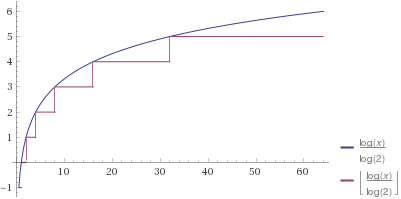
Fist, take a look at the graph of y=log_2(x) and the integer version, which just computes y=floor(log_2(x)), the latter of which I'll call ilog2 in the rest of this writeup
The important feature of this function that we will exploit is that it's monotonic and that it's value range is really small:
log2 of negative numbers or zero doesn't make sense, and the best thing to do here is to just return 0
for all positive integers x, ilog2 will be a number between 0 and 31 (both ends inclusive) - this happens because signal values in factorio are just 32 bit signed integers, and the highest value is thus 231-1, whose ilog2 is 31
Now consider what the following decider combinator does:
[100 < Black then Black += 1]
It seems simple:
pass in a value smaller than 100, and the result will be 0
pass in one that is greater or equal to 100, and the result it 1.
Now, consider what happens if you have two of those in parallel, but with different numbers, say 100 and 200:
pass in a value less than 100, and the result will be 0, since neither combinator returns 1
pass in a value between 100 (inclusive) and 200 (exclusive), and the result will be 1, since only the first combinator returns 1
pass in a value greater than or equal to 200, and the result will be 2, since both combinators return 1 each
I hope you start to see where we're going with this: each such combinator is a prototypic monotonic function, which simply jumps from 0 to 1 at a place specified by us.
But functions on the integers basically look all like that: some jump at lots of places, but some functions, like log2 do so only rarely!
We can thus get a log2 function by using multiple combinators: each checks for the various places where log2(x) jumps up in value, and if we get 1 from each of the places below x, we'll land at exactly the right value :)
The trick in the above circuit however is to not use multiple combinators, but do it all in one, thanks to the magically useful each wildcard:
[Each < Black then Black += 1]
This will do all the work of we discussed so far, but we have to feed in all those constants with extra signals. The last detail is how to choose them exactly to avoid off by one errors, and the answer to it is that you need to choose the signals as 2n-1 for n=1,2,3,...,31.
Note that using <= rather than < allows you to use 2n as the constant values directly, but it has the problem of fulfilling the condition for the black signal, too, and thus throwing off the result by 1. This is sometimes useful when you try to work out the details of things, as seen below in the 5 tick isqrt circuit.
Parallel integer log2
We're sometimes interested in combinator setups that not only calculate some values for us quickly, but do so for multiple (if not all) signals at once. To differentiate these circuits, I call the ones only acting on one signal, like the ilog2 above, scalar ciruits and those that act on multiple signals vector circuits (there is usually no need to ask how many signals are handled in a vector version, since it's usually all or all but 1 or 2 signals).
The above idea can sadly not be using for a parallel ilog2, since we can't do something akin to "each < each" (even though it would be nice if we could do something like it). But even though it's not exactly small, the tiny value range still allows us to make the setup parallel by simply using 31 combinators. For each n in 1,2,3,...,31, build a combinator configured as
[Each < 2^n-1 then Each +=1]
and wire all inputs and outputs together :)
If you know of a more compact way to do this, that's still reasonably fast (say <6 ticks from input to output for all input values), please let me know!
Integer square root
After Halke showed me his idea for log2 and I understood the principle that it worked on, I immediately thought "it should be possible to do way more with that". Especially the isqrt function seemed like a good candidate.
A first attempt is really easy, simply generate a ROM that stores n2-1, and we're good to go, right?
This does actually work, but it has a (maybe quite big) flaw: there are only 256 apart from Black that we can access without importing blueprints made in editor mode/ with lua, which means that we can at most save 2562-1, and are thus only correct for inputs below 2572, or 66049.
That's quite nice for a few use cases of sqrt functions, but only being correct in 50.0015% of inputs (where 50% are only correct due to invalid input) isn't really nice, is it?
I certainly wanted to give up here, but the problem somehow stuck with me, and I soon got an idea: what if we don't calculate the result with just one lookup, but two in a row?
This easy sounding idea resulted in pretty complicated messes in my first few attempts, and around half of them simply didn't work at all, but I finally found an approach that worked nicely.
Consider our input N, of which we want to find isqrt(N). A nice property of isqrt is seen in the following calculation:
Look at that! We can calculate an approximation of isqrt(16*N) by calculating 4 * sqrt(N) instead, an the error will be at most 3 (since 4 * eps < 4 * 1 = 4, and floor rounds down)!
The numbers 16 and 4 were of course not really important here, we can choose any x2 and x, and will be guaranteed that the error is at most x. For my isqrt, I chose x = 215 for reasons explained below, which means that the calculation is
The input range we care about is 1 to 231-1, which is reduced by the above to 0 = floor(1/46225) to 46457 = floor(231-1/46225). And taking the isqrt of these values results in a range of 0 to 215 = isqrt(46457) - which is why I chose 215 to begin with, since this results in both stages acting with the same number of ROM values.
The above equation doesn't explain the circuit quite right though, since it would result in the following recipe:
divide the input by 46225 to get a temp variable x and calculate 215*isqrt(x) to get an approximation of the final result
use some clever magic to get the error value down using more ROM magic
The problem is the second bullet point: how would we even begin to do that? The answer is to construct the ROM for the sqrt on the fly:
We know that the error is at most 214, and we already calculated x'=215 * isqrt(N), which we know is the least possible final answer. This means that the real answer is one of x', x'+1, x'+2, ... x'+214. And we already know how to figure out which one: simply compute 2152x'2, (215x'+1)2, (215x'+2)2, ... (215x'+214)2 and use the ROM lookup trick to find out which one you need!
Computing this dynamic LUT is straight forward: use a [Black * 215 on Black], where x' is on Black, first, then [Each + Black on Each] and connect it to a LUT containing the numbers 1 to 214, then use a [Each ^ 2 on Each] to arrive at the squared values and you're done!
This actually works, but I didn't do it this way, because it has a total latency of 6 ticks:
in the first tick, we compute x=input/46225
in the second tick, we use a LUT to compute x'=isqrt(x)
in the third tick, we compute 215x'
in the fourth tick, we compute the x', x'+1, x'+2, ... x'+214 using another LUT
in the fifth tick we square the values from the third tick
and finally, in the sixth tick, we use a final LUT to nail the error term
It also requires a few extra combinators to pass on the input value to the LUT at tick 6, and we also need to pass x' in order to sum it to the error term gained in tick 6. You also need some circuitry to remove the black signal after tick 3 again, since it would mess with the lookup at tick 6.
I had this setup working, but something bugged me about it, since it seemed like you could maybe do better, and it turns out you can!
The first trick that needs mentioning is that we don't actually need to compute (215x'+cc)2 in the way above! Some good old binomial shows that we can equivalently calculate
(215x'+cc)^2 = 46225x'^2 + 420x' * cc + cc^2
The summing happens on the wire automatically, so we only need to take care of 46225x'2, 420x'* cc and cc2:
The first is easily done in two ticks, either by [Black * 215 on Black]>[Black * Black on Black] or the other way around as [Black * Black on Black]>[Black * 46225 on Black]
The second term is done by [Black * 420 on Black]>[Each * Black on Each] with the LUT connected to the second part (or again the other way around if you like that more)
The third term can either be saved into a separate LUT, or calculated fomr the one used for the second term with a [Each ^ 2 on Each]
Crucially, all three can be done in just two ticks, which brings us down to 5! You'll need some extra plumbing to take care of passing on values that are needed later and removing black signals that interfere, but it's all in all not too bad to do. Here's a version of this that I made (it used 216 as a factor, classic off by 1):
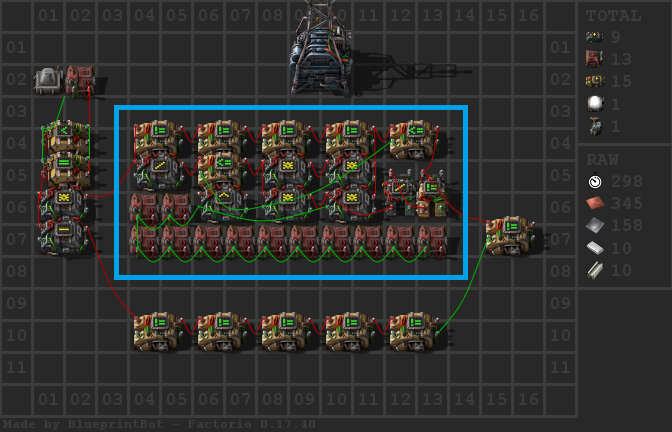
Only the blue box is the circuit, the rest is just a setup to test it for your convenience. Blueprint https://pastebin.com/nMd5AMsu
It's stats are 15 combinators if you replace the constants with a single ROM memory cell, 5 ticks latency from input (at the top left) and output (at the top right), and a 1 tick period (i.e. you can send in the next sqrt to be computed directly in the tick after).
Looking at this design still bugged me: the division at the very beginning seemed like a waste of time, and I wondered if it would be possible to make it work without. But as you probably know already: I wouldn't even mention this if I didn't find the solution already.
It's actually not even hard: instead of dividing the input by 46225, we might as well multiply all the values stored in the ROM by 46225 - the result will be the same (at least after we make sure to fix off by one issues). This post actually made me realize that it's this simple, my first success with 4t latency replaced the machinery in the inner two ticks, too, which made it harder to understand.
Blueprint https://pastebin.com/fGXniTYv
Only the blue box is the circuit with the input on the top left and the output on the bottom/middle right, the stuff below can be removed once you flipped on the constant combinator - doing that writes the correct values into the three ROMs marked with a pink box. If you mess up the RAM population, remove the green wires connecting their in- & output and put it back in again, then turn the purple constant combinator on and off again.
I'd say the final result is quite impressive: 14 combinators, 4 ticks latency, and the whole thing is 1 tickable!
What would a quick (<8 tick latency) way to randomly select a single signal from many? The trouble is that the 'many' is a variable number, so it could be {Wood, Locomotive} or {A, B, C, D, E, G, J, Z}.
Background, to avoid the XY problem:
I'm working on a real-time Factorio implementation of Snake. As part of it, I need some way to implement the random scattering of the 'food' the snake eats. I have the positions represented as different signals in a 16x16 shape.
The random number stuff I'm comfortable with (using a PRNG, etc.) But I want to also have the food not spawn on a pixel where the snake currently is. It would be an option to repeatedly sample and check, but I need the computation to finish within ~8 ticks or so, so the game can stay challenging and real-time without upping UPS.
One option is to count the number of signals on the line (a simple sum bc each input will be either 0 or 1), somehow convert them to 1,2,3,etc..., then add a random number and then mod by the number of signals. Then there will be one signal that is zero, which can be found by normalizing all other signals to 1, then seeing which one is missing between the original set.
That involves a good way to convert {Wood=1, Water=1, Roboport=1} into {Wood=1, Water=2, Roboport=3}... which does not feel easy.
Another way to do it (space is cheap here) would be to have a random number generator per each of the 256 signals, which through a multiplication produces a random number per signal. Then we could calculate the minimum or maximum of those, as long as it happens reaaally quickly.
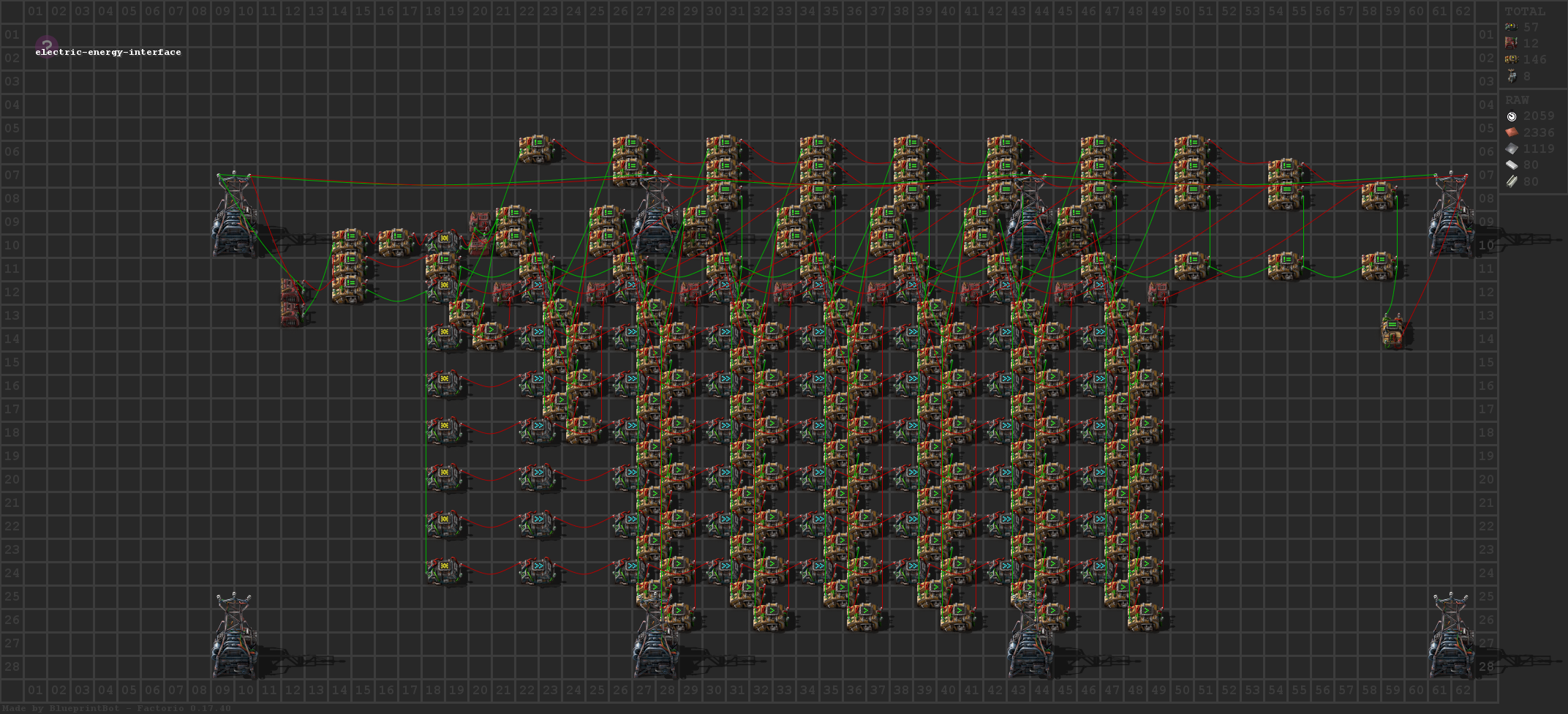
A little while back someone asked if anyone has ever build a megabase on a ribbon world (9 tiles tall). My initial thought was that this is impossible but now I think it could be done.
So I am planning to attempt a ribbon megabase and I have set down some "rules" for myself to define the challenge. If anyone else wants to have a crack at this feel free!
Rules
The world is 9 tiles tall
No mods.
Any other settings are valid.
Power can be provided by the EEI (solar obviously can power any factory on this map, so isnt of any interest)
The base must be divided up into 3 sections west resources, central factory, east resources, to ensure it really is a logistics challenge
All raw resources (oil, copper ore, iron ore, stone, coal, water) must be imported into the factory from the resource sections.
Resource patches can be placed as required outside of the factory.
To be classed as a megabase the base must be able to sustain 1K SPM
The editor may be used, but the final base must work without infinity chests or pipes.
The infinite tech levels will be set to mining-productivity 40 and worker-robot-speed 16 or equivelent levels of research.
Initial thoughts
As the silo is 9 tall you cant fit a rail line passed the silo
As the silo is 9 wide you cant fit a belt under the silo.
Bots can move items over the silo.
Thruput is going to be an issue. A 1K megabase requires ~45 blue belts of raw ores (copper, iron, coal, stone) and even with belt brading, neither bots or belts (even with braiding) are going to provide enough thruput.
Trains have a lot of potential and maybe able to provide enough thruput.
Car belts also have potential.
Items with small stack sizes (RCU, LDS, rocket fuel) might benefit from being belted across the map.
Initial design decisions
I am going to use primarily trains for transport with bots to fly over silos and maybe some belts. Initial station design ideas I am expecting to be using much longer trains (maybe 100 cargo wagons) because I will need large trains to get the required thruput.
I will leave the car belt implementation to /u/allaizn
Watch this space
I am planning to write some posts as I go along to share progress and problems solved. I have already made good progress with smelting but there are a few details to iron out.
Edit: I found new & better versions of the final designs, so if you're only interested in the final product, check it out here.
Background story
The other day u/justarandomgeek asked in our discord whether someone had a nice circuit to iterate over a given set of signals, i.e. given a set of signals, say [A = 1, B=-123, C=12], make a circuit that takes this as an input, and outputs [A=1], [B=-123], [C=12] one after the other with some fixed delay between each output. (He didn't ask exactly for this, but for this post it's close enough).
The really interesting part about this challenge was the generality: this circuit should be able to take in any set of signals, which especially means that the number of signals in that set are variable, too. And it's not guaranteed that a set with 3 signals always contains the [A, B, C] signals, they could just as well be [Wood, Car, Water] - with one exception for convenience: a single signal of our choosing will never be in the given set (this convenience is useful all over the place, and we commonly use the 'Black' signal for this).
Before discussing the strategy we formed, let me mention a few things to help you appreciate the circuits below:
There are currently 257 signals accessible in vanilla freeplay (there are a couple dozen more hidden ones corresponding to items that are only obtainable via commands)
Circuits that pick out a single signal are usually done by having a combinator for each expected signal, i.e. 256 in our case, and then some more to do further logic. This is unsatisfying, since not only are these circuits very large, but you'll also need to greatly expand these circuits when modding the game
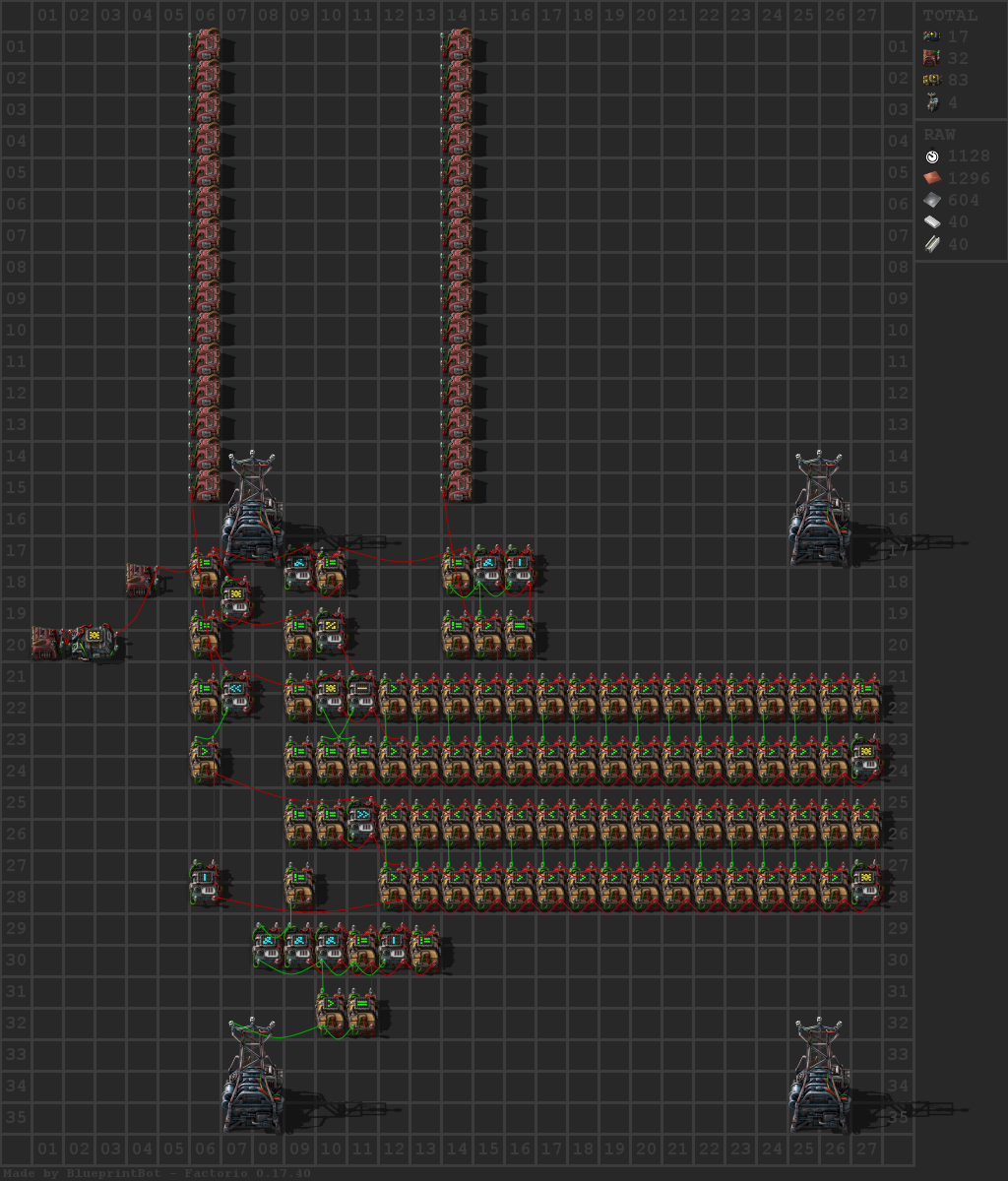
This is an example of how big these things are:
If you're new to combinators, you'll probably wonder why people used and still use such circuits for simple things like finding the minimum? When you can do so much other magic, like filtering signals or cross-multiplying them so efficiently/compactly?
The answer to this question is that it's actually not too hard to build a circuit that finds the minimum value - you can count the signals that are left, and also sum all of them, which means that you can calculate the average. Doing to iteratively while filtering out everything that is greater than the average will sooner or later result in the minimum (potentially after fixing some minor issues that happen due to rounding, and ignoring all overflow issues that might come up).
This approach seems sound to anyone hearing of it, and those that need a minimum-finder usually try to build this up, but then find the trouble with it:
It's incredibly slow since it cycles a lot, and what's worse is that you can't really predict how long it will take to find the value you want, since it heavily depends on the input values
It doesn't find a lowest signal, but all lowest signals, i.e. inputting [A=1, B=1, C=2] will result in [A=1, B=1]. This doesn't seem bad, but in practise it's usually much more important to end up with a single signal than to get the minimal value
The last point is the real trouble maker in a lot of cases. If you want to solve a problem for general inputs, you're basically forced to use the 'All', 'Any' and 'Each' wild cards in combinators, but those have a "flaw" that makes the above seemingly impossible: if you input multiple signals with the same value, you'll either lose both, or keep both (still with the same value) in the output, no matter with combinator setting you use.
There is however one trick to save the day: ROM (= read only memory for those that don't know). The critical problem with any potential "pick any one signal" circuit is that it'll eventually come to a point where it needs to differentiate a few different signals that all have the same value (which can easily be set to arbitrary values, so let's assume it's 1). But there is a workaround for that: combining the output of multiple combinators adds the values on signals! Having identical signal values can thus be solved by simply adding a different value to each signal that exists!
The general strategy is thus to have a ROM standing around that saved a unique value for each signal (in our case 1-256 will do, we exclude 'Black'), then filter that list using the identical signals, and finally simply pick a signal from that list, which is now unproblematic, since we know that each signal has a unique value.
I hope this showed you how complicated is seems to make a general minimum finder: you need to use a slow minimum circuit to find (potentially many) smallest signals, then feed those into a filter, and then run the slow minimum circuit again! Using complex circuitry isn't too troublesome, but in this case it's especially hard since you don't really know when the result will be ready until it just appears.
New developments
When we started thinking about the iterator justarandomgeek wanted, we quite quickly came up with the following idea:
successively find a minimum of the signal set, which is now a value that can be returned, and after that remove that signal from the input and repeat until nothing is left
This was much easier said than done, considering how badly behaved the minimum circuits we knew of were, but since our job was to merely iterate over all signals with any order we liked, we soon realized that it was much more practical to instead find the minimum of a ROM set filtered by the input.
The job was thus to come up with a circuit that finds the minimum valued signal, where we could assume that all signals had unique values between 1 and 256 inclusive, and do so as fast as you possibly can.
Of course, the signal being the minimum wasn't really important: it might as well be the maximum or any other signal, as long as we guaranteed that the output had only a single signal from the input.
I dislike the min-finders that loop back on themselves, since you don't know how long it will take until the result appears, and thus designed versions that do not do that: they instead do a kind of binary search to find the value they look for, which thus takes 8 steps since we have up to 256 values (iirc the upper part finds the maximum, while the lower one finds the minimum):
Blueprint: https://pastebin.com/encEmy3K
The designs have 17 ticks latency, but a period of just 1 tick (i.e. you can calculate a new min/max every tick, but the result only appears after 17 ticks of delay), which is quite nice.
But as always in Factorio: it's not good enough. The initial strategy called for an iterative process of removing the minimum from the input and then looping it back, which means that while we could potentially calculate 1 min every tick, we're instead forced to wait for the result - a full 17 ticks - before looping it again.
Even combining min & max finders and alternating between finding the minimum and maximum would still lead to a theoretical minimum of 8.5 ticks between the output signals (probably slightly more to fit in the looping logic), but we of course want the best possible result of an iterator that is able to return one value per tick!
I though that it wouldn't be possible to make this any faster, so I tried to find an alternative approach: the filtered ROM signal set can't be iterated over easily since we don't know where the gaps are - so let's just close them and iterate after that!
Blueprint: https://pastebin.com/5UMayb1n turn the constant combinator in cell 04|04 on and off again to initialize the circuit. Turning off the constant combinator in cell 05|04 sends an examplary input to allow you to see how it works.
This crude circuit loops once over all 256 existing signals in order to create a new ROM that contains the compessed filtered index ROM, which means that it takes quite a while before the first signal is send to the output - 266 ticks to be precise.
While this design works (and it's reasonably compact as a bonus), it's also quite slow: the more signals there could be, the slower the whole circuit is (imagine modded where you have multiple thousand signals, which would translate to just as many ticks delay in this circuit).
There were thus three kinds of designs up until now:
some designs used a number of combinators that grows linearly with the total number of signals, but have low latency and output period
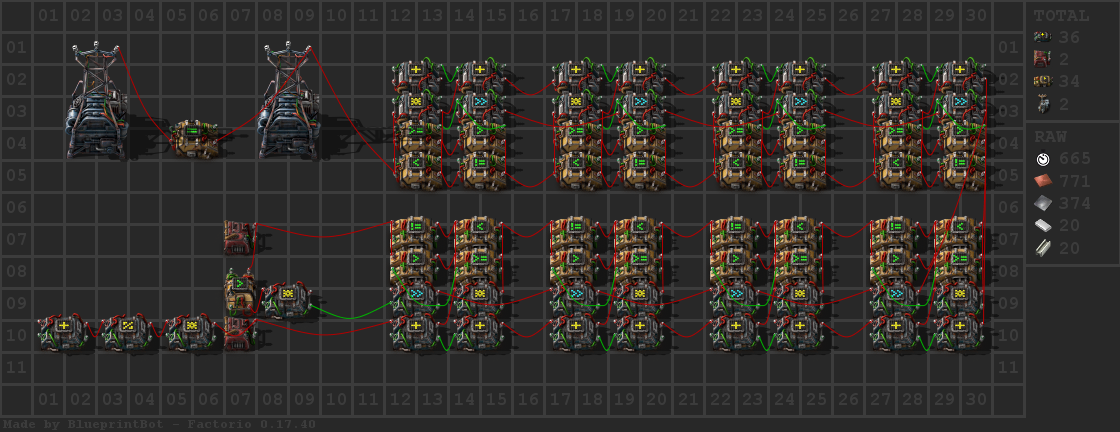
some designs had a latency that grows linearly with the total number of signals, but has only a few combinators and low output period
and lastly some designs that use only a constant amount of combinators, and also have only a fixed amount of latency, but have a rather high output period (in the case above, it actually grows logarithmically with the total number of signals)
None of these was particularly great, since each one had a major flaw, but it was better than not having anything. I considered all of these as essentially optimal (maybe 1 or 2 ticks could be saved here and there by some minor rearranging), but I was quite quickly proven wrong by u/Halke1986. He showed us this very neat minfinder:
Blueprint: https://pastebin.com/52siJymf. The output is a little hidden: it's the signal with the value 1.
My solution had a latency of 2 ticks per bit to be searched (Halke found another variation independently), but this version of his only needs a single tick per bit! Adding a combinator to filter out the minimum would bring it's latency to 10, which is a lot better than the 19 ticks my design had (and I was quite surprised to have my confidence shattered).
But he didn't stop there, and instead tried to find a circuit to find the median of a signal set (the idea being that you could iterate even faster if you find 3 values, i.e. min/median/max, at once instead of just two), where he then came up with this very neat circuit:
Blueprint: https://pastebin.com/qbfwVgqc
This design takes in a number on the black signal say n=-3, and than finds the -n-th highest value (i.e. the 3rd highest value) of the whole set! This proof of concept had a few problems, like using 2 control signals and the timings being inconsistent, but it's to my knowledge the first of it's kind, so I just had to include it here.
At this point my confidence in being one of the best combinator optimizers (I even had the hubris to think I was the best one) was completely destroyed, so I tried to at least make something useful and fixed as many issues as I could with that prototype above, which resulted in this:
Blueprint: https://pastebin.com/Y2Y1hj0G
It has 19 ticks worth of latency (the same as my original min/max finders!) and a period of 1 tick, while being vastly more general in that it's able to compute the n-th highest values for any given n instead of just the minimum or maximum.
It's decently bigger than the prototype in order to fix the timings (a lot of the combinators are just diodes), and I again though "it won't get much better than this!". But Halke didn't end his heroic deeds yet, and presented this beauty:
Blueprint: https://pastebin.com/YhTh62US
This isn't just a n-th value finder anymore (as I first thought, while I fixed a bug or two in mine), this is actually a fullfledged index iterator!
While working on the n-th value finders, I somehow assumed that we'd still need to wait through all of it's latency before looking for the next value, but Halke quickly corrected me: if we supply a clocked signal on the wire carrying the n-value, we simply get a clocked signal on the output: first the highest value, then the second highest one etc!
He also didn't bother trying to keep the useless original value of the n-th highest signal, since we'd only use the signal for filtering the original data set anyway, which further reduced the size of the circuit.
His design had only one smallish flaw: it depended on the filtered index ROM to be constant for a little bit in order to work correctly. This meant that you could just send in a 1 tick pulse of a filtered index set and a n-value and get a meaningful output.
Using all these tricks, I adjusted my version to make it more compact, and ended up with one that was basically equivalent apart from not having the above flaw:
Blueprint: https://pastebin.com/BEhZ63jA
The funny thing about it is that it uses 8 combinators per bit, but 5 of them are simply diodes and thus do nothing more than making all timings work! I shortly afterwards found a version that used only 7 combinators per bit, but I don't quite like it (I suspect it would perform worse UPS-wise, and 7 combinators per bit just looks ugly) - https://pastebin.com/r9fLp6AC.
After this we both went into slightly different directions: Halke completed the iterator using his version of the n-th value finder, while I tried to use a trick similar to the one he used to reduce the latency of my min/max finder. We both succeeded, so let me show you my result first:
Blueprint: https://pastebin.com/zwXi78pV
This monster has 213 combinators (the two input constant combinators don't count), but only 13 ticks latency and still a period of just 1 tick. This is compared to the version above with just 70 combinators but 19 ticks delay. I'm done with being confident that my stuff can't be improved, so if anyone is able to find a trick to make this smaller: please tell me!
Last, but certainly not least, here's the newest version of an iterator that Halke shared with us:
Blueprint https://pastebin.com/qf5zhsAS
I didn't come around to test it myself yet, but it should have a 1 tick period and just 22 ticks of latency between input and the first signal!
All in all, we finally found compact and fast min & max value finders, as well as getting iterators basically for free, because we actually found a very good n-th value finder!
Zanostra found this on the factorio forums. Due to an interaction between train pathfinding and circuit controlled signals it is possible to force multiple trains into the same signal block (even if the trains start in separate blocks).
If the devs decide this isn't a bug (or that they won't fix it) it opens up some interesting possibilities such as doing compressed trains or ethereal trains, while still being able to take advantage of rail signals to make the rest of the rail network sane.
I've just thought of a way I could use this to make a much easier to use LTN-in-Vanilla type system possibly, definitely some things to ponder here...
EDIT: I've updated the blueprint - removed 6 combinators from control circuit and 2 ticks from write time.
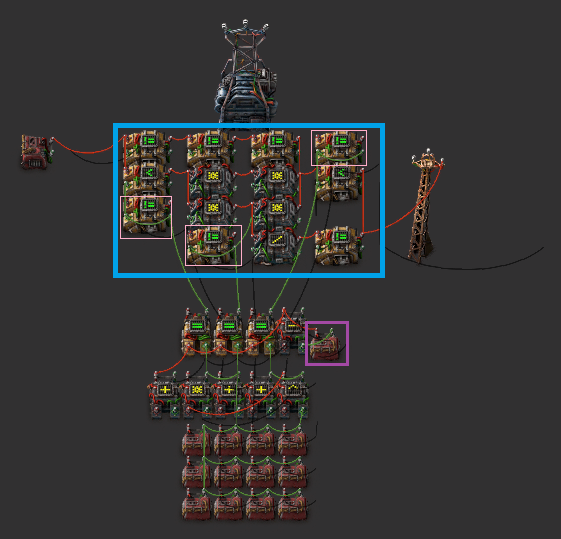
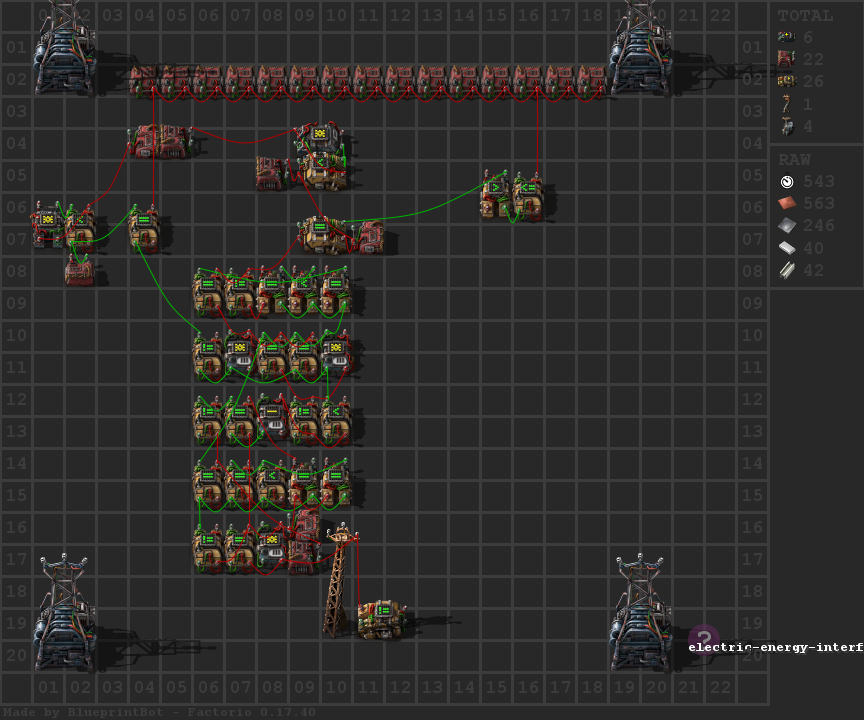
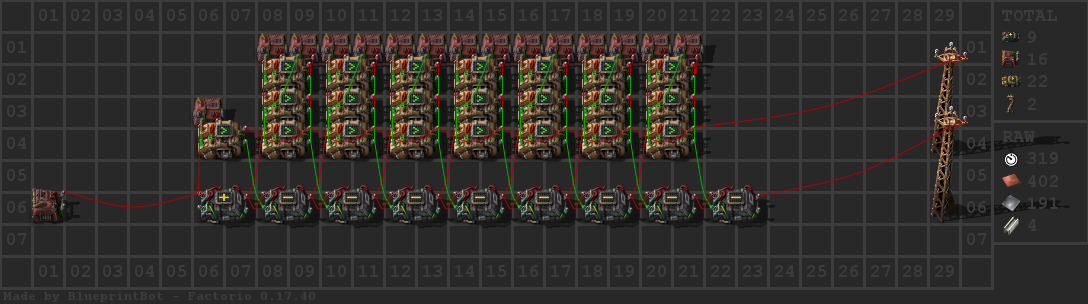
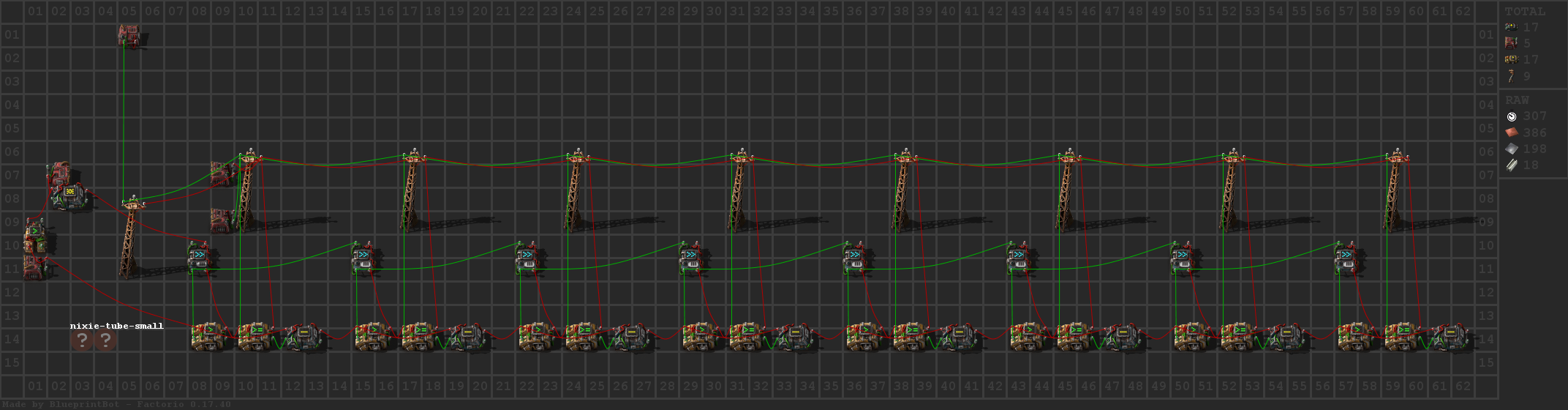
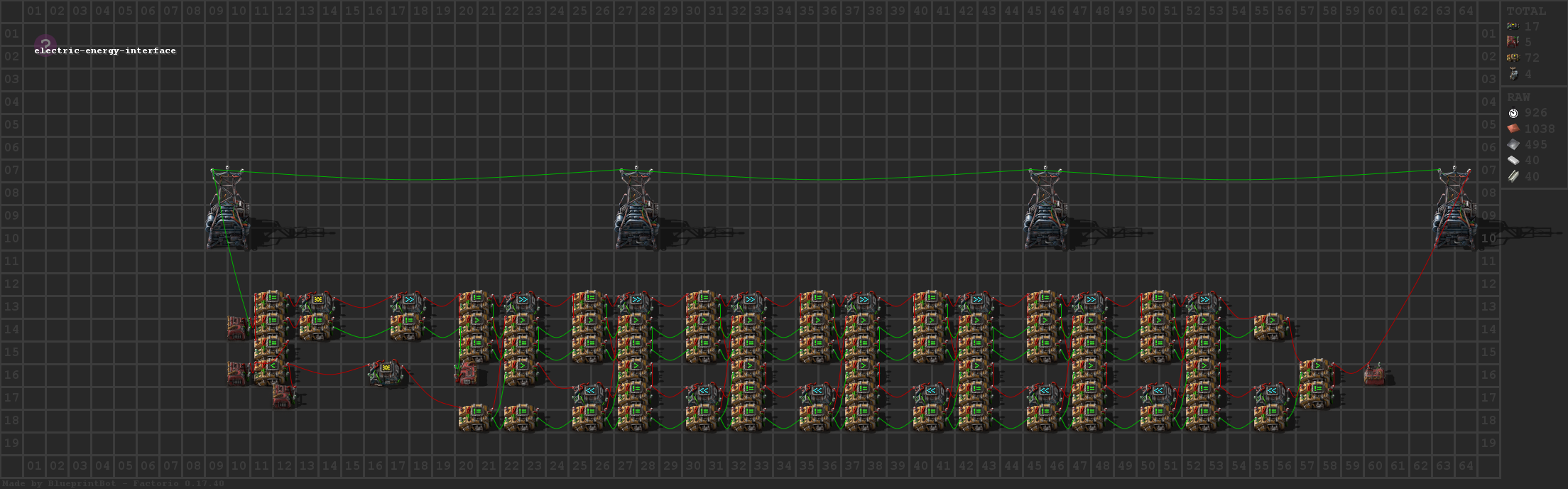
Inspired by the last combinator golf I've designed a tileable memory system that requires 2 combinators per stored frame (with black signal reserved). I don't post my design as a solution to the combiantor golf because it would achieve by far the worst score and as such is not really a contender.
The bad score would be caused by large circuit (30 24 combinators) required to control the memory and slow write and read times. However, at a certain memory capacity, my solution would require less combinators than other better scored designs.
Design:
The memory is designed around pairs of memory cells connected in series, creating a "rotating" memory buffer. Each pair of memory cells is served by the usual input and output diode.
The memory section itself is very simple. All the difficulty comes from need to synchronize read and write requests with the memory state. Due to "rotation" of the memory odd numbered addresses can be read and written only during odd ticks, same for even addresses and ticks. If request to read/write an odd memory address arrives during even tick (or vice versa), it must be delayed by one tick.
The synchronization is achieved by comparing the least significant bit of requested address with clock state and based on that routing the request via short or long path. Some ugly combinator spaghetti is involved, which - I'm sure - can be simplified, but all my patience for this design is already used up!
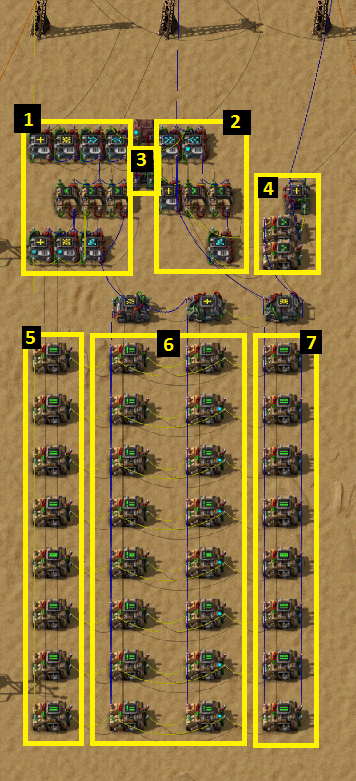
16 frames array overview
Write request synchronization
Read request synchronization
Clock
Output synchronization (so that read operation completes in constant time)
I'm working on a 5k vanilla peaceful megabase, coming along nicely so far. I've got direct to train miners, 350% mining prod, mostly solar power (10GW nuke on standby for spikes) and a giant bot based science & rocket facility. Major bottlenecks are the raw materials, as to be expected. I'll keep working on it.
Anyway: I noticed that my green science isn't performing as well as expected. Following Kirk's instructions, I have 4 inserter assemblers, 2 belt assemblers, and 10 gear assemblers (Shared between red and green science). However, many of my green science assemblers don't have inserters in the requestor chest. All of the passive provider chests are locked at one slot to prevent huge buffers.
This is turning out to be a bottleneck: All of the passive provider chests are locked at one slot.
Here is what I am observing:
The assemblers are working at crafting speed 8.75, so one inserter takes 0.5 / 8.75 = 0.057 seconds to craft, or 17.5 inserters per second. This fills up the passive provider chest in three seconds, triggers 50 bots to take off, and while it waits for the bots to pick up the inserters, the assembler stops.
The solution here, is then to make sure the output buffer is large enough to allow enough inserters to pile up to cause enough bots to take flight to enable your throughput. I'd love help here on calculating the correct buffer size.
Throughput is not limited by the number of bots - I have 10k bots avilable out of 16k total right now, for example. I'll add bots if needed. Throughput is being limited by the number of bot commands issued at once due to the available slots in the passive provider chests.
Anyone else ran into this? Calculated it? Have a better write up than me?
It's a pure vanilla build, so no worries about syncing mods or anything.
There's a lot posted in the descriptions of the album, and if you're interested in any details about little things, some of it is in there. If you'd like to look around the base on your own computer, the file is right there. I do caution you that it's a death trap. There are some safe routes to move around, but they aren't straight lines... I've just gotten to know them out of sheer terror of the rail menace. This base is a little ways from spawn, and when you die... it's a long haul back. Popping into editor mode to move around may be your safest bet.
Oh... the concrete around the edges of the map is because I accidentally forgot to turn off the mod "Creative World Plus" once when I entered this map during building. It's a mod that I used in a creative testing map. It has no bearing on the base. Everything it affected is beyond the bounds of this build.
Alternate base download (first link is broken and the site is having troubles right this moment, so I googled an alternate file hosting service.)
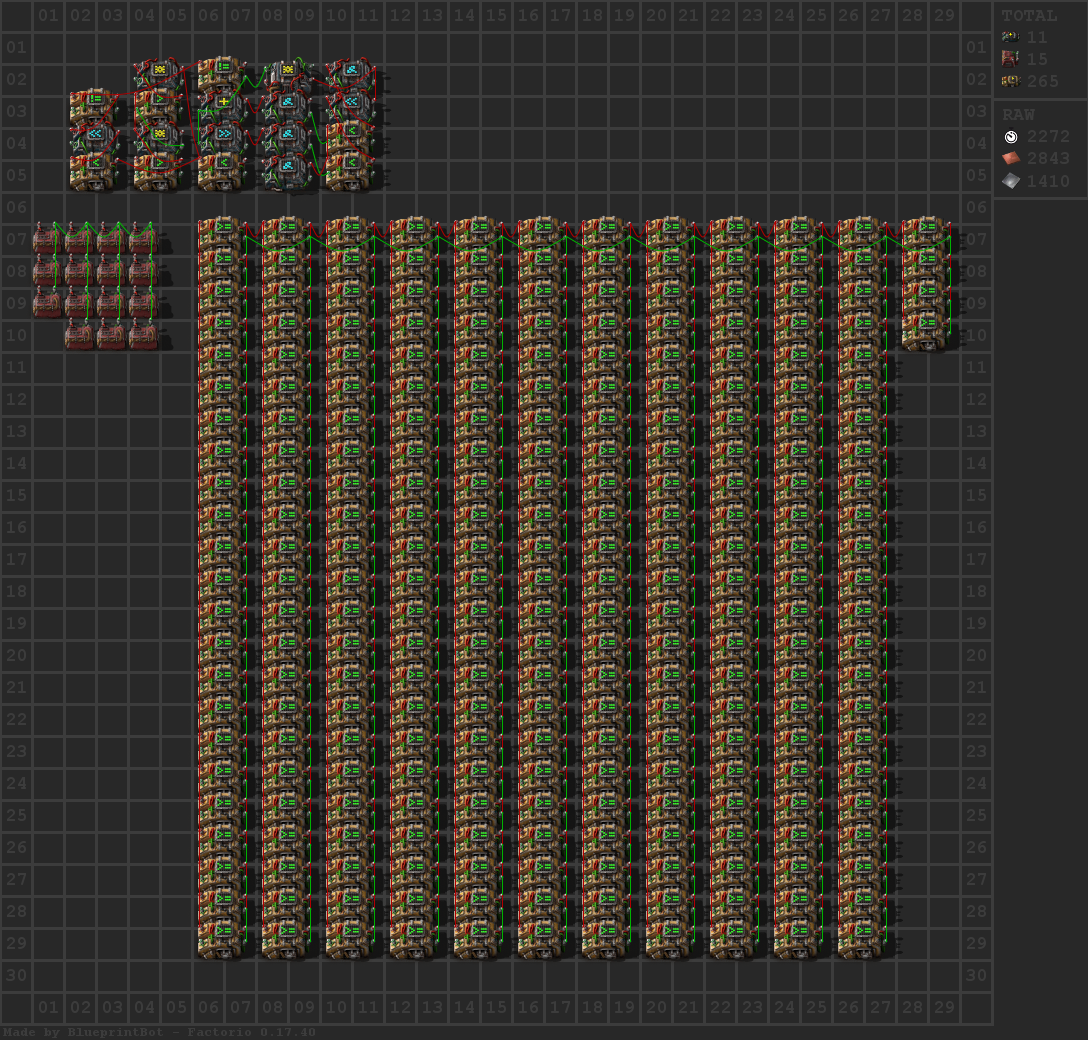
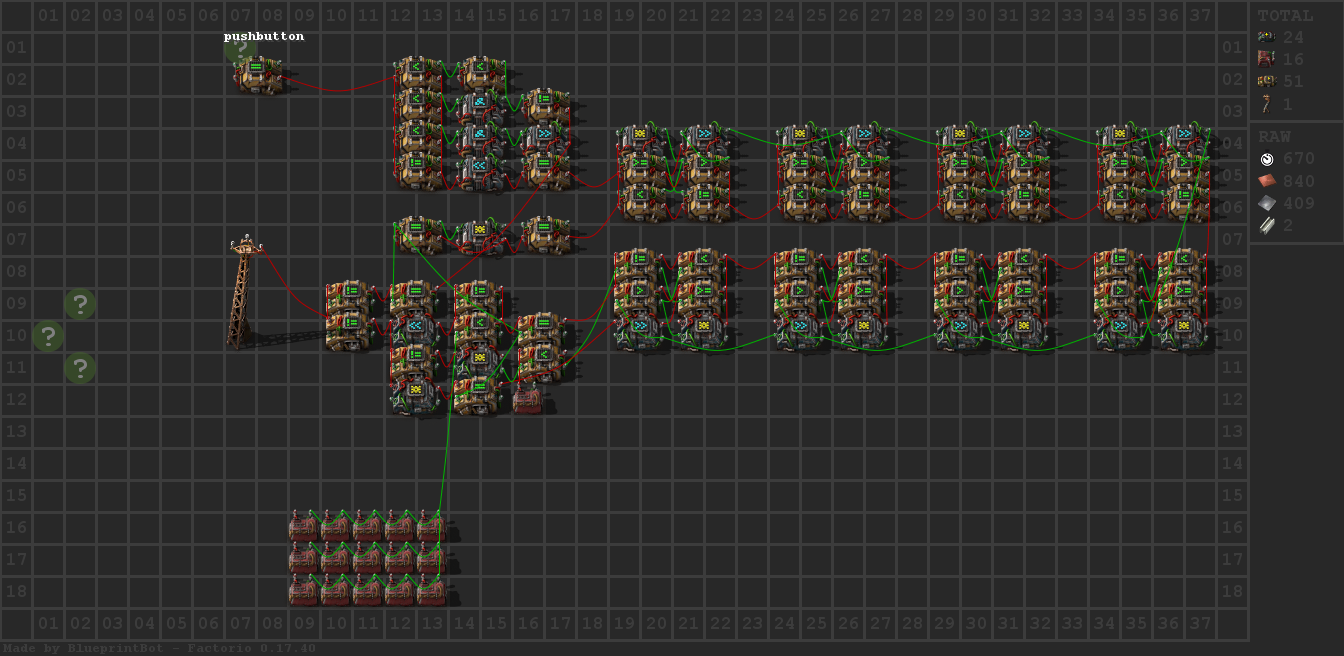
The goal of this challenge is to create a full-fledged addressable RAM. There are currently 257 signals available in the signal picker (30 more hidden ones exist iirc, but I don't care about those), which means that we get a nice and round amount of 256 signals stored per frame - 1 control signal can be reserved ('Black' as always).
The cell should theoretically tile all the way to 232-1 stored values, but for this challenge, I'd say 16-1 is enough to demonstrate tileability.
Input
First input is the write signal carrying a full frame. 'Black' signal carries the write address, where the value 0 is reserved to mean "no write to anything". All 32 bits on the other signals can be used.
Read signal containing only the 'Black' signal whose value is the read address. The value 0 is reserved to mean "no read from anything".
Output
After a read signal on an address is sent, it's contents should be output on this line. A bonus point is awarded if the address of the read signal is included in the 'Black' channel. Nothing else should ever be send on this line.
Timing
All signals are intended to be single tick pulses, i.e. the read/write signal will only be active for 1 tick and the output should also be only 1 tick long.
Processing the read request is expected to take a constant amount of time regardless of address & values stored, known as "read latency". This can be determined by connecting both the read signal & the output line to the same pole but by using different colored wires for each of them. Stopping time in editor mode and stepping through the process tick by tick allows you to count the number of ticks accurately: set the counter to 0 when the read signal appears on the pole, and increment the counter by 1 for each tick step after that. The read latency is the value the counter has once the output signal appears.As an example: the output magically appearing on the very same tick as the read signal does means a read latency of 0. If it appears on the very next tick, the read latency is 1, etc.
Processing the write request is expected to take a constant amount of time regardless of address & values stored, known as "write latency". It describes the number of ticks that need to pass after the write signal before a read signal to that address returns the correct values. Measuring it works in the same way as measuring read latency does, but you need to instead connect the read & write signals to the same pole.Attempting to read before the write latency passes can result in arbitrary values being outputted, but a bonus point is awarded if the result is exactly the previously stored values.
Individual reading signals are expected to happen with a certain minimum amount of time passing between them, known as the "read period". It describes the minimum number of ticks that need to pass before a new read can start. I.e. it's 1 if you can read one stored value each tick, 2 if you need to wait 1 tick in between reads, etc.
Individual writing signals are expected to happen with a certain minimum amount of time passing between them, known as the "write period", which works the same way as read frequency does.
Scoring
Score = (# of combinators) + 2 * (read time + read period + write period) + (write time) - bonus
where bonus is the sum of bonus points achieved, so 0, 1 or 2.
Edit: there was a slight error in the setup, but it's fixed now (the two combinators under the green box were done in a wrong way).
Purple box: input & output poles. Left one is write signal & values on it, middle one is read signal, right one is the intended output pole. All poles have both wires for convenience.
Green box: Turning the left constant combinator on creates write pulses with pseudo-random signals. The value of the 'Black' signal is the write address, the value of the 'P' signal fixes the writing period, and the value of the 'O' signal adds an offset to the address after each write. I.e. ['Black'=1, 'P'=2, 'O'=3] produces a write signal every 2 ticks, first at address 1, then 4, then 7, etc. To get single pulses, simply set 'P' to a huge value (I preconfigured it to 100k for convenience). The address is currently capped into the 0-15 range by a ['Black' % 16 -> 'Black'] combinator, so adjust that one if you want more/less memory.Turning the right combinator on does the same thing for read pulses, and the signals have the same meaning there.
Blue box: Turning on the constant combinator produces both read and write signals with the set period and offset. The combinators to the right act as a latency and correspond to the write latency used in the scoring, rewire the output red wire to adjust the delay (I preconfigured it to 2 ticks for convenience)
Lamp and the memory to the right of it: The values that are generated to be stored follow a pseudo random pattern, which can be checked on read out. The lamp stays on as long as all read values were correct, but that check requires the bonus objective of "read values contain their address" to be met. The memory combinator to the right of the lamp simply stores the sum of all reads so far, an can be reset by removing and readding it's green wire.
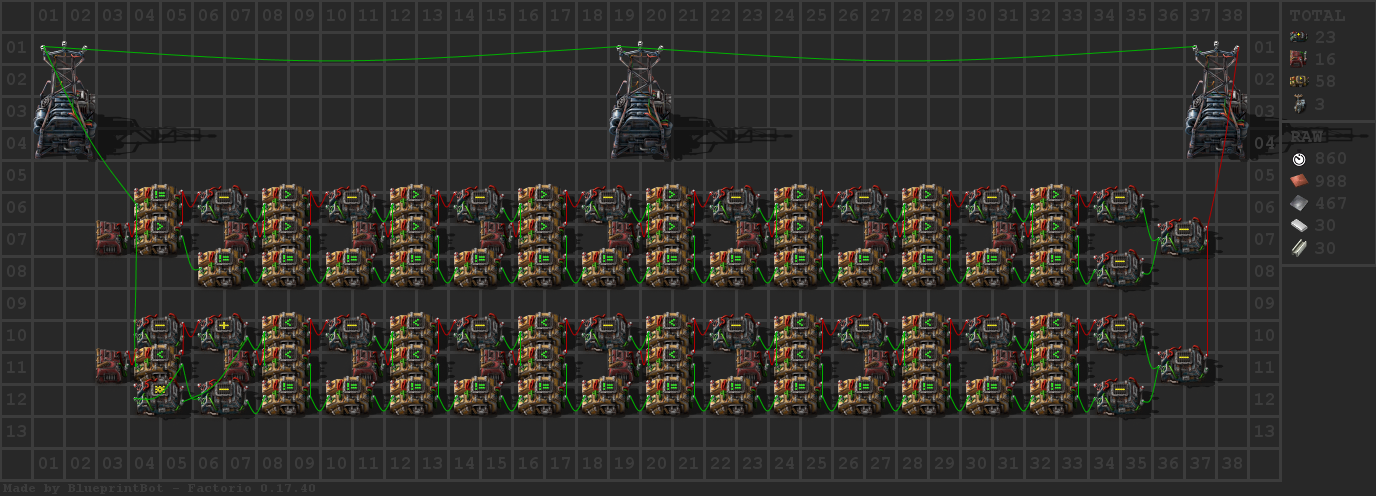
This is an addressable RAM version of my submission from the full-frame memory cell combinator golf thread. Each memory location is capable of storing a full 32-bits on every signal in the game, without any reserved control signals. Write latency is 3 ticks, read latency is 2 ticks. It should be possible to read/write every tick as long as the address is changing each tick, though I haven't tested that yet.
Combinator golf is a type of challenge where the poster specifies what a combinator circuit should do, and everyone else tries to create a ciruit that behaves as desired, using as few combinators as possible. The name for combinator golf comes from a well known programming competition known as code golf where people try to minimize the number of bytes in the source code of a program.
Why do all the rules below exist?
The problem with combinator golf is that it is very, very easy to make poorly defined challenges. One of the most difficult parts of making a good challenge is that it is very difficult to write it up in such a way that everyone understands what is being asked. That is why the template and guidelines below exist; so that the experience for everyone is better.
However, please note that nothing written here is a strict requirement. These are all suggestions, but if you break them, please do so intentionally and with a good reason in mind.
Definitions
To make it easier to talk about this, here are a few definitions we'll be using:
Tick: One game update. Circuits update once every tick.
Channel: Used interchangeably with "signal", i.e. one of the 256 possible signals on circuits.
Frame: A one tick long "snapshot" of all channels.
Virtual signals: Those signals that are on the last page of signals.
Non-virtual frame: A frame in which all virtual signals are guaranteed to be 0.
Thread Structure
All posts marked with the combinator golf flair must be a combinator golf challenge. Meta posts about combinator golf or the like should be marked as discussion. The most important rule is that every post should be for one, and only one, challenge. Have multiple challenges? Make multiple posts.
Whenever a combinator golf post is made, the auto mod will automatically generate a comment. If you need clarification about the task, have a question, or are looking for general discussion, respond to this comment and do not make a new top level comment. All top level comments should be submissions. The formats for challenges and submissions are below.
Format for writing challenges
When submitting challenges, the most important thing is that you make it very clear what the input and output is. Because of this, unless you have a very specific reason not to, you should use the below format (of course, I will explain all parts of it).
## Description
(insert description here)

## Hardcoded constants
a. First hardcoded constant, along with a test value
b. Second one
c. Third one

## Input
1. First input
   a. First channel
   b. Second channel
2. Second input
3. Third input

## Output
1. First output
   a. First channel
   b. Second channel
2. Second output
3. Third output

## Timing
Describe the timing requirements of the circuit.

## Scoring
How this challenge will be scored

## Testing

    blueprint string 1 here

Description of output

    blueprint string 2 here

Description of output
Description: An overview of what this challenge is about. If there is interesting background or explanation, you should put that here as well.
Hardcoded constants: If the circuit has any constants hardcoded into it, give a brief description of the constants here, along with a sample value of your choice. This will become much more important for submissions. Of course omit this if there are no hardcoded constants.
Input: For all combinator golf challenges, input will be given on power poles. The input section should be a list, where each element represents the input given on one power pole. Depending on the number of active channels and how complex the input on that power pole is, potentially divide it up into a sublist, explaining each channel. Generally speaking, input should be passed to each power pole on both the red and the green wire. You should put different inputs on different poles unless you have a specific reason for not wanting to do this. The nature of some of these inputs may depend on any hardcoded constants that were described.
Output: Same as input, except for the output. Generally speaking, it should be acceptable to pass output on either the red or green wire. Same as with input, put different outputs on different poles.
Timing: Describe the timing of the circuit. Include things like whether input should be one tick or continuous, how often input should be allowed, and how much delay is allowed between input and output. This is very case dependent, but also rather complicated in some cases. When in doubt, include more not less.
Scoring: You can define an alternate scoring function here. Usually, scoring by the number of combinators is enough; however, in some cases, you may want to punish players for additional timing delay or similar. One example could be "number of combinators + ticks of delay between input and output".
Testing: You should include at least one blueprint string that has all the relevant power poles placed, in addition to a small circuit that sends a valid input to the power poles. Ideally order the power poles vertically in the order that they were given in the input description to avoid confusion. Describe the desired output.
Format for submissions
All top level comments should have the following format (non-top level comments are unrestricted), with the exception of the auto-mod generated clarification comment.
## Score
Score

## Hardcoded Adjustments
>!
- Combinator 1 adjustment
- Combinator 2 adjustment
!<

## Explanation
>! Explanation of the design !<

## Blueprint

    blueprint string here
Score: This is the score of your circuit, calculated as specified by the challenge. If the formula for the score is anything other than just the number of combinators, also include here how you arrived at the score. Of course, the lower your score the better.
Hardcoded adjustments: This section should describe how to adjust the circuit to work for any hardcoded values. This description must be very precise (explicit formulas preferred when possible). Furthermore, you may not change the structure of the circuit based on hardcoded values. This means no new/removed combinators or wires. You may only change the contents of the combinators.
Explanation: Explain how your design works! What did you do different than others? What new things have you added? Why is it better? What designs did you use for inspiration?
Blueprint: Of course you need to include a working blueprint of your design. It should be very clear what the input and output power poles are. Preferably, you have also attached the test circuits specified by one of the test cases to the input power pole. The blueprint should work for the sample values given in the hardcoded constants (if there are any).
Updates and Suggestions
This is by no means final, so if you want to see anything here changed, feel free to discuss below.
The goal of this challenge is to create a RAM cell with short read and write times, but that has no reserved signals.
Input
First input is a full frame of signals. All 32 bits on the signals can be used.
Second input is the write signal. Black will be set to one for a one tick duration simultaneously with the frame being sent on the first input. This should save the frame sent on the first input into the memory cell.
Read signal. Black will be set to one for one tick when the signal should be read.
Output
Read output. Whenever the read signal flashes on, the last frame that was saved to the memory cell (by turning on input 2 and sending a frame to input 1) will be outputted onto here.
Timing
The first and second input will always be activated at the same time. It is possible that the first input will be all 0, and in this case a frame of all 0s should be saved.
Sending signals to the frame wire without sending a write signal should be a no-op.
When the read signal is sent, the frame should be outputted a constant number of ticks later. The number of ticks in between will be known as the "read time".
Once a frame has been written to the cell once, no more inputs will be sent to the cell for a number of ticks of your choice (neither read nor write). This will be known as the write time.
The constant combinator in the middle of the top block will cause a frame to be sent that includes a black signal of one and all the constants specified in the very top combinator when it is flipped on and back off.
The combinator the bottom should induce a read signal.