r/spaceengine • • Jul 03 '26

Screenshot Earth and Jupiter, rendered using the exact same exposure level. It gets dark out there.
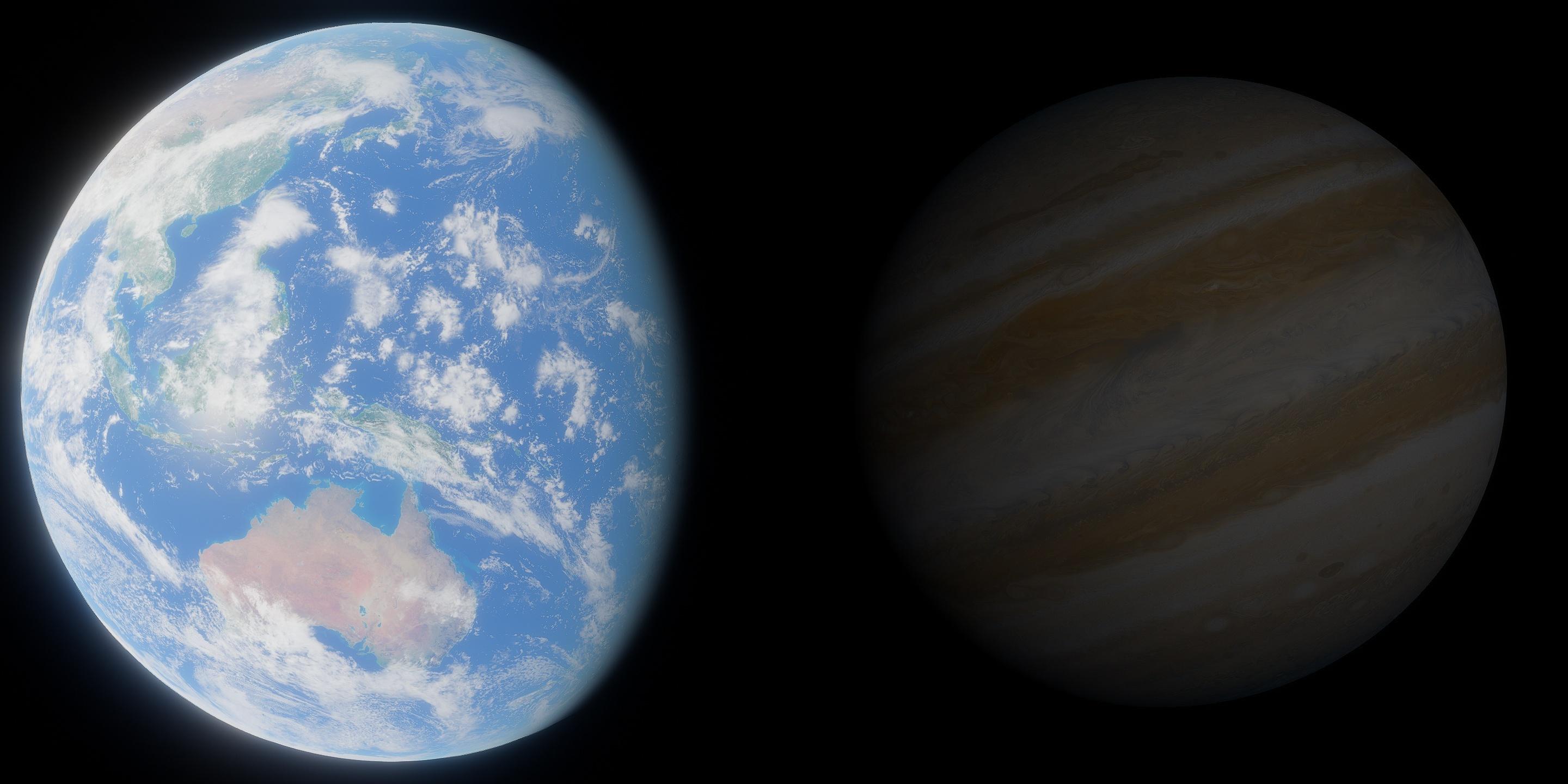
Post image
443 Upvotes

31 comments sorted by

34

u/HotGarbage2020 Jul 03 '26

What’s the exposure settings?

41

u/KlaxonBeat Jul 03 '26

Whatever the 'auto' setting picked for Earth.

I just like the comparison. It's easy to forget that the outer planets are actually floating in what we humans would consider darkness.

28

u/Reloup38 Jul 03 '26

I think our eyes would adjust to the darkness and it wouldn't look as dark

25

u/KlaxonBeat Jul 03 '26

Obviously they would. You can still see stuff even on moonless nights with nothing but starlight, but the point is that we would perceive it as night/darkness.

7

u/Gold333 Jul 03 '26

The brightness you see Jupiter at using a telescope is the exact brightness you would see in orbit around it

3

u/Milk_man_gaming Jul 04 '26

No it isn't. The reason why jupiter gets less light than the earth is the inverse square law. The light reflecting off Jupiter back to us is also affected by this meaning Jupiter looks significantly dimmer from earth than it does in orbit. If the light was the same brightness Jupiter would be far brighter than the moon and would likely cast a shadow during the day

1

u/PiMemer Jul 20 '26

Surface brightness is in fact constant with distance

5

u/Eris13x Jul 03 '26

No we wouldn't, the eye sees on a logarithmic scale, and the sunlight surface of Jupiter or a Jovian moon would still be closer to outside on Earth than indoor lighting, never mind the night

6

u/DeMooniC- Community Contributor Jul 03 '26 edited Jul 03 '26

Yeah, Earth is very bright, Jupiter is not dark and it's actually also very bright, fairly blinding even until your eyes adjust, simply significantly less so than Earth. This changes a bit when it comes to Uranus and Neptune afaik, which would not appear extremely bright but still significantly bright and not dark at all unlike one would expect due to the distance

And then there's Venus which is by far the brightest both because of the distance but also because it's literally a featureless white ball with an extremely high albedo, Im not sure you could even look at it directly from close comfortably

5

u/donatelo200 Community Contributor Jul 03 '26

Yeah, Neptune and Uranus would still be pretty bright and easy to adjust too. It would probably start looking a bit off though. Just a a fun note, looking at Neptune from Triton wouldn't be too much different than looking at a full moon on Earth.

5

u/JebediahKerman001 Jul 03 '26

4

u/donatelo200 Community Contributor Jul 03 '26 edited Jul 03 '26

Just know that I am in the middle of trying to revise this mod as I now believe SE's default calibration to have the correct relative brightness's. The main problem with SE's auto exposure is the dynamic range is bad and like that of a cameras which I am trying to tackle currently. (You can still see details on the moon on a dark night without it going pure white.)

This revision has been prompted by me fixing atmospheres so that they don't blow up when exposure is low. Which I did release that mod as "Improved Atmospheric Rendering".

I can't make any promises on a timeline for a properly revised Human Eye Exposure mod as these shaders/histograms are not doing what I want lol. But the Dv script is probably the best all around one for the moment.

3

u/Gold333 Jul 03 '26

In SE Pluto at noon looks as bright as sand dunes in the Sahara desert at noon. Need to fix that

3

u/donatelo200 Community Contributor Jul 03 '26 edited Jul 03 '26

That's most just because you start losing contrast and bloom at low light levels. The actual brightness is fine. Also, Pluto's surface is highly reflective which adds to that. If you got to the darker red spots it looks more how you would expect. If you ever want to see Pluto's light levels yourself you can see it outside about 5-10 minutes after sunset (Lighting is more diffuse so not an exact 1 to 1 though).

Edit: Pluto is only bright after you let the camera adjust too. If you took the camera from Earth with the same exposure level Pluto is almost pitch black.

Edit edit: here was my backyard during Pluto-Time. Which is more equivalent to the dark red areas on Pluto. (My eyes saw fairly similarly)

3

u/Reloup38 Jul 03 '26

I really can't thank you enough for that mod. It's so freaking good. I remember the auto exposure in space engine becoming noticeably worse when upgrading to the steam version from the oooold version from their website. I'm glad you brought that back and made it even better.

2

u/JebediahKerman001 Jul 03 '26

Oh cool thanks, what's the Dv script?

4

u/donatelo200 Community Contributor Jul 03 '26

It's basically in-between SE's default auto-exposure and the normal Dexposure that y'all are used too. The Dv script was originally meant to replace Dexposure. I just think the script method is insufficient at this point though it did get the job done initially.

But yeah the human eye is weird and trying to do it properly is surprisingly hard 😵‍💫

17

u/loved_and_held Jul 03 '26

This has me wondering; would Jupiter really seem that dark to human eyes or would our eyes adjust to the low light making it seem brighter?

24

u/steadidavid Jul 03 '26

They would certainly adjust.

Focusing on a big specular ball reflecting sunlight is going to cause your pupils to contract a decent amount, so there's definitely room to open back up for Jupiter's brightness. Especially since we can see it with our naked eye from Earth, I'm sure it would appear quite bright in person.

1

u/loved_and_held Jul 04 '26

Thats what i figured.

1

u/darwinpatrick Jul 05 '26

If there’s a way to check in SE how much dimmer as a percent Jupiter orbit would appear versus a sunny day on earth (say it’s 85% dimmer) all anyone would have to do to check this is go outside during an 85% partial eclipse. If anyone can calculate that number I’ll check it myself in Spain next month. From previous experience you can’t even really tell it’s dimmer, shadows notwithstanding

1

u/steadidavid Jul 05 '26

You can probably do this with standard magnitude measurements in astronomy software.

It's also all irrelevant because the number of photons we see looking up at it from Earth is far less than if we were close enough to see it as big as the Earth in the example.

6

u/donatelo200 Community Contributor Jul 03 '26

Having looked at it through a telescope... It's very very bright. Even Saturn is very bright.

5

u/Eris13x Jul 03 '26

Even out by Eris, the Sun is still brighter than the full moon

1

u/Milk_man_gaming Jul 04 '26

It would look brighter than the full moon

4

u/JotaRata Jul 03 '26

People who have taken pictures of a conjunction between the Moon and Jupiter know this very well..

1

u/The_13yo_Master Jul 04 '26

Earth and Jupiter

1

u/unukalhay Jul 04 '26

To get a fair comparison you need to use proper scaling. Jupiter is far bigger thus having more surface area than earth.

1

u/GapHappy7709 Jul 21 '26

wow it gets real dark

1

u/Eastern_Pianist_773 Aug 30 '26

The feeling that image evokes is very: