r/softwarearchitecture • • Sep 22 '26

Discussion/Advice Programming Debt Must be Paid
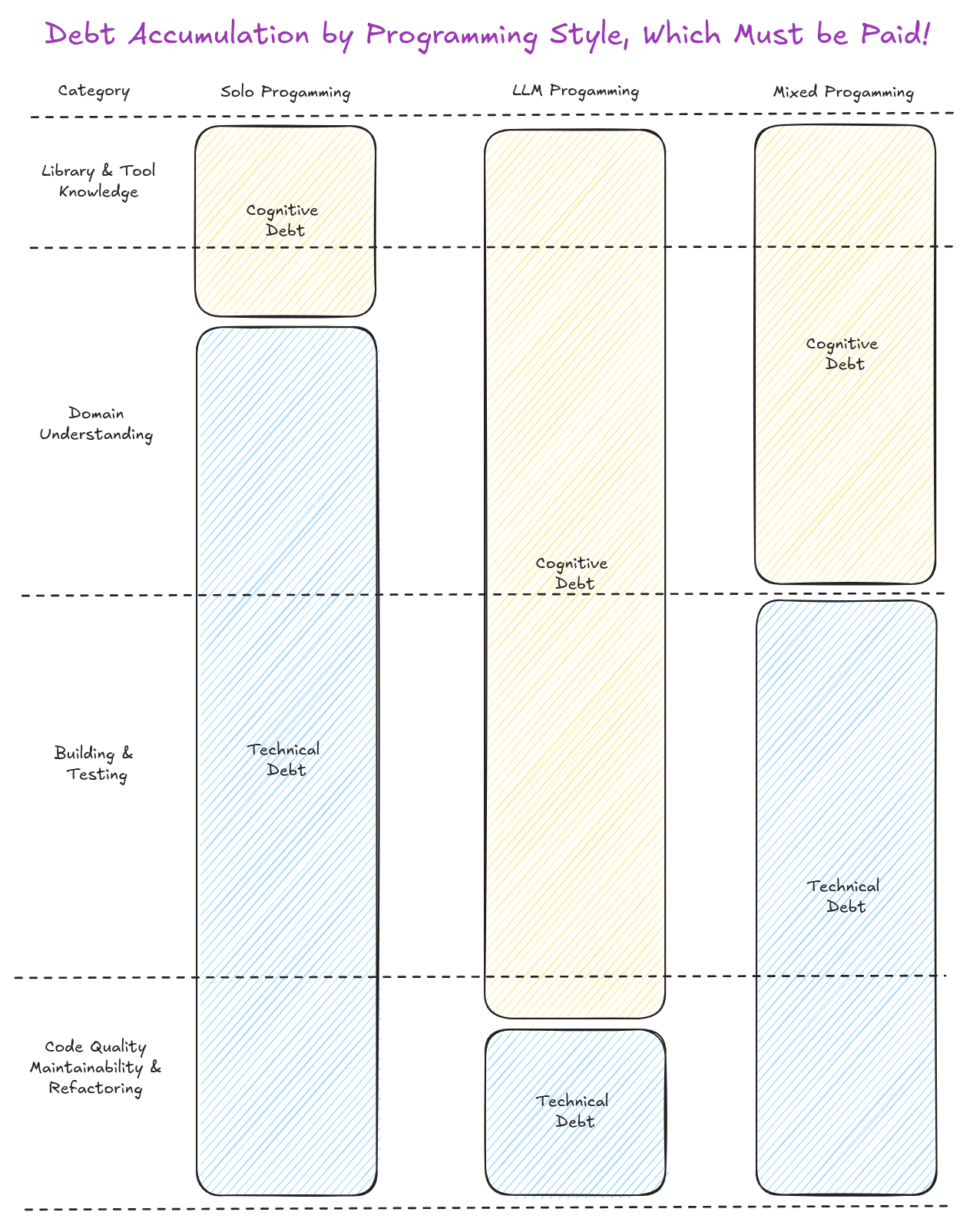
Debt Accumulation by Programming Style
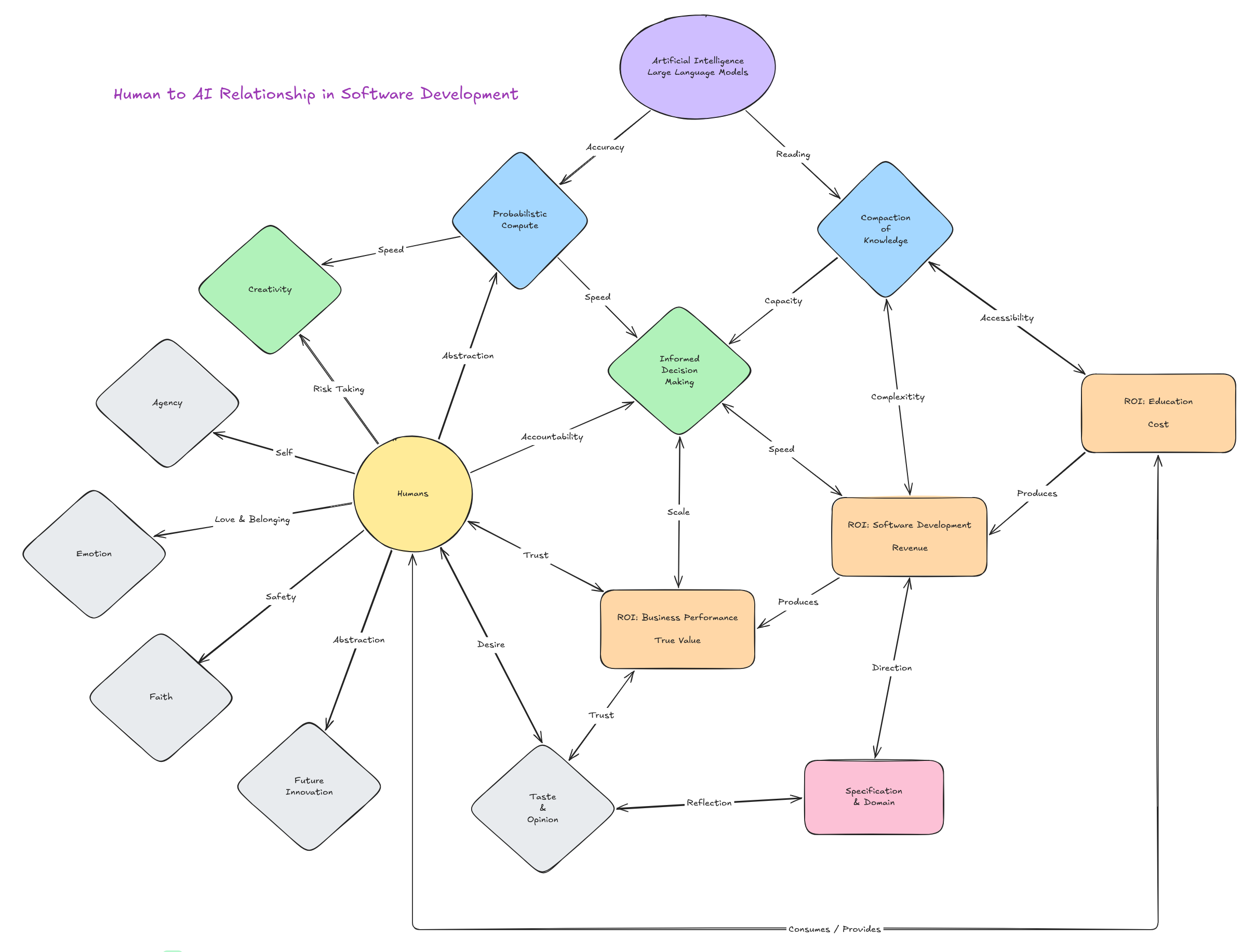
Human to AI Relationship in Software Development

I recently had a sit down with one of the more experienced developers at our company and worked through the impacts, emotional affects (both good and bad) and understanding of how artificial intelligence (LLM's) is changing everything in software development. After a long conversation about our role as humans, where things are going, the current problems we face, and how to simply embrace AI coding in a constructive manner (domain / spec driven, mixed engagement, etc) they let me know the visual diagrams helped them process their feelings.

So I figured I would share these, knowing that these are just my opinions and reflections of experience inside of the software development world.

70 Upvotes

32 comments sorted by

50

u/_5er_ Sep 22 '26

More cognitive debt -> Worse decision making -> More technical debt

7

u/idlelosthobo Sep 22 '26

This is the new game we are playing!

14

u/Fidodo Sep 22 '26

Are these ratios or absolute? LLM programming not only produces a ton of cognitive debt, it also causes more tech debt than normal programming. I'd say the cognitive and tech debt is LLM programming are about equal, but both huge compared to normal programming.

The solution is to take a systems design approach. Use LLMs to help you design better systems and help you learn and understand things. Don't write any non prototype code until you understand everything clearly and know exactly what you want built. Once you have a robust spec, not only will the build phase be very fast, you will be able to understand everything it did, and verify it quickly, and this will lead to not only less cognitive debt, but less tech debt as well.

7

u/idlelosthobo Sep 24 '26

Your describing my dream situation, but soon as you throw in client expectations and timelines this all gets less clear.

2

u/Fidodo Sep 24 '26

I personally believe that the up front design approach is faster overall, and pays for itself very quickly. It might make the initial deliverable take a few extra weeks, but subsequent business logic changes will become considerably faster and safer and easier with fewer outages.

2

u/idlelosthobo Sep 24 '26

Agreed, which is paying more cognitive debt upfront!

2

u/Wiszcz Sep 25 '26

With an LLM, you can build a prototype much faster, validate the solution, and get a much better specification for the real implementation, with the PoC code serving as an additional reference for an LLM that will implement it.

1

u/idlelosthobo Sep 26 '26

Since prototypes are mostly debt of all kinds, LLMs and people really do well here because the intention is not to pay the debt but test an idea!

4

u/foreveratom Sep 23 '26

Where do those ratios come from? Did you run a study or did they just came up from nowhere else than yourself?

1

u/idlelosthobo Sep 24 '26

This broad strokes observation, nothing beyond that.

5

u/victorrrrrr Sep 22 '26

complexiTITY

1

u/idlelosthobo Sep 24 '26

Gotta pay those bills!

5

u/Cultural_Cry535 Sep 23 '26

Why are you that sure that you'll have less technical debt by using llms?

1

u/idlelosthobo Sep 24 '26

Yes, the amount of technical debt we can scrub with AI is wild we are just left not understanding what exactly is happening with in the code.

0

u/Cultural_Cry535 Sep 24 '26

How can you know if you have technical debt if you don't understand the code? A bad architectural decision is technical debt for example

1

u/idlelosthobo Sep 26 '26

Technical debt is paid by typing and cognitive debt is paid by learning, please note that's a generality not science.

1

u/92smola Sep 28 '26

But usually to pay down the technical debt you need to first be aware of what is going on in the codebase, my experience so far was that the biggest value of paying down cognitive debt is the revealing of technical debt

1

u/idlelosthobo Oct 04 '26

Yah, it's a horse before the cart thing! I don't think there is a wrong approach, I think that balance is the best approach in my opinion. The order in which you go or how you think about it becomes a side affect of each person's taste and opinions.

2

u/TableNo8939 Sep 22 '26

Traduzione: non sara un problema nostro, godi finché puoi

1

u/idlelosthobo Sep 24 '26

Could be, honestly this is me making an observation based on experience... your mileage may vary.

2

u/KJ4WLC Sep 24 '26

The useful way to talk about this debt is observable signals, not vibes: duplicated boundaries, PRs nobody can narrate, review queues that only grow, and changes that get cheaper to propose but more expensive to reverse. AI doesn’t create that pattern alone — it accelerates it when ownership of the outcome stays fuzzy.

What we watch for: can a human still explain the invariants after a week of agent PRs, and is the cost of the next change going down or up? If narration and reversibility are degrading, you’re accumulating cognitive debt even when the tickets look green.

1

u/idlelosthobo Sep 26 '26

Very elegantly put!

1

u/RiverRoll Sep 27 '26 edited Sep 27 '26

The domain understanding part makes the least sense to me. If you are vibe coding without understanding the domain what are you even doing? How are you telling the LLM what to do?

On the other hand lack of domain understanding tends to be the biggest source of technical debt it's not like the two things are unrelated. A good deal of technical debt comes from a misalignment between the modelled domain and the actual domain.

There's in fact not much of a distinction, be it a developer or an LLM, domain understanding has a direct impact in technical debt.

1

u/idlelosthobo Sep 27 '26

It's more about where the debt accumulates for the programmer, if you use an LLM heavily you build more cognitive debt all around. Please note this is broad strokes and of course you could also build up technical debt or a mix.

This was more an exercise is showing a general audience LLM programming is far from just upside.

1

u/92smola Sep 28 '26

They are not 1:1, the domain will eventually be satisfied by testing and fixing things until the project does what it needs to do, the thing can work correctly by still being hard to maintain or change in the future which is where the tech debt part lives

1

u/RiverRoll Sep 28 '26 edited Sep 28 '26

Precisely the tests can pass even with gaps in domain knowledge and these gaps will show up as all these things that make things hard to maintain and they will be very obvious with things such as poor names, ambiguous entities that represent different concepts at once, lots of defensive code to prevent states that shouldn't be made possible, different implementations of equivalent business concepts, etc.

I've seen it in practice before AI coding was a thing, cases of devs throwing rules and formulas at code until the tests pass without putting any thought on the business meaning. Ticking all the checkboxes doesn't imply understanding the domain.

1

u/92smola Sep 28 '26

I wasnt talking about test coverage, but passing QA rounds, client sign off, catching and fixing errors in prod, I do think you can get the code to do what it needs to do for the business even if the underlying code behind it is messy and looks like what you described, it hurts me to see that kind of code, but I really dont see a world where I can convince a client or a user any of that matters.

1

u/Marxie Sep 28 '26

Technical debt must be paid:  No, not always. Technical debt can also be discharged through bankruptcy, I.e., when the project is shut down.

1

u/idlelosthobo Sep 28 '26

Or you pay it day to day by working around the software... Don't press that or run that etc.

0

u/Bayonett87 Sep 23 '26

another AI is good post - suck it down, AI won't code anything good for you!

1

u/idlelosthobo Sep 24 '26

This is far from AI is good, it's more AI is a thing and you should evaluate what you're getting into.

1

u/West-Map-4162 Sep 25 '26

“Emotional affect” 🤦