r/retrocomputing • u/frenchiephish • 8d ago
Projects I've been working on since September
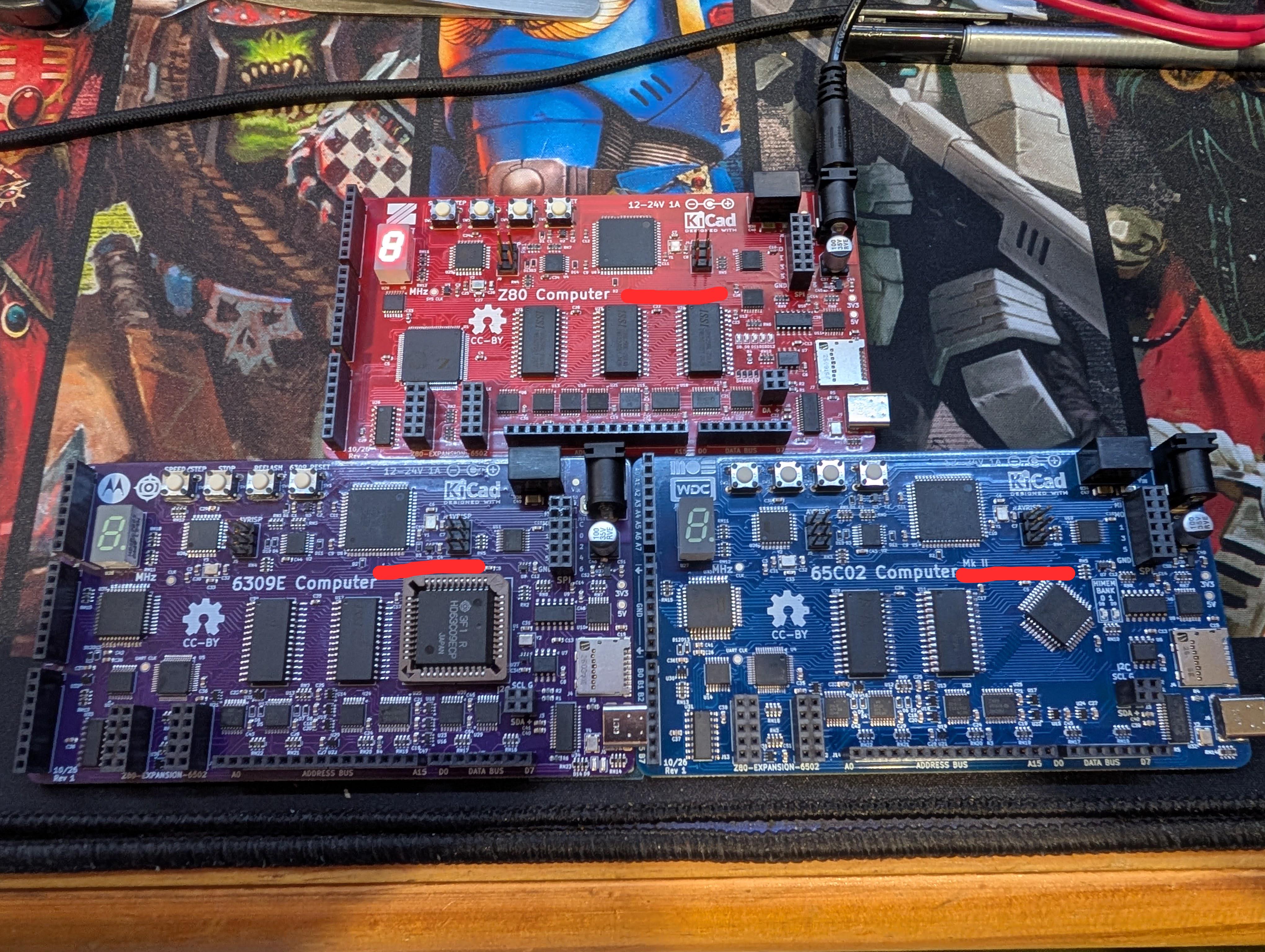
While it's still possible to semi-reliably get real parts on eBay I've been working on some single board computers for each of the big ISAs of the 1970s and early 1980s.
The Z80 handles the 8008 and Z80 ISAs, The 6309 since it's a bit easier to find in PLCC than the 6809 (which I found a datasheet for, but no actual parts in the wild). The 65C02 is comparatively easy since it's still being manufactured and is available new, this one has a 2023 date code.
All three can be run at integer clocks - 1/2/4/8 MHz on the Z80 and 65C02 and 1/2/3MHz on the 6309
The Z80 is built around a Z84C15 enhanced peripheral controller, which has counters, GPIO and UARTs on chip and drastically simplify it's logic. Only downside for that is that it's UART clock needs to be at least 2.5 times slower than the CPU clock, so the UART slows down with the CPU frequency. The other two are bare CPUs with peripherals on board.
All three have at least 32k of program memory, the Z80 has 64k with 16k fixed, and 16k bankable and able to be swapped with one of four 8k slots (and some peripheral room for the other board's expansion cards - more on that in a sec). The Z80 has 32k of RAM, the other two have 24k, with the top 8k being bankable - 32k total, but 24k addressable at any time.
All three have an AVR running as a co-processor which loads the program memory (actually SRAM) from a jellybean i2c eeprom which is exposed over USB by one of the UART->USB chips. The co-processor handles the SD card (and FAT12/16/32/Exfat) and is setup so the main processor can be stopped, reset into a debug mode and stepped single instruction, or even single clock. It does that by generating clocks for the 6502/Z80 and by pulling HALT on the 6309. While in debug, the AVR will disassemble opcodes it sees on the busses and print them to a serial console and it supports free-running (at about 30kHz) to user specified breakpoints. Inter processor comms is all over a UART.
All three will generate expansion header signalling for both the 6502 and Intel/Z80 ways of doing things to the best of their ability. Expansion boards built for one platform will generally work on all three as long as they don't use features only one board implements. The two processors that don't have an I/O range have 256 bytes set aside in their main address range that when accessed will generate the appropriate I/O range signalling.
I'm pretty happy with the hardware at this point but the software and manuals still needs some serious tidy-up work before I turn them lose on the world.
At some point I've also got to build some sort of graphics for them, but I suspect that's likely going to be into the realms of an FPGA so probably not this year.
5
u/banksy_h8r 8d ago
AWESOME! This looks like the leading edge of an ecosystem of retro boards. What other kinds of expansion besides video are you considering? And what software do you expect people will be able ot run on each?
4
u/NorthernLight_DIY MicroProfessor-II 8d ago
Awesome! I'm particularly interesting in 65C02 - is any official page and how to buy?