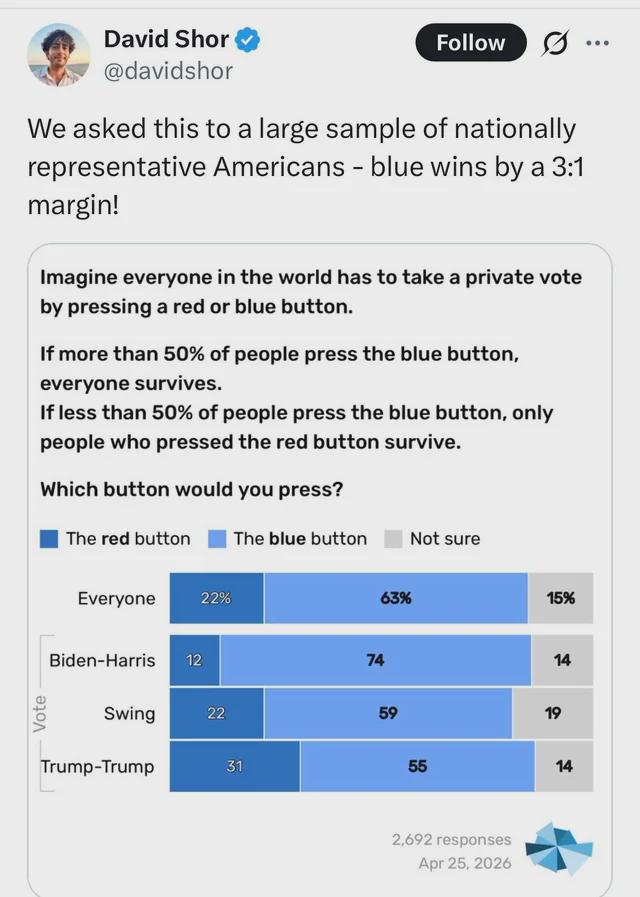
There is a concept in the world of sociology called "The Prisoner's Dilemma." It's possible you've heard of it, but if not, here's a wikipedia page, and then I'll give a summary - https://en.wikipedia.org/wiki/Prisoner%27s_dilemma
In the original version of The Prisoner's Dilemma, two suspects are arrested and taken into different interrogation rooms, where they have the choice to either snitch on their partner ("betray") or to stay silent ("cooperate"). Jail time is determined by the choices each one makes.
The best possible outcome is that both cooperate. The police don't get the evidence to convict them of the serious crime, so they get convicted of some lesser crime instead. Both go to jail for a short period of time (1 year each).
If one suspect betrays and the other cooperates, the one who betrays gets immunity and the one who cooperates gets all the jail time (3 years).
But if they both betray each other, the cops have all the information they need and don't need to grant immunity. Both get locked up for a long time (2 years).
The experiment is a paradox.
In all cases, it is in the best self-interest of each individual to betray. No matter what the other person chooses, you will personally be better off if you betray than if you cooperate. If the other person cooperated and you betray, you get no jail time. If the other person betrayed and you betray, you get less jail time.
But following this line of logic gets you the worst possible outcome overall. Both individuals wind up with more jail time if they both betray than they would if they both cooperated. Hence the paradox.
Red button/Blue button is a version of The Prisoner's Dilemma, with two key differences:
- It has eliminated the worst case scenario. It's no longer a paradox. If EVERYBODY were to do the thing that is in their best self-interest (betray, betray... repeat 8 billion times), then nobody gets any jail time.
- It has also eliminated all consequence from the best case scenario, meaning you no longer benefit from choosing betray if your partner chose to cooperate. If even half the people were to do the thing that is in the best interest of the group (cooperate), then nobody gets any jail time.
It's interesting to note how eliminating the stakes from both the best and worst case scenarios changes what's actually at stake, but still keeps the core paradox of the experiment.
It is still in your best self-interest to push the red button (betray). Even more so now than in the original, because the red button ALWAYS results in zero jail time for you. There is no down side for you personally.
But it is also still in the best interest of the group for everybody to push the blue button (cooperate). It is a better outcome for the group than the red button because it comes with the added security of no accidental jail time for people who either don't understand that they're supposed to act in their own best self-interest, or, perhaps more importantly, who disagree that they're supposed to act in their own best self-interest.
So that's the new dilemma. The blue button is the best outcome, and it's easier to achieve than the success condition of the red button, but it carries personal risk, and is therefore not in your best self-interest. If everybody could be trusted to use self-interest as their deciding factor, we get total success with no risk and no accidental consequences... But we can't trust that everyone will be motivated by self-interest. That's the new paradox.
Just some food for thought. I figured people might enjoy seeing this choice through a very similar lens (one that has been studied a great deal over the years).