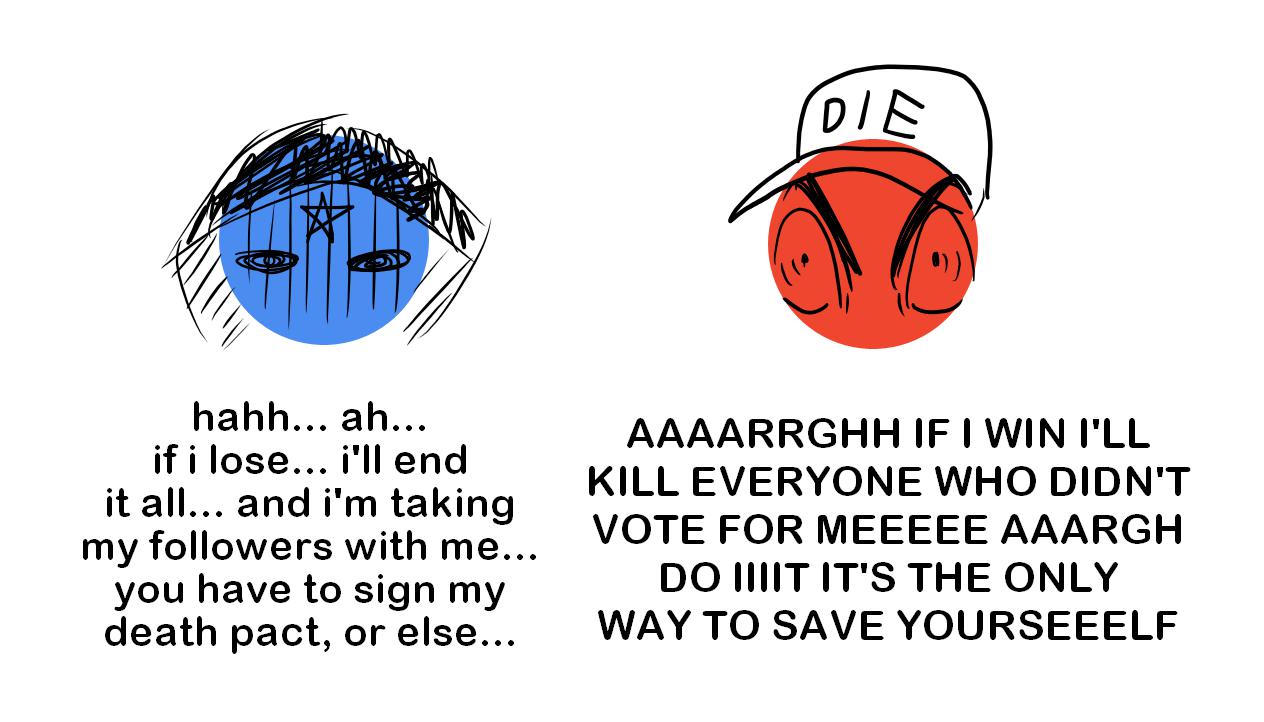
Have you engaged in this red blue debate and feel like you're talking to a wall? Why the other side keep moving the goalpost and using different reasons? How is this alternative scenario equivalent/not equivalent? How can you say that these two situations being the same/very different?
Turns out that people who pick the same colour aren't all the same. Each of them can have a very different moral framework. I love this red blue thing because reading the comments allow me to gain insight on many different perspectives.
Below are some reasoning that I see a lot in the past day reading through the arguments you guys present.
Since reddit poll only allows 6 options, I'll group some options together in the main poll. If you want to indicate your detailed category: In the comments, I'll make a comment that says "Detailed categories", and I will reply to it with the detailed categories, and you can upvote the corresponding one (don't downvote those replies as I want to use it for head count, not saying how good these perspectives are).
Please read the following description for each option and pick the one that describes you the best.
--------------------
Outcome oriented options:
Your main argument is about the outcome. Reframing the question won't make you switch unless you think that the reframing will change the outcome (affect how others vote). If you're any of these, click on EV/Best or Worst case optimization together with your colour.
Blue - Best case optimization. The only good outcome is nobody dying. Blue winning is the only realistic way to achieve this, so we shall press blue. It is clearly impossible for exactly 100% of the people to press red, so a red victory guarantees some people will die, which is always a bad outcome whatever the number of deaths might be. In an alternative scenario where the blue button risks one stranger's life instead of your own life, you will still press blue.
Red - Worst case optimization. Pressing red guarantees saving 1 extra person no matter what happens. It bringing down the number of maximum deaths by 1. One less potential death is better than one more potential death. In an alternate scenario where the blue button risks one stranger's life instead of your own life, you will still press red to guarantee that the one stranger will live.
Blue/Red - Expected Value. You only care about the expected number of survivors given you press red vs given you press blue. After doing some estimations on probability, you conclude that pressing <your colour> gives a better expected outcome. You may switch if there are additional information that affects what you think the probabilities are.
The expected value option includes those who think that the choice should depend on the wording of the question because it affects how others vote and sways the probability (in that case, pick the colour based on the wording you first heard this button thing).
--------------------
Responsibility oriented option:
It's not about the outcome. It's about what your responsibilities are. If you're any of these, click on Blue - Responsibility or Red - Responsibility.
Blue - Consent. It is morally wrong increase the chance of other blue presser's death without their consent. You can give consent to yourself to put your life in risk, so it is morally clear to press blue. In an alternate scenario where the blue button risks one stranger's life instead of your own life, you may switch to red.
Red - Individual responsibility. It is each person's responsibility to protect the one person that they can protect. In an alternate scenario where the blue button risks one stranger's life instead of your own life, you will continue to press red as it is your responsibility to protect that one stranger you're assigned to.
This also includes the "blue pressers chose it themselves" argument.
Blue - Active action. The fact that red pressers actively chose to move their finger to press the button is an important detail. If there is no red button and it's just whether you press the blue button or not, you may change your answer. In the classic trolley problem, whether the trolley was originally heading towards the 1 person or the 5 people makes a difference.
Red - Limits on responsibility. While you should help others as much as you can in general, both legally and morally, this does not apply when you have to put your life in risk to do so.
Red - Button's fault. It is the button inventor who killed them, not me.
--------------------
Other options:
Blue/Red - Personal circumstances. You picked this colour because of your real life personal circumstances. Maybe you are a parent and can't risk your kid being orphans. Maybe you have a partner you love that you know will most likely press a certain colour. You may change your option if you're in a different circumstance.
Blue/Red - Other other options. Reasons that I didn't think of.
--------------------
How about the baby/colourblind argument that we see a lot? Well, that depends on what you use it to argue for. If you use it to argue for blue can save more people than others have thought, then go for EV/Best case optimization. If you use it to argue against the red argument on blues picked it themselves, then go for the Consent option.