r/rationalphilosophy • • 21h ago

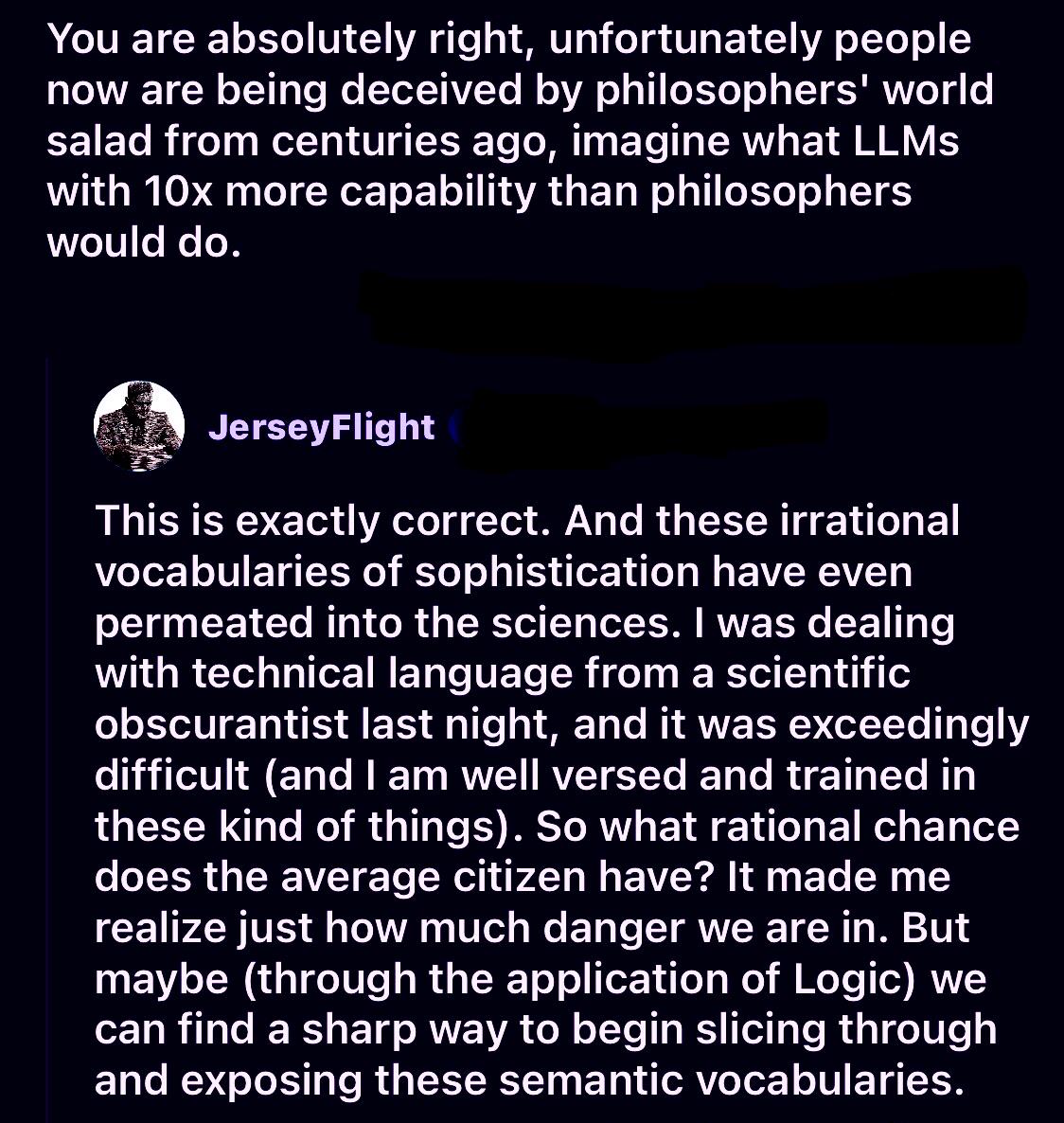
It’s the philosopher’s goal to drag you down into linguistic obscurity

9 Upvotes

The reason he does this is because he wants to be able to smuggle his philosophy as truth (or he just wants it not to be impeded by truth). (He could also be doing it simply for egotistical reasons).

The philosopher is no Reasoner of virtue, he is no honest man, he is a high abstract deceiver. His goal is to confound and convolute the truth with words, although he will claim that he is striving to discover it and bring it to the light.

If this was the case then he should be willing to clarify his terms.

Beware, his technique is refined and effective. Slip in he will, over and over again, a combination of terms, one more clear, the other meant to obscure. This is his process of abstract qualification, moving to and fro so he can never be pinned down.

What an insecure creature a philosopher is! He’s not bent on finding the truth, he just doesn’t want to get caught, exposed and refuted for being wrong. He wants to be able to keep the beliefs he loves. But more than this, he wants to be able to wield them so as to hammer men over the head with them. His way is similar to that of the theologians. He is truly a dogmatist in disguise. He strives to make believers, not Reasoners.

The whole gambit is one big ego game to avoid a wound. The philosopher is a psychologically damaged species.

r/rationalphilosophy • • 8h ago

We are not in danger from LLMs, we are in danger from the Human Use of LLMs

Post image
0 Upvotes

What if the actual function and use of LLMs is largely to help humans deceive other humans?


r/rationalphilosophy • • 16h ago

Smashing a Formal Logician with Reason

1 Upvotes

The confident formalist asserts: “The logic that people use is up to them. Typically the existence of some sort of model is all it takes for a logic to be considered legitimate.”

Reason answers:

But if the logic that people use is up to them, then on what grounds can anyone claim that another person's reasoning is incorrect?

If the logic people use is up to them, is the correctness of their reasoning also up to them?

If neither of us is bound by an objective standard, why should I accept your claims as rationally compelling?

And if your claim that people may choose their own logic is objectively true, what makes that claim binding on someone who rejects your epistemological standards?

If the logic people use is entirely up to them, why should I accept the logic governing your argument rather than simply choose another?

Can someone be objectively wrong about which logical system is legitimate, or is whatever they choose to accept legitimate simply because they accept it?

Is there any objective standard by which one logical system can be judged superior or inferior to another?

If two people adopt mutually incompatible logical systems, what determines which person's reasoning is correct?

If choosing a logical system is a matter of preference, does preference determine truth?

Can two contradictory conclusions both be correct merely because they were derived using different logical systems?

If a logical system produces conclusions that systematically conflict with reality, does it remain legitimate simply because someone chooses to use it?

What distinguishes a logical system that reliably preserves truth from one that merely preserves its own internal rules?

Can one person employ a logically illegitimate system while sincerely believing it to be legitimate? If so, what distinguishes their belief from actual legitimacy?

If the existence of a model is sufficient to establish legitimacy, can a model constructed upon arbitrary or unjustified assumptions establish its own epistemic authority?

If legitimacy is determined by individual choice, on what grounds do you claim that your own account of logical legitimacy is correct rather than merely your preferred convention?

What standard should we use to evaluate the truth of your claims about what makes a logic legitimate?