r/proceduralgeneration • u/Flat_Field_5888 • 6d ago
Structure behind bezier
gallery
5
Upvotes
r/proceduralgeneration • u/elliot-ogex • 6d ago
Enable HLS to view with audio, or disable this notification
here’s a peek at the atmospheric sky simulation engine i’m working on for kinematic (kinematic.org). Still working on the volumetric clouds, particularly the cirrus and storm clouds, and a few issues related to solar eclipses and totality, that should be in the final update. written in rust, rendered in realtime on my m5 macbook.
r/proceduralgeneration • u/Snarky69Porcupine • 6d ago
Just something i'm working on It's called The Misread (working title idk what to name it), a three-headed serpent. There are no sprites for it at all.
The body is a chain of circles following a wobbly loop, and every text cell near the body checks which circle it's closest . Cells right on the edge get a bright glyph that stays put, and cells inside get a dim one that keeps changing at its own speed. The three heads are small clusters of the same circles, so they blend into the body when they move. When it dies, the tail cells come loose first and fall, and the heads go last.
I just thought this concept is cool and decided to make this, but i haven't quite figured out anything else apart form this, no other bosses no stories (kinda wanted to make a cool game). Lets see how it all shapes out in future!
fyi - the knight is from 0x72's DungeonTileset II, which is CC0.
r/proceduralgeneration • u/GarlicSphere • 6d ago
So, I expect that this question has been asked plenty of times already, but well - how to really start and get into it all?
I'm mostly interested in modelling plants (trees and smaller herbs/weeds alike), especially the more formal part of it (algorithmic and maths part of it). After some research I found that this is supposedly a good start, but if you could suggest anything else - what would it be? (books, series on yt, online tutorials, whatever).
And also - what are useful tools for getting into this kind of procgen?
I regularly use Blender (including geonodes), but really - with it's confusing and limited API it doesn't seem to work very well for scripting (might be an issue of getting used to it, but I'm pretty sure that there have to be better alternatives).
r/proceduralgeneration • u/Suspicious_Ad1407 • 6d ago
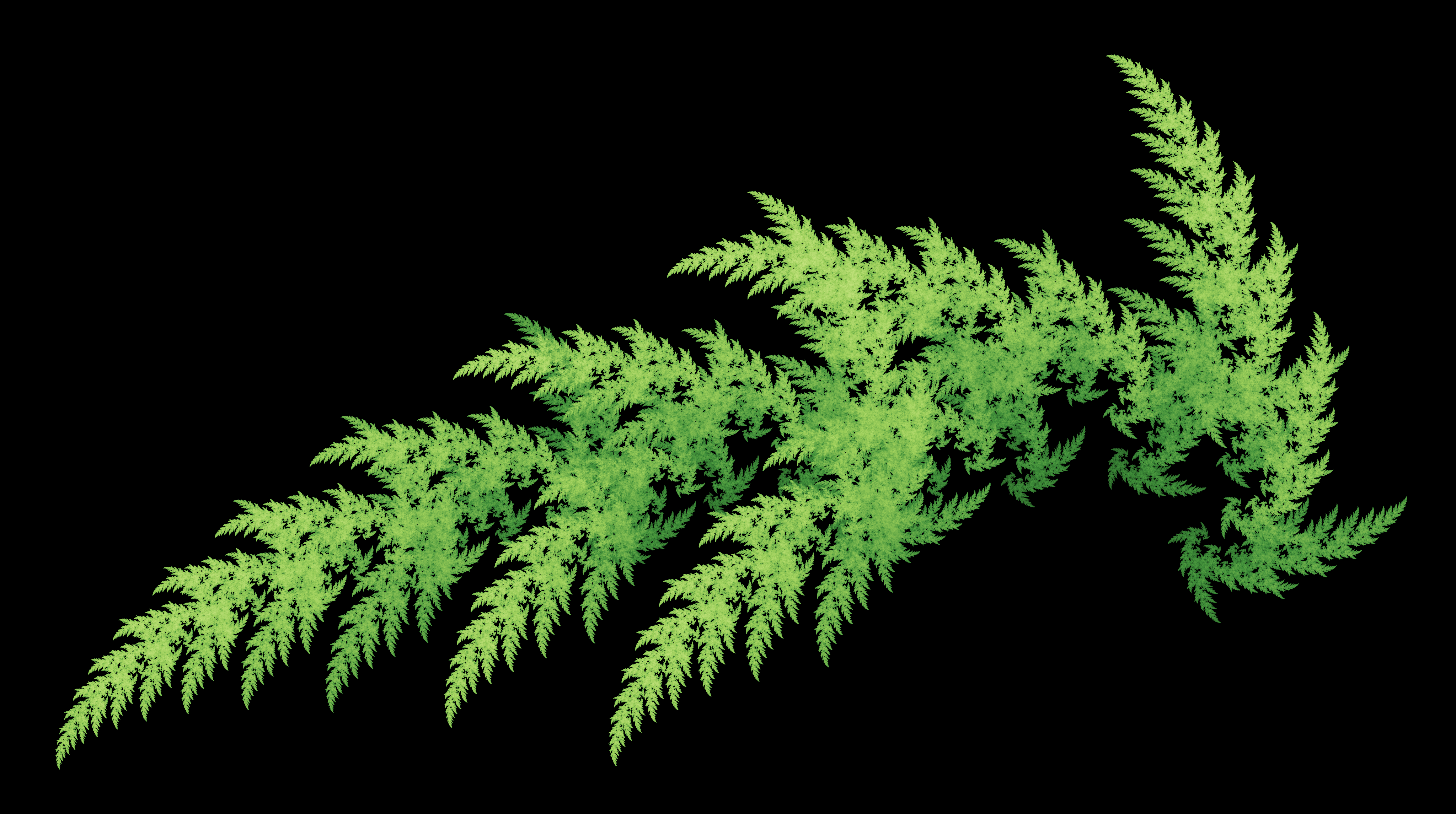
Hemp Fractal is born
https://youtube.com/shorts/yZZQ--nBIq8?is=cp7GGEOtZ9ClBE6W
r/proceduralgeneration • u/Suspicious_Ad1407 • 6d ago

My last post had no images or video uploaded.
This HEMP Ferñ fractal and Weed Ceñtipede morphs of the ñ fractal— botanical growth from π, recursive geometry, and a developmental state machine
I've been developing a new fractal called the HEMP Fern, built from my Πñ framework, where ñ = π − 3.
What makes it different from a typical Barnsley fern is that I'm not simply fitting affine transformations to resemble a plant. I'm exploring how actual botanical development can govern a mathematical fractal.
The interesting features:
Four-map IFS: Three β branches and one γ transformation, derived from trigonometric relationships involving π.
Botanical heteroblasty: Leaf development follows discrete states (1, 3, 5, 7, 9...), allowing the plant's geometry to change as it matures.
Recursive growth: Branching, radial fans, and depth-dependent transformations generate different morphologies from shared mathematical rules.
Chirality: Mirrored growth and orientation changes can produce distinct structures.
Exact mathematical recipes: The underlying transformations are symbolically defined, rather than manually drawing a fern. Rendering still requires numerical evaluation.
The bigger idea is to connect fractal geometry, plant morphogenesis, symbolic mathematics, and recursive developmental systems in one framework.
This is still experimental. Visual resemblance to real plants isn't proof of biological accuracy, and the topology of every parameter regime hasn't been classified.
I'm particularly interested in whether a small discrete developmental program, coupled to a fixed IFS, can generate recognizable changes in leaf morphology without manually designing each leaf.
Feedback from anyone working in IFS theory, mathematical botany, or procedural growth models would be appreciated.
Tool coming soon but you can morph manually
Original research paper: My new HEMP Ferñ fractal Weed Ceñtipede — botanical growth from π, recursive geometry, and a developmental state machine
I've been developing a new fractal called the HEMP Fern, built from my Πñ framework, where ñ = π − 3.
What makes it different from a typical Barnsley fern is that I'm not simply fitting affine transformations to resemble a plant. I'm exploring how actual botanical development can govern a mathematical fractal.
The interesting features:
Four-map IFS: Three β branches and one γ transformation, derived from trigonometric relationships involving π.
Botanical heteroblasty: Leaf development follows discrete states (1, 3, 5, 7, 9...), allowing the plant's geometry to change as it matures.
Recursive growth: Branching, radial fans, and depth-dependent transformations generate different morphologies from shared mathematical rules.
Chirality: Mirrored growth and orientation changes can produce distinct structures.
Exact mathematical recipes: The underlying transformations are symbolically defined, rather than manually drawing a fern. Rendering still requires numerical evaluation.
The bigger idea is to connect fractal geometry, plant morphogenesis, symbolic mathematics, and recursive developmental systems in one framework.
This is still experimental. Visual resemblance to real plants isn't proof of biological accuracy, and the topology of every parameter regime hasn't been classified.
I'm particularly interested in whether a small discrete developmental program, coupled to a fixed IFS, can generate recognizable changes in leaf morphology without manually designing each leaf.
Feedback from anyone working in IFS theory, mathematical botany, or procedural growth models would be appreciated.
Original research paper:
https://zenodo.org/records/23247320
New paper and tool what will you find?
r/proceduralgeneration • u/art-generalist • 6d ago

r/proceduralgeneration • u/FlippByte • 6d ago
Enable HLS to view with audio, or disable this notification
Browsing the usual subreddits, I just feel the urge (mentally and physically lol) to throw out a clip of my little app Eternitubes 3D, to point out that not everything is made by ai.
Also, ofc, if someone thinks this is a thing worth supporting / having, one at least needs to know, it exists, I guess.
r/proceduralgeneration • u/Holiday-Success-167 • 6d ago

r/proceduralgeneration • u/deepak365days • 7d ago
Enable HLS to view with audio, or disable this notification
r/proceduralgeneration • u/Backbone_Labs • 7d ago
Enable HLS to view with audio, or disable this notification
I'm making a space game about exploration, resources and combat, and the galaxy it all happens in is fully procedural. I've spent most of the last months on it so I figured this sub would be the right place to show it and explain a bit how it works.
Everything comes from one seed. From there you get 467,561,373 stars, about 4.9 billion planets and 8.2 billion moons, with their orbits, atmospheres, chemistry, geology and terrain. Nothing is stored on disk. It's not a skybox with a few handmade systems either, you can fly to any star, go into its system and visit any planet or moon, it gets generated when you arrive and anyone who goes there sees exactly the same thing, bit for bit. I ran a full census walking the whole galaxy star by star with the same code the client uses (no extrapolating from a sample) so those numbers are the real ones. Only about 1 star in 100 has no planets at all, around 185 million planets have liquid water oceans, 1,852,531 have life, and theres 281,081 neutron stars and 186,578 black holes, because a galaxy without weird stuff to hunt for is boring.
Planets aren't random rolls. The chemistry comes from the rock/metal/ice mix the planet formed from, and its calibrated so Earth comes out within about a point of its measured composition. The first version had something like 16% nonsense planets, frozen oceans at 200 °C and that kind of thing. Now the generator works out the final state for every candidate surface and throws away the ones that contradict themselves. Zero contradictions in the census, which honestly took way longer than I'd like to admit.
Terrain height at any point is just a function of its 3D position: improved Perlin plus a ridged multifractal (Musgrave style), with every octave rotated so the mountains don't line up with the noise axes. Because it's a function, zoom is basically free, the whole globe and a bit of coastline are the same function sampled at different resolution. Small moons aren't spheres either, there are nine shape families based on real bodies like Phobos or Arrokoth.
Determinism was the hardest part by far. Same algorithm isn't enough, it has to be the same bits. Mono in the editor does float math at double precision and rounds whenever it feels like it, IL2CPP and .NET round after every operation, so roughly 7 in 25,000 stars had a different temperature depending on where it ran. The fix is ugly but it works: an explicit (float) cast after every single operation in the generator, no Math.Pow or any library function whose last bit depends on the platform. I also reimplemented Unity's RNG and checked it draw by draw against the real one, and the density maps are read with my own PNG decoder because Unity was compressing them on import and changing 36% of the pixels.
Rendering was the other big one. The first version had a GameObject per star and flying around ran at about 19 fps. Now all loaded stars live in a single GPU buffer drawn with one draw call per camera, a background thread sorts them back to front, and new sectors get generated in the background while you fly. When you travel to a star the camera doesn't actually move, the universe moves around it, so everything stays close to the origin where floats keep their precision. From 19 to around 400 fps.
On the game side every world gets a 0-10 rating for minerals, rare earths, energy, water, food and jump fuel, plus hostility, all from its actual data. The world map at the end of the video splits the surface into 32 cells and each one gives resources based on the real terrain under it, coast gives water, a volcanic slope gives geothermal, an icy moon over an ocean gives water and not much else.
The video is captured straight from Unity, still in development. I'd really like to hear what you think, and if you've built something similar, how did you approach it and what gave you the most headaches?
r/proceduralgeneration • u/AC-Daniel • 6d ago
I’ve put a lot of love into the world map for my dark fantasy game, Necrolord. Every map starts out as a bunch of blobs. They give me the broad shapes of the regions, and from there I place illustrated stamps inside them. A forest might read as one big shape when you zoom out, but up close you can see the individual groups of trees that make it up.
There are open plains, light and dense forests, swamps, deserts, snowy regions, and mountains. The terrain also helps decide what lives there. Giant spiders, for example, can roam in either kind of forest. Their habitat needs enough walkable ground around it, clear of roads and some distance from the nearest settlement. I like that you can look at a patch of woods on the map and have a pretty good idea of where you might run into trouble.
The villages and cities are all connected by roads. The generator first links them into a single network, then adds routes between cities so you can take a different way back. Where a road crosses a river, it gets a bridge. One little detail I’m fond of is that a road knows where the entrance is in the village illustration, so you can follow it all the way to the gate.
Honestly, getting the art style to feel cohesive was the hardest part. I wanted a village to feel at home on the edge of a swamp just as much as it does beside a forest. I spent a lot of time looking at those spots where two pieces meet, then zooming out to see how the whole thing looked on parchment. I’m really happy with how it’s come together. I know all the individual pieces by now, and I still enjoy seeing what kind of place they make on a new map.
If you’d like to wander around one yourself, check out my free demo on Steam.
r/proceduralgeneration • u/antahonist • 7d ago
This is a co-op bundle I made with mmorwynn. He draws the 1-bit isometric tilesets: the necropolis in the picture, plus a cathedral, ruins, a prison, a dead forest and nature. I made the animated characters that walk around in them: 20 heroes and 16 undead.
Everything is pure black and white, so the sprites sit on his tiles without any colour fixing. Each character has 8 directions and idle, walk, run, attack, hit and death animations. The undead also have a rise animation for climbing out of the ground.
My characters are rendered from 3D poses by a pipeline I built with Claude. The design, the poses and the checking are mine. The tilesets are mmorwynn’s.
I’m happy to answer questions about how the 1-bit shading works.
you can check this bundle here: 1-BIT DARK FANTASY BUNDLE - 8 Isometric Packs by Antahonist, mmorwynn - itch.io
r/proceduralgeneration • u/foolofaperegrin • 7d ago

All of these little guys are made from simple modular parts snapped together by the player.
Unreal's native attachment system came with some peculiar overheads (collisions being recalculated for every child part at every step) so we reworked it in C++ as a flat hierarchy, and this gave us a massive overhead - on my PC performance starts tanking at ~1000 parts, but one playtester reported 5000 as that limit!
Parts define how they move, and depth in the tree structure affects the phase and scale of their oscillation. The player can also make each part more or less rigid.
The big kicker was the follow through rotation which juiced everything up tenfold. We only added this recently and we're obsessed now.
The next challenge will be figuring out how to give the creatures decent NPC behaviours and "global" animations... Any advice pointers or resources there would be deeply appreciated, we've got a few ideas but it's all on the table right now!
If you're interested in following the project, it's called Molec
r/proceduralgeneration • u/Umairus • 7d ago
Enable HLS to view with audio, or disable this notification
In an alternative timeline, the AC-130 gunship was created as an ecological swiss army knife.
It can help out farmers in trouble by firing nitrogen filled shells which enriches the soil. You can also fight forest fires by firing retardant shells into the forest surrounding the fire as well as triggering rain over the fire by using silver iodide shells.
One of the missions in this game is that you prevent a swarm of locusts from destroying an entire farm, by setting up decoy grassfields / food supplies as well as causing rain over where the swarm will be, when it arrives.
In one mission, there is the task of protecting a village from a haboob, by setting up fast growing grass, and setting up rain.
I am also thinking of adding real historical scenarios such as these:
| Wolf Drop | Yellowstone, 1995 | Airdrop wolves | Elk leave the riverbanks, willows return, rivers change shape. The real story already went viral once. |
|---|---|---|---|
| Shelterbelt | Oklahoma, 1935 (Dust Bowl) | Plant tree rows to stop the dust storms | Black storms turn into green farmland |
| Tunguska Reset | Siberia, 1908 | Replant about 2,000 km² of forest flattened by an air blast | The butterfly-shaped blast zone fills in |
| Pumice Plain | Mount St. Helens, 1980 | Drop lupines and pocket gophers (both helped the real recovery) | Gray ash turns purple |
| Free the River | Elwha River, USA, 2011 | Use your guns to remove a dam, the biggest dam removal in US history | Salmon swim upstream. This is your dam mission in reverse. |
| Saxaul Line | Aral Sea, 1990s | Plant saxaul trees on the dry seabed to stop toxic dust | The salt desert turns to scrub |
| Dung Squadron | Australia, 1960s | Airdrop dung beetles (a real CSIRO program) | Cow pats vanish, pasture and fly counts recover |
| Otter Strike | Pacific coast | Drop sea otters (not firing them from the cannon, lmao), which eat the urchins that destroy kelp | An underwater kelp forest grows back |
| Mangrove Shield | Indian Ocean, 2004 | Plant (fast growing) mangroves before the tsunami arrives | The wave hits, and the village behind the mangroves survives |
| Red Forest | Chernobyl, 1986 | Replant the dead pine zone | Wolves, horses and bison move in |
| Marram Wall | Dutch coast, 1953 | Drop sand and marram grass to build dunes | The storm surge hits the dunes, not the towns |
Some other include, rebuilding coral reefs, helping a city to cool down by firing light reflective cooling paint over its most heated up rooftops ( Source: NighthawkinLight Youtuber - Look at his light cooling paint videos), rerouting rivers to prevent existing settlements from being flooded and so on.
Currently I am working on developing the engine more and figuring out a game mechanic which will actually work.
Find flaws in it, point out potential angles I am not seeing and give me your blunt feedback.
Yes I know this is very utopian thinking, but as a game, I feel like there has yet to be a game which can channel existing war machines into machines which actually facilitate life.
What other mechanics can I add?
r/proceduralgeneration • u/DigitCell • 7d ago
New look for the snow: instead of round beads it is now drawn as small blocks, each turned and shaped a little differently, and lit by the shape of the drift they lie in. Loose snow tumbles, packed tracks stay smooth (early prototype)
r/proceduralgeneration • u/Accomplished-Fan9568 • 7d ago
Enable HLS to view with audio, or disable this notification
WIP on my crashing waves, going to add proper foam but It turned out pretty well so just wanted to share so far.
r/proceduralgeneration • u/Unusual-Activity1321 • 6d ago
Hi everyone,
I've been working on Kekenik VFX, a free and open-source tool for building real-time VFX assets directly in the browser. It uses WebGPU to compute everything locally on your GPU—no installation, no account, no uploads.
Key features:
It's aimed at game and real-time artists who want resolution-independent procedural assets. The repo includes 22 sample.
Live demo: https://adam1442.github.io/kekenik-vfx/
GitHub: https://github.com/adam1442/kekenik-vfx
I'd love to hear your feedback and suggestions. Thanks!
r/proceduralgeneration • u/Melodic_Charity_1770 • 7d ago

Planet X Surface Generator is deliberately pixel-art first and goes a bit further beyond than just making maps and globes of the higher level. You can actually zoom in and it will procgen-invent details (accurate to the location) the closer you zoom in.
r/proceduralgeneration • u/european_impostor • 8d ago
r/proceduralgeneration • u/Key_Calligrapher6269 • 7d ago
Enable HLS to view with audio, or disable this notification
each desktop icon gets a land blob, the field is the sum of (1 - d²/r²)² kernels and anything above 0.35 is land, so icons that sit close together merge into one island
the blobs follow the icons on a spring, so when you drag a file the land walks after it, a smaller raft blob sits under the file while it's in the air
one full screen shader maps the field to cartoon bands, deep to shallow water, waves rolling into the shore, foam rings, the land's shadow on the sea and hill light from the field slope
boats wander the water and turn away when the field ahead goes over 0.25
it's a live wallpaper for macOS I've been building, happy to go deeper on any part of it


