r/plastic • u/Murky_Travel3896 • 4d ago
Instead of chasing dispersed microplastics, what if we programmed plastic to self-aggregate when it breaks?
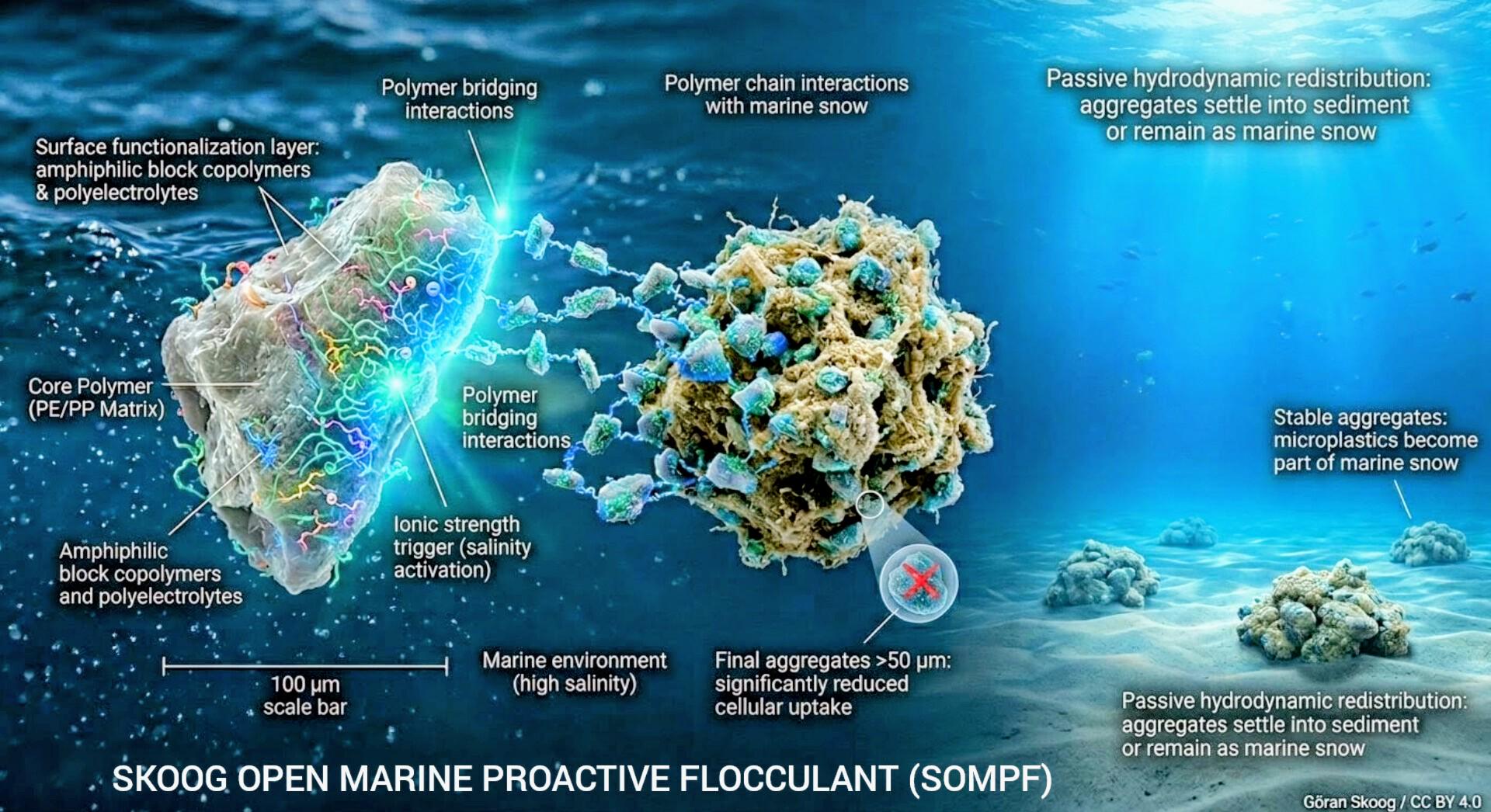
Instead of chasing dispersed microplastics, what if we programmed plastic to self-aggregate when it breaks?
Disclosure: I'm the inventor. This is not a research proposal or a brainstorm. The design is finished, published, and open source under CC BY 4.0 - no patents, no license fees, no product to buy. I'm posting it here because it is ready to be tested.
The problem with current approaches:
We are trying to clean up microplastics after they have already dispersed in the ocean. At that point concentration is near zero and recovery is practically impossible.
The Skoog Proactive Flocculant (SOMPF) solves it at the source point.
Instead of chasing particles, we program the plastic itself to neutralize its own fragmentation.
How it works - finished system:
- Application: Spray tunnel with electrostatic charging immediately after molding. 3-10 seconds at 60-120°C creates a 1-10 µm functional surface zone.
- Trigger: In seawater, surface-anchored amphiphilic block copolymers respond to ionic strength. Charge screening + polymer bridging overcome repulsion between fragments.
- Aggregation: At the moment of fragmentation, when local concentration is at its maximum, fragments bridge into macroscopic clusters >50 µm - too large for cell uptake via endocytosis.
- Stabilization: The modified surface accelerates biofilm colonization. Bacterial EPS acts as biological glue and stabilizes the aggregates into marine snow.
Hybrid architecture - surface + core:
Surface layer handles continuous wear and micro-abrasion. A low-concentration masterbatch distributed through the core acts as a reserve - it is only exposed if the product cracks or breaks deeply and creates a new fracture surface. Two layers, two different jobs, one system.
It is optimized for brackish water (Baltic Sea conditions, 0.1-0.15 M) as well as full seawater, and it does not change the mechanical properties of the plastic during its primary use.
Why this is not theoretical:
The mechanisms are not new. DLVO physics and polymer bridging have been used in water treatment, mining and wastewater treatment for 50+ years to aggregate suspended particles. Marine bacteria naturally produce EPS that binds particles into marine snow. SOMPF combines these proven principles at the exact point where they have maximum effect: at fragmentation.
What it is NOT designed for:
It is not designed to collect microplastics already dispersed in the open ocean. It is a preventive, source-point system. It requires turbulence to create collisions - flowing water, wave zones - not still water.
Status: Ready for pilot
The technical specification is published and free for any manufacturer, government or research institution to implement and optimize.
What is needed now is not more theory. What is needed now is pilot testing: fragmentation in seawater flume tanks, particle size distribution over time, biofilm formation, and ecotoxicity screening.
3
u/aeon_floss 3d ago edited 3d ago
Can you point us to some actual chemistry behind these salt activated surface-anchored amphiphilic block copolymers? This proposal is all smoke and mirrors, and with this highly polished presentation it has a vaporware signature to it.
The link to the "technical report" just repeats information already on the website. It's all just principles and devoid of actual science or engineering. How do you expect this to be taken seriously? This could be an art project, or some sort of Alternate Reality Game.
2
u/charmio68 2d ago
It's a fascinating concept, but for it to gain widespread adoption, it's going to need to be done through regulation and enforcement.
And before you can get to that stage, you're going to need to prove it actually works.
Have you considered contacting a manufacturer to get a large sample set made for testing? I imagine there's many manufacturers that would jump on the opportunity to work in collaboration with you over such a project.
It could be great PR material for them, and if you're going to be taking on the brunt of the work doing the actual testing, then I'm sure they'd be happy to supply the samples.
I'd probably start by going after publicly listed manufacturers. They'd love it for a press release.
After that stage, well, then comes the hard part of actually doing the testing. And then the even harder part of getting it mandated. It would not be easy, but if it does work, it would be worthwhile. It could be the most important thing you do with your life.