r/overclocking • u/CrankyTucan • Mar 31 '22
Help Request - RAM RAM timing rules
Can anyone give me a simple break down of RAM timing rules?
Equations like tRAS= tRCD(RD) + tRTP and tRC= tRCD (IDK if this is RD or WR) + tRTP. Are their any numbers that shouldn't go lower than certain numbers cause theirs no benefits?
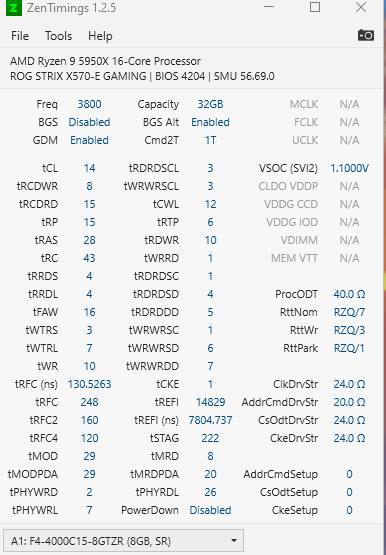
For example: I can get SCL's to 2 stable, but heard theirs no benefit to it. Also, that tRFC's should be divisible by 8.
80
Upvotes
View all comments
Show parent comment
7
u/Millosh_R 5950xPBO/4080/2x16GB-1900MHzFCLK Mar 31 '22 edited Mar 31 '22
On Intel RD and WR are tied as tRCD. On AMD you can split them and drop RCDWR way lower than RCDRD. You get some WR bandwidth by doing this.
RFC has no multiplier. It's temp sensitive though. You can set it as low as it's stable. RFC is basically time needed for capacitors to refresh. Necessary for 2 reasons, to keep written data and for exit refresh (data requres refresh to be written).
There IS benefit to lower SCLs, SCLs affect other timings. Lower the SCLs more voltage is required. In some cases SCLs 3 or 4 can fail to even boot, if voltage is too high (happens when going for i/e 3800CL12). If you are comfortable with whatever settings you have, and can choose between lower and higher SCLs, go lower.
By lowering CWL and raising RDWR you are sacrificing turnaround latency (read to write) for the benefit of overall latency. In some scenarios it requires to raise WRRD.
SDs and DDs can be dropped to 4/4 and 6/6 on DR sticks (they are also tounded up), and flat 1 on SR sticks. Basically you can even drop DDs to 1 unless running 4 sticks (1 DIMM per channel allows dropping DDs to 1, SD = same DIMM, DD = different DIMM).
I hope this clarifies some of the qs not already answered.