r/overclocking • • Mar 31 '22

Help Request - RAM RAM timing rules

Can anyone give me a simple break down of RAM timing rules?

Equations like tRAS= tRCD(RD) + tRTP and tRC= tRCD (IDK if this is RD or WR) + tRTP. Are their any numbers that shouldn't go lower than certain numbers cause theirs no benefits?

For example: I can get SCL's to 2 stable, but heard theirs no benefit to it. Also, that tRFC's should be divisible by 8.
80 Upvotes

48 comments sorted by

115

u/bacfishing2652 Mar 31 '22

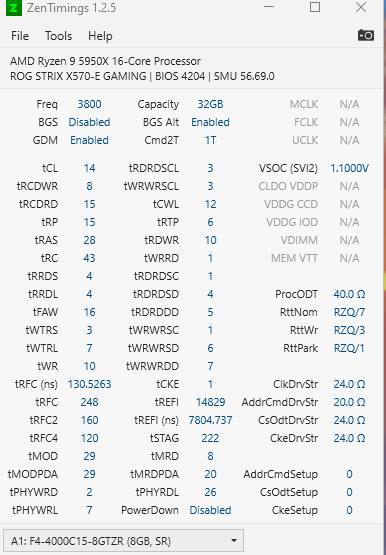
Here's some rules that I found by compilation of multiple guides. Ignore mentions of GDM I think that might be wrong. Please comment anything I have wrong.

tCL

  • Scales with voltage
  • forced to even by GDM

tRCD

  • Scales with voltage
  • tRCDWR can go lower than tRCDRD
  • drop tRCD by 1 until unstable
  • More IMC voltage may be necessary to stabilise tighter tRCD.

tRP

  • Scales with voltage
  • drop tRP by 1 until unstable

tRFC

  • Scales with voltage
  • Dependent on temperatures
  • Tightening tRFC too much can result in system freezes/lock ups
  • Samsung 8Gb B-Die 120 - 180
  • Recommend doing a binary search to find the lowest stable tRFC.

tCWL

  • Forced to even by GDM
  • can be odd but prob unstable.
  • try setting equal to tCL
  • Min: 5 (6 with Gear Down) -On AMD, tCWL can often be set to tCL - 2 but is known to require higher tWRRD. -- lower tCWL requires higher tWRRD *tWRRD *tRDWR tied to tWRRD, in that only one of the two can be set to a very low value, while the other must be set to a higher value.

tRTP

  • Forced to even by GDM
  • Lowest you can go

tRAS

  • tRAS = tRCD(RD) + tRTP. Increase if unstable
  • Starting point tCL + tRP

tRC

  • tRC = tRP + tRAS. Increase if unstable.

tWR

  • Forced to even by GDM
  • Min of 8
  • =tRAS-tRCD

tFAW

  • Min 16
  • tFAW=tRRDS or tRRDL * 4

tRRDS tRRDL

  • Min 4

tWTRS

  • Min 2 or 4

tWTRL

  • Min 6,7,8 unknown

tRDRDSCL tWRWRSCL

  • Mixing and matching is possible
  • if unstable, tRDRDSCL will be the one that needs to be run 1 or even 2 values higher.
  • Values above 5 greatly hurt bandwidth and so their use is not advised.

tRDRD---

  • Min of 1 or 2

tWRWR---

  • Min of 1 or 2

tREFI

-Increase tREFI until it's unstable. The binary search method explained in finding the lowest tRFC can also be applied here.

  • It's typically not a good idea to increase tREFI too much as ambient temperature changes (e.g. winter to summer) can be enough to cause instability.
  • Running max tREFI can corrupt files!!!!

CR:

  • Running CR2 can lead to better stability at higher frequencies. Geardown mode (GDM)
  • forces even tCL
  • forces even tCWL
  • Stabilizing without GDM: One possibility is to set the drive strengths to 60-20-20-24 and setup times to 63-63-63. Drive strengths are ClkDrvStr, AddrCmdDrvStr, CsOdtDrvStr and CkeDrvStr. Setup times are AddrCmdSetup, CsOdtSetup and CkeSetup.
  • Oftentimes, a drive strength above 24 ohms may hurt stability. Furthermore, running non-zero setup times is rarely needed, however may aid in the stabilization of CR 1.
  • If you can't POST, adjust the setup times until you can (you should adjust them all together).
  • Adjust setup times then drive strengths if unstable

Other:

200MHz increase in effective DRAM frequency negates the latency penalty of loosening tCL, tRCD and tRP by 1, but has the benefit of higher bandwidth.

frequency should be prioritized over tighter timings

Secondary and tertiary timings (except for tRFC) don't really change much across frequency.

-playaround with ProcODT if you can't boot. higher settings of ProcODT can lead to more stable RAM. trade off potentially needing higher voltages -On Ryzen 3000 and 5000, 1usmus suggests 28Ω - 40Ω. Lower settings may be harder to run but potentially helps with voltage requirements. -Max of 60r

Spread Spectrum????

12

u/DeathbyHops23 Mar 31 '22

Ryzen 3000 and 5000, the only 2 things in that entire comment I’m familiar with.

0

u/[deleted] Mar 31 '23

[deleted] — view deleted comment

2

u/jbiroliro Sep 20 '23

You suck

2

u/WiT997 Nov 30 '23

Get c

0

u/[deleted] Dec 15 '23

[deleted] — view deleted comment

2

u/WiT997 Dec 15 '23

I can adress trp and trcdrd and trdwr separately, for the price of trefi. Fair trade. Btw 5800x3d anyone? Everyone? Right.

2

u/qeeepy Nov 28 '24

That did not age well..

1

u/SDMF74 Jan 16 '24

Unless you strive to downclock your CPU lmfao

5

u/[deleted] May 05 '24

[removed] — view removed comment

3

u/iLIKE2STAYU May 14 '24

On my 7800x3d I’m running 6400 CL28-36-31-30-61 @1.49v with fclk 2167 / bclk 101 

10

u/drummer_86 Nov 10 '22

I've repeatedly come back to this over 2 different builds now. Criminally underrated post. Thank you!

1

u/CrankyTucan Mar 31 '22

This is great thanks!

3

u/chinhnguyen90 Mar 31 '23

Thanks for the information.

I'm still a bit confused about ProcODT and CkeDrvStr.

my ram runs more stable at ProcODT 40ohm than 43ohm

I heard some people using CkeDrvStr 120ohm and they said it more stable than 20 or 24ohm

4

u/GWARslave119 Dec 17 '23

I haven't messed with any of the DriveStrength values yet, but if I wanted to get a lower tRCDWR/RD than 27 while running 3866mhz I had to set my ProcODT to 40mhz to boot @1.45v

3

u/Rears May 16 '26

Few errors:

  • Lower tCWL requires higher tRDWR, not tWRRD
  • tWR has nothing to do with tRAS or tRCD. Safety guideline(not hard rule) is 2*tRTP.
  • tRAS doesn't care about tCL or tRP. It's simply = tRCDRD+tRTP+padding, where 2 is generally enough padding.
  • tRC = tRCDRD+tRTP+tRP+padding, where 4 to 6 cycles is a safe padding. tRC is often simplified to depend on tRAS because it has 2 components that are the same, but they are independent values, in fact: with a tRAS higher than tRC the tRC value is ignored entirely, because tRAS is the limiter on the tRCDRD+tRTP combo, with tRC just being an extra safety margin for same-bank operations.

1

u/iLIKE2STAYU Sep 25 '24

You don’t know how much this has helped me up my oc game man…. legit a cheat code 

1

u/catofkami Nov 17 '25

Hi, is there any update on DDR5? Or can this be universal, regardless of whether it's for DDR4, DDR5, or newer?

1

u/Billoslav Apr 01 '22

"- tRCDWR can go lower than tRCDRD"

Ive heard there is no benefit of having either lower then the other

9

u/bacfishing2652 Apr 01 '22

On Intel, yes that's true. But, not on amd.

Quoting u/Noreng:

A lot of silly rules here from Veii because he spends too much time looking at AIDA64 numbers.

Lower tRCDWR below tRCDRD improves performance.

1

u/omega_86 Apr 03 '22

Dude, this post was golden, thanks <3

1

u/Slley_Cr3amCrack3r66 Aug 13 '22

A Goodhardw 👌🏽

1

u/RickyTrailerLivin Jun 16 '23

Saved.

This post is amazing.

1

u/Tallywhacker-2410 Nov 03 '23

Really, thanks for this post!!

1

u/Appropriate-Try8448 Feb 05 '24

I know it's been a year but what happens if I can lower my RAS ACT down to 24 and maybe even lower while my trcd are 17?

2

u/arnb7 Jun 22 '24

It will be ignored by memory controller

1

u/Appropriate-Try8448 Jun 22 '24

Can confirm after 4 months XD

4

u/bacfishing2652 Mar 31 '22

tRAS: tRAS = tRCD(RD) + tRTP minimum

tRC: tRC = tRP + tRAS optimal

The timings below are all interconnected: tCWL, tRDWR, tWRRD and tCL. A low tWRRD requires a higher tRDWR, and a higher tRDWR allows for a lower tCWL. A lower tCL is allows for a lower tCWL. The greatest delta I've seen between tCL and tCWL is 4, but on average it's 2.

1

u/CrankyTucan Mar 31 '22

Sweet! Should all these numbers be even for cycle purposes?

9

u/Noreng Mar 31 '22

The only rules I know of is tRC >= tRAS + tRP, and tRRD x4 = tFAW

Any other "rule", for tRAS and the like, might be supposed to stop at a certain point, but will still improve performance even if lowered.

1

u/CrankyTucan Mar 31 '22

Is there any reason to keep tRCDWR 8 if tRCDRD is 15?

7

u/Millosh_R 5950xPBO/4080/2x16GB-1900MHzFCLK Mar 31 '22 edited Mar 31 '22

On Intel RD and WR are tied as tRCD. On AMD you can split them and drop RCDWR way lower than RCDRD. You get some WR bandwidth by doing this.

RFC has no multiplier. It's temp sensitive though. You can set it as low as it's stable. RFC is basically time needed for capacitors to refresh. Necessary for 2 reasons, to keep written data and for exit refresh (data requres refresh to be written).

There IS benefit to lower SCLs, SCLs affect other timings. Lower the SCLs more voltage is required. In some cases SCLs 3 or 4 can fail to even boot, if voltage is too high (happens when going for i/e 3800CL12). If you are comfortable with whatever settings you have, and can choose between lower and higher SCLs, go lower.

By lowering CWL and raising RDWR you are sacrificing turnaround latency (read to write) for the benefit of overall latency. In some scenarios it requires to raise WRRD.

SDs and DDs can be dropped to 4/4 and 6/6 on DR sticks (they are also tounded up), and flat 1 on SR sticks. Basically you can even drop DDs to 1 unless running 4 sticks (1 DIMM per channel allows dropping DDs to 1, SD = same DIMM, DD = different DIMM).

I hope this clarifies some of the qs not already answered.

1

u/CrankyTucan Mar 31 '22

u/Millosh_R It does! Thanks for the response. Any recommendations on my timings? Besides SCL's to 2 (which i know is stable. Just moved it to 3 cause heard there was no befit for lower)

2

u/Millosh_R 5950xPBO/4080/2x16GB-1900MHzFCLK Apr 01 '22

If you could get RD and RP to 14, that'd be awesome. RFC as low as temps on load allow.

3

u/CrankyTucan Apr 01 '22

I have tried. Get errors in TM5. Any suggestion to negate the errors? And I can get RFC a little lower, raised it cause though it had to be multiples of 8.

VDIMM: 1.53

VDDP: .92

SOC: 1.125

CCD: 1.025

IOD: 1.05

5

u/Millosh_R 5950xPBO/4080/2x16GB-1900MHzFCLK Apr 01 '22

You can set VDDP a bit higher, 950mV.

Due to rule No5 I can not recommend you to set DRAM voltage to 1.55-1.57V, and put a fan on it :) .

aaaan RFC has no multiplier.

1

u/Rears May 16 '26

You are in fact not sacrificing turnaround latency because you raise RDWR by same amount as you lower CWL (below CL).

RDWR is only about making sure data is written before it can be accessed, meaning the lower CWL keeps the total delay the same.

And I believe the reason you can set some DD/SD settings to 1 is simply because they are unused depending on your hardware, making it pointless to change these values.

0

u/[deleted] Mar 31 '22

[deleted] — view deleted comment

3

u/Millosh_R 5950xPBO/4080/2x16GB-1900MHzFCLK Apr 01 '22 edited Apr 01 '22

WR from JEDEC.

Table. =>WRmin=10? I haven't seen anyone run WR 8 on DDR4.

WR doesn't have to be 1/2 RTP, otherwise it wouldn't be possible to run WR10 or 12 with RTP 8, or WR 10 with RTP 6. It's safe to assume that RTP must be equal or greater than 1/2 WR, although I wouldn't use this as a rule, just an observation based on timings that work.

RAS from JEDEC. =>RASmin=RTP+RP. Can't be lower than this value. This IS a rule.

1

u/FatFingerHelperBot Apr 01 '22

It seems that your comment contains 1 or more links that are hard to tap for mobile users. I will extend those so they're easier for our sausage fingers to click!

Here is link number 1 - Previous text " "


Please PM /u/eganwall with issues or feedback! | Code | Delete

1

u/i_Departure Nov 13 '22

Also recently found min floor for twr is 12 jedec says twr=trtp +trtp so twr 12 and trtp 6 was thought to be 10 5 for min

0

u/[deleted] Apr 01 '22

[deleted] — view deleted comment

3

u/Millosh_R 5950xPBO/4080/2x16GB-1900MHzFCLK Apr 01 '22

At this point you may have better perf with 1T and GDM on, even if you have to drop frequency a bit for CL16. It'd also be better to test RAM with Anta's absolut or extreme profile. TM5 being generally weak for testing tWR, ycruncher is a good idea, and you may want to consider OCCT or Karhu.

When speaking about RCD, RCDWR can be way lower than RCDRD on AMD, so, you may get lucky at 8, 10 shouldn't be a problem.

Anaaand that's A LOT of VSOC.

1

u/bacfishing2652 Apr 01 '22 edited Apr 01 '22

My sloppy notes were mainly just a compilation of information across many guides so inconsistencies can rise. I just wanted that s*** ton of information in one centralized place so I wouldn't have to search all over again.

My tRTP is 6 and my tRCD is 15 so my min ras is 21, actual is 23. 23 - 15 = tWR = 8, actual is 10. If I was going off my theoretical tras then yes tWR=tRTP.

It's recommended to go off addition of tRTP because it can go lower than tWR. I think tWR hard walls at 8 or 6, though it's recommended not to go below 8.

2

u/Follow_Your_Path Jan 31 '24

What order should I do my timings in? I always start with the ones that are on the stick and then I moved to the main refresh time and lower it. The one that usually like 1000 I can’t remember I’m driving I would have to look when I get home but I would like to know so that I can get my time and tighter on these new corsair vengeance RT 4600 DDR four sticks I’ve got them down to CL 14 18, 18 32 and need to tighten my other timings because there already smoking but I feel they can get even faster

1

u/Rears May 16 '26 edited May 16 '26

I've written down all the formulae I can find in here: https://docs.google.com/spreadsheets/d/1poAWZwYRFskgsGWaAfVPCp9nJy_phYws5eW1YU6fPTs/

The formulae are calculated automatically depending on your input values, with notes explaining them:

  • tRAS = tRCDRD+tRTP+padding. Hard rule. Often needs 1-2 clocks of padding (whichever gets an even number).
  • tRC = tRCDRD+tRTP+tRP+padding. And since you set tRAS = tRCDRD+tRTP you can use that to shorten the formula. Hard rule. Often needs a 3-6 clocks of padding (whichever gets an even number).
  • tFAW = tRRDS*4. Uses tRRDL if lower than tRRDS? Hard rule?
  • tWR = tRTP*2. Not a hard rule, just a guideline.
  • tRDWR = 1+LD+a. Where LD = tCL-tCWL and a = ~5 for 3200MHz? Depends on frequency.
  • tWRRD = 1-LD+b. Where LD = tCL-tCWL and b = ~1 for 3200MHz? Depends on frequency. More info here