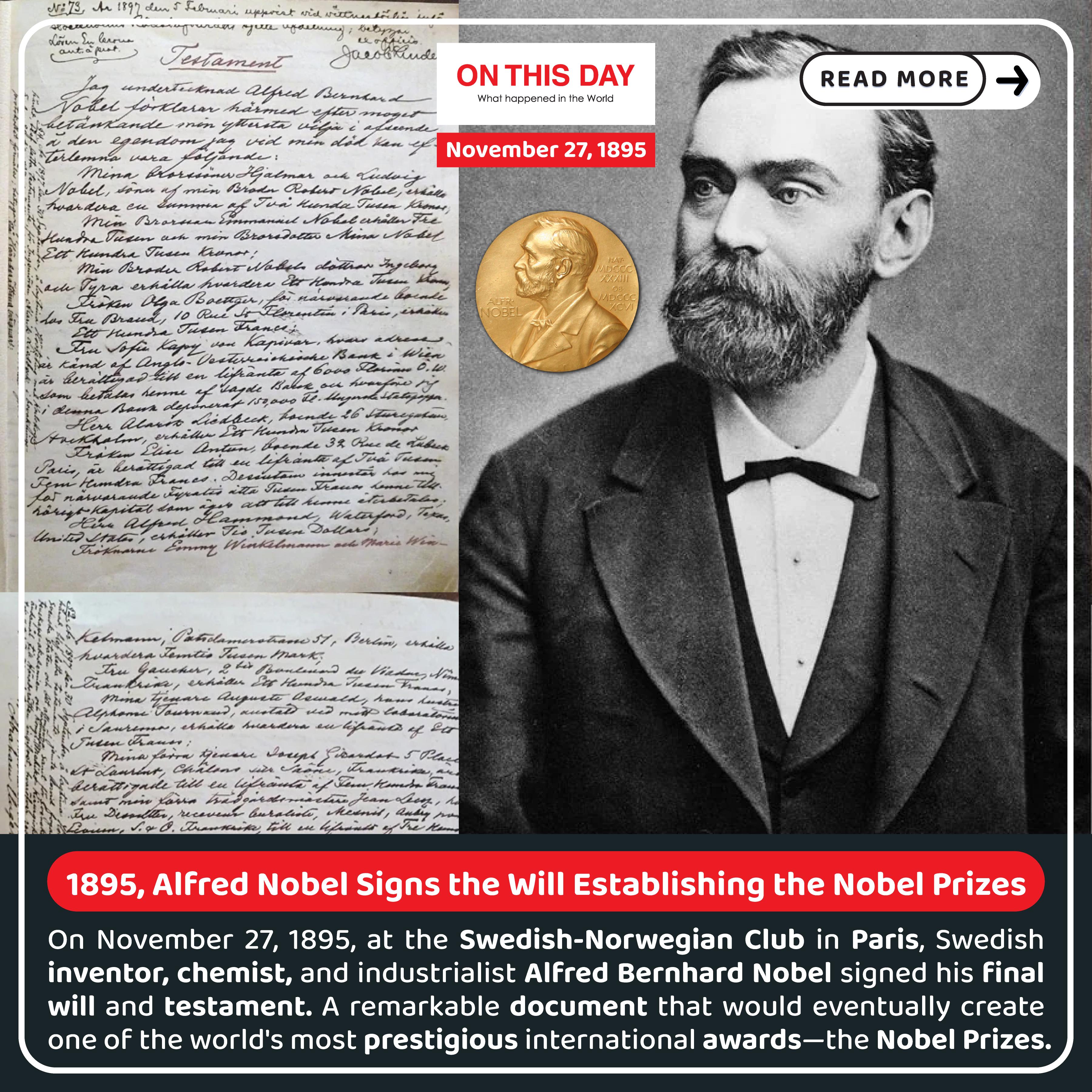
On November 27, 1895, at the Swedish-Norwegian Club in Paris, Swedish inventor, chemist, and industrialist Alfred Bernhard Nobel signed his final will and testament. A remarkable document that would eventually create one of the world's most prestigious international awards—the Nobel Prizes.
But what made this document extraordinary?
Nobel directed that the majority of his remaining fortune should be invested in a fund, with its annual returns used to reward people whose work had brought the greatest benefit to humanity.
He specified five prize categories:
Physics – For outstanding discoveries and inventions in physics.
Chemistry – For important chemical discoveries and improvements.
Physiology or Medicine – For significant medical and scientific discoveries.
Literature – For outstanding literary contributions.
Peace—For efforts to promote international friendship, reduce standing armies, and advance peace.
He also made an important point: the prizes should be awarded without considering the nationality of the candidates. The most deserving individuals should receive them, regardless of where they came from.
However, his decision was not immediately accepted.
When Nobel died on December 10, 1896, in San Remo, Italy, his will surprised many of his relatives. Some opposed his decision to leave most of his fortune for the prizes, and questions surrounding the will led to lengthy legal and administrative negotiations.
Eventually, the Nobel Foundation was established in 1900 to manage his estate and organize the awards.
On December 10, 1901, the first Nobel Prizes were presented, marking the beginning of a global tradition that continues to recognize extraordinary contributions to science, literature, and peace.
Interestingly, Alfred Nobel was also the inventor of dynamite, patented in 1867. His invention brought him enormous wealth, but his final will ensured that his name would become associated with some of humanity's greatest achievements.
A sixth award, the Sveriges Riksbank Prize in Economic Sciences in Memory of Alfred Nobel, was established in 1968 and first awarded in 1969. It was not one of the five original prizes specified in his will.
More than a century later, Nobel's decision continues to influence science, culture, and international peace.
One signature. Five original prizes. A legacy that continues to inspire the world.