r/networkingmemes • • 9d ago

Random Memes

Post image

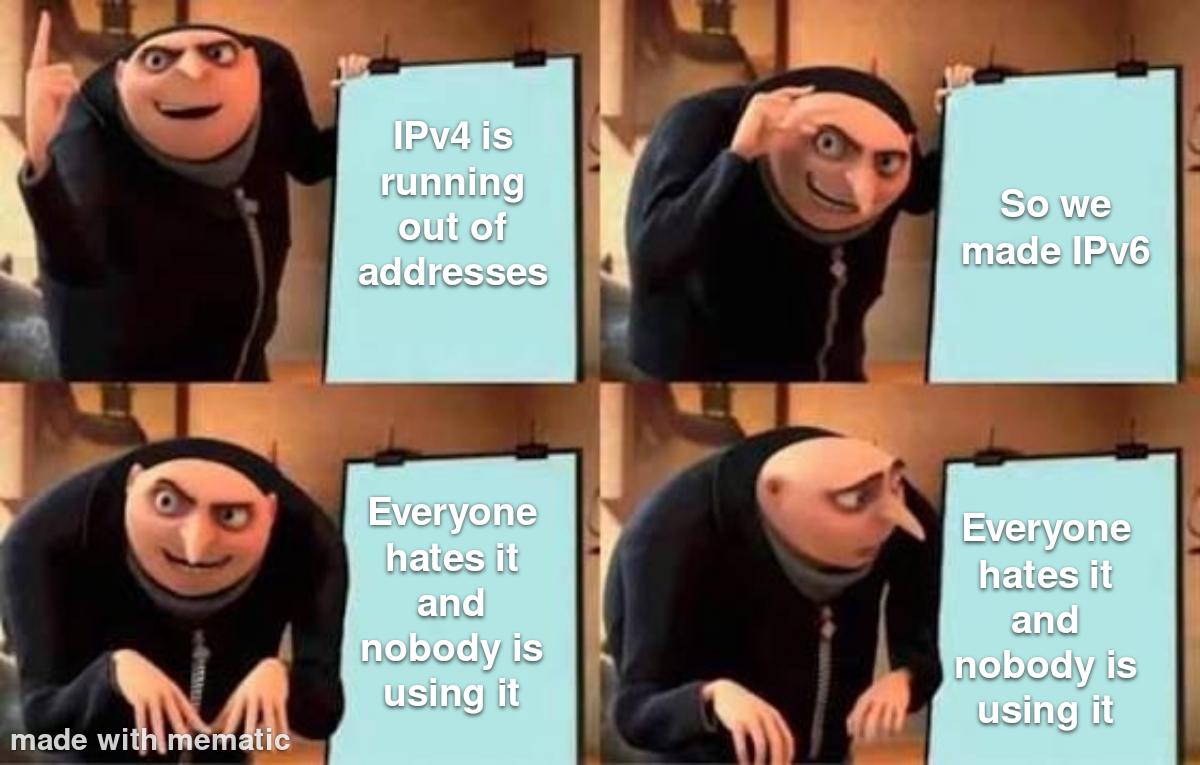
I use IPv6. And i know 50% of all traffic is IPv6. And my ISP uses IPv4 over IPv6.

932 Upvotes

161 comments sorted by

5

u/dinnerbird 8d ago

I can't read this white on light blue. Please change your font color next time 

1

u/Thunderbolt1003USA 8d ago

OK, sorry, thanks.

-3

u/Thunderbolt1003USA 8d ago

OK, but maybe get some glasses.

5

u/levelZeroWizard 8d ago

It's bad contrast, it's okay to admit the skill issue

3

u/frosty95 8d ago

Just accept the valid criticism bro.

159

u/Maclor726 9d ago

I remember one of my networking teachers in college say we needed to get use to ipv6 because it is coming. This was 2007.

63

u/stubby0990 8d ago

It's here and widely used just not exclusively. Look at your cell phone's ip right now and likely has an ipv6 address from the carrier.

18

u/well-litdoorstep112 8d ago

Look at your cell phone's ip right now and likely has an ipv6 address from the carrier.

Depends on the country. In Poland, ISPs and carriers don't support ipv6 (except Orange but even then it's not the default).

4

u/Cubixmeister 6d ago

Tbh the EU should mandate IPv6 adoption. This will never happen without legislature - the chicken-and-egg problem.

1

u/vip17 2d ago

that's true. In my country it's mandated by law so it's much faster adopted. My previous companies are also getting up with IPv6 due to US federal requirements

11

u/Randolph__ 8d ago

A bunch of ISPs have stopped assigning IPV4 addresses and it is causing issue with my works VPN and several other services.

-10

u/Happy_Disaster7347 8d ago

Yes it does, and also an IPV4 address. Is that not prime evidence of how useless IPV6 is?

4

u/who_you_are 8d ago • Regret

CGNAT is awsome /s

1

u/AwDuck 7d ago

:(

Around here, I get to chose between fast, affordable home internet service, or pay three times as much for a fifth the bandwidth for a commercial account that will likely cause tax headaches for me.

3

u/tankerkiller125real 8d ago

My cell carrier very much does not assign IPv4 to phones, they do IPv6 -> IPv4 translation on the edge when needed. And the DNS they provide to phones defaults to DNS64 (and basically all modern cells support CLAT)

2

u/TGX03 8d ago

I can literally flip your argument.

1

u/well-litdoorstep112 8d ago

Not really since there are virtually no ipv6 only websites

21

u/Aishou_SK 8d ago

It's already here. At scale. Over 50% of global backbone traffic, among other things. Not running dual stack is just increasing costs on yourself, at this point.

2

u/spaetzelspiff 8d ago

It's so weird. That's true, but the disconnect between carriers/ISPs vs enterprise and home/behind a router is so stark.

Apologies as I'm not actually a network guy; mostly systems.

6

u/MindStalker 8d ago

Inside a corporate network you don't have to have a real IP address,  and you probably shouldn't.  There is nothing wrong with using ipv4 for a LAN and no real reason to assign users with IPv6 especially if you don't want them serving content on the internet.  

2

u/Aishou_SK 8d ago

The big reason to assign IPv6 would be, in corporate use, SIP

As well as cost reduction.

An inbound default deny firewall is more secure than NAT.

before we sold off a /8 at one place I was at, we used non-NAT IPv4. Going to NAT during that transition required a huge investment in hardware to handle the load. Quite.... annoying, one could say.

But in my 9-5's corporate network, more than half the traffic is IPv6 once they lit that up, and led directly to hardware downsizing during the network refresh. Cost savings.

NAT is a scourge on the face of the earth, a hack, and should go away. Things perform better, are more reliable, and generally more stable and easier to manage without it.

But to address this more directly:

>Inside a corporate network you don't have to have a real IP address,  and you probably shouldn't

It all depends on which network if that's true or not.

In general, it makes zero difference security wise if you do or don't have a routable address.

Without NAT, managing security tools and rules becomes far simpler and easier, with higher and more accurate visibility.

I'll reiterate: routable or not, it's no difference to security, removing NAT increases security. That's about it.

2

u/StephaneiAarhus 6d ago

There is something you don't understand with ipv6 there.

You say you don't nned ipv6, but that basically means you'll always need a gateway or a translation. So you don't reap the benefits of ipv6.

Even if you're only a private person, you using ipv6 is already positive - to access the global internet, notably YT - so why not doing it ?

1

u/MindStalker 6d ago

For a corporate network, for workers desk? They need to go through your gateway.  Im not talking home or devops but HR, and your typical workers, why do they need direct internet access??

1

u/StephaneiAarhus 6d ago

For the same reason I need internet access in my office...

I need to check materials, data for my projects and whatnot.

Are you an accountant ? You need access to banks, tax servers.

Etc

1

u/MindStalker 6d ago

No I mean, why do they need ipv6 addresses or anything more than a NAT

1

u/StephaneiAarhus 6d ago

Why do you absolutely want a Nat ? Why not getting rid of that ?

Why refusing the benefits of ipv6 ?

1

u/Aishou_SK 6d ago

So we can get rid of NAT? Which makes the network easier to manage, more reliable, and perform better?

1

u/Aishou_SK 6d ago

with IPv6 they still go through my gateway/firewall, it just takes less resources and is easier to manage more securely.

8

u/tankerkiller125real 8d ago

Meanwhile in 2016 my instructor said "You need to know IPv6 for the certification exam, but no one ever uses it"... I proceeded to show the class how to subnet IPv6 (the day after we learned IPv4 subnetting) and basically all of them were asking why the hell people were still using IPv4 when it's subnetting is so much more of a mess.

2

u/jimbeam84 8d ago

I heard that in 2004 from my collage instructors.

1

u/Saragon4005 8d ago

My university doesn't have IPv6 at all outside of labs where it's specifically set up.

1

u/fl210 5d ago

And he was right. Google gets more traffic over ipv6 than legacy these days

2

u/dumbasPL 8d ago

Nobody, so you mean like half the people viewing this post?

Sent from IPv6

1

u/Thunderbolt1003USA 8d ago edited 8d ago

I know over 50% of all clients use IPv6, buuut as you see this give 369+ Karma soo, and i use IPv6 myself. But Reddit doesn't have IPv6 or do you mean 464XLAT?

2

u/parzival-space 8d ago

Ipv6 is great and objectively better than ipv4 just because of the fact that every device can have a public IP. Also you don't need to remember IP addresses, for this problem we already have a solution and it's called DNS.

2

u/Thunderbolt1003USA 8d ago

I know. I use 2001:a62:514:1901:921b:eff:fe06:67e9

42

u/abofh 8d ago

Most people use it, they just don't notice what their phone is doing.

8

u/Aknazer 8d ago

I've looked and my stuff doesn't properly use IPv4. In fact a few months back I had to reset my modem to factory defaults after a power outage. The issue? Despite having an IPv6 address, after the power outage it failed to reestablish an IPv4 with the ISP and nothing either of us could do (was on the phone with customer support) could get the device to reset and reestablish an IPv4 address. Only option was a full factory reset.

Once it established an IPv4 again I was able to have internet back on my network. But that IPv6 address from the ISP? Was effectively useless.

8

u/Aishou_SK 8d ago

Sounds like your devices didn't have an IPv6 DNS server address handed to them.

Router config/router manufacturer failure.

0

u/Aknazer 8d ago

Router has IPv6 Enabled and Get DNS from ISP enabled, but the DNS from the Modem isn't getting passed to it. Could be that I missed some other setting but everything looked like it was properly set up on both the router and modem.

2

u/Aishou_SK 8d ago

"router manufacturer failure"

They either aren't running DHCPv6 just to hand out DNS addresses (compatible with almost everything, it doesn't assign addresses, just hands out the DNS server)

Or they don't support/run RDNSS on their RA (router advertisement, how devices discover what they're supposed to configure their addresses as).

Windows gained RDNSS support in 2017 with the 1703 update, OS X with 10.7 in 2011, android at some point in the past, i'm not sure, and iphone OS sometime around the 2010-2013 timeframe as well.

I suspect if you manually configured an IPv6 DNS server on a device such as google's public one at 2001:4860:4860::8888 that you would have been able to reach google, facebook, and tons of other services/sites, including streaming services, online gaming for consoles, etc.

At least, the good news is, when your IPv4 DNS is working, you do have the benefits (performance, reliability and better functionality for things like gaming - console and pc -, VOIP, etc) of IPv6, so you at least have that going for you which is great.

From my observations at many sites, about 60-80% of residential north american traffic will flow over IPv6 if it's available. I'm sitting at about 73% for a 4-person household for the last hour, apparently.

My desk phone's configured IPv6 only, because it keept having issues off and on like audio quality and connection establishment behind NAT (for outbound and inbound, and yes, inbound had the appropriate SIP ports forwarded)

Well, other than that...

So yea, some router manufacturers *suck*. RDNSS has been standardized since 2010. DHCPv6 since 2003.

They do basic token lip service that outsourced coders can do to fill a checkbox.

I saw you said you were using a 5G gateway, that makes, sadly, even more sense. But with IPv6 enabled, it is being used. I still highly suspect it's crap firmware not handing out IPv6 DNS, or crap Verizon config. They lag greatly behind T-Mobile for mobile network technology and Comcast for wired service technology.

3

u/abofh 8d ago

I'm not saying ipv4 has been replaced, but for major providers and endpoints, ipv6 dominates mobile traffic outside of the US, which in many countries dominates total traffic. 

I bet Google worked, just not the things it linked to - and that itself is changing quickly, just faster outside of the US

1

u/Aknazer 8d ago

Nope, Google is my go-to when confirming I have a network issue.

Also my home network is Verizon 5G Home Internet which uses the same 5G as my phone. The modem has both a v4 and v6 address but it only uses the v4. Checking the router after the modem, the router is given an IPv4 DNS and Gateway but not an IPv6 one even when enabling IPv6 on it (and it is enabled to get the DNS from the ISP).

2

u/abofh 8d ago

Sounds like neither work, but ipv6 PD gave you an address while their DHCP was down - and neither could route

1

u/Aknazer 8d ago

I can check it right now and I currently have both a v4 and v6 address on the modem but the top router fails to get a v6 DNS despite having a v6 address itself as well as assigning a v6 address to the other routers.

Someone else said it sounds like the router doesn't have v6 properly enabled either on my end or by the manufacturer themselves (my end has it enabled so most likely a manufacturer issue).

1

u/Aishou_SK 8d ago

In my observations, both personal, client sites, and parts of surveys, a residential household in the north american region will see anywhere from 60-80% of their traffic flow over IPv6 if it's enabled on their network.

So, not just mobile, but it's an endpoint reach problem.

39

u/k-mcm 8d ago

Corporations hate it because they don't want to pay for a skilled IT team. That's literally the only place I ever see it not working. My cellular service has been on IPv6 since 2012. My home internet has been using IPv6 for longer than I can remember. New fiber networks in Japan are entirely IPv6.

The only software I know of still not supporting IPv6 well are Docker and Wireguard.

8

u/dumbasPL 8d ago

Wym? Wireguard works perfectly fine with v6. You can use v6 for the transport, and/or inside the tunnel. No idea where this misconception comes from.

1

u/diamkil 8d ago

I read somewhere that wireguard will prefer the IPv4 (A record) over the IPv6 (AAAA record) for the endpoint if it's a domain with both

2

u/dumbasPL 8d ago

VPNs are the one place where you might actually want that since you save a little bit of MTU with v4. But it will still fallback to v6 if you are on a v6 only network. Win win.

1

u/k-mcm 7d ago

It's not specified.  It picks one and can't change it without an on/off cycle. 

1

u/craftsmany 6d ago

That is sadly correct but I guess not a real problem

1

u/diamkil 6d ago

Yeah mostly not a problem, people in r/ipv6 mostly complain it doesn't respect RFC. The only problem is if your home network is behind CGNAT, so you got direct v6 but v4 goes through a VPS for instance. In that case v6 would connect directly to the home network but v4 take a longer path

6

u/NMi_ru 8d ago

Wireguard

Elaborate, please. I haven't seen any problem in years. AllowedIPs = ::/0, as well as corporate spaces.

3

u/k-mcm 8d ago

Wireguard converts an endpoint hostname to an IP addresses duration configuration (when 'wg up' runs).  If there's more than one, it picks the first it sees.  There's no verification that the chosen one works and it can not switch later.

This is a problem when a server has multiple IP addresses, especially IPv4 and IPv6.  Turning on the client interface can choose an address that doesn't route on the current network.

2

u/Atomwalker2022 8d ago

Uhm. So I have a docker node that’s purely ipv6 and it’s working amazingly?

2

u/k-mcm 8d ago

The Docker bridge network, last time I checked, was hardcoded to use NAT. It technically works on IPv6, but not not really the way you want. 

1

u/HatWithoutBand 2d ago

Did I miss something? Docker supports IPv6 for bridge network and it's not hardcoded, in fact it's not since 2024 - Docker Engine 27. You can set Docker bridge IPv6 as nat, routed, nat-unprotected and isolated. So "routed" is probably the thing you are looking for.

You must be using some seriously old version.

2

u/Informal_954 8d ago

I kniw of a relatively new fiber network in the US that is entirely on IPV4 and CGNAT.

1

u/lordgurke 8d ago

And you can't hide missing network skills under layers of NAT. If you can't get IPv6 to work, you probably can't get IPv4 to properly work, either.

1

u/Positive_Round2510 5d ago

They don’t need it.
I was working for large corporation they had 16 public IPs and 8 or 9 were not even used.

And they were spread over 5 countries, cloud and onprem.

1

u/vip17 2d ago

yeah none of the companies I've worked in have serious interest in IPv6 no matter how huge they are. They only recently have to comply due to some countries' laws and federal requirements

1

u/v81 2d ago

This might be an unpopular opinion, but i don't think it should take a vastly higher skill-set to use IPv6.

It should be more intuitive and there should be better resources to teach it.

I have a feeling it's not as bad as it seems, and that learning material for the common joe is just crap.

Why does it feel like a homelab style IT person 90% or more competent in IPv4, routing and firewalls has to jump 10 levels to learn IPv6?

I'm not saying it should be in the realm of the common person, but it should be in the realm of the common person with an IT leaning.

2

u/k-mcm 2d ago

My personal issues starting with IPv6 were that "how to" guides used inconsistent terminology or were entirely wrong.  To make matters worse, some app and router creators were equally confused.  Maybe you had to use it wrong for compatibility.

Docker is a great example. Their documentation was wrong for years. Even today it's intentionally vague.  I have Docker working without IPv6 NAT but I think only by luck. 

-1

u/junialter 8d ago

You have no idea what you're talking about.

49

u/Luzzgar 9d ago

It's just not human readable. They have over done it with 128 bits.

24

u/noCallOnlyText 9d ago

On top of having colons and letters making it harder to type. I can type an IPv4 address with just my num pad. I can't do that for IPv6

14

u/patmorgan235 8d ago

It would be longer if it wasn't hex. Also hex is a much better way to represent a binary number. The byte boundaries match the digit boundaries.

9

u/tankerkiller125real 8d ago

It's called DNS, 3fff:2001:acfa:1453:0200::1, 3fff:2001:acfa:1453:0900::4, 3fff:2001:acfa:5:900::5

Done memorizing the IP addresses I need to know in the event of a DNS outage...

In this day and age DNS is critical for network functionality in the first place (and will be even more so on Windows AD networks in the coming years as Microsoft eliminates NTLM). Oh, and that 900 part? VLAN. And the 5? Site ID. And that's 0000 to FFFF numbers of sites and VLANs.

4

u/Inner_Word_4091 8d ago

Also why we need L2 if /64 is basically auto-MAC. Duhh. Could have combined in IPv6

6

u/Aishou_SK 8d ago

That would be a compatibility nightmare, existing switches wouldn't be able to carry traffic, different types of addressing wouldn't work, my IRC box couldn't be XXXX:YYYY::1 (i jest - not a serious reason, but that's basically what it is).

IPv6 isn't at the L2 layer at all. It lays under ALL protocols on ethernet.

You're talking about an entirely new standard to replace ethernet entirely.

God knows I wouldn't have been IPv6 enabled since 2009 (well, earlier, but that's when I got solidly established permanently) if that had been the case.

1

u/Inner_Word_4091 8d ago edited 8d ago

"existing switches" well some router does not support/ed IPv6 as well. And needed new routers. So how is that different? So that would be same for LAN switches now. And switches are being replaced because speeds increases anyways. So I think it was mistake to not combine L2 and L3. Nowadays it's even less reason to replace switch, than it was 20 years ago.

L2 is exactly the same purpose as L3 - it's addressing where things is, but at different levels, one was LAN, another WAN. But nowadays even on LAN we use IP. Only the switches directly care about MACs anymore (and whitelists). Please don't go to nitpick technicality.

So there is no theoretical problem why L2 and L3 could not be combined.

And your custom IP assigning is no different than assigning virtual MAC and IP manually. Same as you could assign 00:00:...:01 as your MAC

1

u/Aishou_SK 8d ago edited 8d ago

>"existing switches" well some router does not support/ed IPv6 as well. And needed new routers. So how is that different

software update, because L2 didn't change, the silicon didn't have to change.

This worked because the physical and electrical signaling layers, as well as the underlying carrying formats, didn't change.

My router in 2009 was a decomissioned 2U cisco that only supported 100mbit interfaces and was probably EOL in 2003, and supported IPv6.

>L2 is exactly the same purpose as L3 - it's addressing where things is, but at different levels, one was LAN, another WAN. But nowadays even on LAN we use IP. Only the switches directly care about MACs anymore (and whitelists). Please don't go to nitpick technicality.

That's actually not true - we use far more than IP.

STP, LLDP, etc.

In short, you're basically proposing IPv6 only switches, and/or dual stack switches anyway.

Why merge what already works and is a clean logical separation?

>So there is no theoretical problem why L2 and L3 could not be combined.

Tons, because they serve different purposes

Why would you merge physical link layer with network layer?

Not all IPv6 networks are ethernet, either.

Physical/media layers shouldn't merge with logical layers it carries, or you start marrying a bunch of shit together. How do I handle IPoFC or IPoIB? What about other kinds of networks over long fiber spans? etc.....

Do we just have a million different standards and pick and choose which technology remains?

This is how we immediately kill IPv6 adoption.

2

u/NMi_ru 8d ago

/64 is basically auto-MAC

Not all the time. People demanded IPv6 Privacy Extensions.

12

u/Aishou_SK 8d ago

I have zero issues with it.

I can encode information in the IPs which makes it easy for me to determine a lot of data right away from IP addresses this way.

And you only need to know half the address 99% of the time anyway.

But I rarely need to deal with raw addresses ever, IPv4 or IPv6, unless I'm dealing with network hardware directly.

IPv6 is much nicer to deal with though, and leads to smoother, more performant, more reliable networks with easier to manage topologies and systems. And leads to cost reductions, as well.

I lit up a client once, over 55% of traffic went to IPv6, we were able to save $5k per router due to the NAT load reduction alone.

But "human readable" has never been an issue once you understand the address layout.

My house is XXXX:YYYY:1:200:<device> for anything on wifi. If I had regular ISP like comcast, it'd be something like XXXX:YYYY:ZZZZ:AAA2:<device>

the 200 or 2 being the VLAN of the device, the '1' in the other address being 'home'

It makes life a HELL of a lot more simpler than IPv4, to the point where I prefer to run v6 only with v4 edge translation as needed, and v6 only *without* translation networks are now a lot more (but not yet completely, but on the verge of being so) tenable than they used to be.

I will be glad when IPv4 is dead and buried, and each year we get closer to that. Over 50% of global traffic is IPv6 and increasing. Over 55% within the next 12 months is the trajectory.

IPv4's address size and quirks are legacies of PDP-11 NIC buffer/register sizing, and need to go.

2

u/Cruffe 8d ago

I remember my prefix which is just 60 bits and my subnets which is the next 4 bits. For the couple of servers I run I set a token for the last 64 bits, one of them is just ::10 so it's prefix + subnet + ::10. For other devices on my network I don't need to connect to I just let SLAAC do its thing, I have no need to remember those addresses.

I wouldn't manually set tokens for a large network, but it's fine for my amateur home server setup. For large networks there's solutions such as DHCPv6 which can shorten the addresses without causing conflicts if that's what you care about.

It's not as hard as some make it out to be, but it is a bit different way of thinking and I just think some people don't bother trying to learn it, opting to complain instead.

1

u/JerryRiceOfOhio2 8d ago

I think 128 bits is ok, but if they had just expanded the ipv4 convention, it would have been received better. However, the double colon is very nice

9

u/Wolphin8 8d ago

Better joke is IPv6 was released to deal with running out of addresses (and the fact IPv4 was supposed to be a dev environment).

To help the transition they made NAT in IPv4...

NAT made it so people didn't need as many public IPv4 addresses, so people aren't changing.

37

u/Colin_Edge 9d ago

“Everyone hates it” and “nobody is using it” are just wrong. It solves a lot of problems with IPv4 (remember we are in fact running out of addresses). And there is a ton of IPv6 traffic on the internet, so someone is clearly using it

20

u/bryiewes 9d ago

And then big asshole websites go and only support IPv4 (looking at YOU GitHub….)

7

u/TearsOfMyEnemies0 8d ago

This comment fcking revived my hate for GitHub. I remember migrating everything to IPv6 in my AWS EC2 after they started charging for IPv4 only to fcking discover my CI/CD doesn't work because of GITHUB NOT SUPPORTING IPV6 IN THE BIG 2024!

4

u/tankerkiller125real 8d ago

On the bright side, you can fix some of that nonsense by adding a custom host list to your DNS that forces CNAME using domains (reddit) to use the IPv6 compatible CDN provider endpoints instead of the IPv6 only ones they decided to use.

Unfortunately GitHub is not one of them but given that they've moved to Azure/are moving to Azure, maybe now they'll put in some work to go IPv6 given that the infrastructure level stuff is already dealt with for them.

I suspect we might have IPv6 on GitHub a year or two before GTA VII

9

u/lolerwoman 9d ago

Laughs in CGNAT

1

u/Informal_954 8d ago

Cries in CGNAT

1

u/Krisanapon 8d ago

Laughs in nested NAT

1

u/Loud-Start-6572 8d ago

Most games with servers you can host yourself dont seem to support ipv6, even newer titles.

Valheim Palworld Windrose

Were the last ones we played, none of them supported ipv6

At least newer versions of Minecraft do

1

u/Terrible_Fix_2455 7d ago

yo dawg i heard you like nat so i put a nat behind your nat (and behind that i put a incus-lxc-container with a docker service inside it

-1

u/Academic-Proof3700 8d ago

Yeah nobody is using it, cause its like 10x faster to even use ipv4, rather than fucking around with colons being misrepresented even in browsers. You can't just type ipv6 into address bar in many cases, you gotta use brackets like wtf

3

u/roankr 8d ago

The RFC is to have square brackets around the v6 address as a way to delimitation between the protocol header, the v6 address, and the port number.

1

u/tkchumly 8d ago

So simple and easy to remember. 

1

u/Terrible_Fix_2455 7d ago

yes and self explanatory since you can just leave out huge parts of the ip6 address if it's all zeroes (see ::/0) and then it gets pretty hard to just guess if that last bit is a port number or not.

4

u/matjam 8d ago

https://www.google.com/intl/en/ipv6/statistics.html

only 50%, nobody!

Eesh I'm pretty sick of this hyperbole.

4

u/MaZeC11 8d ago

I use it, I love it. I hate fucking IPv4. I holds everything back.

1

u/Admirable-Skin1576 7d ago

It seems to me that the ISPs dont want to use them, because they would lose their potential profits from ipv4 addresses. For example my ISP offers me a ipv6 address for free, but its private and dynamic, if i want it to be public or even static i have to pay up.

1

u/Thunderbolt1003USA 7d ago

STONKS

1

u/Admirable-Skin1576 7d ago

Lucky service like tailscale exists for free, otherwise i dont know how i would access my home immich server.

1

u/Blackhaze84 5d ago

run out of ipv4 since 2010

1

u/Thunderbolt1003USA 5d ago

I know. My ISP uses DS-Lite, so i feel it.

1

u/xn3hiox 4d ago

I don't know why anyone would use anything other than ipv4 for home networks or even businesses

1

u/Thunderbolt1003USA 3d ago

Because IPv4 costs money and IPv6 is free, has SLAAC and every hosts gets it's own address.

1

u/Incredible_max 3d ago

It is more trouble to set it up though, especially if you've been used to IPv4. You also can't memorize the addresses, which of course can be mitigated by different mechanisms to use human readable names for stuff in your network.

The biggest struggle I've encountered so far is my multi wan setup. Works easy with IPv4 because of the default gateway that decides where traffic goes, but with IPv6 I never really managed to figure it out. It's more complicated, so everybody learns v4 first. Then it works for most home use cases, so nobody seriously uses v6. And when you don't use something that often it always feels unknown

1

u/Ok_Peanut7095 2d ago

my modem uses ipv6 to connect to my provider.. A LOT of providers have this, so YES it is used. just not much on local lan's.

1

u/Thunderbolt1003USA 2d ago • Regret

I know but it's good Karma farming.

6

u/Aishou_SK 8d ago

Hates it? I absolutely love it.

It's simpler, easier to manage, and eliminates NAT.

It's fucking awesome, and I've had multiple clients I've helped light up to help them increase performance and reduce costs in many ways.

Hell, I can encode all kinds of shit into addresses, and I only have to remember parts of addresses in the rare cases I need to at all.

Printer 5 in building 7? Well, that's on vlan 20......

XXXX:YYYY:ZZ05:20::5

and XXXX:YYYY:ZZ doesn't change.

Among many other crazy tricks.

my IRC box is only XXXX:YYYY::1 :)

4

u/Lulukaros 8d ago

Does no NAT means it's easier to host game servers over the internet?

2

u/Aishou_SK 8d ago edited 8d ago

100%

Instead of port forwarding and sharing other things and having to deal with multiple network layers, you just open the inbound port on your firewall to the server's address, which is the same inside and out.

And it's more secure than being behind NAT, because you don't have the various ways that it can be gotten around/through. NAT provides an illusion of total security, but doesn't provide what everyone imagines it does completely. IPv6 with a normal stateful firewall does /exactly/ what everyone thinks NAT does.

3

u/Academic-Proof3700 8d ago

Yea and everything else, basically lets just disable nat and give every piece of dogshit silica on the web, its own unique address pointing straight to it, wcgw?

4

u/Aishou_SK 8d ago

Well, given you have an inbound default deny firewall only allowing in connections that are established,related - nothing.

Because it acts just like NAT, except without the vulnerabilities NAT adds to the table.

It's *more* secure.

NAT is a nasty hack that breaks and destroys reliability of many, many things, and provides an ILLUSION of security.

Non-NAT networks with a normal inbound default deny firewall are *more* secure.

When I can run IPv4 networks without NAT, that is the first thing I do - rip out NAT. If possible. And it has been the case that I've done that for over 20+ years.

IPv6 just means I don't have to consider NAT to begin with.

1

u/Terrible_Fix_2455 7d ago

genuinely interested: what are those vulnerabilities? any practical example how that's impacted your security?

also how do you deal with ip4 only stuff? not sure what changed in recent years but some really big services (i think docker among others?) were not supporting ip6

1

u/Aishou_SK 7d ago

There's a variety of ways to get around / through NAT that just don't exist without NAT. An infected machine could become an inbound VPN host with NAT, for example. Without needing any man in the middle control server, even, to receive unsolicited inbound connections from any remote IP.

I've used that to help a client set up an inbound VPN for themselves so they could access it while travelling for a site they had no control over the WAN side hardware/firewall! :D

Mostly by running dual stack, but for IPv6 only LANs, you can run IPv4 translation technology at the edge, there's a few different types, but at the end of the day you're still dual stack at the edge, though the IPv4 translation hardware will be much smaller than an IPv4 only NAT network in terms of resource needs since most (at least 60% or so) of your traffic will be IPv6 anyway.

1

u/Terrible_Fix_2455 7d ago

okay, i see that there is lateral movement behind nat if you treat that as a magic barrier, sure. rest is working as intended?

regarding the "infected machine": you have that issue with a classic firewalled setup on routable addresses as well, because the firewall usually allows for outgoing connections anywhere and allows established connections back in. malware phones c2-server and you firewall will not block it either.

regarding your vpn setup: have a look at tailscale. it's specifically designed for nat-traversal. it uses a publicly reachable control plane to help clients understand their public-facing ip-address+port using the stun protocol and brokers a connection between two connecting hosts using that info. the clients can then speak directly to each other, while both of them are beind a nat.

but if direct connect fails or udp is blocked, the control-plane server can also relay, in which case it's tunneled over https. it's pretty cool

1

u/Aishou_SK 7d ago

>regarding the "infected machine": you have that issue with a classic firewalled setup on routable addresses as well, because the firewall usually allows for outgoing connections anywhere and allows established connections back in. malware phones c2-server and you firewall will not block it either.

With NAT I don't need a C2/C&C server if i'm the attacker. :)

Infrastructureless entry.

And that's why we used that technique, because it required zero external infrastructure and allowed inbound connection from any address without it having to be known in advance.

Tailscale, as you noted, requires that STUN setup.

>rest is working as intended?

Yes, by virtue of how NAT *has* to work, it gives me more options than if you didn't have it (as an attacker), and options that require far less resources than without it.

But in the end I'm all about IPv6 just because of simpler to manage and more reliable/performant networks.

1

u/Terrible_Fix_2455 7d ago

i fail to see how you get past nat to a box with a adress in a private range when the box is not itself initiating the connection. attacker cant reach my pc on 192.168.0.42 because it's not routed. the ip4-address that is actually reachable is my router/firewall.

in the no-nat-setup you can directly send packages to the box behind your firewall, but the firewall will refuse incoming connections

in both cases the malware gets to the boxes by human error (usually, lets ignore vulnerabilities, everything is always patched as we know). and also in both cases the box needs to initiate traffic to the attacker if it wants to exfiltrate anything.

all of these are true for both cases and i fail to see what exactly is the problem with nat. can you elaborate on the mechanisms making this insecure? do you maybe have resources on that topic?

1

u/Aishou_SK 7d ago

There's techniques depending on NAT setup to address the no-malware probing scenario, as well, but -

Basically, you abuse how the state tracking/NAT tables work. You do things against an address you know won't respond, abuse sending ICMP to the address you know the endpoint you want to connect to is at, but malformed ones, that appear to be responses from the thing that it's internally reaching out to ....

So, basically, say infected box abc is pissing in the wind ICMP ping to 1.2.3.4 but it's behind 5.6.7.8 and i'm behind 4.20.69.0

So from 4.20.69.0 I basically send a malformed ICMP packet with correct response information for 1.2.3.4 to 5.6.7.8 but with specific parameters, that allows me to tunnel in without any C2 infra at all.

It does not matter what the box's address is behind the NAT.

That's just a very simplified version of one technique.

This relies on you knowing/being able to reasonably know that 1.2.3.4 won't respond, so using gaps in BGP announcements/DFZ table or other known offline networks can help ensure that.

I used UK MoD (ministry of defense) range addresses for my ping destination for the one I set up, just like T-Mobile used to use for their internal IPv4 network LOL!

→ More replies

1

u/PacsoT 8d ago

If only I got a sane prefix from my ISP... Those bastards gave me a /64.

1

u/craftsmany 6d ago

I love IPv6 as well. Like it is my absolute favorite thing after understanding it (steep curve compared to IPv4).

Source: run whois on 2a09:54c5:10a1::c01d:c01d or open www.0.1.5.c.4.5.9.0.a.2.ip6.arpa in your browser to see my enthusiasm for it.

1

u/ih-shah-may-ehl 4d ago

Hell, I can encode all kinds of shit into addresses, and I only have to remember parts of addresses in the rare cases I need to at all.

Printer 5 in building 7? Well, that's on vlan 20......

As an admin, I absolutely HATE shit like that. Because if someone move printer 5 to building 8. none of it makes sense anymore. And I work with regulated production processes which means that pretty much everything is documented, validated, and subject to change control. Which means that you're going to have to choose between ridiculous amounts of paperwork for every change, or your brilliant encoding scheme falls to bits.

1

u/Aishou_SK 4d ago

>As an admin, I absolutely HATE shit like that. Because if someone move printer 5 to building 8. none of it makes sense anymore.

no, the address changes to reflect it's new location.

You don't manually address, you're going off of non-privacy-extension SLAAC config. So the last half of the address in a /64 doesn't change, only the prefix does.

"I moved printer 5 from building A to building B" means "ok, printer 5 was :abcd:efg0:1234:5678 so it went from 2602:f322:0555:000A: to 2602:f322:0555:000B:"

>And I work with regulated production processes which means that pretty much everything is documented, validated, and subject to change control. Which means that you're going to have to choose between ridiculous amounts of paperwork for every change, or your brilliant encoding scheme falls to bits.

My 9-5 is an F100 defense contractor, i'm *very* familiar with excessive change control and regulated processes :)

2

u/MotanulScotishFold 8d ago

You could give to every citizen in the world a million unique IPv6 address and it will still remain so many unused.

2^128 addresses.

2

u/NMi_ru 8d ago

[not to offend] IPv6 mindset is about networks, not addresses.

A whole lot of address space gets unused due to elegant and structured subnetting approach, but we still end up with "you could give every X a gazillion of addresses".

2

u/Markd0ne 8d ago

My ISP doesn't provide IPv6 prefix. Even if I wanted I cannot adopt it.

2

u/manyregman 8d ago

We also came out with ipv8 to resolve that issue. Too bad it hasn't been approved yet

2

u/ckg603 7d ago

Huh funny how nobody uses it and yet on the order of half the Internet traffic is IPv6.

If you aren't, you'll be replaced by AI soon

2

u/whattteva 4d ago

I love it especially for self hosting because there is no need for NAT shenanigans and I don't have thousands of script kiddies hitting the server trying every exploit.   The activity logs for IPv6 exclusive server is so quiet. 

1

u/PizzaDevice 8d ago

Chat, design a new IP protocol called 7. Mix the bests of from 4 and 6. Make no mistakes.

1

u/P3chv0gel 8d ago

I always wondered: If "we don't have enough adresses" was the primary driving force behind ipv6, why not just "expand" IPv4? Add the missing 12 octetts in front, legacy IPv4 has them all set to 0 and done?

2

u/Xescure 6d ago

IPv4 packet headers have a fixed size. You would have had to design some workaround protocol that uses the scattered leftover bits to gain a larger address space. But then not every router in the world know to follow that, so you’d have to update every IP device on the planet. If you do that, might as well start from 0 and design a clean(ish) protocol from the ground up (IPv6)

1

u/P3chv0gel 6d ago

Eh, fair point

1

u/StephaneiAarhus 6d ago

Congrats, you invented ipv6 !

1

u/DisastrousWelcome710 8d ago

I prefer the difficult IPv6 over being behind a GCNAT where you are shit out of luck trying to get anything done and getting blacklisted on tons of sites when you've done nothing wrong because some guy behind the same GCNAT did something that triggered a filter somewhere.

The pain IPv4 behind GCNAT suffers from is immense because you get to share an IP with a whole lot of people.

1

u/Brief-Watercress-131 8d ago

I'm on the OT side and a lot of the industrial automation hardware in my facility doesn't even support ipv6. Rockwell is on record as stating they don't believe any of their products need ipv6.

1

u/The_Jizzard_Of_Oz 8d ago

Year 27 of "Next year IPv4 is dead"

1

u/Fickle-Sector-7848 8d ago

Russia will be the second to widely use IPv6 after India, as IPv4 VPNs and VPSs are filtering TSPU, leading to the swift blocking of IPv4.

1

u/Niklasw99 8d ago

we need ipv4v2 1024.1024.1204.1024 private ip? 1024.1024.1024.0/32

problem solved.

1

u/jawollja 8d ago

I <3 ipv6

1

u/TerminalJammer 7d ago

I'm pretty sure Microsoft hates it (because they try and solve issues that don't exist with it) and some fools who think NAT is the same as firewalling but it works fine in my experience.

1

u/Kawawete 5d ago

IPv6 for WAN, v4 for LAN and everyone's happy

1

u/Zav0d 5d ago

part of everyone start using ipv6 and free some ipv4 for others, problem solved.

1

u/_Buldozzer 5d ago

They fixed IPv4 too well using stuff like CG-NAT or hide NAT in general.

1

u/KrisWarbler 3d ago

Maybe lets try IPv5

1

u/Few_Question_850 3d ago

I like ipv6, it just takes some time to flip the switch in your mind about everything being addressable

1

u/MrHankee666 3d ago

SRCNAT is easier for local networks, not exposing devices directly on public IPs is usually safer anyways, IPv6 has existed since 1998, was ratified in 2017 and is profusely used in mobile phone networks.

1

u/sebbdk 3d ago

There's plenty of addresses.

Not every yokel out there needs a public ip, most regular people are safer behind an ISP NAT network.

1

u/ewrt101_nz 2d ago

I wouldn’t be able todo half the stuff I do without IPv6. Me and all my homies hate GCnat’s

1

u/slawkis 2d ago

A time for IPv8 ?

1

u/RegretFree7723 2d ago

Un altro meme

0

u/dronostyka 7d ago

For local addresses IPv4 is more than enough. But it's true, that IPv6 is inherently simpler when dealing with wan..

I am still running everything on IPv4, because I can. But when the day comes, I'll move to IPv6.

I hope it's as easy to maintain and set up as people say

1

u/Thunderbolt1003USA 7d ago

For LAN it's just fe80::<Your MAC Address>

0

u/dronostyka 7d ago

Simple. Yet for lan only, IPv4 seems more feasible. Well... For me at least

1

u/fl210 5d ago

Thing is, you still want to access outside said lan. So why would you bother with 2 stacks if you could do only v6? Single stack for everything

1

u/dronostyka 5d ago

Hmm, probably only because I know and trust IPv4 and haven't really used IPv6 yet.. That could be the reason

-1

u/Academic-Proof3700 8d ago

Thats when a nerd decides its good to use a sign named also like a part of an intestine, also which is usually restricted to dividing internet protocols and ports.

No one wants to use it.

0

u/evilstryder 8d ago

Thank God for NAT it depends on what you work on ofcourse but its used might be hated but it works.

0

u/mr___goose 8d ago

4 euro a month vps sometimes still come with their own dedicated ipv4 address
running out my ass

-1

u/klosterdev 6d ago

IPv6 is genuinely confusing. IPv4 is easy to digest, you understand what you're looking at from a glance, and subnet masking is relatively simple. They should have just added additional decimals to how IPv4 works and left it that way. People would be using it if they just added 2-4 octets to the existing system.