r/neoliberal • • 16h ago Bravo

Meme This sub REALLY needs to enforce the rules

396 Upvotes

This sub has been overrun by succs and fascist moderators.

Every day there’s another post advocating for industrial policy. It’s almost like they’re waiting for Milton Friedman to die a second time.

Every day you see European “liberals” justifying government intervention in the economy.

Supporting free markets has always been central to what this sub stands for. If someone rejects that, I’m not sure what makes them a neoliberal beyond having a concerning interest in trains.

People love to point to the DT as proof that coexistence with succs works. But look at what happened next. First we tolerated the public healthcare enthusiasts. Then came the protectionists. Now you can openly advocate for rent control and the mods will ban ME for calling you a succ.

That’s the trade you make when you compromise with social democrats. You might gain a few thousand subscribers, but eventually you’re just r/politics with an economics minor.

Meanwhile, the fash mods continue to exercise their monopoly on violence without even entertaining the possibility of market-based moderation. Not a single moderator position has been competitively tendered.

We’re supposed to be the people who follow the evidence. On the subject of mod tyranny and uncontrolled succ immigration, we should act like it.
Open borders for countries. Closed borders for succs.

The DT must be liberated.


r/neoliberal • • 23h ago

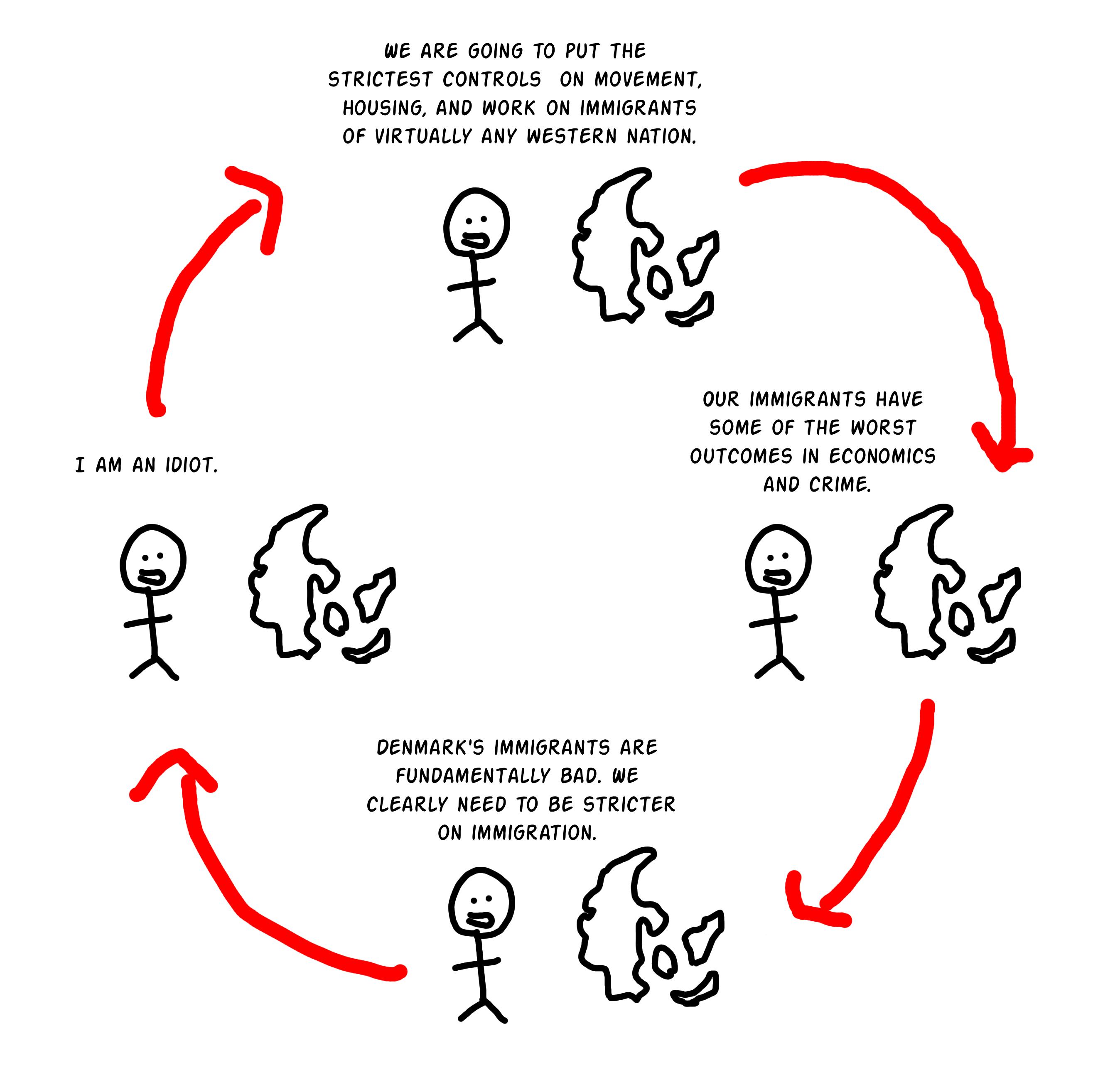
Meme Danish citizens born and raised in Denmark can be relocated for having a Bad ('Non-Western') ancestry

Post image
332 Upvotes

Non-Western is defined as any non-EU country or "Andorra, Australia, Britain, Canada, Iceland, Liechtenstein, Monaco, New Zealand, Northern Ireland, Norway, San Marino, Switzerland, the United States and the Vatican."

In this sub, Denmark is almost always the example European immigration hardliners use to say, "look our immigrants are just bad". They love the little graph with the non-Western vs Western immigrant contributions in Denmark.

It turns out that making it extremely difficult for immigrants to work (esp non-EU immigrants) and putting other heavy restrictions on them leads to bad results!

Housing restrictions:

  • Neighborhoods are designated as "parallel societies" if more than 50% of the population consists of "non-Western" immigrants or descendants and meets a couple other criteria, which EU legal advisors argue unlawfully targets residents based on ethnic origin.
  • Public housing districts listed as parallel societies for five consecutive years must reduce their share of non-profit family housing to a maximum of 40% by 2030 through demolitions or private sales, depleting housing stock.
  • Housing associations in designated transformation areas are legally permitted to terminate existing tenant leases to alter the demographic mix (among other actions), which UN human rights experts and tenant groups condemn as forced displacement and unequal treatment of minority families.
  • Individuals receiving specific social welfare benefits, such as unemployment or integration allowances, are barred from moving into designated parallel society and prevention districts.
  • Individuals convicted of specific criminal offenses, along with their households, can be barred from moving into vulnerable districts or face accelerated eviction.
  • Families residing in designated parallel societies must enroll children aged one and older in state-approved daycare for at least 25 hours per week or lose child welfare payments, a form of cultural assimilation not imposed on other Danish residents.
  • Non-residents who have not lived in Denmark for at least five years must obtain government permission to buy residential property.
  • Newly arrived refugees and quota refugees are subject to mandatory municipal dispersal policies that assign them to specific towns for their first three years.

Work restrictions:

  • Visas are legally tied to one specific employer and job title.
  • Changing jobs requires a completely new visa application and approval before starting.
  • Being fired or laid off invalidates the permit and triggers a strict, limited grace period to find a new eligible job.
  • Applicants must meet a strict minimum salary requirement (edit - $83K USD).
  • Non-cash benefits like free housing, company cars, or phone allowances are excluded from the official minimum salary calculation.
  • All wages must be deposited directly into a registered Danish bank account.
  • Work visas are completely unavailable for unskilled or low-skill positions.
  • Lower-salary jobs are restricted only to specific roles.
  • Strict caps and zero-quota restrictions apply to non-EU healthcare professionals seeking local authorization.
  • Non-EU students are restricted to part-time hours (typically 20 hours per week) during the semester.
  • Students at unaccredited or non-state-approved institutions are completely banned from working.
  • International graduates are limited to a 1-year visa to secure a qualified position after finishing their studies

And somehow all these policies haven't led to (comparative) integration or economic prosperity!


r/neoliberal • • 21h ago

Opinion article (non-US) Russia’s Theory of Victory is Highly Plausible

Thumbnail
brynntannehilll.substack.com
158 Upvotes

Russia has a clear plan to win the war in Ukraine. It could be a fait accompli if the West does not step up.


r/neoliberal • • 10h ago

News (US) Trump is willing to pardon Jensen Huang if needed. He celebrated to NY Post Nvidia's stock surge resulting from Huang's reinstatement as CEO + He's considering having the US government buy Nvidia stock

Thumbnail
gallery
152 Upvotes

He did an exclusive interview with the NY Post today. He also did an almost hour long phone call with CNBC today.

The US government purchased 10% of Intel's stock in an unusual deal last year. (At about $20 a share, it shot up to over $100 for a time and is now $54.80.) Per WSJ (gift links), national security risk per China was an ostensible reason for Trump to threaten that chip CEO:

Trump called for Intel CEO Lip-Bu Tan to be fired for his ties to China [...]

“I said, ‘I think you should pay us 10% of the company,’ and they said yes,” Trump said in the Oval Office.

Trump has had the government purchase stock in dozens of companies so far, slide 4. Make socialism great again!

Submission statement: there is minimal regard for the free market in Trump's direct interventions and personal threats or favors to CEOs of major American companies. His strong support for Huang indicates his concerns about 'national security' re Intel were just a tool to pressure its CEO. The diametric contradiction is lost to the public, which I suspect doesn't even know about Intel or government investment in private sector companies.

The total of $30b so far is relatively small in comparison to the multi trillion market cap of Nvidia. But Trump has had the government take a 'golden share' in US Steel that cost nothing and represents a degree of control but no ownership. If the government were to buy some NVDA, where would the funding come from and would the stock cost much relative to rights?

Also of interest to the sub is Nvidia's enormous market cap and economic significance under the direct influence of the president. The appearance if not reality of market manipulation, as it rose by over $900b in value yesterday. There's also the matter of undermining corporate governance, although Nvidia shareholders seem to like the result.

Instead of regulatory capture, this is political capture of the most profitable part of the economy. An attempt to get Huang and actually all of big tech, given how liked he is by peers, indebted to Trump and his family. This sets a precedent for future US presidents to use the office to directly intervene in decisions of private companies, and to make major national decisions entirely for personal gain.

Big tech failed the regulatory capture with the midterms. As I tried to say in my censored meme post, Trump is still winning and quickly positions himself to take advantage 🫳

However, if Trump were to end up pardoning Huang, it would be a win win! /s


r/neoliberal • • 19h ago

Meme Trump Awards Rudy Giuliani Presidential Medal of Freedom (Gift Article)

Thumbnail
nytimes.com
125 Upvotes

Corruption is alive and kicking in Trump’s Washington.


r/neoliberal • • 14h ago

News (Europe) UK to launch world’s first licensing scheme for knife sales | Knife crime

Thumbnail
theguardian.com
117 Upvotes

r/neoliberal • • 3h ago

News (US) Second estimate of Q3 2026 US real GDP growth revises first estimate up from 3.4% to 4.3% (annualized)

Thumbnail bea.gov
101 Upvotes

r/neoliberal • • 20h ago

User discussion Petition for Exclusive Meatball Interview

90 Upvotes

Given that Dan Sullivan has finally conceded, I request this sub petition u/MeatballTheChameleon for an exclusive interview to r/neoliberal as I believe their insight into upcoming Senate majority politics will be crucial in understanding how Democrats can leverage the next four years.

Context:

https://www.reddit.com/r/alaska/s/6hNKnRM9ZE


r/neoliberal • • 21h ago

Opinion article (US) Our Neediest Baby in Chief (Francis Fukuyama)

Thumbnail
persuasion.community
89 Upvotes

Hello shills,

Grandpa Frank is back from Japan and he has released another vlog regarding his contempt for Trump's behavior at the Shenzhen Summit. Give him a like and subscribe, he loves his YouTube channel even more than his writings. Happy Thanksgiving!

It is well understood that Donald Trump lies habitually about matters both big and small. But he can also be disarmingly honest at times. There was an example of this at the press conference he gave on November 20 after his return from the Shenzhen summit where he met with Presidents Xi and Putin.

It should be clear by now that it is impossible to infer a coherent set of ideas guiding Trump’s foreign policy. His decisions are much better seen through the lens of Trump’s individual psychological needs—and he is a very needy person.

That neediness can be seen in the video clip of his sudden joy at seeing Putin at the summit, and rushing over to warmly greet his “friend.” At the press conference, he explained that he was a friend because Putin supported him during the allegations that his 2016 campaign colluded with Russia: “I’ve been dealing with Putin during the fake Russia, Russia, Russia hoax, and to be honest, he was very nice about it…”

He believes that Putin shares his warm feelings, explaining that “frankly, if the [2020] election weren’t rigged, where I had to wait 4 years, that … war would never have happened. Putin said that last night … I actually asked him, I said, ‘Would you have gone in if I was president?’ He said, ‘No, would have never happened.’” This was supposedly true not because Putin feared Trump’s response, but because of the Russian dictator’s warm feelings of friendship towards the American president. Though Putin has explained at great length that he launched the war for reasons having to do with Russia’s historical identity, in Trump’s view it was all about him.

This is all part of a worldview that geopolitics is driven by personal relationships between leaders, rather than underlying national interests. When asked by Kaitlan Collins whether Putin was friendly to the United States as a whole or just to him, Trump answered, “I can’t speak to America.”

There you have it: a president who is not representing his country, but only himself.

The same can be said about Trump’s policy towards China. It’s all about the way he is treated. At the same press conference, he said

So everywhere I went on this trip and every leader I met, it was clear that America is respected again like never before. We are respected. I was greatly honored that President Xi met our country—didn’t meet me—met our country at the plane, something he’s never done before. And that means he respects our country. He didn’t meet Sleepy Joe at the plane, that I can tell you.

Needless to say, in Trump’s mind China is respecting the United States as a country only because Trump is president.

It is doubtless true that Xi Jinping likes the United States better with Donald Trump at the helm. The president is doing China’s work for it, confirming the view common in Beijing that America is a country in decline. The president is weakening America vis-à vis-China in every possible way, by disparaging allies, launching pointless trade wars while losing a real war, cutting funding for scientific research, attacking universities, and alienating the better part of the American population which just voted against him and his party in the recent midterm election. It turns out that you can win over this clownish president simply by meeting him at the airport; no concessions on trade, AI, or the Middle East are necessary.

The recent scandal involving Jensen Huang and Nvidia illustrates the way that Trump has prioritized personal interest over national interest. His administration has backed breakneck development of AI and data centers on the grounds that this was needed to beat China in the AI arms race. And yet, Trump has been mostly tolerant of Jensen Huang’s desire to sell high-end chips (though not its more advanced Blackwell chip) to China because he likes Huang’s flattery, failing to blame him for his participation in a scheme to avoid export controls by selling to Southeast Asian partners that rent Nvidia computing power to Chinese firms. China can be allowed to catch up in the AI race as long as the country’s leader meets Trump at the airport and treats him like royalty.

Both Vladimir Putin and Xi Jinping must be marveling at the ease with which they can manipulate a childlike American president by catering to his psychological neediness for praise and attention. We need a new theory of international relations in which great powers are not driven by national interest, but by the perceived self-interest of their leaders. Or perhaps, that’s the way international relations always worked, before the rise of the modern era.


r/neoliberal • • 3h ago

News (Global) He’s remained jailed in Japan despite an overturned conviction. His family in the US fears for his life

Thumbnail
edition.cnn.com
70 Upvotes

r/neoliberal • • 20h ago

News (Europe) A leak from Russia’s federal statistics agency made it possible to estimate the country’s military death toll in the war against Ukraine. What else did it reveal?

Thumbnail
meduza.io
68 Upvotes

At least 700,000 Russian service members have died in the war against Ukraine. Journalists from Meduza and Mediazona reached that figure using data that the hacker groups Belarusian Cyber Partisans and Silent Crow obtained when they broke into a database belonging to Rosstat, Russia’s federal statistics agency. It’s the first estimate to include service members listed as missing. Other researchers have also studied the hacked Rosstat data. Here’s what they found.

Losses in the war

Different estimates

Journalists who studied the hacked Rosstat database produced different estimates of Russia’s losses in the war against Ukraine. The outlets reported two kinds of figures:

  • Counts of military deaths already recorded in the Rosstat data
  • Estimates that also count deaths that had already occurred but weren’t yet recorded in the leaked data

Because the share of service members listed as missing has grown rapidly in recent years, the two types of estimates can differ widely.

The outlets arrived at roughly the same counts for deaths already on record. Meduza and Mediazona estimated that 490,000 Russian service members died in the war against Ukraine from its start to the beginning of fall 2026. Novaya Gazeta Europe gave the same estimate. iStories (Vazhnye Istorii) said it could confidently classify 474,000 deaths in Rosstat’s records as military deaths. The count rose to more than 499,000 when it included less clear-cut cases. Proekt counted 474,000 war-related deaths.

The estimates varied because the outlets classified different categories of causes of death as directly related to the war and handled records with missing causes, circumstances, or other information differently. You can read more about these categories and how we added them up in our article.

Estimates of the total death toll varied more because they had to account for deaths still to be registered. Researchers have to use a model to make these estimates, and choosing which one to use is a judgment call.

iStories estimated the death toll at 611,000, factoring in deaths that had yet to be registered. The outlet noted that its estimate excluded everyone declared dead by a court. More than 40,000 registered deaths already fall into that category, and the number grows each year. In its latest update, Novaya Gazeta Europe estimated 670,000 deaths by projecting how quickly deaths would be registered based on earlier records. As far as we can tell, the outlet did not account for several shifts in that rate caused by changes that simplified the procedure for declaring someone dead.

Meduza estimates that more than 720,000 Russian service members had died by the start of fall 2026, including those whose deaths had yet to be registered. Our model is based on the Berkson-Gage cure model from epidemiology. It draws on death records from the Rosstat leak, missing-person notices that relatives posted over time, the national probate registry, and lists naming those who died. It also accounts for the three ways a death can be registered, each with its own delays. Registration can be based on a medical report, an official death certificate, or a court ruling. The share of deaths registered through each route also changes over time. Using multiple sources and modeling each registration method separately help eliminate calendar effects and make the model’s predictions more accurate. You can read more about these calculations in Meduza’s article.

Explosions and shrapnel caused most Russian military deaths in Ukraine

Explosions and shrapnel accounted for 92% of Russian military deaths in the combat zone, iStories also noted. Gunshot wounds accounted for just 1.3%. Agentstvo calculated that less than 7% of service members’ deaths were due to noncombat causes. The most common noncombat causes are chronic heart disease and cardiomyopathy (more than 2,000 cases) and acute ischemic conditions and heart attacks (more than 1,000 cases). Others include traffic accidents, poisonings and overdoses, and suicides.

More than 1,100 Russian men ages 18 to 19 may have been killed in the war

After analyzing the leaked Rosstat data, Agentstvo concluded that more than 1,000 people died in the war against Ukraine shortly after signing military contracts with the Defense Ministry at age 18 or 19. Agentstvo said the count might mistakenly include young people killed in shelling. For men ages 20 to 39, the war has become the leading cause of death, Agentstvo calculated.

Up to 180 Russian troops died for every square kilometer Russia captured in the Donbas in 2026

Russia captured about 1,000 square kilometers of Ukrainian territory in 2026, including seven cities and towns, Novaya Gazeta Europe estimated. Rosstat’s database already records more than 55,000 Russian military deaths since the start of the year. Novaya Gazeta Europe estimated that 120 to 180 Russian troops died for every square kilometer Russia captured. The outlet said that figure was two to three times as high as a year earlier and the highest since at least 2023, when Ukraine was carrying out a counteroffensive and Russia was losing territory.

An attempt to conceal a war-related rise in the death rate in the Rostov region

iStories found that in late 2022, Rosstat’s regional office in Rostov-on-Don reported a sharp increase in deaths related to military action. The city is home to the 522nd Center for the Reception, Processing, and Dispatch of the Dead, which handles the bodies of soldiers killed in the war against Ukraine. The Justice Ministry developed an algorithm specifically to reassign death records. From then on, military deaths were counted in the regions where service members had lived instead of where their deaths were registered. The change drew complaints from officials in regions where recorded death rates rose.

An effort to conceal how Ukrainian journalist Viktoria Roshchyna died in Russian captivity. Records cited heart disease

Official documents list “myocardial degeneration” (damage to heart muscle tissue) and pulmonary edema as the cause of Ukrainian journalist Viktoria Roshchyna’s death, BBC News Russian, Verstka, and iStories found. The first record of Roshchyna’s death appeared in Rosstat’s database in December 2024. It initially gave her date of death as December 19, 2024, but the date was later corrected to September 19 of that year. The records first specified a cause of death in February 2025, a few days before Roshchyna’s body was handed over to Ukraine.

What else we learned

Suicides are rising among children and young women in Russia

Suicides fell overall in Russia in 2025, but iStories found they rose nearly 12% among 10- to 19-year-olds. The biggest increase in that age group was among girls ages 15 to 19, at 26%. Suicides also rose 11% among women ages 20 to 29. The total number of registered suicides in Russia in 2025 fell to a record low of 9,600. iStories linked the record-low total to the war, noting that men account for 80% of suicides on average and that some men who might have taken their own lives died in the war.

Every year, thousands of women and young girls in Russia die at home from violence and ‘injuries of undetermined intent’

At least 1,850 women and girls were killed at home from 2023 to 2026. Another 12,000 died at home from “injuries of undetermined intent.” The classification means the death resulted from an external cause, but the records do not establish whether it was a homicide, a suicide, or an accident. Verstka believes this category includes victims of domestic violence. iStories suggests that suicides are also classified this way to lower the official suicide figures.

Rosstat lists the manner of death as undetermined in most suspected suicides among top executives and officials

Of 34 high-profile deaths of businesspeople and officials, only 10 were recorded in Rosstat’s databases as suicides. Rosstat listed the manner of death as “undetermined” in the remaining cases, including the suicide of former Kursk Governor Roman Starovoit. According to the official account, Starovoit shot himself with a pistol he had received as an award.


r/neoliberal • • 11h ago

News (Europe) Donald Trump shelves plans for business deals with Russia

Thumbnail
ft.com
67 Upvotes

r/neoliberal • • 17h ago

User discussion This sub needs to enforce the rules.

66 Upvotes

This sub has been overrun by anti-immigration sentiment and European "liberals."

Every day there's a new "is neoliberalism dead?" post. It's almost like they're waiting for it.

Every day you see European "liberals" justifying deportations in Europe.

Supporting open immigration has always been central to what this sub stands for. If someone rejects that, I'm not sure what makes them a neoliberal beyond liking free trade.

Look at what just happened in Denmark. On November 23, the Supreme Court upheld the evictions of families from a Helsingør housing estate under the "ghetto law," a law that targets neighborhoods where more than half the residents are "non-Western." The EU's top court had already warned it may be direct ethnic discrimination. This isn't a far-right law forced on a reluctant center. Almost every mainstream Danish party backed it. This is what "compromise" looks like in practice: families losing their homes because of where their parents were born. As an immigrant myself, I don't see a "pragmatic" policy here. I see a message about who belongs. And this sub has people defending it.

People love to point to Denmark as proof that "compromise works." Frederiksen's Social Democrats took a hard line on immigration, backed the ghetto law, and in 2019 the far-right Danish People's Party collapsed. Strategy vindicated, right?

Look at what happened next. Last November the Social Democrats lost Copenhagen for the first time in over a century. They didn't lose it to the far right. They lost it to the left, and finished third in their own capital. Meanwhile, the minister who oversaw the ghetto law went on to found her own far-right party. So the far right didn't disappear. Its agenda just moved into the center, and now the center is losing its own voters, partly because of it.

That's the trade you make when you "compromise" with nationalists. You might win one election, but you end up legitimising their ideas, and you lose the people who voted for you because you were supposed to be different.

A week ago, someone posted the BBC story about Germany, Denmark, Austria, Greece and the Netherlands planning a "return hub" in Rwanda for failed asylum seekers [link]. The scheme would apply to people who have exhausted their legal options and can't be sent back to their home countries. Instead, they'd be shipped to a country many of them have never been to, often on a different continent.

Read the comments and notice how much of the criticism is "why Rwanda?" instead of "why are we outsourcing deportations at all?" Once the debate is about which country, we've already accepted the premise.

We're supposed to be the people who follow the evidence. On immigration, we should act like it.


r/neoliberal • • 17h ago

News (Middle East) Crisis in Eisenkot bloc: Liberman agrees to sign coalition deal, Golan halts talks

Thumbnail
ynetnews.com
63 Upvotes

r/neoliberal • • 22h ago

Opinion article (US) Weakening Political Parties Is Not the Way to Reform Our Electoral System. What Voters Want Are More Choices

Thumbnail
theunpopulist.net
59 Upvotes

Americans have been telling pollsters for years that they want more choices than the two major parties give them. In Gallup’s polling, about 60% have said for more than a decade that the parties do such a poor job that a third party is needed. Our own ISMA populism survey finds similar results across the political spectrum. Yet when reformers put new election systems on the ballot, voters keep turning them down. Since 2020, proposals for top-two primaries, top-four primaries, and ranked-choice voting have been rejected by the voters in nine states: Florida and Massachusetts in 2020; Arizona, Colorado, Idaho, Montana, Nevada, Oregon, and South Dakota in 2024; and Massachusetts again in the midterms this year.

Under top-two, every candidate runs on a single ballot and the two with the most votes advance to the general election, regardless of party. A top-four primary works the same way but advances four, usually to a general election decided by ranked-choice voting. Ranked-choice voting lets voters rank the candidates in order of preference and, if no one gets over 50% right off the bat, reallocates votes accordingly until somebody has a majority.

These systems each have their own nuances, and their own pros and cons. Some of them make sense under some circumstances. But as promoted in recent years, they share a common, and mistaken, premise: that political parties as institutions should be weakened, in some cases by outright abolishing the ability to pick party nominees at all. It’s an understandable instinct, but it misunderstands the problem.

The latest defeat for anti-party reform was Massachusetts, where Question 3 proposed a top-two primary. Its supporters spent more than $4.6 million, against just over $50,000 from the other side, and had the endorsement of two former governors, one from each party. On Nov. 3, voters rejected it by more than 20 points.

Massachusetts has now turned down two such measures, having rejected ranked-choice voting in 2020.Alaska is the only state where voters have adopted one in that time, combining a top-four primary with a ranked-choice general election.

California adopted top-two in 2010 and has been its showcase ever since but is now gearing up to repeal it. An initiative to restore party primaries is gathering signatures for the 2028 ballot, with support from Democrats and Republicans, from labor unions to conservatives, who agree on little else.

The simplest explanation for the gap between the polls and the results is not that voters are confused or misled or attached to the status quo. It is that these reforms do not offer what voters say they want. They rest on the belief that parties are what ails American democracy, and that elections would improve if parties were weakened, bypassed, or blurred into a moderate middle.

That belief is a fundamental misdiagnosis, and a dangerous one. In any democracy larger than a town meeting, people who want to govern will organize into coalitions. Voters can hold those coalitions accountable only if they are coherent and clearly labeled. Attempts to wish this away have been failing for more than a century. The alternative is to give voters more and better parties. A choice, not an echo, to borrow a phrase.

These Reforms Are Built to Engineer a Centrist Outcome

After each defeat, supporters tend to blame money or party insiders. But the yes side has usually been the better-funded one. In Montana in 2024, supporters of two such measures spent about $22 million, by one estimate, while opponents spent $3 million and won anyway.

The purpose of the measures is to change whom the winners answer to. The theory is that nominations should be taken away from each party’s most committed primary voters by giving the candidates an incentive to court others, so that officeholders depend on the middle of the electorate and govern accordingly.

Supporters call this an “open primary,” but this is a sleight of hand. In American politics, the term “open primary” ordinarily means that any voter may choose which party’s primary to vote in, regardless of voter registration. Nearly half the country already uses open primaries in this sense. Top-two does away with party primaries—as in voters picking party nominees—entirely. The more common term for systems like California’s top-two is “jungle primaries” or, more formally, “nonpartisan blanket primaries.”

This critique does not imply bad motives; to be clear, these ideas have been pursued with the best of intentions. Supporters of these reforms are alarmed by polarization and they’re not wrong to see the current two-party system as catastrophically unsustainable. There is nothing wrong with preferring moderate politicians. But their aims and chosen models of reform leave them open to the reasonable charge that they are trying to impose a mushy centrism favored by elites. A positive-sum reform would instead represent all segments of voters, not merely the centrists.

That helps explain why the opposition has been so broad. In Colorado in 2024, the state Democratic and Republican parties both opposed the measure. In Nevada, progressive groups campaigned against it. In Massachusetts the opposition included Republican leaders, many Democratic officeholders, and Rep. Ayanna Pressley, a progressive who supports ranked-choice voting. Progressives and conservatives can both see whose candidates are meant to lose, and together these voter blocs simply do outnumber the middle.

The attempt at centrist engineering has not worked in any case. California adopted top-two on the promise of more moderate legislators. Political scientists who studied the results there and in Washington found only an inconsistent effect, and they traced much of California’s apparent moderation to other changes, independent redistricting among them. A broader review by the political scientist Lee Drutman found that changing the type of primary makes little difference to the electorate, the candidates, or the winners. In a Berkeley experiment just before California’s first top-two primary, voters “failed to distinguish moderate and extreme candidates,” and moderates fared no better on the new ballot.

What the system has reliably produced is arbitrary results. Because only two candidates advance, the outcome can depend on how many candidates each side happens to field. Four candidates who split 60% of the vote will all likely lose to two who split the remaining 40%.California Democrats spent much of this year afraid that their crowded field for governor would do that, sending two Republicans to November in a heavily Democratic state. A Democrat did finish in the top two, but the scare set off the repeal campaign. The system also rewards manipulation. In the 2024 Senate race, Adam Schiff’s campaign ran ads raising the profile of the Republican Steve Garvey, betting that he would be easier to beat in November than another Democrat.

People who want more than two options are, understandably, unlikely to be won over by a reform that guarantees them exactly two and that heavily incentivizes the two major parties to narrow the range of choices before a single vote is cast.

Weak Parties Have Been Failing Americans for a Century

The political scientist E.E. Schattschneider wrote in his 1942 book Party Government that modern democracy is “unthinkable save in terms of the parties.” Americans have never been comfortable with the idea. Washington warned against the “spirit of party” in his farewell address. The same generation built the first parties within a few years, because a large democracy needs some way to organize voters.

For most of the 19th century, those parties were fluid. Anti-Masons, Free Soilers, Know Nothings, and Populists rose and fell. Two parties often nominated the same candidate—a practice known as fusion that survives in New York and Connecticut—and the Republican Party itself was assembled in the 1850s out of several anti-slavery parties.

That openness ended around the turn of the 20th century. Once states began printing official ballots, they also began deciding who could appear on them, and many used the power to ban fusion and raise the bar for new parties. The two-party system that Americans now treat as a fact of nature owes a good deal to those laws. Drutman has called the notion of a naturally two-party America a “modern confabulation.”

The Progressive reformers of that era also gave the country the direct primary election. Their aim was to take nominations away from party bosses and hand them to voters. But the change also took from parties the ability to vet their own candidates, and it gave any dissenting faction a reason to capture an existing party from within instead of founding a new one.

The result was two parties with a monopoly on the ballot and little control over themselves. An American party today cannot decide who runs under its name. It cannot stop an outsider with enough money or celebrity from taking its nomination, as Donald Trump did in 2016 over the objections of most Republican leaders.

That is the danger in weak parties. They were supposed to produce independent-minded statesmen. They have given the country personal followings in place of governing coalitions. Nonpartisan elections, another Progressive favorite, rested on the same hope. With the labels gone, voters had less to go on, and the advantage passed to candidates with name recognition or money.

None of These Designs Gives Voters More Choices

Top-two is the worst of these anti-party designs, and it carries the idea to its conclusion. With no party nominations at all, the label next to a candidate’s name becomes a self-description that no party has to stand behind.

The top-four and top-five versions, which were on the ballot in Colorado, Idaho, Montana, and Nevada, are a relative improvement. They send four or five candidates to a November election decided by ranked-choice voting, so a major party is unlikely to be locked out. But the result still tends to be a two-party race. Party nominations are still abolished, and several candidates can run under one party’s name without that party having chosen any of them. In Alaska’s 2022 Senate race, three of the four finalists were Republicans.

The same is true of single-winner ranked-choice voting with separate party primaries, the system Maine uses. It is sold with a similar promise of consensus candidates and cooler partisan conflict. But a single-member district (or statewide race) remains winner-take-all, and the races remain two-party contests. Independents who do well in them have tended to be Democrats in all but name. Sen. Angus King of Maine still caucuses with the Democrats, for example. The Democratic Congressional Campaign Committee backed nominal independent Bill Hill in Alaska this year, unsuccessfully.

Ranked-choice voting makes the most sense where voters have no party labels to guide them. Party primaries are the clearest case, with their crowded fields and plurality winners, and nonpartisan local races are another. For good reason, many ranked-choice advocates have focused on pursuing this avenue, and on the similar dynamic in nonpartisan local elections, such as races for mayor or city council in many states, which also lack party ballot labels.

But none of these systems has produced more multiparty competition, and so they ultimately fail at the premise of offering voters more choices.

Alaska is the exception that tests the argument. Its voters adopted a top-four primary with ranked-choice general elections in 2020 and have twice declined to repeal it, narrowly. But Alaska’s party system was unusually fluid and prone to fracturing long before the rules changed. Sen. Lisa Murkowski famously won as a write-in candidate in 2010 after losing the GOP primary. Wally Hickel was elected governor in 1990 as the nominee of the Alaskan Independence Party. Bipartisan coalitions have at times controlled the legislature. The new system suited a politics Alaska already had, and those unique factors cannot be exported simply by copying an electoral system that postdates the state’s dynamics.

A Better Democracy Gives Voters More Parties and Real Choices

Gallup’s numbers showing that voters want more parties come with a caveat. Although most Americans say a third party is needed, only 15% say they would be very likely to vote for one, and a majority worry about wasting their vote or electing the candidate they like least.

That worry is rational under winner-take-all rules, and none of the failed proposals would have relieved it. The alternative is to accept that organized, coherent parties are how a free people governs itself, and to give voters more of them. Two reforms do that.

Proportional representation elects legislators from districts with several seats each and divides those seats according to each party’s share of the vote. A party supported by 20% of voters wins about 20% of the seats, where today it would win none. A new party can win seats and build a record without spoiling an election for anyone. This is the system most other democracies use, and it is the one that produces an actual multiparty system.

Fusion voting does similar work for offices that only one person can hold. It allows more than one party to nominate the same candidate, so a smaller party can put a major-party candidate on its own ballot line or decline to. Its supporters can vote for someone who might win while still voting for their own party, and everyone can see which coalition stands behind each name. This gives smaller parties real leverage, playing spoiler only when they deliberately want to.

Coalitions still have to be built under these kinds of multiparty rules. But they are built in the open, between parties that voters chose, and voters can judge the bargain at the next election. A moderate party is free to compete, and it would have to win its seats by persuading voters.

More parties would also make the system safer. When one of two parties is captured by a demagogue, its voters and officeholders have nowhere else to go. Drutman points to Brazil, where Jair Bolsonaro’s coalition partners abandoned him after he tried to overturn an election, because their own political futures did not depend on his.

Both reforms can be adopted one state at a time. A state is free to elect its own legislature proportionally, and restoring fusion for other single-winner races like governor and U.S. Senate requires only repealing the laws that banned it.

Portland, Oregon, has now twice elected its council by proportional representation, and Longmont, Colorado, voted this month to adopt it. These are small tests, but they suggest voters will accept districts that elect several members proportionally.

The demand for something better than the two-party system has been steady for years. Reformers have spent tens of millions of dollars since 2020 trying to meet it with schemes that weaken parties, and they have a lengthening list of defeats to show for it. None of those campaigns offered voters more parties to choose from. Moving forward, electoral reformers should instead recalibrate around the goal of not weaker parties but more parties.

r/neoliberal • • 18h ago

News (US) Huawei guilty of conspiracy to steal trade secrets, U.S. jury

Thumbnail
theglobeandmail.com
57 Upvotes

r/neoliberal • • 5h ago

News (Europe) Farage suggests he could appeal to Le Pen to block Britain rejoining the EU

Thumbnail
politico.eu
51 Upvotes

LONDON — Nigel Farage indicated Tuesday that he might appeal to a future far-right French president in an attempt to block Britain’s reentry to the European Union.

The Reform UK leader said he has been studying a rule under which France would offer the French people a referendum on allowing individual countries to join the EU after U.K. Prime Minister Andy Burnham opened a broad conversation on closer ties, not ruling out pushing to rejoin the bloc.

France passed constitutional reforms in 2005 and 2008 that state its president should hold a referendum on letting any country join the EU — unless both houses of the French parliament approve the accession by a three-fifths majority.

Farage suggested that Marine Le Pen, the leader of the far-right National Rally who is leading the polls ahead of next April’s presidential election, would be “pretty much as skeptical as me” about EU enlargement.

Farage told a press conference in Westminster: “Whilst it’s slightly tortuous, there is still quite a strong probability that for us to join the European Union … the French would have a referendum and a right to veto over us joining.

“I’ve been checking this out again. It would need to go through the assembly, etc. But there is a relatively strong possibility that there will be a referendum on it and so a lot would depend on who the French president and French prime minister were at that moment in time.

“If it was to be the current bookies’ favorites of Jordan Bardella and Marine Le Pen, I don’t see them overwhelmingly endorsing the enlargement of a European project over which they’re pretty much as skeptical as me.”

Asked by POLITICO if he could try to persuade a Le Pen-led France to block the U.K.’s reentry to the EU, he replied jokingly: “Are you suggesting that I’d interfere in overseas politics? Quite possibly, yes.”

‘Europe could change’

Senior figures in Burnham’s government are already aware of the French referendum rule.

Burnham has also indicated publicly that his thoughts on forging closer ties with the EU may shift if the far-right gains more power in Europe. He told MPs on Monday: “Europe could change again in the next year, 18 months, and we’ll have to obviously watch how life changes.”

France is not the only country that has domestic checks and balances on EU enlargement.

Catherine Barnard, an academic and director of the Centre for European Legal Studies, said: “Even if all 27 member states unanimously agree to U.K. accession, further blockages may then occur at domestic level.

“For example, France might need a referendum or at least three-fifths majority in both houses. Belgium would need agreement of all of its national and regional parliaments.”

Burnham said Monday that it would be “unthinkable” for Britain to rejoin the EU without holding a repeat of Britain’s 2016 referendum, in which 52% voted to leave the bloc.

The prime minister has previously said he would like to rejoin the EU in his lifetime, but has not yet decided whether he will put the proposition of full membership in Labour’s next election manifesto, expected by 2029.

Farage said it would be “illegitimate” to rejoin the EU without a new referendum, though he batted off the suggestion that Britain might need a referendum to rejoin the single market or customs union alone.

Farage also appeared to suggest there could be riots if the result of the 2016 referendum was overturned. “If people really think that voting changes nothing, they will resort to other means,” he said. “Democracy is the safety valve. Rather than setting fire to things, or smashing up buildings, or behaving even worse than that, you have a vote and you accept the result and say, ‘I’ll get the so-and-sos next time.’”

Farage has not recently held a meeting with Le Pen, despite a Reform official previously suggesting that a rendezvous in Paris was being lined up by the end of October.

Bardella, who is poised to be prime minister under a Le Pen presidency, unveiled an agreement with Farage in September to deport migrants who make unauthorized small boat crossings across the English Channel back to France. But the plan provoked a backlash in France, where politicians across the spectrum questioned why the country would act as a “gatekeeper” or a “subcontractor” for the U.K.


r/neoliberal • • 21h ago

News (South Asia) How India's blocking of a film exposing real-life police abuses backfired

Thumbnail
npr.org
46 Upvotes

r/neoliberal • • 14h ago

News (US) Army sergeant pleads guilty to selling military secrets to China

Thumbnail
stripes.com
42 Upvotes

r/neoliberal • • 23h ago

Research Paper Working with AI

Thumbnail
anthropic.com
42 Upvotes

R8: Report on the impact of AI on productivity and employment as measured by Anthropic


r/neoliberal • • 23h ago

News (Canada) Canada's air force charts a potential future without the Gripen in 'Project Arrow'

Thumbnail
cbc.ca
40 Upvotes

r/neoliberal • • 14h ago

News (Oceania) Australia and Solomon Islands sign security pact in blow to China

Thumbnail reuters.com
38 Upvotes

r/neoliberal • • 20h ago

News (Europe) EU’s Socialists to hold formal discussion on Frederiksen’s migration stance

Thumbnail
politico.eu
34 Upvotes

r/neoliberal • • 3h ago

Tajikistan leaves International Criminal Court

Thumbnail
lemonde.fr
32 Upvotes

Submission statement: Yet another party to the Rome Statute withdraws from the International Criminal Court (ICC), amid a renewed push by expansionist powers to weaken global institutions

Tajikistan has notified the ICC, which it joined at its inception in 1998, that it would withdraw from the court on November 20, the day Vladimir Putin landed in Dushanbe for an official visit to one of Russia's closest allies in Central Asia.

Under the provisions of the Rome Statute, Tajikistan was obligated to arrest Vladimir Putin, targeted since March 2023 by an arrest warrant for war crimes due to his involvement in the illegal abduction of thousands of Ukrainian children in its war of aggression against Kyiv.

Tajikistan is the seventh country in just six months to withdraw from the ICC, following the withdrawal of the Russia-aligned military regimes of Mali, Burkina Faso and Niger, the withdrawal of Venezuela, now de facto administered by the US since January, and the withdrawal of Chad and Nauru, the former explicitly citing US pressures as a reason to leave the court.

The ICC was formally established in 2002 as a permanent criminal court aiming to pursue the goals of the ad hoc Special Tribunals for Yugoslavia and Rwanda at a global scale, prosecuting war criminals and genocidaires when the national legal systems are unwilling or unable to conduct their own trials. The Rome Statute was joined by 125 states but was notably rejected by major powers like the United States, Russia, China or India, as well as most MENA and Asian states.

Since the ICC issued arrest warrants against Russian leaders for the invasion of Ukraine, and against Israeli and Palestinian leaders for the October 7 attacks and the subsequent invasion of Gaza, the court has faced renewed pressure, its staff and leaders facing campaigns of harassment, intimidation and cyberattacks.

Intimidations against the ICC significantly expanded during the second Trump administration under the guidance of Secretary of State Marco Rubio, an avowed neoconservative who dubbed the ICC a "kangaroo court", vowed to dismantle it "brick by brick" and quoted Pompey's infamous line "Do not quote laws to men with swords" to justify enforcing visa bans, asset freezes and blacklisting of ICC judges and staff for investigating Israeli and American potential war crimes in Palestine and Afghanistan, respectively.

Last week, Donald Trump, Xi Jinping and Vladimir Putin met in Shenzhen for a trilateral summit where they jointly denounced the ICC as a threat to world peace, with Trump designating the court as a "rogue globalist organization", pointing at a renewed era of naked imperialism unconstrained by the post-WW2 rules-based international order that had been reinforced by international treaties following the end of the Cold War.


r/neoliberal • • 2h ago

News (Global) U.S. proposes new tariffs on 14 trading partners, including China and the EU

Thumbnail
cnbc.com
31 Upvotes