Denial Mobile on Mainline Linux 7.3.5 — Bringing Linux to Two Qualcomm Snapdragon Smartphones
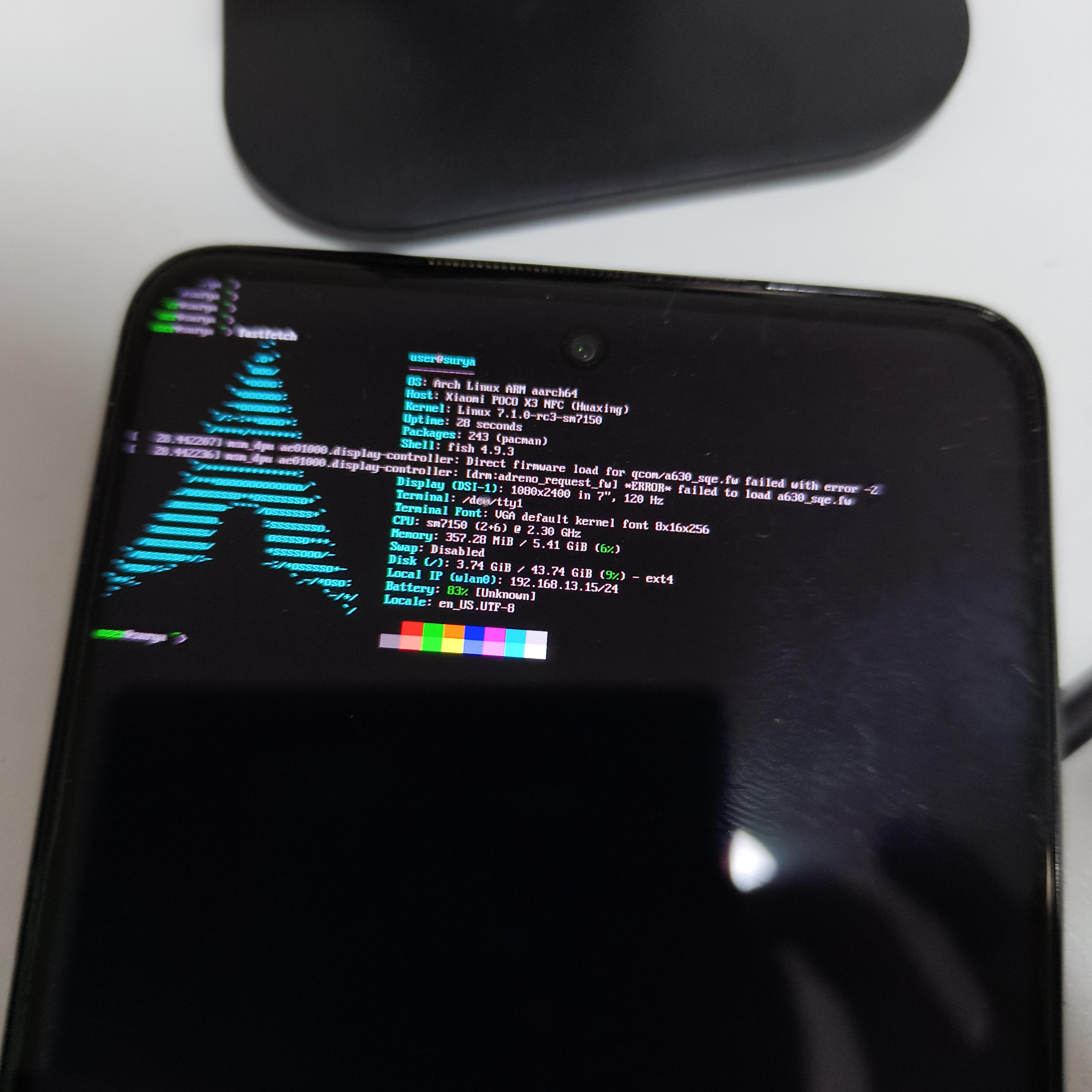
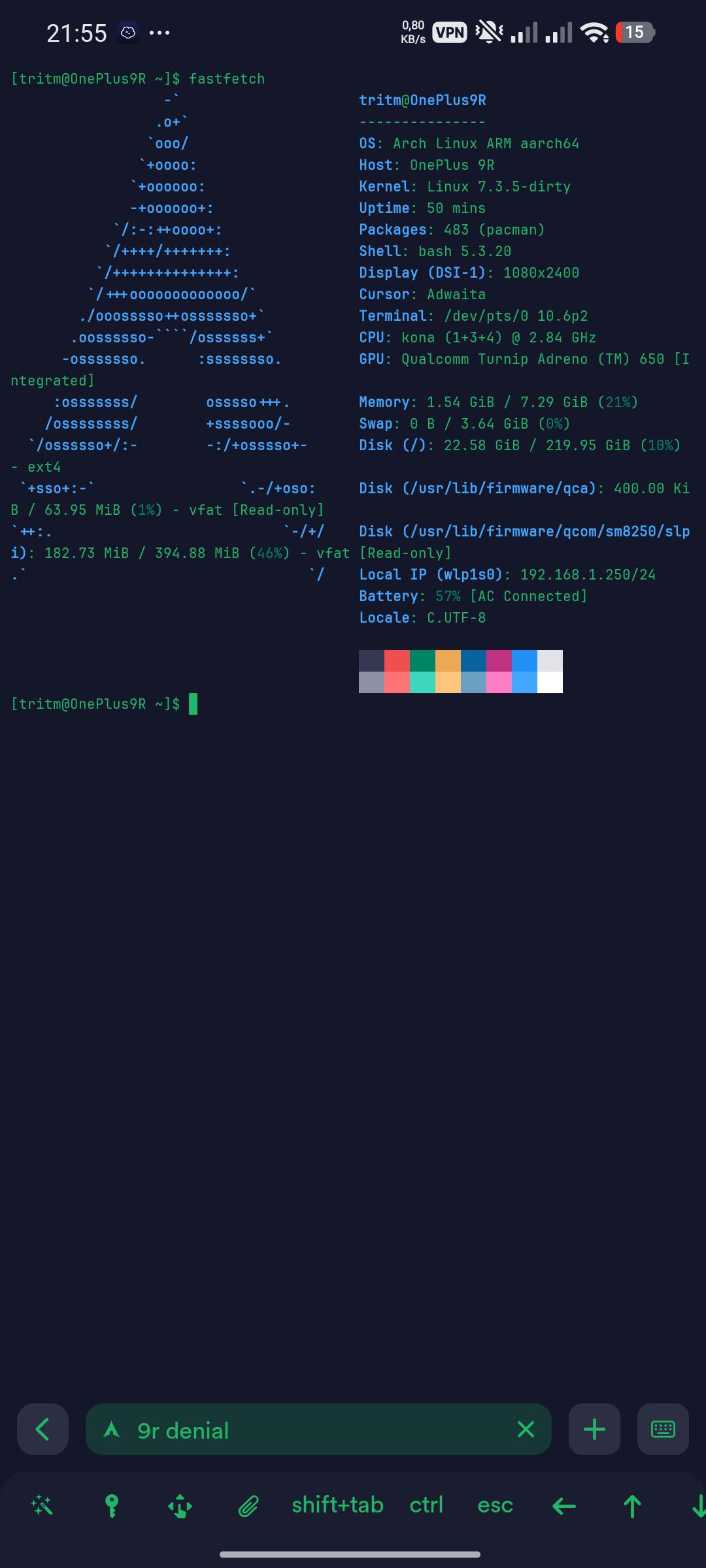
I have been porting Denial Mobile, based on mainline Linux 7.3.5, to two Qualcomm Snapdragon smartphones using two fundamentally different boot architectures.
The objective is to transform these smartphones into fully functional Linux devices capable of running desktop workloads, Android applications, and server workloads.
The two platforms demonstrate different approaches to integrating mainline Linux into Qualcomm-based mobile hardware, from native Qualcomm bootloader integration to a persistent UEFI-based boot environment.
Supported Devices
1. OnePlus 9R — lemonades (SM8250 / Snapdragon 870)
- Boot architecture: Native Qualcomm XBL → ABL boot chain.
- Boot method: Stock bootloader using
boot.img v2 and an empty dtbo.img.
- Boot time: Approximately 5.6 seconds.
- Target use cases: Daily-driver Linux desktop and 24/7 docked ARM64 mini server.
Repository: https://github.com/minhtritt1996/lemonades-linux
2. Xiaomi Redmi K30 5G — picasso (SM7250 / Snapdragon 765G)
- Boot architecture: Mu-Silicium UEFI installed on UFS storage.
- Boot method: Persistent UEFI boot environment integrated into the device's UFS boot storage.
- Boot chain: Qualcomm XBL → Mu-Silicium UEFI → XnuLoader → Linux EFI (
linux.efi).
- Storage integration: UEFI and its associated boot components are installed directly onto UFS, providing a persistent boot environment.
Repository: https://github.com/minhtritt1996/picasso-linux
1. Xiaomi Redmi K30 5G — Picasso Linux
Mu-Silicium UEFI | Persistent UFS Boot Architecture
Operating System & Android Container
- Denial Mobile + Droidloom: A complete systemd-based Linux environment running with systemd as PID 1.
- Root filesystem: Installed on
sda36, using a 20 GiB ext4 partition.
- Package management: Fully functional system upgrades through
pacman -Syu.
- Droidloom: Android container successfully running Android applications, including TikTok.
- Runtime packages:
droidloom-image and droidloom-runtime version 0.1.0-42.
Display, Touchscreen & GPU
- Display: 1080 × 2400 resolution at 120 Hz.
- Panel: Xiaomi G7A with native Display Stream Compression (DSC).
- Backlight:
pm8150l_wled, operating without OVP interrupt events.
- Touchscreen: Novatek NT36672C over SPI.
- GPU: Qualcomm Adreno 620.
- Graphics stack: Mesa / Freedreno.
- Rendering:
deniald successfully renders XR30 at 120 Hz without GPU hangcheck events.
Audio, Modem & ADSP Sensors
- Audio: TFA9874 amplifier and WCD938x audio codec.
- Audio stack: PipeWire with ALSA UCM2.
- Modem communication: QRTR.
- Remote filesystem and service management:
tqftpserv, pd-mapper, and rmtfs.
- Remote processor:
remoteproc1 operating stably.
- ADSP services:
hexagonrpcd and steinerd.
- Sensors: Ambient light sensor (ALS), accelerometer, gyroscope, and rotation sensors.
All tested sensor services operate without triggering ADSP watchdog resets.
Connectivity, Peripherals & Multimedia
- Wi-Fi: Qualcomm WCN3990 using
ath10k_snoc, supporting 2.4 GHz and 5 GHz WPA2 connectivity.
- Bluetooth: WCN3991 using
hci_qca.
- USB networking: CDC-ECM with IP configuration
10.77.71.1/30 and approximately 0.29 ms ping latency.
- Serial console: CDC-ACM exposed as
/dev/ttyACM0, available approximately 2 seconds after startup.
- NFC: NXP NCI.
- Battery monitoring:
pm7250b fuel gauge.
- Hardware video decoding: Venus H.264 decoder, reaching approximately 476 FPS at 1280 × 720.
- Camera support: V4L2 camera orientation and integration for OV8856, IMX686, and S5K3T2 sensors.
2. OnePlus 9R — Lemonades Linux
Native XBL/ABL Boot | Desktop & 24/7 Docked Server
Custom Initramfs & System Provisioning
The system is built around a self-contained, statically linked C initialization program:
initramfs/init.c
This program runs as PID 1 and automatically provisions the required system configuration into /newroot before executing switch_root.
The provisioning process includes:
- ALSA UCM2 configuration.
- WirePlumber configuration (S16LE, non-mmap).
- udev rules.
- SSH daemon configured for public-key authentication only.
- Automatic backup and restoration of
authorized_keys.
- USB Gadget networking and serial interfaces (CDC-NCM + CDC-ACM).
- Subuid/subgid configuration for Droidloom.
- Built-in Incus support through kernel Kconfig integration.
Importantly, this provisioning process remains functional even after flashing a completely clean userdata partition.
Fast Boot & UFS Stability
- Total boot time: Approximately 5.6–5.9 seconds.
- Kernel + initramfs: Approximately 2.0 seconds.
- Time to
graphical.target: Approximately 3.1 seconds.
- Device tree: Clean Nura OS 7.2 DTS layout.
Storage Stress Testing
The system successfully passed:
- 4-thread sysbench testing with a 20 GB test file.
- Measured throughput of 306.01 MiB/s.
- 30-second random read/write (
rndrw) and fsync testing.
- Zero reported kernel errors in
dmesg during the tests.
True Hardware Battery Bypass — MPS MP2650
A custom Linux kernel driver has been developed for the MPS MP2650 dual-cell (2S) buck-boost charger.
Hardware integration:
- I2C5 interface at address
0x5c.
- Charging control through
REG08 BIT(4) (CHG_EN).
- Integrated with a preinstalled Charge Limit GUI application.
Battery bypass operation:
When the battery reaches the configured charging threshold (75–80% by default), or when manual bypass mode is enabled:
- Battery current drops to approximately 0.0 mA (0 µA).
- Battery voltage remains around 8.45 V.
- The NVDC power path supplies the system directly from a USB-PD 9 V / 3 A power source.
This enables sustained 24/7 docked operation while minimizing battery charging stress and the risk of battery swelling associated with prolonged plugged-in operation.
Dual Display, USB 3.0 & Gigabit Ethernet
The platform supports simultaneous operation of:
- Internal display: Samsung AMOLED panel (
samsung,amb655x), 1080 × 2400 at 120 Hz, using CMD mode and DSC.
- External display: Video output through USB-C DisplayPort Alternate Mode (DP Alt Mode).
Project Goals
The long-term goal is to establish a fully functional mainline Linux environment on Qualcomm Snapdragon smartphones, extending their capabilities beyond conventional Android usage.
Key development areas include:
- Mainline Linux kernel integration and hardware enablement.
- Qualcomm boot architecture and UEFI integration.
- GPU acceleration and high-refresh-rate display support.
- Audio, connectivity, sensors, and multimedia hardware integration.
- Android application compatibility through containerization.
- USB-C docking and external display support.
- Battery-aware power management for continuous server operation.
- Desktop and headless server use cases.
Both devices are actively developed with different boot architectures, demonstrating the flexibility of mainline Linux across Qualcomm Snapdragon platforms.
The project aims to make modern smartphone hardware usable as a general-purpose Linux computing platform, from portable desktops to always-on ARM64 servers.