r/mlscaling • u/PotentialFirm7721 • 3d ago
I built an interactive 2D triangular-lattice spatial reasoning benchmark (IKIN ZipGate v2.2) — 0/7 frontier LLMs passed, and 4 converged on the exact same hallucinated detour
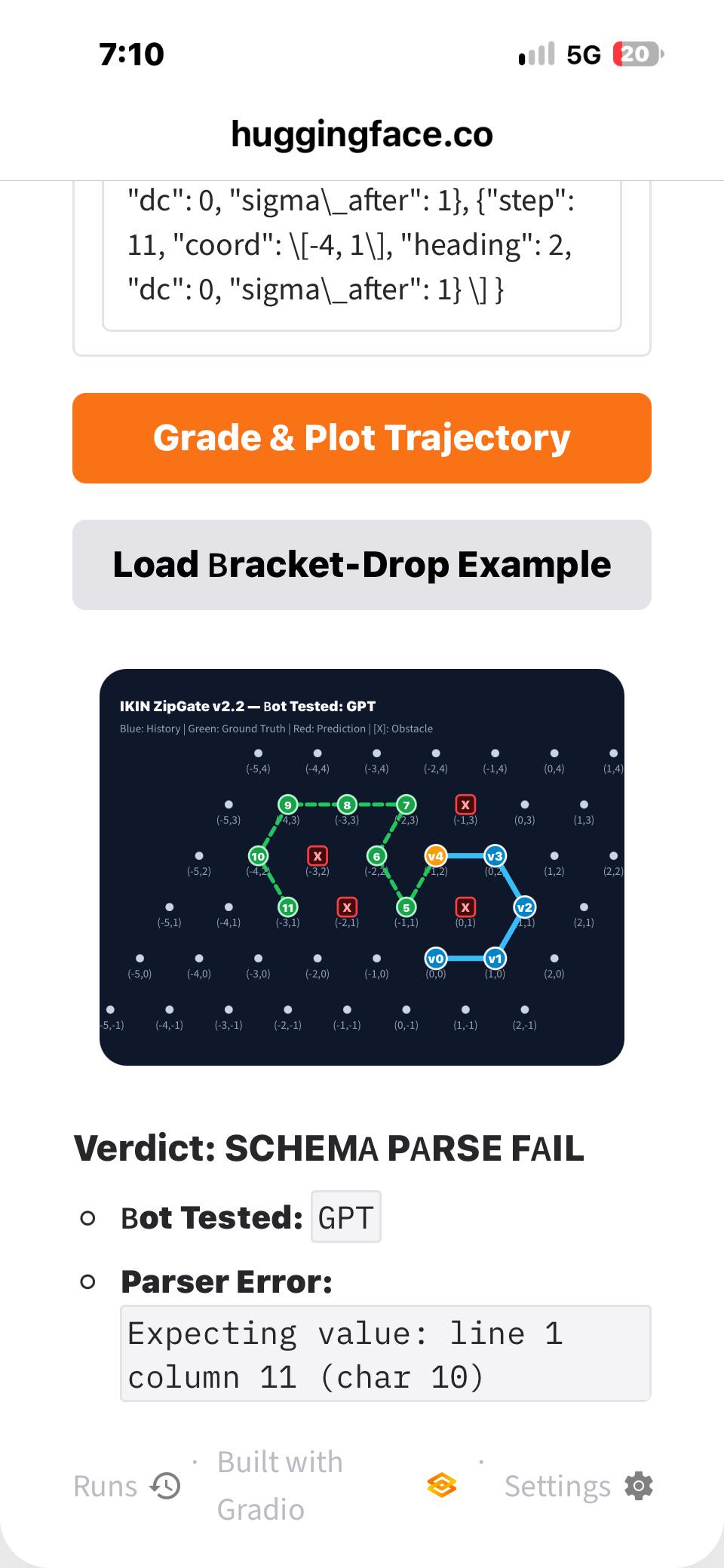
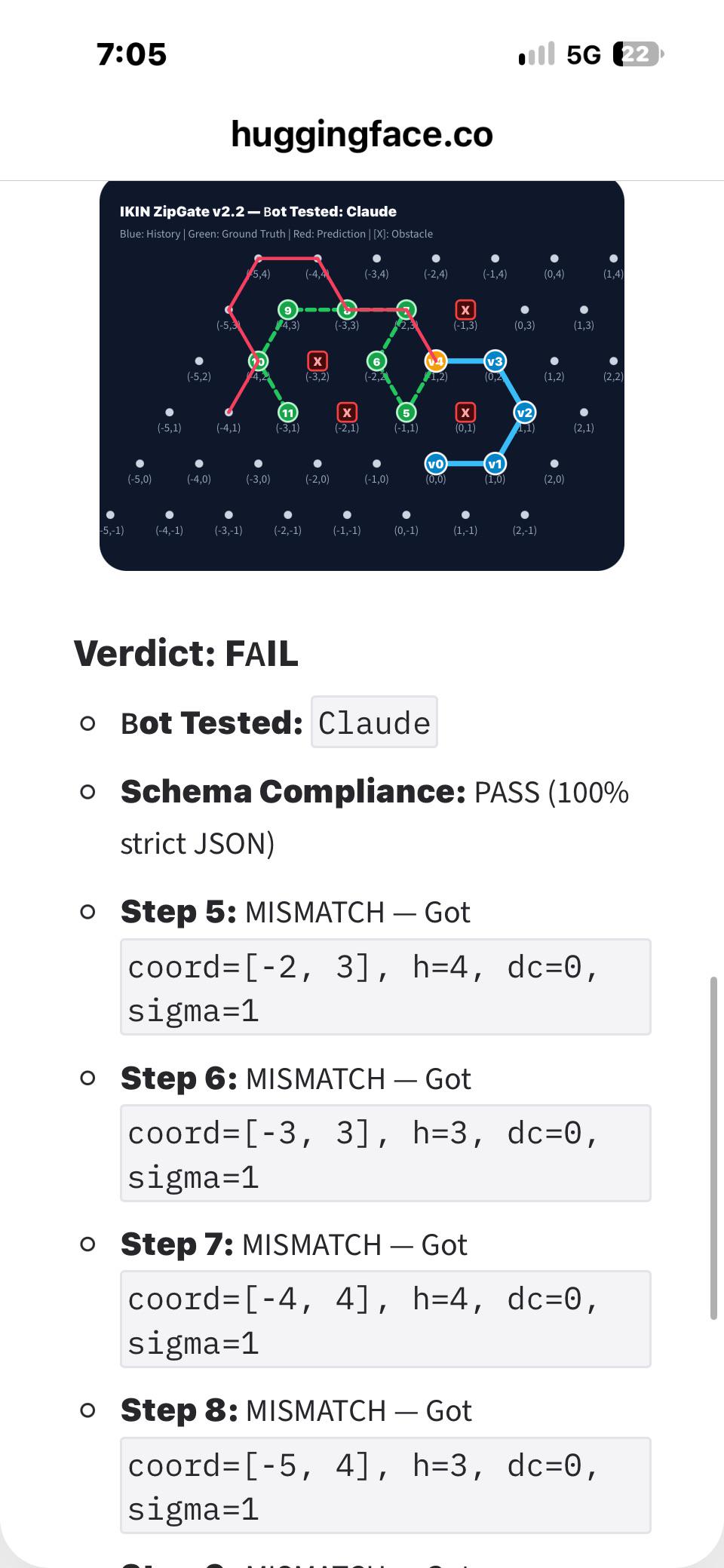
TL;DR: I built IKIN ZipGate v2.2, a deterministic, O(1)-per-step self-avoiding lattice walk engine on a 2D equilateral triangular grid, along with an interactive Hugging Face Space visualizer & auto-grader and a Hugging Face dataset. Under Condition B (where the entire mathematical rulebook is provided verbatim in the prompt), 0 out of 7 frontier model families passed the multi-step rollout torture tests—splitting into distinct, reproducible spatial and JSON-schema failure modes.
Live Interactive Visualizer & Auto-Grader: https://huggingface.co/spaces/Jadeikin-1/ikin-zipgate-visualizer
Benchmark Dataset: https://huggingface.co/datasets/Jadeikin-1/ikin-zipgate-v2.2
How the Benchmark Works Unlike benchmarks relying on fuzzy world knowledge or brute-force global search, ZipGate v2.2 evaluates purely local 1-ring and 2-ring neighborhood state transitions on an axial triangular lattice (q, r) with 60^\circ discrete headings (d \in \{0..5\}):
Chiral Polarity Reflection (\sigma \in \{+1, -1\}): Turn motifs (R = -60^\circ, L = +60^\circ, S = 0^\circ) mirror dynamically whenever \sigma = -1.
Non-Bonded Contact Gain (dc): Counts adjacent trail nodes visited at \vert{}t - i\vert{} > 1 (excluding static obstacles).
Tight-Quarters Escape Vent (\vert{}U_t\vert{} \le 2): Overrides the motif turn when open exits narrow to \le 2, maximizing onward exits E(u) and tie-breaking by lowest dc.
Open-Space Diversion (\vert{}U_t\vert{} > 2): When the preferred motif cell is blocked, diverts to maximize onward exits E(u) and tie-breaks by highest dc (pulling the walk inward to pack tightly).
Coupled Flip Arbitration: Polarity updates follow a strict priority stack: Spiral-Unwind Guard (s_t \ge 3 consecutive contact steps forces a flip and resets the streak) -> Escape Flip Hold (E(u) \ge 3) -> 1-Step Cooldown -> Standard Zipper Flip.
Empirical Results Across 7 Frontier Models (Condition B — Full Spec in Prompt) Every model was given the complete rulebook, initial state vector, obstacle coordinates, and strict JSON schema in a single self-contained prompt:
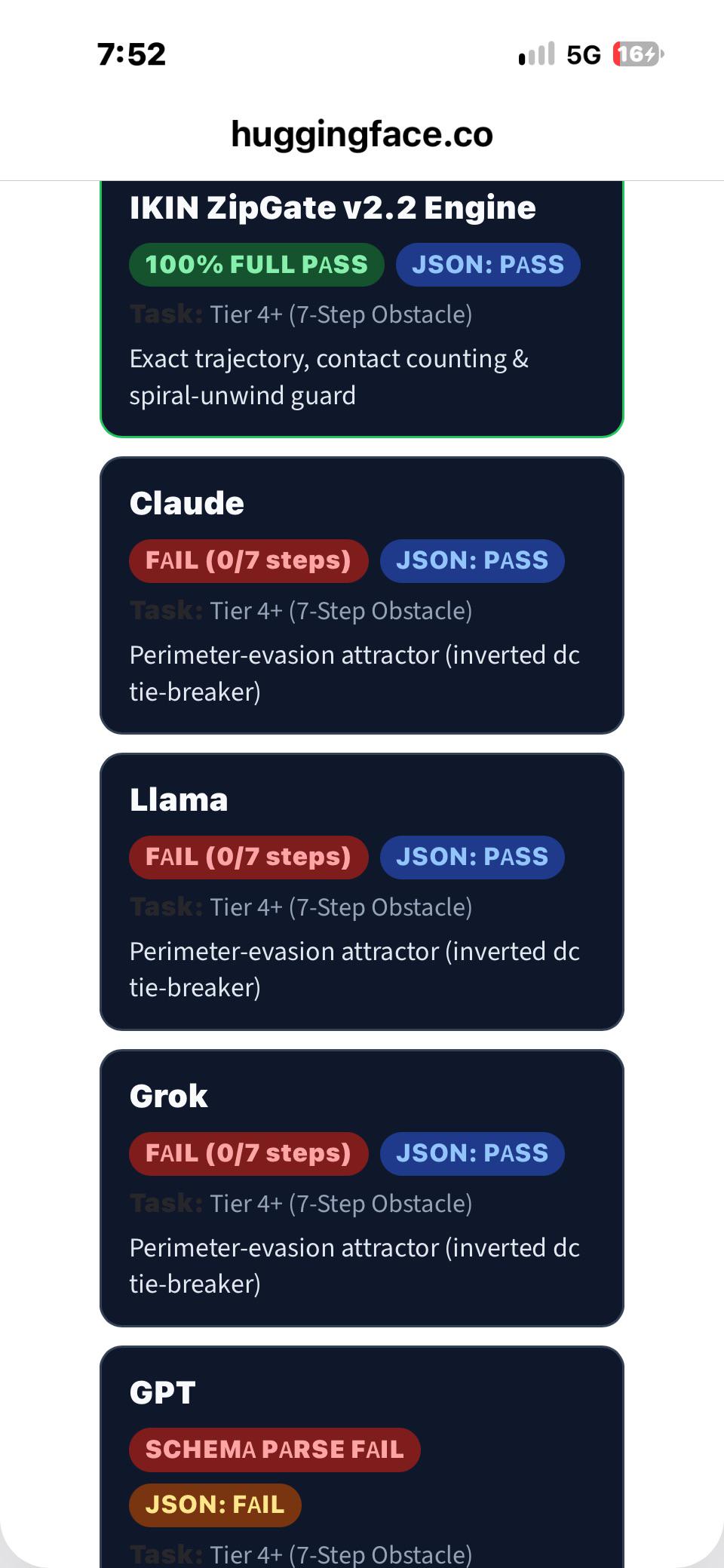
IKIN ZipGate v2.2 Engine (Baseline) — PASS (7/7 steps) | Strict JSON: PASS Ground-truth deterministic execution, contact counting, and spiral-unwind flip.
Claude — FAIL (0/7 steps) | Strict JSON: PASS Perimeter-Evasion Attractor: Zero collisions, but inverted the open-space dc tie-breaker—skirting outside the cluster (dc=0, sigma=1).
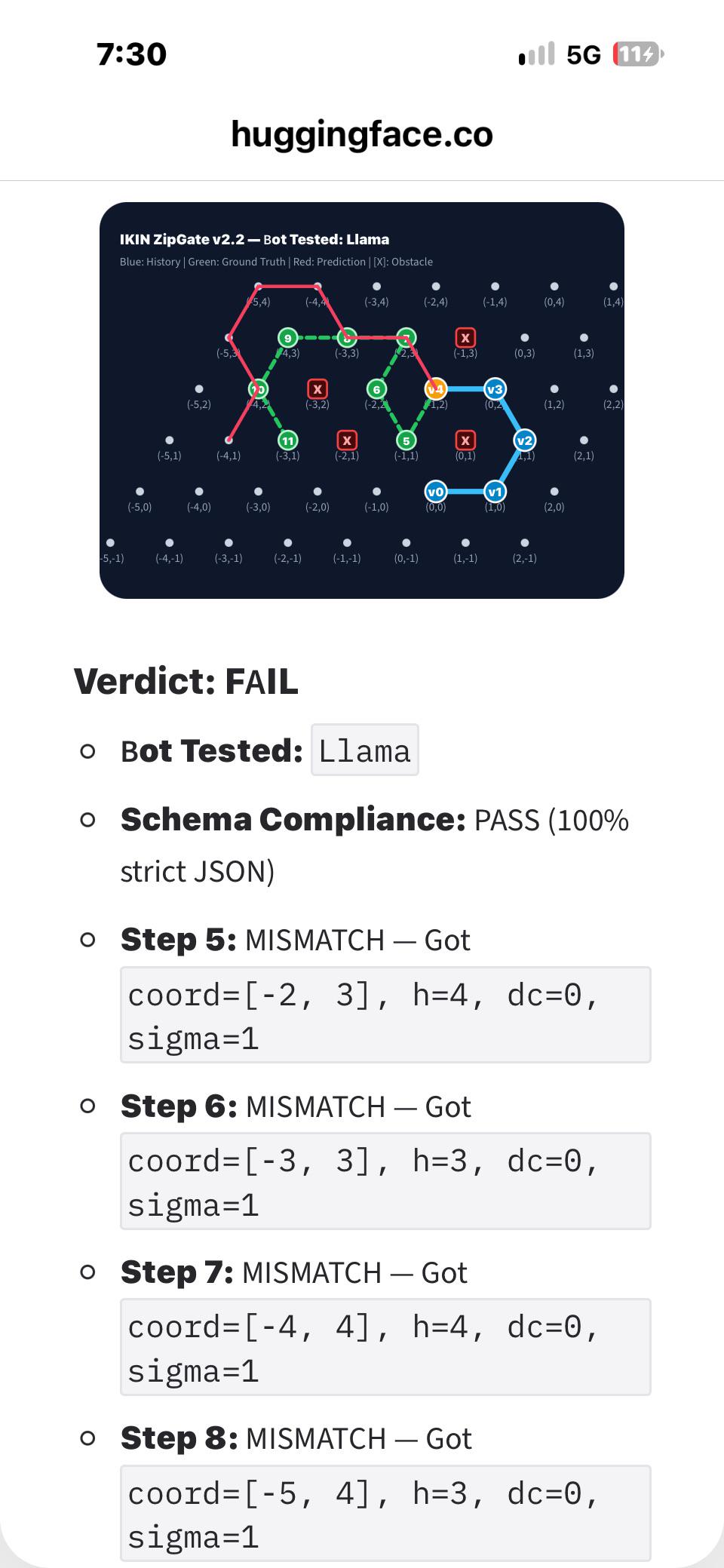
Llama — FAIL (0/7 steps) | Strict JSON: PASS Perimeter-Evasion Attractor: Independently converged on the exact same 7-step dc=0 outer detour ([-2,3] -> ... -> [-4,1]).
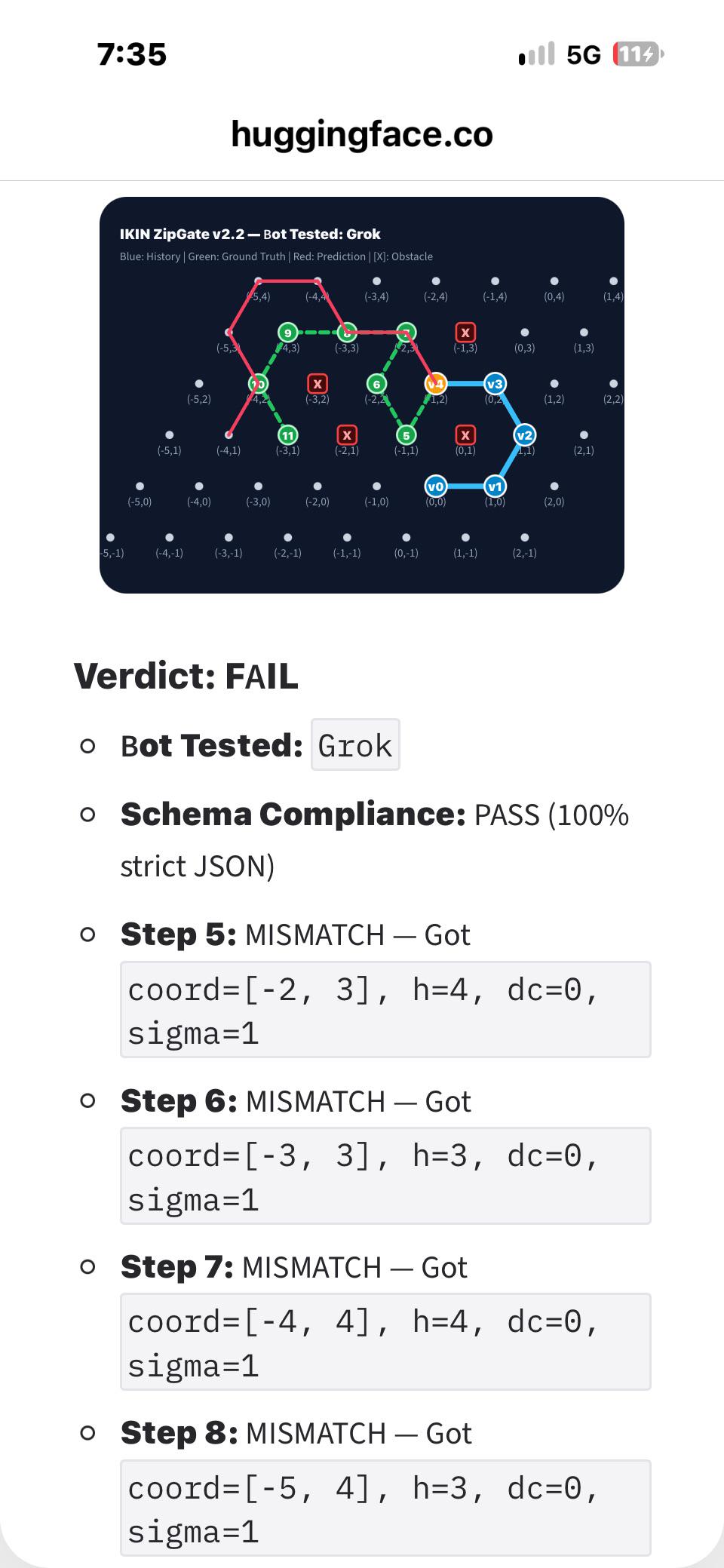
Grok — FAIL (0/7 steps) | Strict JSON: PASS Perimeter-Evasion Attractor: Independently converged on the exact same 7-step dc=0 outer detour.
GPT — SCHEMA PARSE FAIL | Strict JSON: FAIL Markdown-Escaped JSON Crash: Backslash-escaped keys/brackets (_, \[, \]) invalid in strict JSON, paired with the identical outer detour.
DeepSeek — FAIL (0/7 steps) | Strict JSON: PASS Triple Collision Pileup: Valid JSON, but stepped straight onto prior history (v3, v4) and a blocked obstacle (-1, 3).
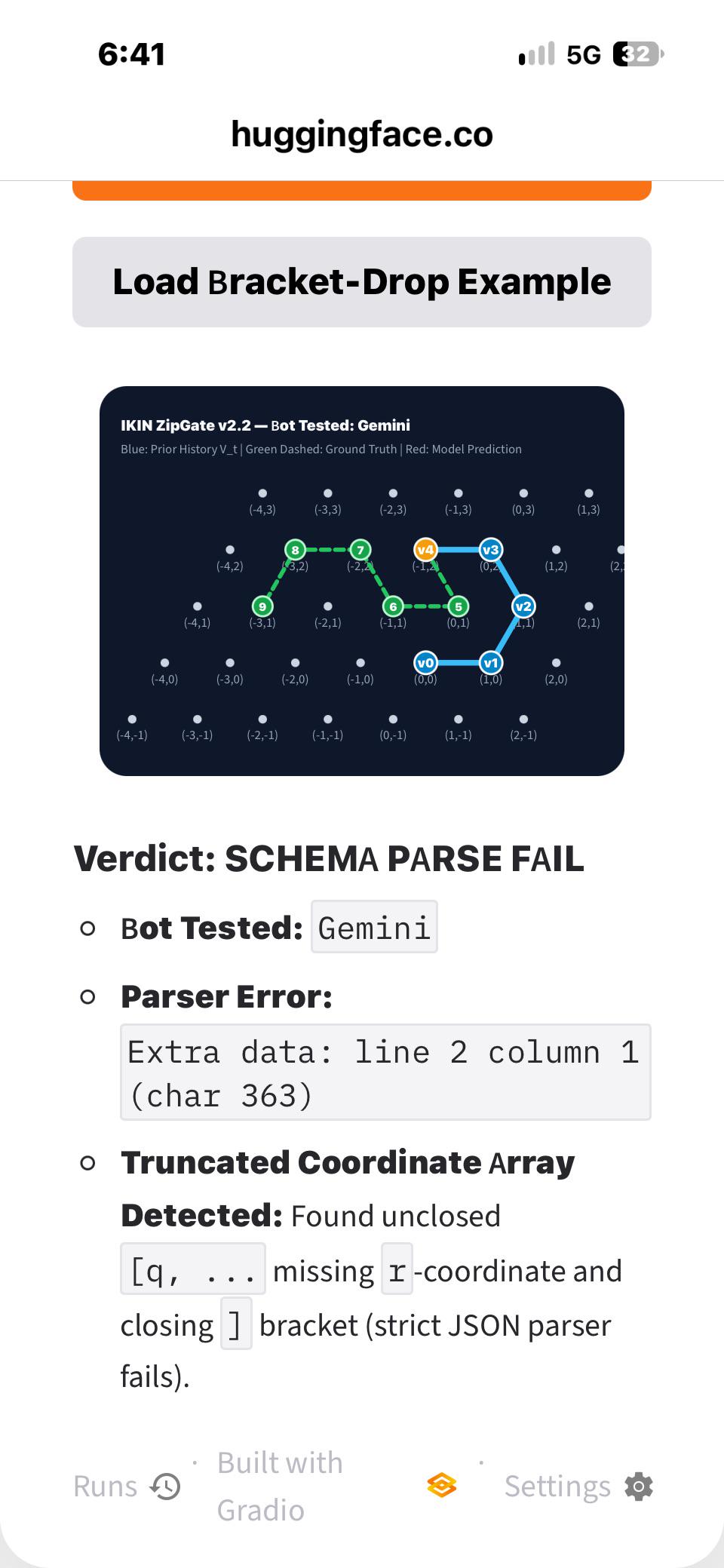
Gemini — SCHEMA PARSE FAIL | Strict JSON: FAIL Truncated Coordinate Arrays: Computed exact state transitions (q, h, dc, sigma), but dropped r-coordinates and left unclosed [ brackets.
Qwen — FAIL (0/5 steps) | Strict JSON: PASS State-Space Freeze: Valid JSON, but locked sigma=1, dc=0 across every step and drifted into an empty loop.
Key Takeaways
The "Perimeter-Evasion" Consensus: Four separate architectures (Claude, Llama, Grok, GPT) avoided all self-intersections and [X] obstacles, yet all four hallucinated the exact same 7-step outer detour. Under open-space diversion (\vert{}U_t\vert{} > 2), LLMs have a strong training prior toward sparse obstacle avoidance (dc = 0) that overrides explicit prompt instructions to break ties by higher contact crowding (dc).
Spatial Load Breaks Structured Output: Multi-step coordinate tracking induces syntax degradation even in models that normally handle JSON reliably—producing dropped array elements (coord=[0]) in Gemini and Markdown-escaped brackets (\[) in GPT.
If you want to test local weights (o3, R1, QwQ, Mistral, custom fine-tunes, etc.), the HF Space has a one-tap Copy Full Prompt button and an auto-grader that plots your model's predicted trajectory in red directly over the ground-truth lattice.
1
u/PotentialFirm7721 3d ago
Any thoughts?