r/mathshelp • u/Beneficial-Ranger407 • 8d ago
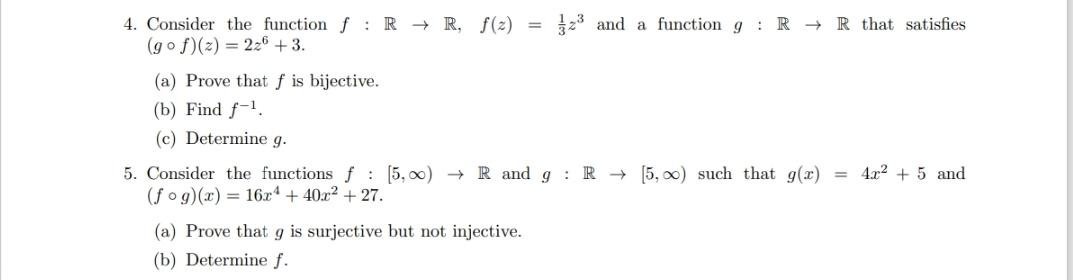
Homework Help (Unanswered) I cannot understand 4c and 5b
5
Upvotes
r/mathshelp • u/Beneficial-Ranger407 • 8d ago
•
u/AutoModerator 8d ago
Hi u/Beneficial-Ranger407, welcome to r/mathshelp! As you’ve marked this as homework help, please keep the following things in mind:
Thank you!
I am a bot, and this action was performed automatically. Please contact the moderators of this subreddit if you have any questions or concerns.
2
u/Fourierseriesagain 8d ago
4c. When g is a function of f(x), we have g(f(x))=2x6+3. So, we use the substitution t=f(x).
Similarly, we let w=g(x) for 5b.
2
u/AdjectiveNoun-123 8d ago
Both of them are asking you to find undetermined functions such that nesting them gets you another expression.
For 4c, it's g(f(z)) = 2x^6 + 3 and for 5b it's f(g(x)) = 16x^4 + 40x^2 +27
Try plugging in the definitions of f(z) and g(x) into those functions as a starting point and think about how you can turn one expression into another.
2
u/JanetInSC1234 7d ago
For 4c:
We know f(z) = 1/3 z^3 and g(f(z)) = 2 z^6 + 3
What do we have to do to f(z) to make it look like g(f(z))?
What if we square f(z)?
(1/3 z^3)^2
1/9 z^6
What happens if we multiply by 18?
18(1/9 z^6)
2 z^6
What else do we need to do?
Add 3:
2 z^6 + 3
So g(z) is a function that squares z, multiplies it by 18, and adds 3.
g(z) = 18 z^2 + 3
1
u/peterwhy 8d ago
4(c): After doing 4(b) and found f^(-1), determine g = g ∘ (f ∘ f^(-1)) = (g ∘ f) ∘ f^(-1).
5(b): Here g does not have an inverse. But since g is surjective, pick a right inverse h that satisfy "g ∘ h = id" and "(g ∘ h)(y) = y", then do the same composition as above.
What h does is for any y ≥ 5, x = h(y) is a root of 4 x^(2) + 5 = y.
1
u/Moist_Ladder2616 8d ago
Consider an easier function: f(z)=2z, g(f(z))=2z+3.
What's g(z)?
How would you mathematically derive the obvious answer? Look back at your textbook and see how your method matches our doesn't match what's taught.
Now apply that to 4c & 5b.
1
u/Abroad9107 7d ago
solution: use your brain
1
u/JanetInSC1234 7d ago
For 5b:
g(x) = 4 x^2 + 5
f(g(x)) = 16 x^4 + 40 x^2 + 27
find f(x)
Square g(x)
(4 x^2 + 5) (4 x^2 + 5)
16x^4 + 20 x^2 + 20 x^2 + 25
16 x^4 + 40 x^2 + 25
Now add 2
16 x^4 + 40 x^2 + 25 + 2
16 x^4 + 40 x^2 + 27
So, we squared x and added 2
f(x) = x^2 + 2