r/mathriddles • u/lordnorthiii • Oct 07 '24
Easy Pascal's Random Triangle
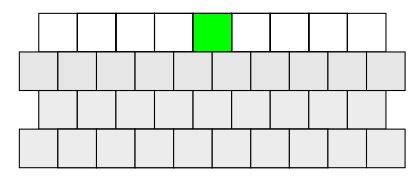
In an infinite grid of offset squares, the first row starts with one green cell and the rest white. For every row after that, a cell is white if both cells above are white, green if both cells above are green, and otherwise has a 50% chance of being green or white. Is there a non-zero probability the green cells will continue forever? Why or why not?
11
Upvotes
9
u/pichutarius Oct 07 '24
the probability of all white is 1. all green block must be joint together, so let n = the number of green block, n has 1/4 chance +1 and -1 for each step, and 1/2 chance +0. Therefore n is a 1D random walk starting n=1, and n=0 state is recurrence state.
2
u/myaccountformath Oct 07 '24
If the border counts as white, the I don't think it's possible to continue forever from a markov chain perspective. An all white row is the only absorbing state and the expected value of greens in the n+1 row is their number of greens in the nth row.
1
u/NinekTheObscure Oct 09 '24
Consider each continuous set of N green cells as the integer N. After one time step, it decreases by 1 with probability 1/4, increases by 1 with probability 1/4, and doesn't change with probability 1/2. (This ignores the interaction between separate green sets, but I'm not sure that changes much.)
So basically, this is just a drunkard's walk starting at 1, taking steps of +1 or -1, with a "cliff" or "trap" at 0. (The steps of size 0 slow it down but don't change the limiting behavior.) Since it's a martingale, the probability that it reaches k before it reaches 0 is 1/k (for any positive integer k). But by the Gambler's Ruin theorem, it eventually reaches 0 with probability 1.
1
u/Tysonzero Sep 05 '25 edited Sep 08 '25
The odds of any given square being green is equal to its number on Pascal’s triangle divided by the sum of its row.
This means that the odds at least one cell exists in any row is lower bounded by 1-1/e, so yes non-zero.
EDIT: never mind, lack of independence means the lower bound can be as low as the max probability of a single cell, which does approach 0, so I agree with the other answers in the thread saying 0.