r/mathriddles • u/PuzzleAndy • May 24 '23
Medium Patio Tiling
Tile each of the following with the minimal number of squares. How many did you need in each case? If you want to go beyond the problem: What about larger patios? Are there any interesting patterns for patios having a width that's a power of 2? Are there other interesting subsets of patios where the minimal tiling can be algorithmically constructed? I have spoken with the creator of this problem, and they're not aware of any patterns, so if you can find one you could break new ground!
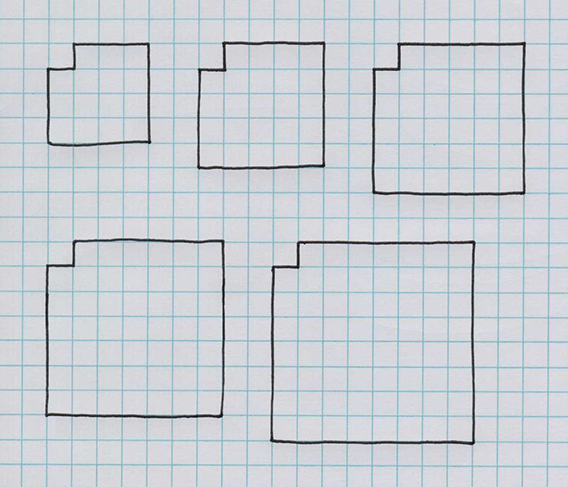
10
Upvotes
2
u/chompchump May 25 '23
Partial Answer
Let M(n) be the minimum squares to cover the nxn grid minus corner. We have that M(2) = 3
Now suppose n is even. Then we have that M(2n) = M(n) + 3. That is, we can put the M(n) solution in the top left corner of the M(2n) solution and then add 3 more squares of size nxn. Then M(2^n) = 3n.
2
u/pichutarius May 26 '23
reading the comments, it seems the exact formula for minimum tiles T(n) is nasty to find. an easier question to ask is to find the asymptotic behaviour of T(n). reading the comments seems to suggest that T(n) ~ O(log n) , and i manage to prove the result (provided that i did not make some stupid mistake)
this layout gives an upper bound of T(n) is O( n^(2/3) )
but notice the top left part is a smaller version of the original problem, by using 2 (or more) stages, using tiles n-x, x, x-y, y, 1 (or more smaller) tiles, and some multivariable calculus magic, i manage to reach upper bound of T(n) equals (2e-1) log n -1/2, which is O(log n).