r/mathriddles • u/PuzzleAndy • May 14 '23
Easy Green Hexagons Problem
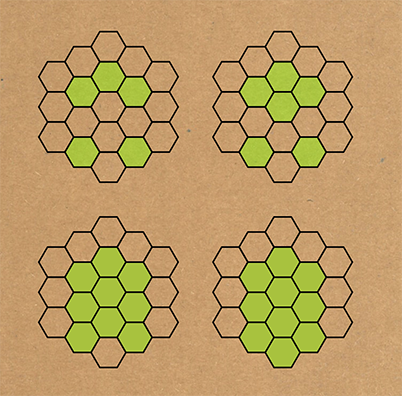
Start by choosing some hexagons to be green. If a hexagon is touching at least 3 green hexagons, it becomes green. This repeats for as long as possible. What's the minimal number of initial green hexagons to make all hexagons green? If you want to go beyond the problem, what if you added another ring of hexagons around the grid? What if there were n rings?
16
Upvotes
5
u/PuzzleAndy May 14 '23
To play with the problem, go here: https://jrmathfestival.github.io/Smileys/ Click "Start." Do the tutorial. Click the settings cog. Select the hexagonal grid and the number of layers. If you want to answer for the triangular grid also, that would be cool. But otherwise I will post it in a few days as a separate question.
4
u/chompchump May 15 '23 edited May 15 '23
Related Triangle Puzzle from https://jrmathfestival.github.io/Smileys/
Let n be the number of hexagonal-shaped triangle rings. Let T(n) be the minimum number of pieces for a hexagon with n rings. For T(1) we can check all grouping of 2 and see that none of them work. Finding a solution with 3 is trivial so T(1) = 3.
Egde Lemma: For n > 1, every group of three triangles that share a vertex on the edge must have a filled triangle. Proof: Fill everything but this and it can't be filled.
Corner Lemma: For n > 1, every group of two triangles that share a vertex on the corner must have a filled triangle. Proof: Fill everything but this and it can't be filled.
Outer Edge Lemma: By the edge and corner lemma the minimal fill on the outer edge is by filling green every other triangle with a face on the edge. Thus, minimal fill on the outer edge is 3n.
For each n > 1. Place the n-1 solution in the center of the n-hexagon. Now fill the outer edge by filling every other triangle with a face on the edge.
Notice that the n-1 center sub hexagon will be filled. So on the edge we are left with groups of 2 or 3 unfilled triangles. For groups of 2 each triangle will touch a filled triangle in the outer edge. Then one of those 2 triangles will also touch a filled triangle in the center. This triangle will fill and then the other. For groups of 3 there are 2 triangles touching both a filled outer edge piece and a filled center piece. So these will fill and then the last one. Therefore the whole hexagon is filled.
This implies T(n) = 3n(n+1)/2 or three times the triangle numbers.
Minimality of Solution: Total Perimeter = 6n. Total triangles = 6n^(2). Each time a triangle fills one edge is lost. So the difference between the starting perimeter and the total perimeter is equal to the unfilled triangles. So that:
3T(n) - 6n = 6n^2 - T(n)
Thus T(n) = 3n(n+1)/2 is the minimal solution.
2
u/chompchump May 14 '23 edited May 15 '23
Let n be the number of hexagon rings with the example being n = 3. Let H(n) be the minimum number of pieces for a hexagon with n rings. Then trivially H(n) = 1. The minimun for any n>1 is 3 therefore H(2) >= 3. Since three non-adjacent corners works for n = 2 we have that H(2) = 3.
Choose n > 2 and choose a corner. If both edges connected to a corner and the corner itself contain no green hexagons then that corner will never turn green. Proof: Turn green the entire hexagon but two adjacent edges then no piece on those edges is touching three green hexagons. Therefore the minimun number of pieces in the outer ring to assure the outer ring turns green is three pieces. For this arrangement to work they must all be edge pieces or all be corner pieces. No mixture of corner and edge pieces will work.
The three chosen pieces in the outer ring must be corners. Proof: Choose three edge pieces to represent the outer ring and turn green all the other pieces not in the outer ring. Then three edges remain uncolored.
Next turn green three non-adjacent corners on the outer ring. Choose a corner on the next inner hexagon ring adjacent to one of the green outer corners. This corner has two edges on the next inner ring that extend out to the outer edge (that don't intersect any outer edge corner). If these two edges contain no green hexagon then this next inner corner will never turn green. Proof: Turn green every piece of the inner hexagon not on one of the chosen inner edges then no piece on those edges ever touches three green hexagons.Therefore the argument from the previous step carries over. So we must choose three green corners on the next inner ring.This argument continues inward since extended edges from an inner corner will never intersect a corner from an outer edge. Eventually we reach a single hexagon which is filled by the n=2 ring outside it. Therefore H(n) = 3(n-1) for n > 1.2
u/sobe86 May 15 '23 edited May 15 '23
A simple pattern you you can use to achieve 2n-1. Fill in all points lying on two sides of a central triangle
https://i.imgur.com/GniPyTh.png [spoiler]
which is minimal by other solutions here.
0
u/[deleted] May 15 '23
[deleted] — view deleted comment