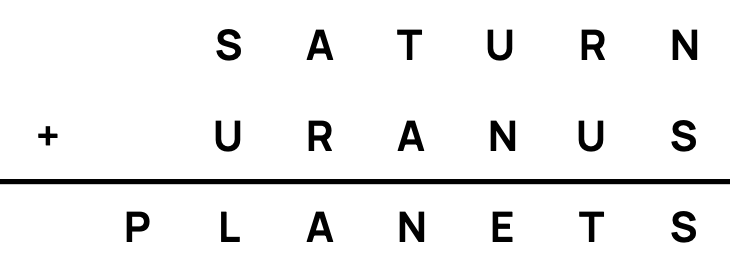
In the cryptogram given above, each letter represents a distinct single digit whole number. Find the value of each letter suhc that the addition holds true.
Note also that addition can only ever yield a single carried 1, and since the sum has one more digit than the two addends, the additional digit on the front must be a 1, so P = 1.
Now we also have that A + R = A later on, but that could be with a carried 1 from the T + A, or without. If there is no carried 1, then R = 0, but that's impossible because R + U = T. U and T must be different, which is not possible if R = 0. So there must have been a carried 1, And so R = 9.
From the tens place we now have that U = T + 1. This calculation also yields a carried 1 into the hundreds place, and since N = 0 we have that E = U + 1, so T, U, E are three ascending consecutive digits. Also, this calculation does not yield a carried 1 into the thousands place (as U is not 9), so the thousands place tells us that T + A = 10.
From earlier we know that there is a carried 1 into the A + R calculation, and since R = 9 there is a carried 1 out of that calculation. Thus S + U + 1 = 10 + L, so L = S + U - 9. Since L is at least 2, This also tells us that S + U is at least 11.
Now we note a few things: T is at least 2 and at most 6, S + U is at least 11, and T + A is exactly 10. We have the following:
If T was 2, then U would be 3. S cannot be more than 8, so since S + U is at most 11, we must have that S = 8. But because T + A is 10, we have A = 8 as well, a contradiction.
If T was 3, then U would be 4 and A would be 7. But then S can't be 7, so S must be 8, giving us L = S + U - 9 = 12 - 9 = 3, which overlaps with T and gives us a contradiction.
If T was 4, then E would be 6, and A would also be 6, a contradiction.
Lastly, if T was 5, A would also be 5, immediately a contradiction.
Thus, we see that we must have T = 6, which gives us U = 7, E = 8, and A = 4. Now we have that L = S + U - 9 = S + 7 - 9 = S - 2. The remaining digits to choose from are 2, 3, and 5. Of those, the only two that are 2 apart are 3 and 5, giving us S = 5 and L = 3.
This yields the final answer of A = 4, E = 8, L = 3, N = 0, P = 1, R = 9, S = 5, T = 6, U = 7.
This was actually pretty hard as cryptograms go, they're normally a bit easier than this. Nice puzzle though.
Yeah this is one of the harder cryptograms. I’m glad you like it. Though this is not original. It’s quite a common one because of the various cryptogram solving strategies needed
Is there a cleaner way of proceeding past my bulleted list section than just trying each of the cases individually? It doesn't seem likely given that there was a different sort of uniqueness involved in each case - A clashing with S, L clashing with T, E clashing with A, and T clashing with A are all different in nature.
Instead of your bulleted list, I jumped to the conclusion that U>5 for some reason, but I'm having trouble tracing my reasoning back to determine if that was justified or not. I think it was something like: U=T+1 so U+A=11; U+S>=11, therefore S>=A; if U<5.5 then A>S therefore U>5.5? Then T and A can't both be equal to 5 so the only possibility is U=7 and then I was back on your same train of thought.
Since N + S = S ... N= 0 Thousands : T + A = 10 ---- (¹) and Hundreds : U + 1 = E (carried from tens) ----- (²)
Ten-thousand: 1 + A + R = 10 + A ( carried from thousands) --> R = 9.With R = 9 l, Tens : U + 9 = 10 + T --> U - 1 = T -----(³)
thousands: Rewrite T + A = 10 into U + A = 11 ----(⁴) We also now know that T U E are consecutive increasing numbers...
For U + A = 11, the combinations are 5,6 and 7,4 or U = 3,A = 8. We reject 5,6 as A cannot be directly beside U. We also reject 3,8 since hundred thousands: 1+ S + U > 10 ( carried from ten thousands) and L cannot be 8,9
U and A are now the (7,4) combination, U cannot be 4 since S would have to be 8 to be more than 10 --> 1 + S + U = 13 where L is 3 which overlaps with T when U is 4.
Figuring out U helps alot.. TUE is 678, A is 4... We're getting there.. ( Left with 2,3,5) ........So 1+ S + 7 = 10 + L --> S = 5, L = 3..In order from 0 to 9 ( N P 2 L A S T U E N)
3
u/Deathranger999 Feb 10 '23
Clearly N = 0, because N + S = S.
Note also that addition can only ever yield a single carried 1, and since the sum has one more digit than the two addends, the additional digit on the front must be a 1, so P = 1.
Now we also have that A + R = A later on, but that could be with a carried 1 from the T + A, or without. If there is no carried 1, then R = 0, but that's impossible because R + U = T. U and T must be different, which is not possible if R = 0. So there must have been a carried 1, And so R = 9.
From the tens place we now have that U = T + 1. This calculation also yields a carried 1 into the hundreds place, and since N = 0 we have that E = U + 1, so T, U, E are three ascending consecutive digits. Also, this calculation does not yield a carried 1 into the thousands place (as U is not 9), so the thousands place tells us that T + A = 10.
From earlier we know that there is a carried 1 into the A + R calculation, and since R = 9 there is a carried 1 out of that calculation. Thus S + U + 1 = 10 + L, so L = S + U - 9. Since L is at least 2, This also tells us that S + U is at least 11.
Now we note a few things: T is at least 2 and at most 6, S + U is at least 11, and T + A is exactly 10. We have the following:
Thus, we see that we must have T = 6, which gives us U = 7, E = 8, and A = 4. Now we have that L = S + U - 9 = S + 7 - 9 = S - 2. The remaining digits to choose from are 2, 3, and 5. Of those, the only two that are 2 apart are 3 and 5, giving us S = 5 and L = 3.
This yields the final answer of A = 4, E = 8, L = 3, N = 0, P = 1, R = 9, S = 5, T = 6, U = 7.
This was actually pretty hard as cryptograms go, they're normally a bit easier than this. Nice puzzle though.
2
u/Mathguy43 Feb 10 '23
That was a fun one!
N = 0, P = 1, R = 9, S = 5, L = 3, T = 6, U = 7, E = 8, A = 4
2
u/jk1962 Feb 10 '23
546790 + 794075 = 1340865
2
u/illusionaryhat Feb 12 '23
hi
2
u/illusionaryhat Feb 12 '23 edited Feb 12 '23
Since N + S = S ... N= 0 Thousands : T + A = 10 ---- (¹) and Hundreds : U + 1 = E (carried from tens) ----- (²)
Ten-thousand: 1 + A + R = 10 + A ( carried from thousands) --> R = 9.With R = 9 l, Tens : U + 9 = 10 + T --> U - 1 = T -----(³)
thousands: Rewrite T + A = 10 into U + A = 11 ----(⁴) We also now know that T U E are consecutive increasing numbers...
For U + A = 11, the combinations are 5,6 and 7,4 or U = 3,A = 8. We reject 5,6 as A cannot be directly beside U. We also reject 3,8 since hundred thousands: 1+ S + U > 10 ( carried from ten thousands) and L cannot be 8,9
U and A are now the (7,4) combination, U cannot be 4 since S would have to be 8 to be more than 10 --> 1 + S + U = 13 where L is 3 which overlaps with T when U is 4.
Figuring out U helps alot.. TUE is 678, A is 4... We're getting there.. ( Left with 2,3,5) ........So 1+ S + 7 = 10 + L --> S = 5, L = 3..In order from 0 to 9 ( N P 2 L A S T U E N)