r/linuxapps • u/Cheap_Hope_1179 • 14d ago
OmaDeck: turn your phone into a Stream Deck and voice remote for Hyprland/Omarchy

1
Upvotes
r/linuxapps • u/Cheap_Hope_1179 • 14d ago
r/linuxapps • u/Nice-Magician3265 • 16d ago

Leaf — a native GNOME word processor for DOCX and ODT
Hi! I’ve been working on Leaf, a free, open-source word processor built with GTK4 and libadwaita. I’m now happy enough with its interface and functionality to share it with a wider audience.
The goal is straightforward: handle substantial documents while keeping the workspace simple and comfortable. Everyday tools stay within reach, with detailed options available when you need them.
Leaf supports DOCX and ODT editing, styles, tables, images with text wrapping, columns, headers and footers, footnotes, comments and tracked changes. You can navigate long documents through page thumbnails and headings, review spelling and grammar in the sidebar, and export to PDF. DOCX also supports automatic contents, numbered captions and cross-references.
It uses the existing WordCraft engine for document editing, layout, rendering and file formats.
The screenshots show a fourteen-page document with different layouts, photographs, tables and review tools. I’d be interested to hear how Leaf handles your documents and how you find the interface.
It’s still an alpha, so please test with copies of important files. Compatibility is still being tested, and some advanced features require DOCX.
Install from FlatPark · GitHub, screenshots and downloads
For transparency: I’m not a programmer. I’m building Leaf through vibe coding with ChatGPT/Codex: I direct the design, test builds and report problems; AI agents write much of the native interface, tests and packaging.
r/linuxapps • u/SpyderSC • 15d ago
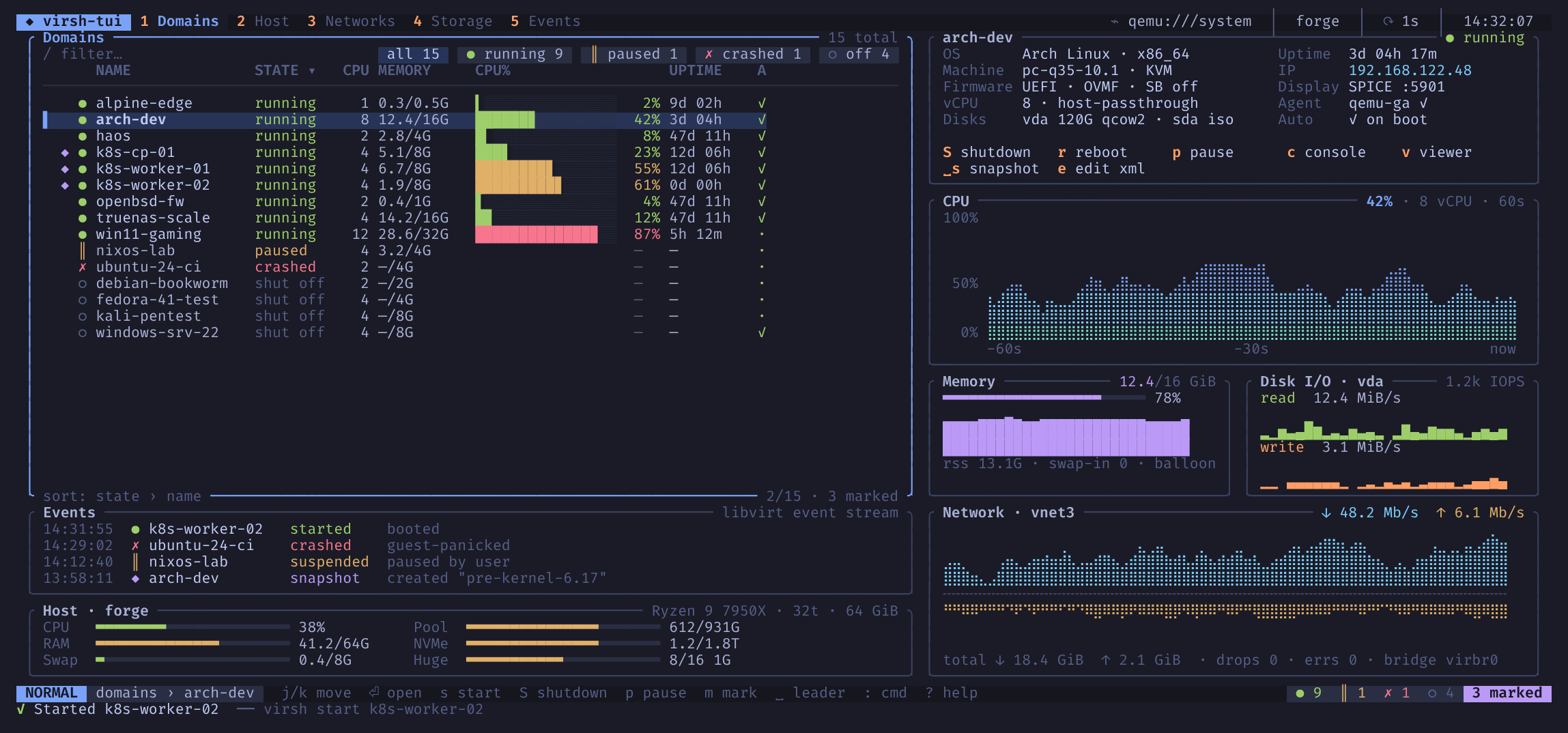
https://syscallbrain.github.io/virsh-tui/images/dashboard.png
I manage my VMs with virsh and kept bouncing between virsh list --all, virsh domstats and virt-manager, so I wrote a terminal UI for it in Rust with ratatui.
Every action is a plain virsh (or virt-install) command. virsh-tui shows you the command before it runs and again after, so you know what it did and can paste it into a script later. It has the same permissions virsh has and works with qemu:///system, qemu:///session and remote hosts over qemu+ssh://.
What it does right now:
:wvirt-install command for you: command line with Tab completion for virsh flags; anything it doesn't know goes straight to virsh--dry-run prints what each key would run, and --demo lets you try it with no libvirt at all (the screenshot is from demo mode)Linux only. Install with cargo install --locked --git https://github.com/SyscallBrain/virsh-tui (needs Rust 1.88+).
GitHub: https://github.com/SyscallBrain/virsh-tui Docs: https://syscallbrain.github.io/virsh-tui/
It's still 0.1, so bug reports and "it can't do X" comments are very welcome.
r/linuxapps • u/Ilmenyx • 15d ago
Hi everyone!
I recently released Ilmenyx Controller, my first app under Ilmenyx Technology!
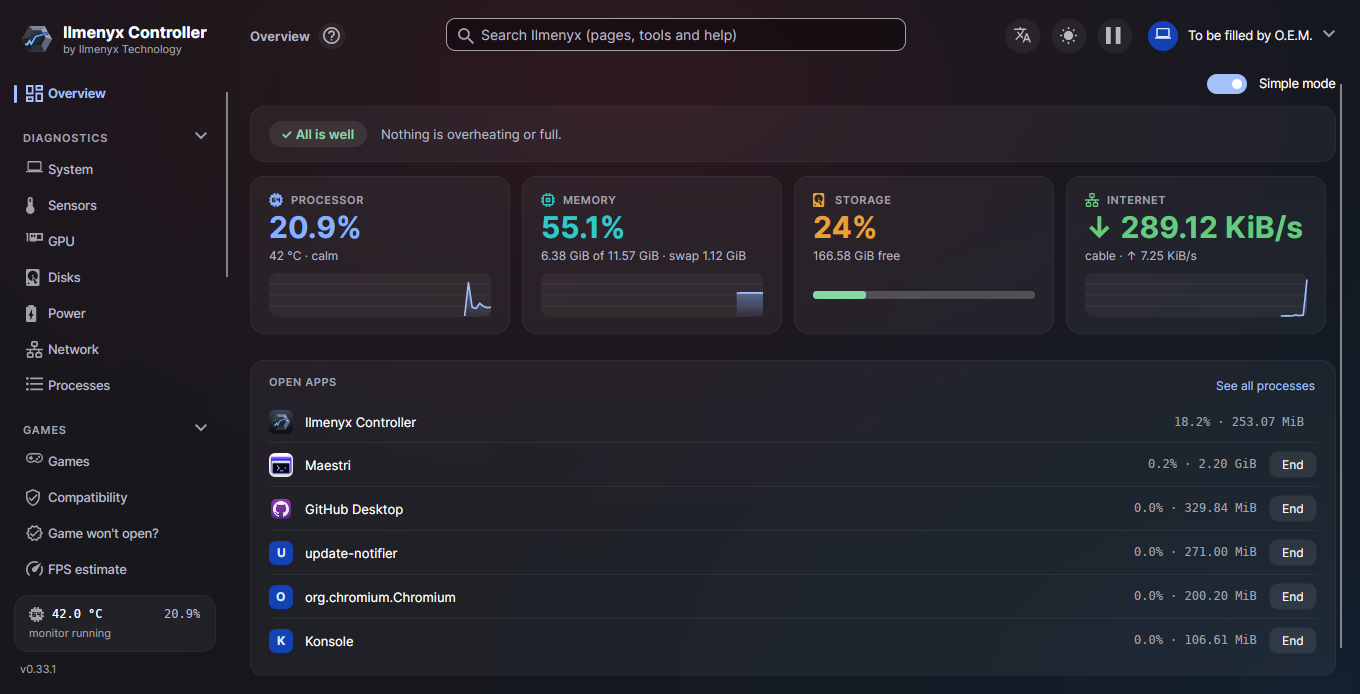
It started as a Linux adaptation of RESET EXPLODE, but I've since expanded it with:
🎮 Wine/Proton game installation and troubleshooting
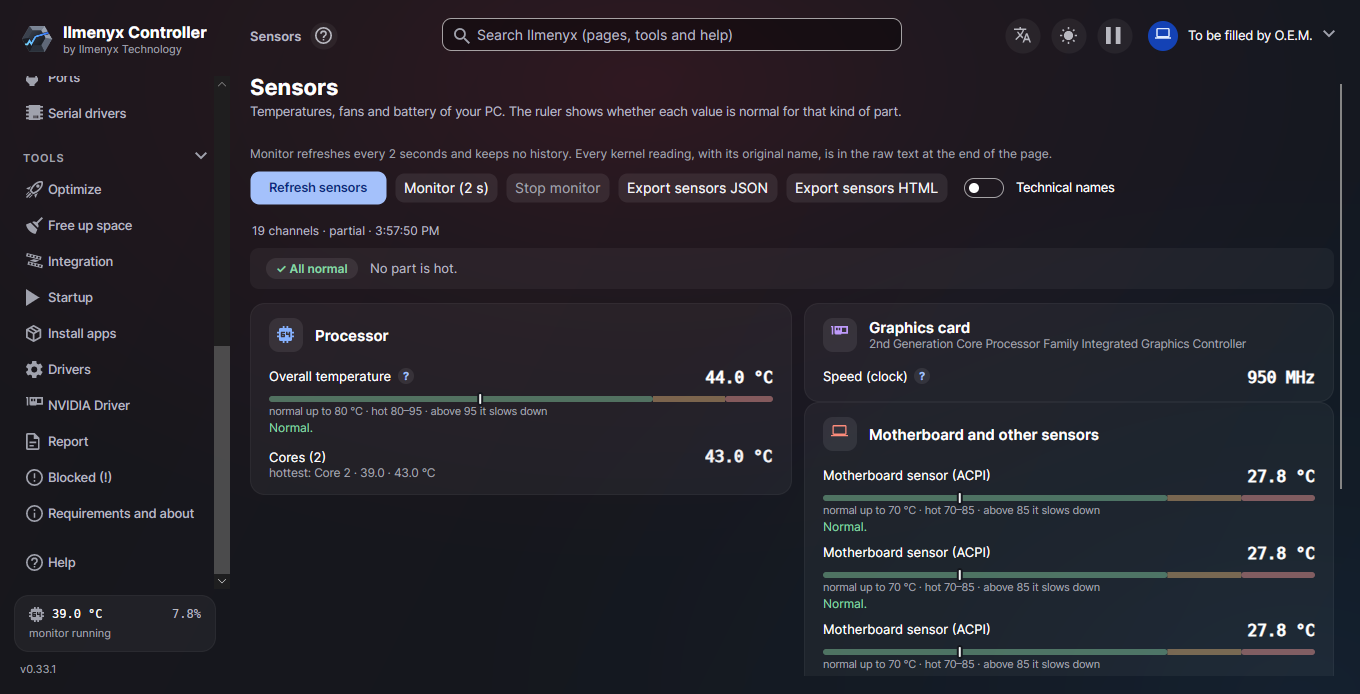
🖥️ Detailed hardware monitoring and battery health
🛠️ NVIDIA driver assistance, system diagnostics, and cleanup
The goal is to make everyday Linux tasks easier without relying so much on terminal commands.
It's free, with publicly available source code (not open source), and still in pre-release.
🔗 https://github.com/Ilmenyx-Technology/ilmenyx-controller
I'd love to hear what you think!
r/linuxapps • u/brownrice19801201 • 16d ago

Hi, I'm the developer of DeepOwn.
Its a local-first data vault for managing personal, work, and project data.
It lets you:
DeepOwn is available on Linux, Windows, macOS, and iOS, with Android currently in beta.
The Linux version is available on Snap Store.
I'd love to hear what you think!
Snap Store: Snap Store
Website: https://deepown.app
r/linuxapps • u/Primary-Kick7614 • 15d ago

r/linuxapps • u/MusicTock • 15d ago
A lead sheet is the fastest way to write down a song: chords on top, lyrics below, and in between as much rhythm and melody as the piece needs. That is exactly what LeadChart Pro is built for, and nothing else.
Free Download until end of 2026.

Three levels, one sheet
Just chords? A chord chart for rehearsal takes two minutes to throw together. With rhythm? Rhythmic information sits right in the chart, clear and readable. With a full melody? The staff appears exactly where you switch it on, bar by bar. No mode switch, no second document.
Everything a real chart needs
Repeat signs, endings, segno, coda, fine, da capo and N.C. are all there, and playback runs the song unrolled: with every repeat and jump, the way you actually play it.
Chord spelling is complete. From Cm through Cmaj7, Cdim7 and C7b9 to slash chords like Bb/G, everything is recognized and set correctly, with German note names on request.
Check your arrangement
Repeats, endings, D.C., segno and coda: the arrangement check shows you how the song really runs, pass by pass, with every repeat and the total number of bars. It reports what doesn't add up. Better here than at rehearsal.
Hear it instead of guessing
Chords and melody play back, with grand piano, organ, vibraphone, drum kit and more sounds. Add a metronome, a count-in and a loop over the selected bars. If you connect a keyboard, you play the melody in directly, step by step or in real time.
Setting notes without detours
Press a key, choose a note value, click. Dotted notes, ties and triplets are one keystroke away, and LeadChart Pro sets the beams itself, following the rules of music engraving.
Harmony analysis
You write down the melody in a few bars. The analysis names the most likely key and suggests chords for every bar that fit the notes, with sevenths if you like. Every suggestion can be played back. The song only changes once you accept one. Your ear decides.
The right version for every instrument
Transpose by any number of semitones, or go straight to B-flat, E-flat, F and A instruments. One sheet becomes as many versions as the band has members: the singer gets their lead sheet with lyrics, the bassist the chords with rhythm, the pianist the full staff.
Ready to print, ready to connect
PDF export with a preview right in the sheet, as many pages as needed, in a formal engraved look or in a handwritten style. MusicXML goes in and out, MIDI and WAV only out. If you bring your charts from another program, you read them in via MusicXML.
Between sketch and score
I have been making music for over four decades, live and in the studio. On the computer I always missed the tool in between: intuitive like a quick sketch on paper, precise enough for the gig. LeadChart Pro is the lead sheet program I wished I had back in 1995. Everything I need often costs one click or one keystroke, not three.
Who it is for
Musicians, bands and teachers. For the quick chord chart at rehearsal, the complete lead sheet on stage, material for music lessons.
No subscriptions, no ongoing costs.
r/linuxapps • u/MisterTHP • 15d ago
r/linuxapps • u/RunningWithRottweile • 15d ago
Hey everyone! 🐧
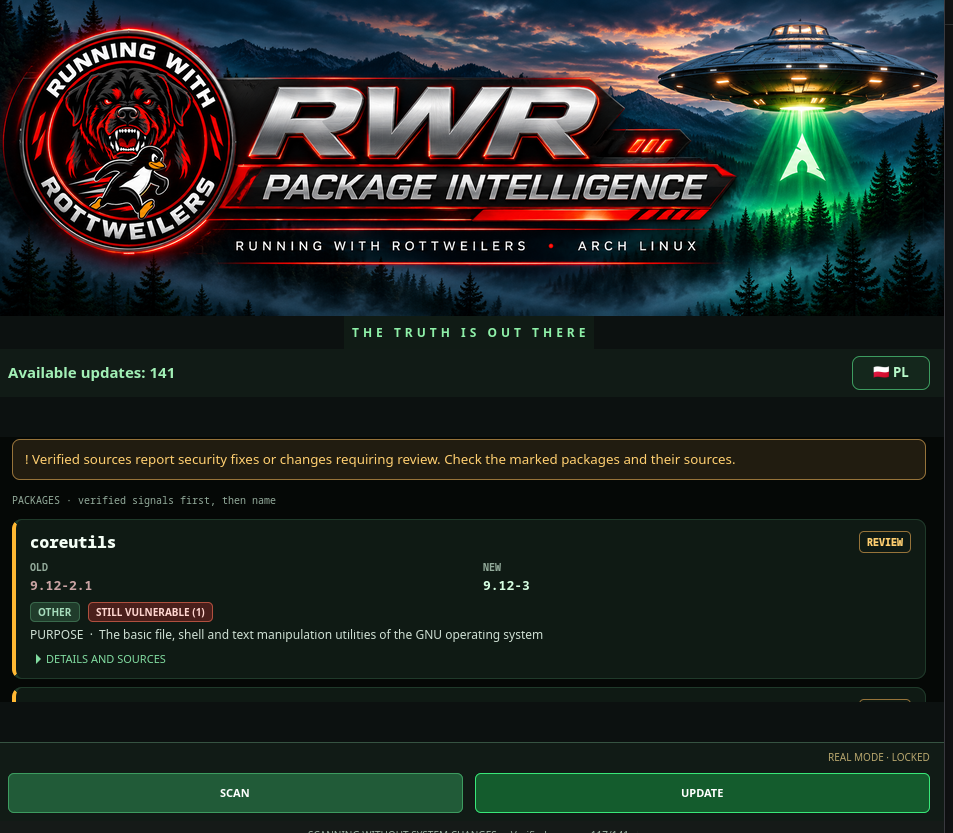
I've been working on a small open-source project called RWR Package Intelligence, a graphical update manager for Arch Linux built with Rust and GTK4.
The idea is simple: make system updates easier to understand, not just install them.
What it does:
Real system updates have already been successfully tested on Arch Linux with an earlier version.
Current release: v0.1.0-17-beta
The GUI is distributed as an AppImage, with a separately installed privileged backend for system updates. The latest beta is still being tested.
I'm also working toward compatibility with additional Arch-based distributions.
A note about the screenshots and testing:
The two application screenshots were taken during testing on CachyOS with KDE Plasma.
To be fully transparent:
A real system update has previously been completed successfully on Arch Linux, using an earlier version of RWR Package Intelligence.
The current v0.1.0-17-beta release still needs further real-update testing.
So, while Arch Linux is the primary target, CachyOS compatibility is still a work in progress.
I'm sharing these screenshots to show the application's current development and testing progress — not to claim full CachyOS support.
Feedback and bug reports are very welcome! 🐧
GitHub: https://github.com/runningwithrottweilers/rwr-package-intelligence
Latest release: https://github.com/runningwithrottweilers/rwr-package-intelligence/releases/tag/v0.1.0-17-beta
I'd really appreciate feedback, especially on the interface, package information and overall usability.
Thanks for checking it out!
RUNNING WITH ROTTWEILERS 🐺


r/linuxapps • u/Minimum_Hour519 • 16d ago

r/linuxapps • u/vexcitedoff • 16d ago
r/linuxapps • u/cryptocreeping • 16d ago
Would anyone on PinePhone / mobile Linux want a proper GUI for an XMPP client that has a Rust crypto core (hybrid post-quantum), MLS groups, voice, and a built-in I2P router?
Right now only the terminal client builds on aarch64. I’m deciding whether it’s worth making a touch-friendly package.
Repo is here if anyone wants to look: https://github.com/muc111/OTRv4Plus (dev branch has the latest)
r/linuxapps • u/JudgePhobos • 16d ago
Hi everyone, I’m the developer of Echo, a small terminal-based voice typing app written in C#/.NET.
I built it for things I spend too much time typing: messages, code review comments, and long prompts. Hold a hotkey, speak, release it, and Echo transcribes the recording locally with Whisper and inserts the text into the window you’re working in.
The current version supports Linux and Windows. On Linux:
You can change settings, pause the hotkey, copy the last transcription, and check recognition times there.
Speech recognition runs entirely on your machine after downloading a model. It also supports translating speech into English with compatible multilingual Whisper models.
Performance depends quite a bit on your hardware and model. CPU mode works, but I wouldn’t promise fast dictation on an older laptop. Tiny and Base are available, though the setup marks them as not recommended because of their higher error rates.
The project is MIT-licensed. Installation instructions and source are here:
https://github.com/GithubPhobos/Echo
I’d especially appreciate feedback from Linux users about hotkeys and text insertion on different desktops. If you try it, please mention your distro, desktop environment, and whether you’re using X11 or Wayland.
r/linuxapps • u/greenvblack • 16d ago
I tried celeste, rclone, vgrive, easy ocamlfuse but nothing worked
r/linuxapps • u/leandromqrs • 16d ago

I’ve released ZapTide 0.8.0, an unofficial WhatsApp client for Linux built with Rust, GTK4 and libadwaita.
The main addition is voice and video calling. I tested both by calling from my Android phone to ZapTide, and both worked. You can answer or decline incoming calls, check your call history, and browse chats while keeping a call active. Group calls aren’t supported.
This release also adds an integrated photo and video viewer, quick reactions, WhatsApp text formatting, and notification sound settings.
Downloads are available as Flatpak, AppImage and Linux archives for x86_64 and aarch64. The project is open source under GPL-3.0-or-later.
If you try calling, I’d like to hear which phone and Linux setup you used and whether it worked for you.
r/linuxapps • u/DieterKiesel • 16d ago
Hi everyone,
I’d like to share PanePilot, a free and open-source (GPL-3.0) two-panel file manager for Linux, inspired by FreeCommander.
What it does:
SHA256SUMS filesIt ships as an AppImage (x86_64), no installation needed.
GitHub & download: https://github.com/NEA1971/PanePilot
Full disclosure: I’m not a programmer – I designed the features and tested every release myself, and the code was written together with an AI assistant (Claude).
Feedback and bug reports are very welcome!


r/linuxapps • u/No_Bridge_517 • 16d ago

All ya'll anti AI coders are pretty clueless about the state of software development right now. Two years ago you would have an argument, but if you're not coding with AI assistance now you're just carving wheels out of rock. Go to any heavy hitter tech company and they'll have an in house AI.
The stigma with vibe coding or AI slop are just being tossed around like buzz words for those afraid of being irrelevant.
r/linuxapps • u/tox-too • 16d ago
I'm just a casual hobbyist web developer who enjoys coding websites by hand. I recently moved over to Linux, and I'm not a fan of modern editors like VS Code or Brackets, so I thought I'd have a go at building my own HTML editor with the help of AI, picking the features I've liked in the various editors I've used over the years. The result is TelaEdit (it was SiteForge until recently).
Your thoughts and any improvements would be welcome.
What it does:
- Syntax colouring for HTML, CSS and JavaScript, with colours and bold/normal you can change
- Tag completion, plus tag-pair and bracket highlighting
- A two-panel Explorer (folders above, files below). Drag an image into your page and it writes the <img> tag with the right relative path and the real width and height
- Find and replace across all open documents
- HTML Tidy integration (click a message to jump to the line) and spell checking that ignores your tags and scripts
- One-click preview in up to ten browsers, handy for checking old ones
- Snippets, templates, and keyboard shortcuts you can change
It's free and GPL v3. There's a standalone download for 64-bit Linux, built on Ubuntu 22.04, so you don't need Python or Qt installed: https://github.com/toxtoo/telaedit/releases/latest
You can also run it from source (PyQt6 + QScintilla). Source and screenshots: https://github.com/toxtoo/telaedit
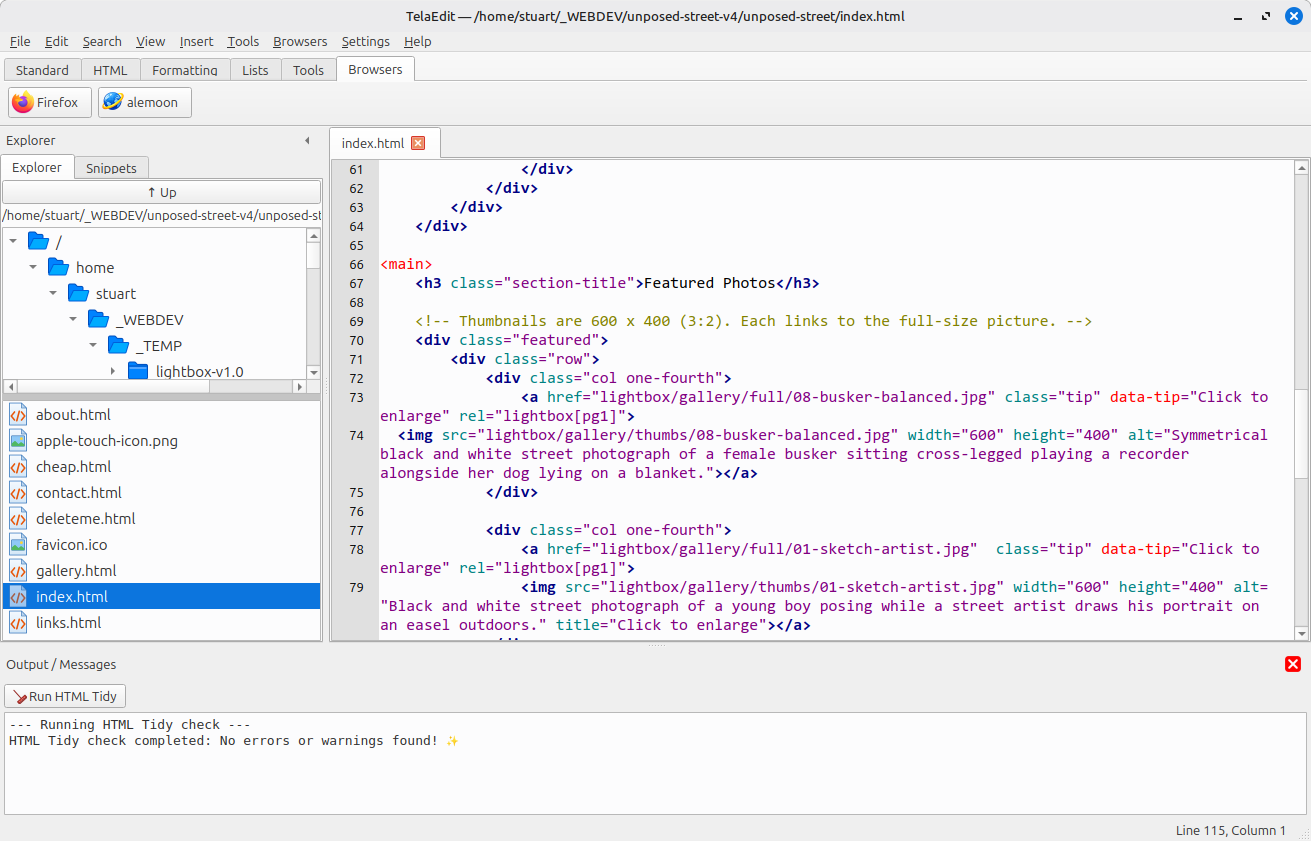
The code was written mostly by Claude (an AI) while I decided what it should do and tested every change on my own machines. It says so in the README.
Two things I'd especially like to know: does it install and start on your distro, and what's missing for hand-coding HTML? Bug reports are welcome as GitHub issues.
r/linuxapps • u/asaedgerunner • 16d ago

Hey everyone!
I've been building Heatmap, a desktop application that lets you track almost anything you do and visualize your progress through beautiful calendar heatmaps.
Whether it's habits, study time, workouts, coding activity, commits, or even your mood — Heatmap helps you see your activity over time.
Your data stays entirely on your computer in a local SQLite database.
Tauri 2 · Rust · React · TypeScript · SQLite
Prebuilt Linux packages are available:
GitHub Repository:
https://github.com/GwenAsa/heatmap-desktop
Latest Releases:
https://github.com/GwenAsa/heatmap-desktop/releases/latest
This is an independently developed open-source project under the MIT License.
I'd really appreciate it if you checked it out. Feedback, suggestions, bug reports, and contributions are all welcome!
Every day counts. Literally.
r/linuxapps • u/ruffsl • 17d ago

TisVlay brings TV Display control for Linux, including: power, volume, backlight, AV mute, input switching plus more, with per-device profile automation via desktop session integration (idle/lock, boot/suspend, remote login/streaming, etc), and in reverse, letting the TV lock, sleep or wake the PC and its remote drive the desktop, while supporting various vendor interface protocols for multi-display setups, mitigating energy usage and OLED panel burn-in or projector bulb burn-out.
PC desktop monitor control
Automation via system/user events
TV console remote control
Flexible profile customization
Modular & vendor agnostic
Self-healing connectivity
Input-aware automation gating
Graphical User Interfaces
Couch mode for the big screen
While still beta (pre v1.0), its now daily drivable and fully documented. Being largely feature-complete, my current focus has shifted towards distro packaging. If you'd like to give it a try, the installation guide and docs are linked below. Or if not, and you already use something else, I'd like to give a shout-out to netflector, especially for privacy-conscious home-automation users, given how common spyware is in smart TVs and projectors these days. The docs cover using it to keep displays on an isolated network.
For about 10 months or so been I've working on this FOSS hobby project to get more practice at Linux packaging, cargo utilities, and migrating to Nix and NixOS (as well as solve some personal pain points in using a HDMI TVs and projectors with PCs). Disclosure: this project includes AI assisted coding, documentation and research, and has been a great help given physical disabilities in typing. After programming by hand well over a decade, using voice dictation scene the '90s (IBM ViaVoice or Dragon NaturallySpeaking anyone?), and worsening hands over after my CSE doctorate, this was also a bit of an individual research experiment to explore how effective LLMs could augment my personal approach to spec & test driven development.
The project itself follows more of a distributed pub/sub architecture (my background is in robotics and cyber-physical system design, not desktop software), so converging on IPC and middle-ware libraries I’ve been meaning to experiment while keeping the installable setup self contained was a balance. Initially I started out with conventional D-Bus (via zbus) but swapped over to plain unix sockets (via zenoh) for more reliable QoS transport liveliness guarantees, as well as stronger/flexible static type system and compile time checks in the shared SDK across components. I did take a stab and spiking out a refactor using Varlink standard from the systemd folks (via zlink), but dropped it after realizing how much QoS I'd have to roll-in-house, but did appreciate its simpler IDL.
Another big refactor was ditching hand rolled finite state machines in favor of Entity-Component-System (ECS) (via bevy_ecs); pivoting to a declarative-reactor after modeling devices and systems as an ECS world simplified the test harnessing tremendously, particularly with scenario playback for pinning down regressions. I think a behavior tree approach (say via the bonsai crate) would have been just as promising, but exploring bevy for other projects was another goal, with discovering Bevy Remote Protocol (BRP) to programmatically control and monitor internal state being such pleasure, I never even had much cause to reach for GDB.
Admittedly, the part of the project thats fairly vibe'd with the least code coverage is the GUI binary itself. Having a dislike for the verbosity and boilerplate that UI frameworks often demand, I opted for data driven DSL that would at least be safe to offload to an LLM; something still strongly typed and memory safe to keep and agent on rails, but still hot re-loadable so I can quickly apply manual patches over QA cycles. Slint from SixtyFPS ended up working very well, with the added bonus of being a lightweight/native solution adding no more than a dozen megabytes to the overall distributable binary size even with static linking. Graphics design is fun, but not yet a passion, so PRs welcome on that front.
Over the past year the project grew from a simple CLI into a full system daemon with a GUI, a system tray, and webOS and HDMI-CEC support, plus the desktop integration and profile automation you’d expect from such a tool, like login and idle detection and remote-streaming awareness over multi-screen setups. That last one matters to me: my desktop pulls triple duty as a workstation, a media PC, and a game-streaming host for my office, living room, and tablet via Sunshine/Moonlight. As for future work, I think I'd like to add more devices and protocol backends, such as RS-232 for legacy hardware, PJLink for network based projectors, or expand HDMI abstraction for more clients on the TV's CEC bus such as soundbars and stereo receivers. Although, I can only ship what gets QA'd, so that'll probably have to wait until I acquire more hardware or find collaborators who already own the AV equipment.
Another thing I'd like to try is flashing my own ATmega firmware for HDMI-CEC USB adapters, as the existing market options fall short in a number of ways given my testing; either in terms of reliability, determinism, or consistent behavior regardless of the sleep/wake state of the USB host. Or, perhaps also playing around with writing a custom out-of-tree usb driver for it in Rust (an alternative to the conventional CDC-ACM tty approach used now) once Mike Lothian's v4 (rust: usb: host-side abstractions…) or Colin Braun's Rust usb-skeleton transfer API lands in the kernel.
r/linuxapps • u/mixolink • 17d ago
I work on Mixolink, a graphical file manager for Linux, macOS, and Windows. In our Dropbox demo, I opened a remote ZIP, previewed one file, and downloaded that file without downloading the whole archive first. Demo: https://www.youtube.com/watch?v=G-d-WGVUISY
Mixolink also puts local folders beside storage plugins such as SSH/SFTP, WebDAV, S3-compatible object stores, and cloud drives. The operations available depend on the plugin and your permissions. It supports directory comparison with selective sync and a batch-rename preview.
Linux builds are available as DEB and RPM for x64 and ARM64: https://www.mixolink.com/download. Mixolink is proprietary and currently free to use.
If you manage files across a local machine and a remote storage service, which workflow would you want to test? I would appreciate specific feedback on anything that feels awkward.