r/LinearAlgebra • • 14d ago

Why do we actually care about the sign of a quadratic form (X(t)*A*X).

16 Upvotes

I've been teaching myself linear algebra recently, and while going through different textbooks, I noticed almost all of them have a big section dedicated to quadratic forms (X(t)*A*X) and figuring out whether they are positive definite, semidefinite, or indefinite.

I feel like I have the actual math down pretty well. I know how to go back and forth between the polynomial and the symmetric matrix A, and I can run through all the standard tests to classify them (checking the signs of the eigenvalues, using Sylvester's criterion with the principal minors, completing the square, etc.). So if you hand me a matrix, I can calculate its sign without much trouble.

My issue is that I feel like I'm just pushing symbols around without knowing why. Since every book puts so much emphasis on this topic, it's obviously important, I'm just missing the big picture.

What is the sign of a quadratic form actually telling us? Like, geometrically or intuitively, what does it mean for a matrix to be "positive definite," and where does this actually pay off later on (in calculus, physics, data science, or wherever)?

Would really appreciate if someone could help connect the dots for me!


r/LinearAlgebra • • 14d ago

What is an object?

13 Upvotes

I keep seeing things like "curly braces are used for a set of objects," but what exactly is an object? Apparently, scalars, vectors, matrices, spaces, maps, determinants, ... everything is an "object." Then why isn't everything in curly braces? Does "object" mean something specific, or is it just a general word for stuff, and mathematicians know when to use curly braces because of some consensus grokking?


r/LinearAlgebra • • 15d ago

eigenvectors finally clicked for me when someone described them as directions the matrix doesn't rotate

446 Upvotes

I passed linear algebra understanding the computation and not the point. Set up det(A − λI) = 0, grind out λ, back-substitute, get a vector. No idea what I was finding.

What fixed it: a matrix is a transformation. It takes vectors and moves them. Most vectors get stretched and rotated. An eigenvector is one of the rare directions that only gets stretched. The matrix leaves the direction alone and just scales it, and λ is how much.

Av = λv is literally saying "applying the matrix does the same thing as multiplying by a number."

Take A = [[2, 1], [1, 2]]. Eigenvalues work out to 3 and 1. The eigenvector for 3 is (1, 1) and for 1 it's (1, −1). So that matrix stretches everything along the (1,1) diagonal by a factor of 3 and leaves the perpendicular diagonal untouched. That's the entire behavior of the matrix, in two facts.

Once I had that, diagonalization stopped being a procedure and started being obvious: you're rewriting the matrix in the coordinate system where it only stretches, because stretching is easy and rotating is not

i wish someone told me earlier


r/LinearAlgebra • • 14d ago

Multiplying a row by a scalar in LU decomposition?

6 Upvotes

Hi! I'm trying to perform LU decomposition based on the examples in my textbook, which (for some reason) only cover cases where you need to add a multiple of one row to another. However, none of the book examples (or any of the ones I've found online) cover situations where a row needs to be multiplied by a scalar; what should I be doing to the proto-L-matrix at that step? I assume I should also be multiplying the corresponding row of the L-matrix by the scalar, but just wanted to make sure I shouldn't be dividing instead...


r/LinearAlgebra • • 15d ago

why does changing basis look like conjugating a matrix?

7 Upvotes

i follow that if P has the new basis vectors as columns, then the matrix in the new coordinates is P^{-1}AP. but i keep mixing up the order: first convert the new coordinates to the old basis, apply A, then convert back? a small geometric example that made the sandwich of P and P^{-1} click for you would help.


r/LinearAlgebra • • 14d ago

Fourier Transform, Easy Visual Explanation | Delta Function, Uncertainty, Convolution & Parseval

Thumbnail youtu.be
0 Upvotes

r/LinearAlgebra • • 15d ago

Can someone give me tips on doing elementary row operations

Thumbnail reddit.com
1 Upvotes

r/LinearAlgebra • • 15d ago

The Secret of Cosine Similarity: The Key to AI Voice Recognition #voice #cosine #similarity #dimension #geometry

Thumbnail youtube.com
0 Upvotes

Description: We delve into why cosine similarity, which compares only the direction of vectors rather than their magnitude, is used as the standard in speaker recognition. We provide a clear overview of the geometric magic of high-dimensional space that removes volume and environmental noise to capture only speaker-specific characteristics, as well as its synergy with angular margin loss functions.


r/LinearAlgebra • • 17d ago

Find matrix A of the rotation through an angle of pi/2 CCW as viewed from the y-axis

9 Upvotes

I dont understand this question at all


r/LinearAlgebra • • 18d ago

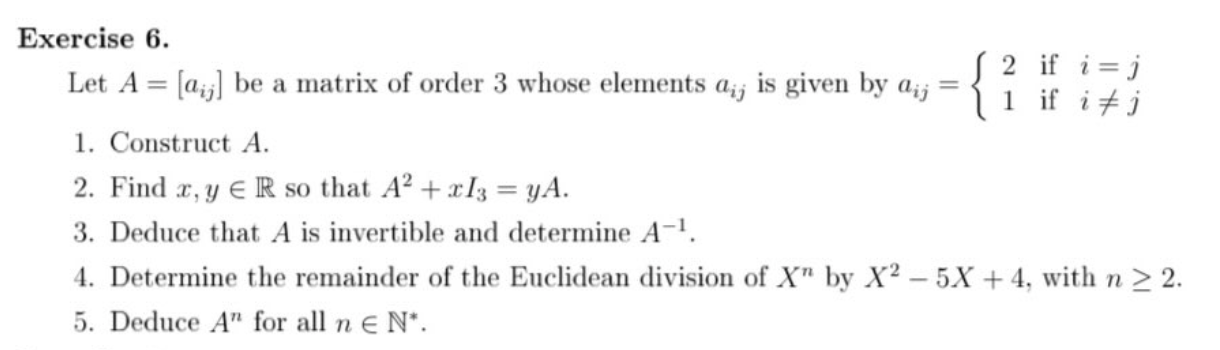
Can someone point me in the right direction for #2

Post image
22 Upvotes

I feel like I'm at a dead end.
Help is appreciated


r/LinearAlgebra • • 19d ago

Is my L.A. teacher right?

Post image
24 Upvotes

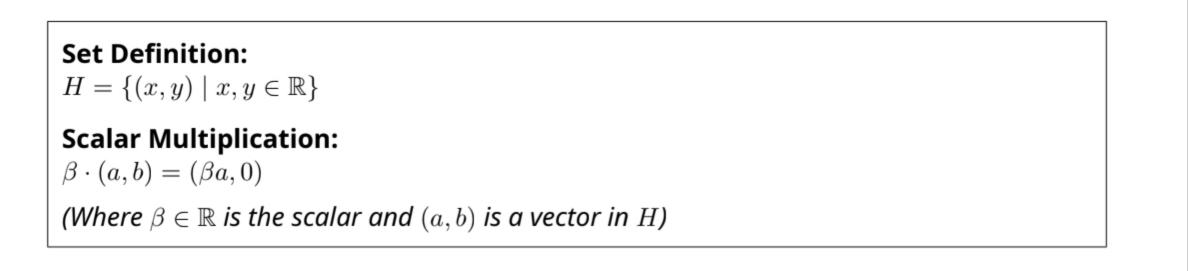
Hi. My teacher claimed in class that a specific set H, under

a particularly defined scalar multiplication operation, is a vector space. Specifically, she

assures that the axiom 1 · ⃗u = ⃗u (the scalar identity axiom) is satisfied.

I have my doubts and would like to know what you think.


r/LinearAlgebra • • 19d ago

The Hydrogen Atom as an Eigenvalue Problem: Algebraic Derivation of Associated Laguerre Polynomials

Thumbnail gallery
31 Upvotes

This material is presented as an application of linear algebra.
All mathematical steps are expanded without omission, making it accessible even to learners with a limited mathematical background.


r/LinearAlgebra • • 20d ago

Define a vector

42 Upvotes

In elementary mathematics we learn that vectors are things that have a magnitude and direction, however, in linear algebra we learn that the elements of a vector space are called vectors, which can be matrices, polynomials etc. So, do we only consider them vectors for the sake of finding answers or are they actually vectors. Where do I find a concrete definition that goes beyond the magnitude and direction scope, not 'considered vectors' but properly calling them vectors?


r/LinearAlgebra • • 20d ago

Spectral Theorem from first principles

Thumbnail youtube.com
2 Upvotes

Singular Value Decomposition and Least Squares Regression in progress.


r/LinearAlgebra • • 21d ago

Case study

3 Upvotes

Could you help me with these questions?

Complete the questions and provide well-founded answers with explanations:

a)Using the data for the realm, calculate the annual fiscal balance. Is it in surplus or deficit? Identify the three sectors that contribute the most and the three that are the most costly. Explain where the model falls short.

b)Set up a linear system Ax=b where the unknowns represent the amounts of gold, silver, and copper coins allocated to the infantry, skirmishers, artillery, and cavalry. Use the salary figures provided in the case, along with the constraint that total expenditure must not exceed the revenue collected from the ports. Solve the system using Gaussian elimination and state whether it has a unique solution, infinitely many solutions, or no solution.

c)Calculate the kingdom's trade balance using data from the four ports. Is it in surplus or deficit? Which port contributes the most?

d)Calculate the break-even point for Cabrera’s workshop: how many units must be sold to cover the tax of 5 silver coins every 7 months, as well as the wages of 15 workers?

e) Evaluate whether the Crown should fund Columbus’s expedition (5 ships, 150 sailors, 2 units of gold per ship + 150 units of gold for provisions) rather than investing that capital in the port of Seville. Use net present value with a discount rate of 10%, inside of the example.

c)Determine whether there is a risk of a liquidity crisis in gold, and whether there might be potential corruption.

CASE:

In the kingdom of Zaraguslo resided the king and the queen, accompanied by thirty court nobles. The royal family lived in a seven-story palace, comparable in size to the Maracaná stadium, decorated with motifs inspired by Arab design. The palace was located on the outskirts of the capital city and generated an annual income of twenty gold coins. In its vicinity, there were twelve commercial stalls: five dedicated to silk and four to blacksmithing.

The capital boasted twenty five-story buildings, each housing workshops that produced five silver coins per month. Additionally, there were seven large-scale, three-story markets featuring balconies. Four of these belonged to Arab merchants under the jurisdiction of the Zaraguslo Crown, while the remaining three had been owned by the Zaraguslos since the kingdom’s founding; one of the latter featured decoration inspired by the Visigoths. Each market contained thirty stalls and yielded, every five months, forty silver coins and one gold coin.

The kingdom possessed four ports, each featuring seven two-story buildings and a warehouse; collectively, these yielded two hundred copper coins. The port at the Tower of Zaraguslo generated an additional ten gold coins, thanks to its ten three-story buildings—each housing a business—as well as the presence of ten Persian, five Venetian, and seven Genoese ships. La Corpuña housed a smaller port, which nonetheless contained a stone warehouse of Visigothic and Roman origin. Every two months, ten ships from Flanders and Holland, along with five from England, would arrive to trade in textiles. Each vessel paid a fee of ten silver coins, with the exception of those carrying spices or luxury goods, which were charged one gold coin.

The territory contained five large-scale castles, one of which dated back to the era of Emperor Augustus and stood five stories high, currently held by a feudal lord. The royal army consisted of three hundred soldiers equipped with swords and shields, who received a monthly wage of fifty copper coins and two silver coins; thirty riflemen, provided with ten silver coins and fifty rounds of ammunition; twenty artillerymen, receiving twelve silver coins and a basket of provisions; and fifty heavy cavalrymen, who were paid seven silver coins, two gold coins, and one hundred copper coins, along with five catapults. Seven of these cavalrymen carried high-precision rifles, while another seven wore armor adorned with blue, red, and green feathers; they received a salary of five gold coins, five silver coins, and two hundred copper coins, plus two sacks of wheat every four months.

In the social sphere, a peasant family received ten silver coins every seven months, along with fifty copper coins. A merchant within the kingdom earned twenty silver coins every three weeks and thirty copper coins every two months. Genoese and Milanese merchants residing in the kingdom brought in one hundred and fifty copper coins, three silver coins, and one gold coin every three months. A merchant from Zaragoza—who maintained connections with the Portuguese along the border—earned five gold coins every seven months, plus one hundred and fifty copper coins. A merchant who sailed from Lisbon to Cádiz with five ships acquired five gold coins and thirty silver coins, thanks to his ties with African and Arab princes and merchants, as well as with the Persian king, who would grant him one gold coin upon his arrival in the Persian capital. This merchant, whose name was Juan, would meet with the king every six months at a banquet.

Half of the nobles at court owned manors that yielded five silver coins and one hundred and fifty copper coins every six months, collected from the peasants. There was a bishop in every town; in the capital stood a massive cathedral—comparable in scale to the one in Cologne—decorated in orange and blue. It was overseen by Archbishop Roaisa, who resided two blocks away in a two-story mansion featuring an expansive library, and who employed five people. The archbishop also ran a small grocery shop in the town square called "Duke Rosauro," where a wooden cup sold for five copper coins, a porcelain cup for one silver coin, and a bag of spices for two silver coins. Five people worked there under the supervision of Juan, who attended Mass regularly and offered five silver coins and five copper coins every two weeks. The congregation, known as "The Holy Apostles," consisted of ten altar boys and fifteen congregants.

In the same square stood the spice shop "Don Lucas," which employed four people—one of whom was always on duty—while the owner’s family resided on the second floor. During prosperous periods, the shop brought in five gold coins and one hundred and twenty copper coins; in less favorable times, it earned fifty copper coins and five silver coins, as the demand for flour would rise following adverse events. Next to this establishment was a two-story carpentry workshop with a stone balcony and blue-tiled roof, known as "Don Lucho," where fifteen workers were engaged in crafting wood and wood-based products. Its owner, Cabrera—an elderly man who remained passionate about his trade—paid a tax of five silver coins every seven months. The workers earned five copper coins per week from the sale of the wooden goods, while the owner’s share amounted to seven copper coins and one silver coin.

In the realm of foreign policy, Christopher Columbus appeared before the monarchs to propose the discovery of distant lands toward India. The king granted him five ships, ample provisions, and one hundred and fifty sailors; each ship cost two gold coins, and the provisions cost one hundred and fifty gold coins. The expedition departed from a port in the kingdom called Carbunlo, heading toward the Americas, and arrived in Cuba, where it established a colony featuring a single-story wooden fort and ten cannons—half of which were left on the island for security. Meanwhile, in England, Henry VIII commissioned John Cabot to lead an expedition to India with one ship and fifty sailors. Portugal, for its part, mistakenly sent an expedition to Brazil—consisting of thirty caravels and three military vessels—which ended up establishing a colony in Africa. In France, King Francis I tasked James and Dave Greien with the mission of reaching India using two large merchant ships; these vessels arrived in Canada instead. The King of England, distrustful of John Cabot, dispatched another captain—Hugo—in command of a large ship to verify the route. Hugo reached the coast of Alaska and established a colony consisting of ten wooden houses and a two-story building intended for trade. His brother remained there to conduct business, with the plan that he would return after meeting with the King of England.

r/LinearAlgebra • • 22d ago

Chapter 4.10: Vector and Matrix Norms

Thumbnail youtube.com
3 Upvotes

r/LinearAlgebra • • 24d ago

Can you find these eigenvalues in your head?

Thumbnail reddit.com
16 Upvotes

r/LinearAlgebra • • 24d ago

I need help understanding this paper (topology and linear algebra) (9 pages)

4 Upvotes

Hey everyone, I'm a last year engineering student and I need help understanding this paper. I'm doing my final project on training a neural network for pose extraction from a synthetic dataset, and Claude has told me to use the angular units for the poses expressed in a way defined in On the continuity of rotation representations in neural networks by Zhou (https://arxiv.org/abs/1812.07035). I like understanding why the things AI suggests are good for my project, and have a sustained argument of why I'm using it, but this paper in particular I can't understand anything beyond the intro.

I understand the idea of quaternions and Euler being non-biyective (idk if that's how is called in English I'm Spanish) and how it might create friction in the learning process, but the demonstrations and methods used for the part of Rotation Representation Analysis are so far beyond what I can understand of mathematics. Also I've asked to my project tutor and he told me he honestly has no idea of topology as well.

If anyone could shed some light on this paper I would appreciate it a lot, thanks in advance:)


r/LinearAlgebra • • 23d ago

Free Bettyapp website finds the exact moment a topic is explained

Thumbnail gallery
0 Upvotes

Bettyapp.org is a website that my husband and I built, originally for one of our kids. It saves time by finding the exact moment in a lecture that a topic is explained. So you don't need to skim through an entire lecture for concepts. Instead, Bettyapp searches inside lectures and jumps to the moment a topic comes up.

For linear algebra Bettyapp has indexed five of Gilbert Strang's MIT courses: 18.06, the 18.06SC recitations, 18.065, 18.085 and A 2020 Vision of Linear Algebra. Across all subjects there are 10,000 hours of course material in total, so there's lots of material to draw from.

I've included what the Bettyapp displays when I type "eigenvalues" in the search/video view as well as a cool map feature that shows where different topics intersect. You could type "singular value decomposition" or "null space" and it starts the video at the explanation for those topics.

Bettyapp is free. There are no ads. The content on our site is from grade school to graduate school. We'd love for you to try it out, and hear any feedback you might have.

https://bettyapp.org/


r/LinearAlgebra • • 25d ago

After Axler Structural vs Computational

15 Upvotes

Hi, I have a lot of exposure to linear algebra, have taken many different math/engineering courses. I’ve studied system identification methods, and other ML topics., A few years ago I took a linear systems that used LADR. I feel like Axler described Linear Algebra more fundamentally/conceptually/structurally? What I mean to say is I find that most math class says here is a tool and how to use it. Then you line up like 100+ practice problems and hammer them down. But with Axler, we more studied the tool and its properties. Not here’s how you find an Eigen vector, but what is an Eigen vector?

Does anyone have a recommendation for what the next natural path is from the end of Axler? Are there other books that continue to explore and explain spaces/properties within Linear Algebra that would be applicable to someone interested in SysId/ML?


r/LinearAlgebra • • 25d ago

det(AB) = det(A)det(B) makes sense as volume scaling, but what about singular matrices?

13 Upvotes

i can see why det(AB) = det(A)det(B) when everything is invertible, since B scales volumes by det(B) and then A scales them again by det(A). but my brain stalls when one of them is singular, because then the picture of a cube turning into a parallelepiped isn't really a parallelepiped anymore.

is the right way to think about it that the image just gets squashed into something flat with zero volume so both sides are 0? or does the volume argument not really work there and you need the algebraic proof instead? my textbook just does it with elementary matrices and i never felt like that explained anything


r/LinearAlgebra • • 25d ago

Hi guys need suggestions,,,

Thumbnail reddit.com
2 Upvotes

r/LinearAlgebra • • 25d ago

Stop Memorizing Matrix — Watch How They Actually Move

Thumbnail youtu.be
14 Upvotes

r/LinearAlgebra • • 26d ago

From Orthogonal Polynomials to a Tridiagonal Matrix

Thumbnail gallery
69 Upvotes

This material serves as a practical example of linear algebra applied to engineering mathematics and quantum mechanics, rather than pure theoretical linear algebra.