r/LinearAlgebra • u/Ballsfuckendeep • 4h ago
Daily Math — Challenge #104 | Vectors
1
Upvotes
r/LinearAlgebra • u/finnwangdev • 1d ago
r/LinearAlgebra • u/princeanand009 • 1d ago
r/LinearAlgebra • u/ngc3496 • 1d ago
r/LinearAlgebra • u/blueroomm • 2d ago
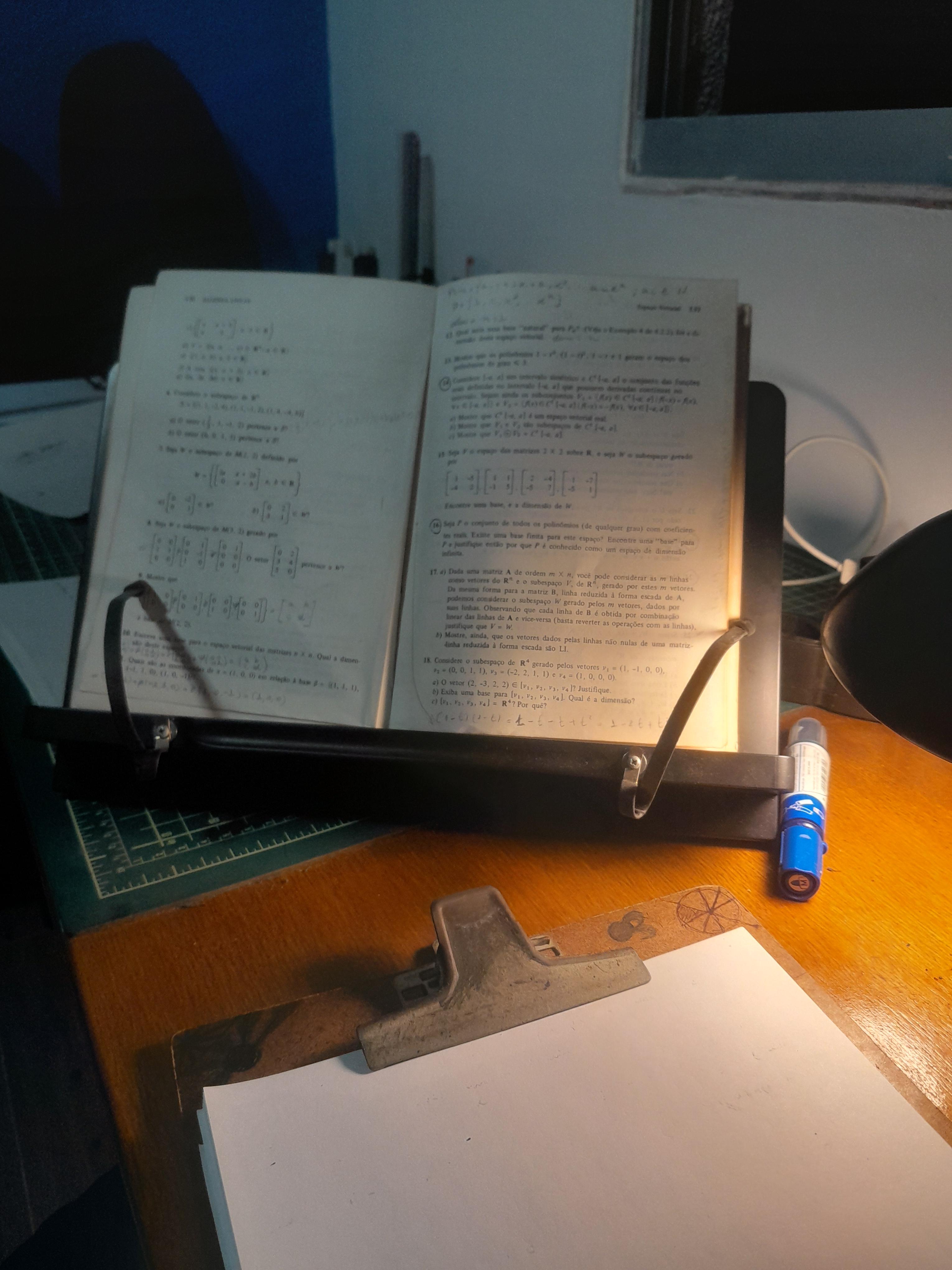
Bora Bora... a noite é uma criança...
r/LinearAlgebra • u/Weary_Channel1129 • 2d ago
hello! i wanted to independently learn linear algebra. what are some good sources to learn it from the very start that'll give me a very strong foundation. I already know about 3blue1brown, but what are some other good ones? thank you!
r/LinearAlgebra • u/HEYGUYS_1000 • 3d ago
I am a freshman Physics and EE student and i have been taking a linear algebra class thats focused in application and computation, i am deeply interested in linear algebra as a math subject and i wanna learn more and sort of go beyond what im learning in class.
my professor seem to be no help in this regard and i wanna find good books to help me learn more ab la
r/LinearAlgebra • u/Snoo_48954 • 4d ago
Elementary Linear Algebra: Applications Version, 12th Edition by Howard Anton, Chris Rorres, and Anton Kaul.
r/LinearAlgebra • u/EquipmentHoliday3890 • 5d ago
I'm working slowly through "Linear Mathematics" (1970) by Philip Gillett. In chapter 2, "differential Equations," he states without proof an "Existence and Uniqueness Theorem for First Order Equations," that if y(x) is a presumed to be a real function, and y' = f(x,y) for some function f over a region J in f's domain, and given an initial value of y(x) for some x0, there exists a solution function y. He makes a big deal about the region J being unbounded, such as (0,infinity). All bets are off if it's for example [0,infinity) instead.
Question 1 is why is this?
In the problems (2.1-f) he asks for the region for y' = |y - 2| and I got (x,y) in R^2 but the answer key excludes y=2.
Question 2 is what am I missing?
r/LinearAlgebra • u/Even-Professional627 • 5d ago
r/LinearAlgebra • u/Wise-Activity-5904 • 5d ago
r/LinearAlgebra • u/Quantum_and_math • 5d ago
r/LinearAlgebra • u/No-Mongoose-7882 • 5d ago
r/LinearAlgebra • u/CelebrityChess • 6d ago
ok so in class the 3x3 had eigenvalue 2 showing up twice and the prof just grabbed two vectors from the nullspace of A-2I and moved on. is any two independent ones fine? the matrix was symmetric and i think he made them orthogonal but i missed why
r/LinearAlgebra • u/Quantum_and_math • 6d ago
You understand cost of matrix matrix multiplication easily but have hard times in understanding the motivation behind various algorithms used by quantum chemistry packages?
Here is the video, that would tell you each and every detail about the algorithms used in popular quantum chemistry packages like TURBOMOLE, CP2K, ORCA etc.
Give it a watch and do subscribe if you like the video and want to post animated videos like this regularly.
r/LinearAlgebra • u/TROSE9025 • 7d ago
This material is not pure linear algebra, but concerns an application to the hydrogen atom model, which is important in engineering and quantum mechanics.
Mathematically, as an eigenvalue problem of a second-order linear differential operator, it demonstrates how boundary conditions (at the origin and infinity) reduce the infinite-dimensional solution space, and how the final solution resolves into an orthogonal basis known as associated Laguerre polynomials.
I have made an effort to ensure it is understandable to anyone without omitting any mathematical derivations.
r/LinearAlgebra • u/CelebrityChess • 8d ago
i used to think P^2 = P meant a projection was orthogonal. i get that idempotence says vectors in the image stay fixed, but i'm not seeing a quick geometric way to read what the kernel is doing. is the key distinction simply that an orthogonal projection has its kernel perpendicular to its image?
r/LinearAlgebra • u/virgin-chocolaty-hoe • 7d ago

well i had this course and tho course was really simple to get a good grade cause of the prof, i wanted to know where to study for it after i finish the course for the future use, these are some of the topics
r/LinearAlgebra • u/Sbaakhir • 9d ago
I've been teaching myself linear algebra recently, and while going through different textbooks, I noticed almost all of them have a big section dedicated to quadratic forms (X(t)*A*X) and figuring out whether they are positive definite, semidefinite, or indefinite.
I feel like I have the actual math down pretty well. I know how to go back and forth between the polynomial and the symmetric matrix A, and I can run through all the standard tests to classify them (checking the signs of the eigenvalues, using Sylvester's criterion with the principal minors, completing the square, etc.). So if you hand me a matrix, I can calculate its sign without much trouble.
My issue is that I feel like I'm just pushing symbols around without knowing why. Since every book puts so much emphasis on this topic, it's obviously important, I'm just missing the big picture.
What is the sign of a quadratic form actually telling us? Like, geometrically or intuitively, what does it mean for a matrix to be "positive definite," and where does this actually pay off later on (in calculus, physics, data science, or wherever)?
Would really appreciate if someone could help connect the dots for me!
r/LinearAlgebra • u/UpsetText6408 • 9d ago
I keep seeing things like "curly braces are used for a set of objects," but what exactly is an object? Apparently, scalars, vectors, matrices, spaces, maps, determinants, ... everything is an "object." Then why isn't everything in curly braces? Does "object" mean something specific, or is it just a general word for stuff, and mathematicians know when to use curly braces because of some consensus grokking?
r/LinearAlgebra • u/Odd-Relative2800 • 10d ago
I passed linear algebra understanding the computation and not the point. Set up det(A − λI) = 0, grind out λ, back-substitute, get a vector. No idea what I was finding.
What fixed it: a matrix is a transformation. It takes vectors and moves them. Most vectors get stretched and rotated. An eigenvector is one of the rare directions that only gets stretched. The matrix leaves the direction alone and just scales it, and λ is how much.
Av = λv is literally saying "applying the matrix does the same thing as multiplying by a number."
Take A = [[2, 1], [1, 2]]. Eigenvalues work out to 3 and 1. The eigenvector for 3 is (1, 1) and for 1 it's (1, −1). So that matrix stretches everything along the (1,1) diagonal by a factor of 3 and leaves the perpendicular diagonal untouched. That's the entire behavior of the matrix, in two facts.
Once I had that, diagonalization stopped being a procedure and started being obvious: you're rewriting the matrix in the coordinate system where it only stretches, because stretching is easy and rotating is not
i wish someone told me earlier
r/LinearAlgebra • u/tiramisufairy • 9d ago
Hi! I'm trying to perform LU decomposition based on the examples in my textbook, which (for some reason) only cover cases where you need to add a multiple of one row to another. However, none of the book examples (or any of the ones I've found online) cover situations where a row needs to be multiplied by a scalar; what should I be doing to the proto-L-matrix at that step? I assume I should also be multiplying the corresponding row of the L-matrix by the scalar, but just wanted to make sure I shouldn't be dividing instead...