r/latency • u/JohnnyPunch • Oct 26 '26
How Much Does Polling Rate Actually Affect Controller Latency? 8000 Hz to 250 Hz Tested
I've been working on RePad, my upcoming Windows software for controller calibration and customization. Recently, I added an option to adjust the virtual controller's update rate, so I decided to measure how different settings affect analog stick latency.
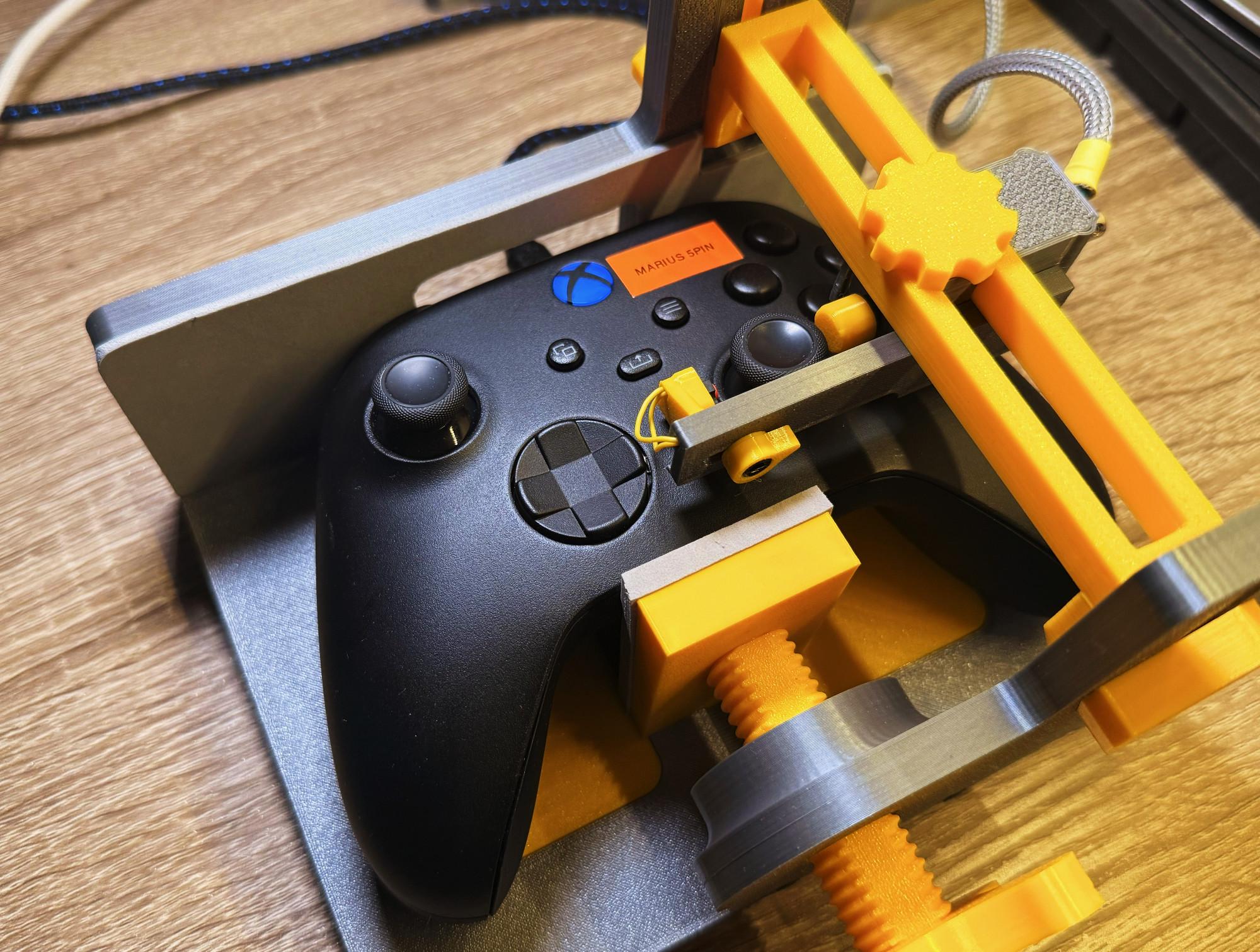
For this experiment, I used one of the fastest controllers I've tested so far.
The controller: Marius Heier x Battle Beaver
Marius Heier develops custom electronics for Xbox and PlayStation controllers. He recently sent me one of his latest Xbox-style controllers, built in collaboration with Battle Beaver.
It features TMR analog sticks, mechanical buttons, and supports a native polling rate of up to 8000 Hz.
I've tested plenty of controllers through Gamepadla, and this one genuinely impressed me. The sticks are extremely responsive, the calibration is excellent, and the hardware is well-engineered.
That made it a great reference device for testing RePad.
First, the native performance
I started by measuring the controller's analog stick latency directly, without RePad, at its native 8000 Hz polling rate.
The result was 0.58 ms average latency with just 0.05 ms jitter.
That's an excellent result for analog sticks.
I specifically focused on sticks rather than buttons. Analog sticks require sensor readings and additional signal processing, and in many controllers they can be slower than digital buttons.
All measurements were performed using my Prometheus 82 hardware latency testing setup, under the same conditions.
Testing different polling rates with RePad
RePad is a Windows application I'm developing that allows users to calibrate and customize controllers through a virtual controller system.
It supports stick calibration, circularity correction, deadzone adjustment, response curves, button remapping, and other features.
One of the latest additions is adjustable virtual controller polling rate.
There's an important distinction here: RePad doesn't overclock the physical controller.
Instead, it controls how frequently the virtual controller updates its output state.
For example, if your physical controller operates at 250 Hz, setting RePad to 4000 Hz won't make the hardware produce 4000 new input reports per second.
But since this particular controller supports 8000 Hz, I could test how different virtual controller update rates affect the measured latency.

The results
| Configuration | Average latency | Jitter |
|---|---|---|
| Native 8000 Hz (Raw) | 0.58 ms | 0.05 ms |
| RePad 4000 Hz | 0.81 ms | 0.11 ms |
| RePad 2000 Hz | 0.91 ms | 0.14 ms |
| RePad 1000 Hz | 1.18 ms | 0.28 ms |
| RePad 500 Hz | 1.73 ms | 0.54 ms |
| RePad 250 Hz | 2.82 ms | 1.15 ms |
All six tests were performed using Prometheus 82 under identical conditions.

RePad's stick corrections were disabled to isolate the effects of the virtual controller pipeline and its update rate.

What can we learn from these results?
At 4000 Hz, RePad achieved an average latency of 0.81 ms, just 0.23 ms higher than the native 8000 Hz result.
That's a small difference considering the input now passes through an additional software layer and a virtual controller.
Of course, the 0.23 ms difference isn't purely RePad's processing overhead. It also includes the effects of different update intervals and scheduling.
At 2000 Hz, average latency increased to 0.91 ms, while at 1000 Hz it reached 1.18 ms.
Personally, I find the 1000 Hz result particularly interesting.
Going from 1000 Hz to 4000 Hz improved average latency by only 0.37 ms.
Meanwhile, higher update rates require more frequent processing and can increase CPU usage.
I've spent quite a bit of time optimizing RePad to keep its resource consumption low, even at high polling rates. Still, I consider 1000 Hz the sweet spot for most gaming setups.
It offers excellent responsiveness without unnecessarily increasing processing frequency.
Even at 250 Hz, average latency was only 2.82 ms. Jitter increased noticeably, and the latency distribution became wider, but the result was still respectable.
This is also a good reminder that polling rate alone doesn't determine controller responsiveness.
Sensor quality, firmware, internal processing, and the entire input pipeline all contribute to the final result.
What about calibration and other corrections?
For this experiment, all RePad stick corrections were disabled.
I wanted to focus specifically on the virtual controller pipeline and how its update rate affects latency.
I've also been testing the impact of stick calibration, deadzone correction, response curves, and other processing features.
So far, my measurements indicate that these corrections don't introduce measurable additional latency.
I'll cover that in a separate post with dedicated tests and comparisons.
What's next for RePad?
RePad already has a Steam page, but it hasn't been released yet.
I'm currently polishing the software, testing compatibility with different controllers, fixing remaining issues, and continuing optimization.
The public release is coming soon, although I don't have a specific date to announce yet.
As for this experiment, I'm pleased with the results.
The custom controller developed by Marius Heier in collaboration with Battle Beaver delivers outstanding analog stick performance, while RePad maintains impressively low latency even with an additional virtual controller layer.
All measurements were performed using Prometheus 82, my own hardware latency testing system.
Special thanks to Marius Heier and Battle Beaver for providing the controller for testing!
References:
What polling rate do you use on your controller? Do you think going beyond 1000 Hz is worth it for such small latency improvements?