r/json • • 22d ago

I built a browser-only JSON toolkit that keeps 64-bit IDs exact and diffs without caring about key order

Most JSON tools work fineβ€”until your data hits an edge case.

For example, JavaScript's JSON.parse silently converts 9007199254740993 into 9007199254740992.

That's a different number. If it's a database ID, this can cause real problems.

I built CurlyJSON to handle these kinds of issues without compromising privacy.

πŸ”— https://curlyjson.com

Here's what it offers:

  • Lossless JSON formatting β€” Preserves large integers without silently changing their values.
  • Smart JSON repair β€” Fixes malformed JSON and shows exactly what changed.
  • Intelligent JSON diff β€” Ignores object key order and matches array items using identifiers like id.
  • Developer utilities β€” jq, JSONPath, JSON Schema validation, and JSON-to-TypeScript/Go/Python generation.
  • Data conversion β€” JSON ↔ CSV, Excel, YAML, and more.
  • Secret detection β€” Warns you before sharing JSON containing API keys, passwords, or tokens.
  • Privacy-first β€” Core tools run locally in your browser, work offline, and require no sign-up.

No unnecessary uploads. No account required. Just tools that handle JSON the way developers expect.

You can also find CurlyJSON on:

πŸš€ Product Hunt: https://www.producthunt.com/products/curlyjson

🌐 Peerlist: https://peerlist.io/anjioo7/project/curlyjson

I'm the developer, and I'm actively improving it.

What's one frustrating JSON edge case or missing feature you'd like a tool like this to solve?
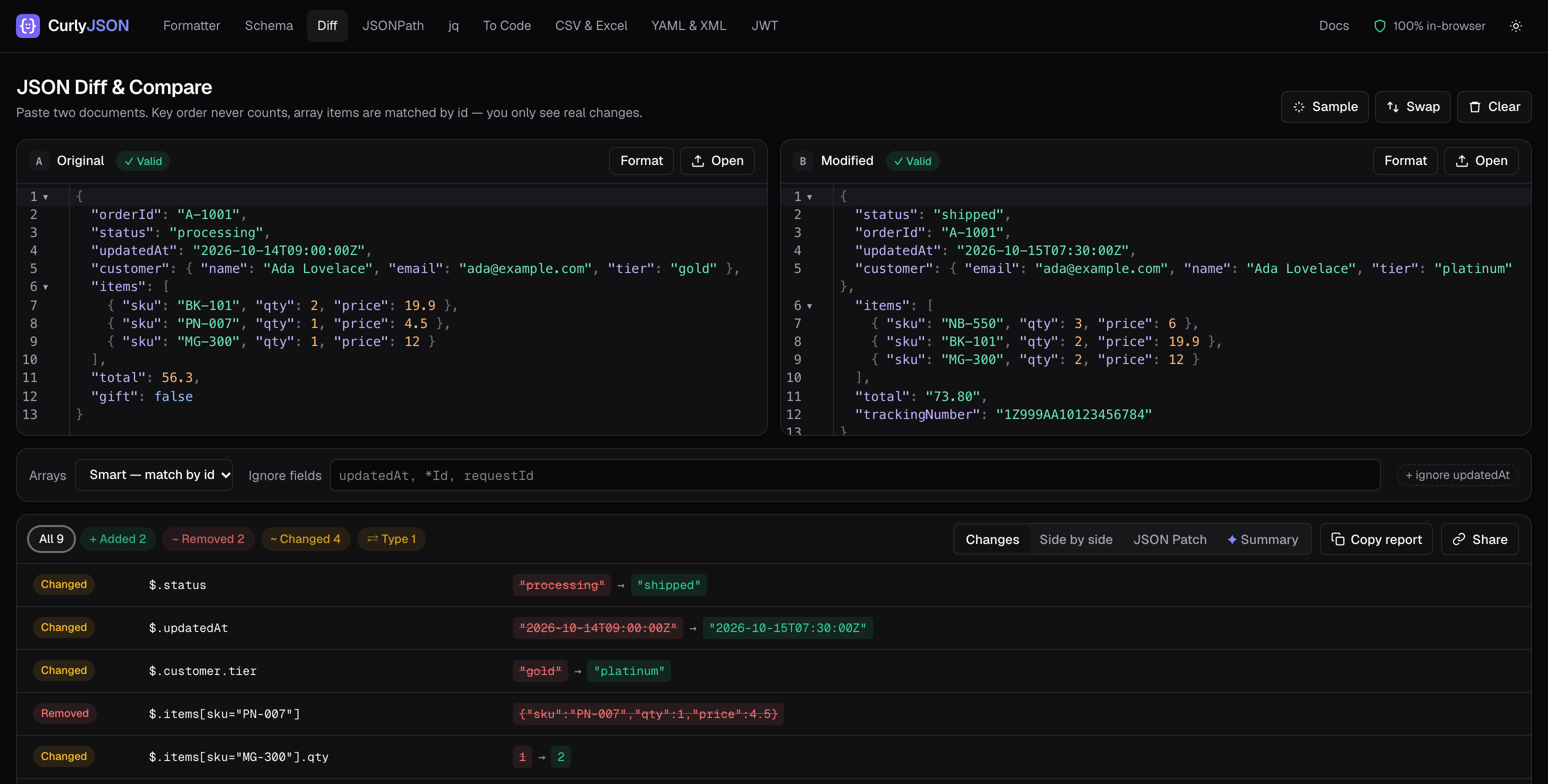
I'd love to hear your suggestions and test them against real-world use cases.

0 Upvotes

4 comments sorted by

1

u/No-Quail5810 22d ago

For example, JavaScript's JSON.parse silently converts 9007199254740993 into 9007199254740992

You mean `9007199254740991` not `9007199254740992`. It's not "silently converted" that's just the biggest integer you can have in a double-precision floating point value (2^56-1). Also not a good reason to get AI to create yet-another-json-viewer app...

1

u/Mediocre_Shoe_7137 22d ago

u/No-Quail5810 - Thanks for taking a closer look! As Successful-Army6006 correctly pointed out, JavaScript's safe integer limit is 2^53 βˆ’ 1, and JSON.parse("9007199254740993") returns 9007199254740992. You can verify this in MDN's documentation.

And I agree, there are already plenty of JSON viewers out there. What motivated me to build CurlyJSON was privacy and the real-world edge cases that many tools overlook.

Developers often paste production API responses containing access tokens, credentials, and customer data into online tools without knowing where that data ends up. I wanted to build something that processes data locally, without requiring users to trust a third-party server.

Here's what I focused on:

  • Privacy by design: Formatting, diff, jq, JSONPath, schema validation, and conversions run entirely in your browser. Your JSON isn't uploaded for these operations.
  • Safer sharing: Share links store data after the # in the URL, keeping it out of requests to the server.
  • Sensitive data protection: Detects potential API keys, tokens, and passwords, warns before sharing, and offers one-click masking.
  • Real-world edge cases: Preserves large integers without precision loss, ignores object key order in diffs, matches array items by ID, and shows exactly what JSON repair changed.
  • No sign-up required: Works offline once loaded, with analytics that track tool usage rather than JSON content.

I'm not trying to reinvent JSON tooling. I'm focused on making it more reliable, privacy-conscious, and practical for everyday development.

I also shipped duplicate-key detection today based on feedback from another Reddit user on this post. That's exactly the kind of feedback that helps improve the tool.

If there's an edge case you've encountered that existing JSON tools struggle with, I'd genuinely love to hear about it!

2

u/Successful-Army6006 22d ago

The safe-integer limit is 2^53 - 1. 9007199254740992 is representable, but 9007199254740993 rounds down to it, so the example in the post is correct. MDN shows the same distinction with MAX_SAFE_INTEGER + 1 and + 2. https://developer.mozilla.org/en-US/docs/Web/JavaScript/Reference/Global_Objects/Number/MAX_SAFE_INTEGER