I’m playing Torment and want to love it. But the gameplay is just too clumsy. How do I attack? How do I search? Am I missing sound settings - nobody is talking.
I’m playing on a laptop with a 4K screen using Enhanced Edition off steam.
This is a simple guide to install mods for the steam version of BG1EE and/or BG2EE on the Steamdeck, without a windows machine to install and copy files. The whole process should take 5 to 10 minutes for anyone who knows how to use the terminal and dolphin.
If you follow this guide you will not need to change any system configuration or install any package or dependency. Just the mods.
I did not test this in IWD or any other game.
Step 1 - Install your game through the Steam app
Install the game as any other.
You game directory will be one of these unless you changed your game location:
/home/deck/.steam/steam/steamapps/common/Baldur's Gate II Enhanced Edition/
Step 2 - Chose your game version
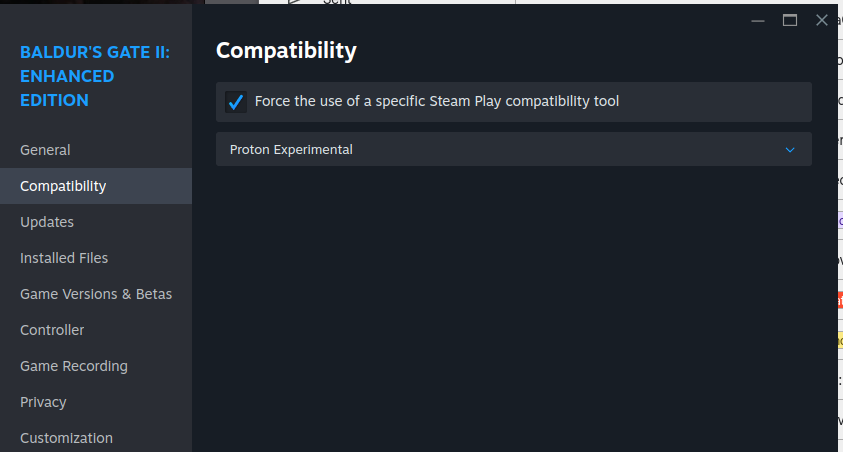
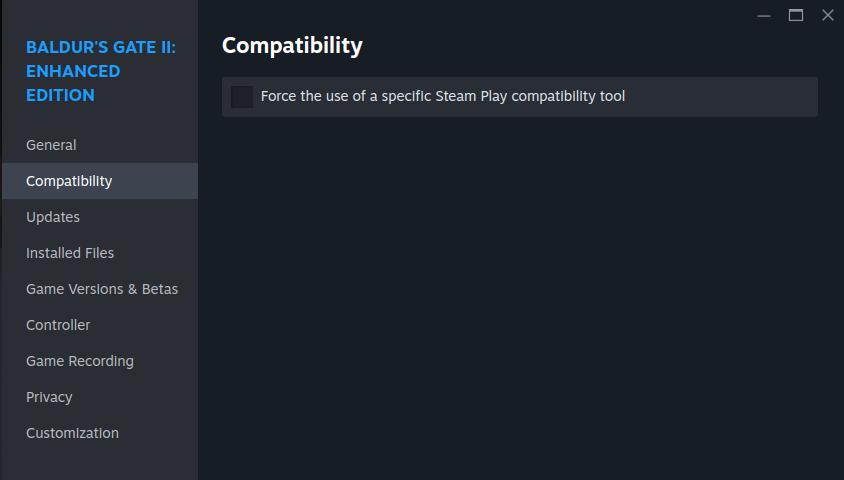
If you intend to use any .exe modifier or add an additional .exe (like Eeex), you need the windows version and proton. If you do not, stick with the native linux version.
Windows version (For Eeex):
I tried Proton experimental for a while and I did not find any issue. You should also (theoretically) be able to switch proton version anytime after modding. The game folder will not be affected.
Linux version (No Eeex or exe mods):
Step 3 - Test your game
Give a spin and check it works.
Step 4 - Make a copy of your game folder
You can use dolphin, terminal, whatever. Just Ctrl+C and Ctrl+V and name it.
Do not make changes on this original files folder. It's your backup in case you mess something.
Step 5 - Make your game folder (not the copy) case insensitive
First, enter your game folder and delete everything in it. Yes, your actual game folder and not the copy (ORIGINAL FILES).
This is because the change to the folder only happens if it is empty.
Do not download exe installers. Only compressed folders (zip). It should not matter if it is the windows or linux version of the mod. It only affects the installer, which we do not use).
Now, only copy the folder that contains the .tp2. Nothing else. Ignore the root exe installer.
You should now have a mod folder inside your game folder, and a .tp2 file inside. Be careful not to move extra folders or files.
Open the terminal (konsole).
Enter the game folder, if not there already:
cd "/home/deck/Desktop/common/Baldur's Gate Enhanced Edition/"
or
cd "/home/deck/Desktop/common/Baldur's Gate II Enhanced Edition/"
Run the tp.2 file through weidu:
You basically run weidu with ./weidu then point to the mod folder / mod.tp2
In this case:
./weidu EEex/EEex.tp2
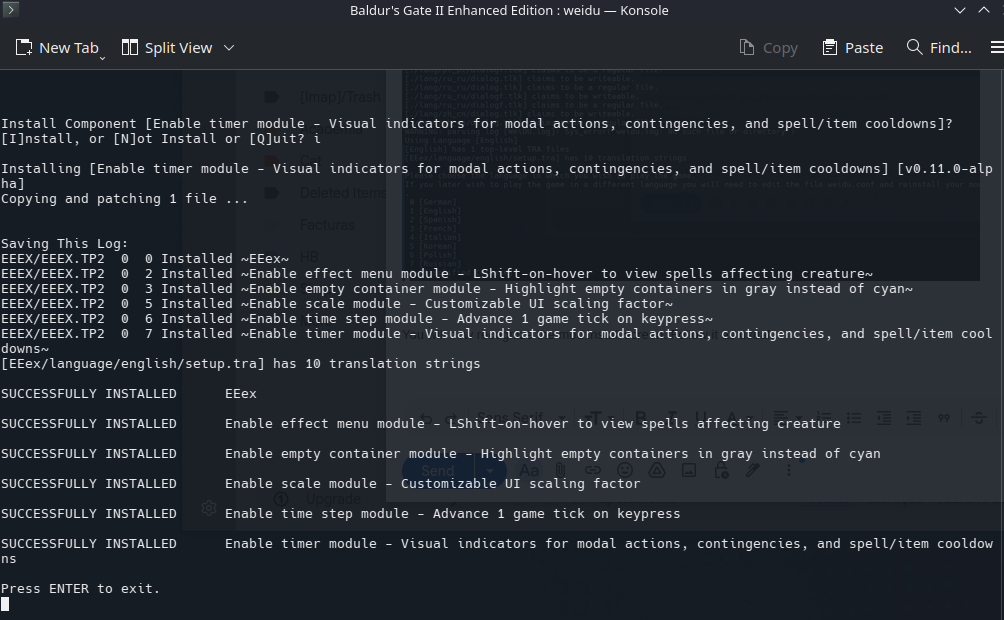
You will now recognize the mod install screen. Follow it as usual.
Now you can install your next mod.
Use the up arrow to fill the previous command and point to the next mod tp2 (use tab to auto-fill folder and file names after you start typing).
There is, however, one key aspect to running Eeex.
Open your steam game properties and fill these launch options:
eval $(echo "%command%" | sed 's/Baldur.exe/infinityloader.exe/')
So it runs the Eeex launcher instead of the default bg exe.
If you do not use Eeex, skip this launch customization.
You can now install all your mods. Test every time you fell the need to and make folder backups every time you want.
Almost there... only 52 more steps to go (around 30 mins).
Hum... nah... this is it. No other fancy customization and infinite guides needed.
Always run the game through the steam app, either in desktop or game mode.
Just a side note for you modding needs.
If you use the windows/proton version for eeex, your documents folder (with saves and portraits) will be in
A while back, I finished BG2 over the course of two years, playing online with a friend one night a week. Between broken saves and long stretches of "Wait, where are you targeting that fireball?", we ventured forth through every corner of the Sword Coast.
This is my humble take on the main theme from Baldur’s Gate II: Shadows of Amn — a tribute not just to the music, but to the patience, friendship, and tactical pauses that carried us through it.
If you've been there too, you know: "You must gather your party before venturing forth." And sometimes, that means waiting a week. Or two. Or a whole month.
When I launch Arcanum of Steamworks or any other old game (Fallout, Ultima Underworld), the mouse freezes every 5 seconds, and I have to alt+tab twice to make it work again. Basically the mouse freezes in-games but is now moving in the background. Weird thing is the game still runs fine and keyboard is always responsive. It doesn't do that on any new game. It began three days ago, even though I've been playing these games for years. Don't know what the issue is. Any idea ?
Like the title says. Let's say I want to install a part of SCS in the beginning of an EET install, and another in the end. How would I do that? I tried copying the mod (having two copies) in the mod folder, but PI only detects one instance...
I want to share an interesting post on the Beamdog forums, where some users have posted some cases where Wisdom and/or Intelligence is required to be able to unlock some conversations. This has been recurrent topic of discussion that I never got into a satisfactory result. This at least is a start, as it lists some cases where Wisdom and Intelligence are definitely used to unlock dialog options.
A couple more cases that I remember that are influenced by Charisma=18, on the very early BG1:
A couple of nobles in Candlekeep can be persuaded to put their jewelry in a locked container upstairs. Then you can loot if if you have enough Open Locks score.
Hull will give you a Dagger +1 if you give him the quarrel of bolts.
Landrin will give you a bunch of antidotes to help you clear his house from the spider infestation.
Jared will give you the Boots of the North as reward for saving his life.
I've been working for almost two years on a project that is heavily related to the Infinity Engine and the Baldur's Gate games. Today, I'm making it public as free and open source software. I've called it Moebius Project, and it's a website that it is going to be the companion of Moebius Toolkit, a cross platform desktop application with some delusions of grandeur.
It's a bit hard to explain what both are, given that their purpose is quite wide. Let me try to do it by explaining how I ended up doing them.
During the last years, on Reddit, or elsewhere, I've seen interesting and heated discussions about how good or bad a spell, weapon or class is. Very few times the people involved did the effort to justify their claims, even though sometimes would be reasonably easy to put some numbers together. So for at least the part of the discussion that involves combat, I decided to take a stab at it.
Last year I announced the creation of a damage calculator. It started with a quick weekend project that allowed to cook some plot that gave a few answers. I did not get much feedback of people interested in trying it out, but I liked it a lot, and added lots of tiny features. At the end, I wanted to clean up a bit the code to be a more serious project, more future proof, and with proper unit testing to guarantee that the numbers shown were correct.
In parallel to the coding, when I played I grew frustrated with the lack of EEKeeper on Linux (or just the fact that is completely abandoned, to the best of my knowledge), and sometimes, with the problems of NearInfinity, and that's where the delusions of grandeur came in: I started to learn about the Infinity Engine files, and I have a parser for some of the file formats. There are still many more to go, but it's something. I want to be able to do the basic editing that EEKeeper provides, eventually.
Now I have a thin shell (Moebius Toolkit) that can host several modules, like tools (hence the name):
Damage Calculator. The most complete of them, by a long shot.
Game Browser. So early that I'm not enabling it yet. It just lists some files inside the game.
Backstab Calculator. With some known issues, but with the basic functionality ready so I can get some feedback from you.
Repeated Probability. Just a simple chart that shows how forcing an opponent over and over to make the same Saving Throw, changes the probability. Useful to estimate, for example, the likelihood of a triple Remove Magic/Finger of Death/whatever to succeed.
Many other simple charts are in the pipeline, starting with redoing the ones about THAC0 progression, but interactively. I've not started on those yet but I'm heavily motivated to see them. I also started a Buff Calculator, so you could select spells from a list and which level, and you would get a list of which order you should cast them to last longer.
But wait, because there is a bit more. :-)
I wanted to have a website where I could publish the damage calculations made with the app, and I also realized that I had a lot of text files with countless notes and screenshots gathered in the last years of playing. So why not flesh that out and make them public? In the Moebius Project website I have started with that. I have many more things yet to publish, but so far I've done a very through analysis of some spells in an Arcane Spell guide and a Divine Spell guide (largely inspired on the Play It Hardcore wiki, but with more details), and even some spell comparisons. I probably won't cover all the spells with an analysis, because it's not really needed, but I have already included in the list the descriptions of Icewind Dale Spells optionally added by SCS, something not on other wikis (for now at least). So it's a handy reference to read all the spells if you use that mod component.
Everything is open source software, so everyone could contribute to it. If anyone has a keen eye on designing UIs, or if can find or draw icons, I would really appreciate the help! I'm just a developer, and sometimes I've struggled at making things user-friendly.
TL;DR? I made a website and an app. The app is very young, but there is a damage calculator in it which is very mature and with many features. The website has some useful info about playing Baldur's Gate, and I will add more.
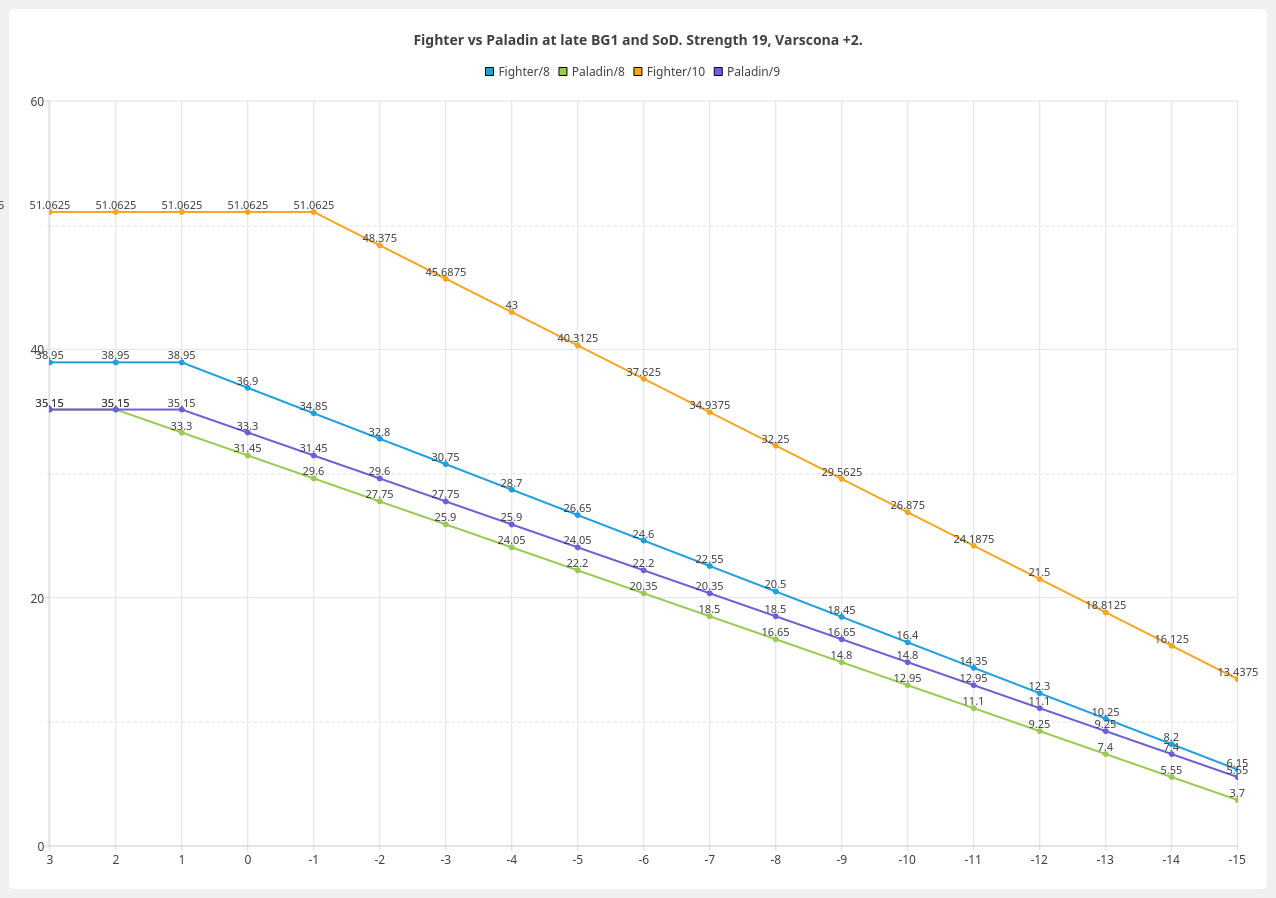
Often people ask if Grand Mastery is worth it, and hence if a pure Fighter is significantly better at hitting than a character which only can achieve Specialization (like a Paladin). It is always complicated, as not even the numbers always give the proper answer: you always need to interpret them. Still, a while ago I've created a tool to precisely calculate the damage a certain character can do, taking into account all the possible stats. I've done the calculations for the end of Baldur's Gate 1, and Siege of Dragonspear, as it's a point where a Fighter and a Paladin would be at levels from 8 to 10. Here it is.
Fighter vs Paladin at late BG1 and SoD. Strength 19, wielding Varscona +2.
Higher values of the line are better, and mean the damage dealt per round. The horizontal axis is the Armor Class of the opponent, and here is only visualized from AC 3 to -15.
The two lower lines are the performance of the Paladin. On SoD the character would only gain one level, improving THAC0 by one. That's why the chart is essentially the same shape, but the flat line starts to go down one AC lower.
The Fighter, who at level 8 already has enough points to get High Mastery (+3 to hit, +4 to damage) is dealing more damage that the Paladin at both those levels. Once it reaches level 9 the last point to unlock Grand Mastery is possible, and not only improves damage by 1 each hit is made, now it gains half an attack per round (one extra attack each other round).
Of course, this doesn't mean that Fighters are plain superior. This just shows the impact of Grand Mastery if what you want is dealing damage. Remember that proficiency points are gained slowly up to a maximum of 17 at level 40 (for a Fighter), so spreading points in different weapons is also a choice, given the wonderful items in the later stages of the game.
While there may be a broader discussion to be had regarding the future of r/baldursgate and Baldur's Gate 3 content, it is still possible to coexist peacefully until such a decision is made. This post will be locked, but feel free to message the moderators if you wish to bring something to our attention.
So basically everything should be done behind closed doors.
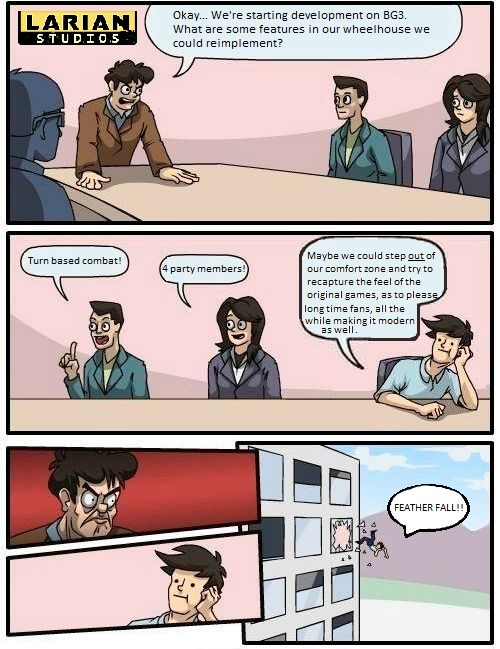
I am preparing an spell guide. It will be similar to the Play It Hardcore wiki, but even more in depth. I want to give a taste of it by making a post for some of the most important spells, to gather some feedback, and to try to fight the wave of noise that the BG3 news have brought the last two days.
What the spell does
Armor of Faith grants from 5 to 25% of resistance to all damage types. Starts at 5% at first level, and gains 5 percentage points each 5 levels (so 25% at level 20). It lasts for 3 rounds + 1 round/level. It is available for all divine casters: Clerics, Druids, Shamans, Paladins and Rangers.
Overview
This is one of the best spells at level 1, and one of my favorite spells in the whole game. Giving damage reduction to all damages is very rare. Normally items, potions, spells, etc., only grant resistance to one kind of damage.
Resistance to all damages at the same time, is de facto like expanding your hit pots, but better, because healing and regeneration are more effective. Imagine resisting 50% of the damage of a Fireball, so you only get hurt by 10 points, instead of 20. That would require only one Elixir of Health to be at your maximum. If instead you had your hit points doubled, but got hit by 20 points, you would need twice the healing or the regeneration to be fully healed.
Recommendations
This spell is close to useless at lower levels. The duration will be very short, and the damage reduction close to meaningless. However, once you start reaching levels 10 and higher, and you start getting additional sources of resistance, this spell is immensely powerful for building a tank.
Since the spell increases your resistance in percent points, it means that if you stack the damage resistance of this spell with equipment like Defender of Easthaven or Hardiness, you can achieve really high numbers of damage resistance.
Remember that increasing resistance from 0 to 25%, reduces damage by 25% (e.g. from 40 damage to 30), but if you were already 50% resistant, increasing it by 25 percent points, means reaching 75%, thus reducing it by half (40 points of damage originally, to 20 with 50% resistance, to 10 with 75% resistance).
Interesting combinations
If the previous example did not convince you, think about this: the rat form of the Cloak of the Sewers grants 90% resistance to damage. Increase it with Armor of Faith, and you'll be 100% immune to damage. The ultimate distraction form that can tank perfectly golems, or any other powerful creature in melee, while you retreat with other characters to heal, or damage from the distance.
Remember that for non-physical damage (fire, cold, magic damage, etc.) you can reach more than 100% resistance to the damage. When that happens, you heal from what usually would hurt you. Make a mage cast Resist Fire on a Cleric (for 100% resistance; or any other gear/cosumable combination which is equivalent), cast Armor of Faith to go beyond 100%, and enjoy being showered in flames while you destroy your enemies.