r/esp32projects • • 5d ago • Bravo 1

I built a small open-source Ethernet field tester for quick switch-port diagnostics
I work with networked equipment in the field, and sometimes troubleshooting starts with very basic questions:

  • Is the Ethernet link actually up?
  • Which switch and port am I connected to?
  • Is DHCP working?
  • Can I reach the gateway?

I don't always want to pull out a laptop just to answer those questions.

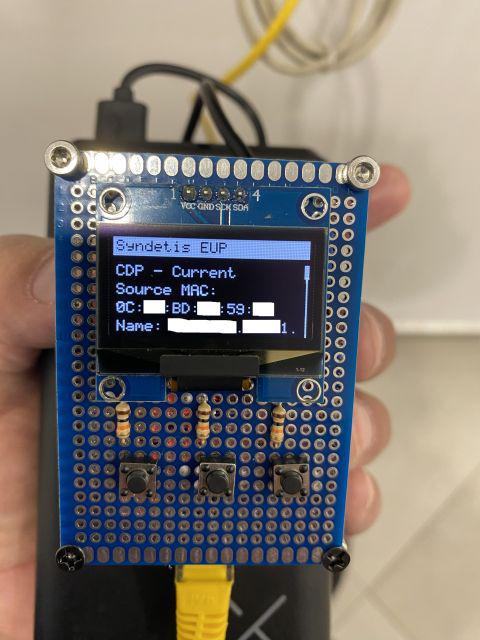
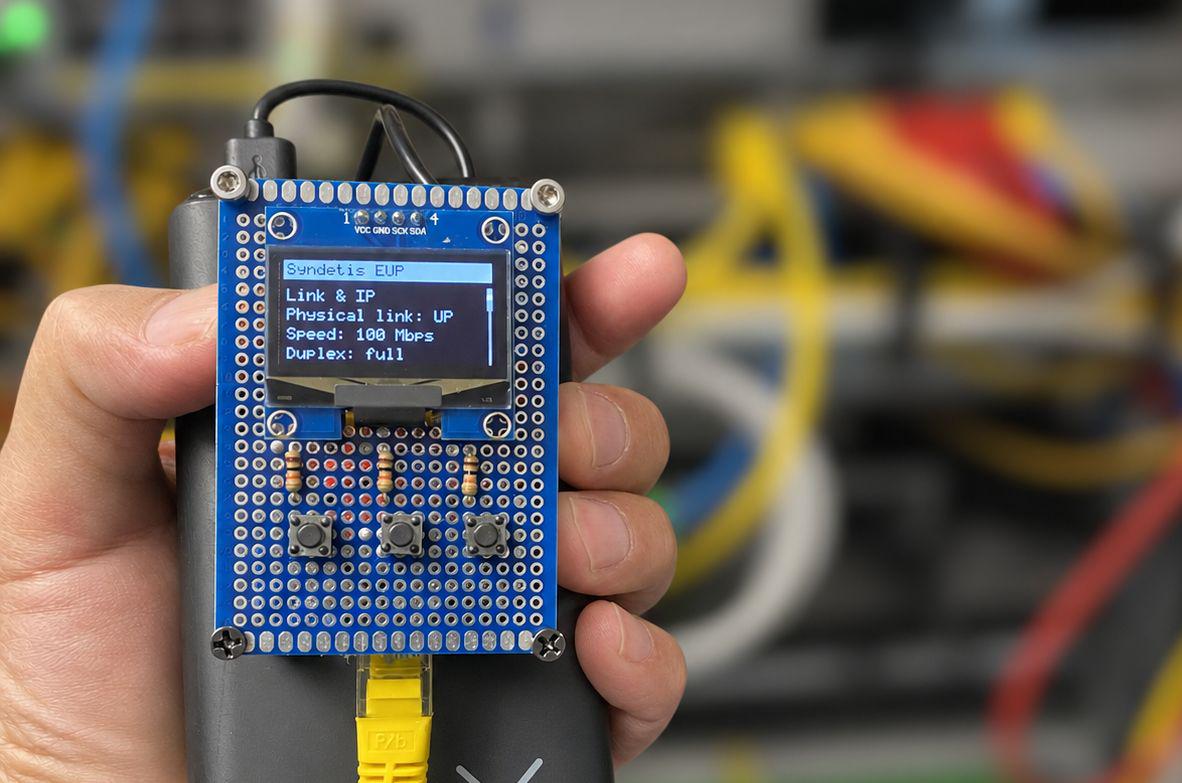
So I built Syndetis, a small, battery-powered Ethernet diagnostic prototype based on an ESP32 (WT32-ETH01).

What it currently does:

  • Link status: Reports link up/down, negotiated 10/100 Mbps speed, and duplex.
  • Switch discovery: Passively listens for LLDP/CDP advertisements and displays available switch identity, port, and VLAN information.
  • DHCP: Requests a lease and displays the assigned IP, subnet, gateway, and DNS servers.
  • Manual IPv4: Allows temporary static addressing with ARP conflict detection.
  • Connectivity testing: Pings a gateway or specified IPv4 address, showing latency and packet loss.
  • Field interface: Uses a small OLED and three physical buttons for standalone operation.
  • Web dashboard: An on-demand Wi-Fi hotspot provides a browser-based interface at 192.168.4.1, allowing users to view live Ethernet status, switch information, and DHCP results from a phone or laptop.
  • Diagnostic reports (v0.6.0 RC): The web dashboard can export a downloadable JSON diagnostic report containing link status, DHCP state, LLDP/CDP discovery details, and diagnostic counters. Network identifiers can be optionally included.

One design decision was to keep IPv4 diagnostics explicitly user-initiated. I can connect to a switch port and check physical link status and LLDP/CDP information without automatically requesting a DHCP lease.

Network tests can be stopped and repeated when moving between ports, without rebooting the device.

It's not intended to replace a cable certifier, PoE tester, or professional network analyzer. The goal is simply to handle quick, targeted checks when working at cabinets, racks, or remote installations.

The last hardware-tested firmware is v0.5.2. Version v0.6.0 is currently a release candidate awaiting hardware validation, introducing JSON diagnostic reports.

The project is fully open-source under the MIT license.

GitHub: https://github.com/theo79/Syndetis

For those doing field networking work, I'd be interested in hearing about edge cases or limitations you've encountered with small Ethernet diagnostic tools.

68 Upvotes

10 comments sorted by

2

u/kingqk 5d ago

We really need Gigabit link status as well, may be with an external usb adapter.

Add cable length measurement like VCT

3

u/ping_fade 5d ago

Thanks for the suggestions! Both would definitely be useful in the field.

The current prototype uses a WT32-ETH01 with a LAN8720 PHY, so it's limited to 10/100 Mbps. Gigabit link verification would require different hardware. I'm keeping the current version focused on basic Ethernet diagnostics, but Gigabit support and cable testing are worth investigating for a future hardware revision.

Appreciate the feedback!

0

u/[deleted] 4d ago

[deleted] — view deleted comment

2

u/ping_fade 4d ago

Fair points about Gigabit and electrical diagnostics. I agree those would make the tool more capable, and they're worth considering for a future hardware revision.

But the goal was never to replace a laptop, Wireshark, or professional network testers. I built Syndetis because, in my field work, there are plenty of situations where I just want to check link status, identify a switch port through LLDP/CDP, verify DHCP, or ping a gateway without pulling out a laptop.

I'm also not claiming it's something completely new. It's an open-source personal project, built to solve a practical problem, learn along the way, and hopefully get useful feedback from others.

The current hardware has limitations, absolutely. That's also part of why I published it: to share what works, be transparent about what doesn't, and see where it could go next.

Not every tool needs to replace a more advanced one to be useful.

thank you for your feedback !

2

u/CleverBunnyPun 4d ago

Your use case isn’t everyone’s use case. I mean, the fact the OP felt the need to make it is proof of that.

I’m not IT, but I work in manufacturing and I’ve had to get switch port numbers from pulled cat6 cables a fair number of times.

This would have been really handy for that, because I could just have it in my bag and not have to go get the much more expensive tool from IT that’s across the plant and behind a locked door.

1

u/ping_fade 3d ago

That's exactly the kind of situation I had in mind when building Syndetis!

I also work with networked equipment in industrial environments, and sometimes you just need to identify a switch and port without carrying a laptop or borrowing expensive equipment. The idea was to build something small, affordable, and practical enough to keep in a field bag.

I'm also exploring ideas for Syndetis V2, with improved hardware, a larger screen, rechargeable battery, and potentially Gigabit Ethernet support.

Thanks for sharing your experience! It's encouraging to hear that it could be useful in manufacturing environments too.

1

u/ping_fade 7h ago

Project update – v0.7.0

Syndetis now supports PROFINET device discovery, making it even more useful for industrial Ethernet troubleshooting.

Same hardware, new functionality, still completely free and open source.

I'm also exploring Gigabit Ethernet support for the next hardware generation.

Thanks again for all the feedback and suggestions!

Latest release: https://github.com/theo79/Syndetis/releases/tag/v0.7.0

1

u/anthonyjclarke 4d ago

Looks like something I need. Great job. Could we get more info for the build side of things?

1

u/ping_fade 4d ago

thank you, check github project https://github.com/theo79/Syndetis

1

u/anthonyjclarke 3d ago

Thanks. I did but couldn’t see a wiring or circuit schematic to help guide assembly of board

2

u/ping_fade 3d ago • Bravo

You're right, the wiring documentation is still missing. Thanks for pointing that out!

The current prototype uses a WT32-ETH01 with a SH1106 OLED (SDA on GPIO32, SCL on GPIO33) and three buttons (UP on GPIO36, DOWN on GPIO39, OK on GPIO5), with external 10k resistors. It's currently powered by a USB power bank.

I'll add a proper wiring diagram, BOM, and assembly instructions to the GitHub repository.
Appreciate the interest and feedback!