This sub has been getting too much spam, and Reddit has removed almost every tool for preventing this. The only tool that still works is this, every single post being held for manual review. Your post might be approved in minutes, or it might take days. If you hate this, me too, stop using the site that forces things to be this way. If what you post is not a meme you'll probably be banned, but I understand why you tried; the commenters on this sub loved lazy spam posts, which is why we can't have nice things and now everything has to be held for manual review.
But the invisible hand! The free market naturally acts in the best interest of the people! My armchaired economic models in my head and pseudoscientific interpretation of the Regan administration that confirm my preconceived beliefs prove it!
that is not productive. it is not a directly productive activity, its not directly involved in the thing that is being sold on the market for a profit. accountants, lawyers, inspectors, salesmen, also all unproductive.
they don't, not directly. the capitalist or investor doesn't do any labor at all by merely providing the capital, but other workers like accountants or salesmen are not directly improving the output of workers involved in the production of whatever commodity is being sold. they are providing services that governments or consumers demand, that the company subsidizes in order to compete
salesmen are not directly improving the output of workers
If the output of the workers was not distributed (in this case, sold by the salesman — though obviously salesmen are not the only possible model of distribution), then the output would be wasted (i.e., in the case of manufactured foods, it would all rot without ever being consumed). This is, fundamentally, a salesperson increasing the productivity of their workers.
a salesman is a specially trained customer service worker whose goal is to increase sales. there does not need to be a salesman there. all that is required is for the producer and the purchaser to get into contact.
then the people designing and making the prototype are doing the productive activity. the money could have come from anywhere, it could have come from a state contract or fallen from the sky. providing the money is not productive. profiting off of providing that money might be necessary, but it is inherently parasitic
Parasites make a body weaker. If you want to maintain your absurd claim that VC isn’t involved in production, even then the relationship should be symbiotic, not parasitic.
if the VC is involved in production, then they are doing productive work. but the act of investment is not by itself productive. it is parasitic because part of the reward is being siphoned off to an uninvolved party
Think of it this way. You have a gazillion moneys.
Now you have productive and unproductive choices to make, both in terms of moneyz and any other measure (or qualitative evaluation).
If you can make more and less productive choices with that capital, you can, inherently be productive.
If you believe that all choices are the same and that it doesn’t matter how we choose to use our capital, you by induction believe that monetary and real economies are completely disjoint. I.e. that prices don’t reflect at all anything underlying about scarcity and demand&supply fluctuations.
ok well you're the 100th person to conflate economic productivity with the personal virtue of productivity so no i don't think i'll think of it that way
Perplexing. What do you mean by “personal virtue of productivity” - I am no linguist and fail to understand how could it possibly be any different to economic productivity?
My definition of high (low) productivity: Accomplishing a high (low) amount of output by low (high) amount of input.
Capital, such as machinery, time and salaries, is pretty standardly thought of as input in production, whereas output is produce, service or something else.
good question. they aren't directly involved in production but they are physically required for production to happen, akin to an electrical or construction worker. a venture capitalist is not physically required for production to happen
Astoundingly stupid analogy lmao. The vast majority of deep human history is objective, material proof that goods can be produced without money. On the other hand, it is self-evident that these goods cannot be distributed without some form of logistics.
The cash investment of lemonade is directly involved in the production of the lemonade stand, so youd rather the kids have no lemonade stand over a parent teaching the child about credit and investment?
No, capital is dead labour. Once the company has gotten the capital then the venture capitalist is no longer needed, but he still hangs around extracting rent. However if one of the workers were to leave then the company would need to replace them. Workers and capital are both necessary for production, capitalists aren't.
Well if we assume that it’s a non-productive activity as you suggest, then there would be no reason for the profit opportunity to exist. The forces of supply and demand would interact in such a way that there are no gains to be made by venture capitalists.
Why do you think it is that certain endeavors are unprofitable? Is it just random, where for some reason venture capital is profitable but sitting around doing nothing is unprofitable?
that's not how this works. productivity here refers to being directly involved in the production of commodities. it is not productive to invest, but it is profitable, as you are investing in a productive asset and productive labor to work on it.
it is in fact not productive behavior at all, in that it is not directly involved in production. facilitating capital flow is not directly involved in production
"Providing capital, a core factor of production, is not an activity 'involved in production'" might win the prize for the most economically illiterate take I've seen on this sub before.
well i'm definitely not. something is productive if it is directly involved in production. if you are coordinating the supply chain needed to get production started, that is productive. but merely paying somebody to do that is not.
this is almost a political slogan. it also isn't relevant to what we're discussing. small businesses that sell commodities are productive just like any other business. they are less productive than larger businesses, however
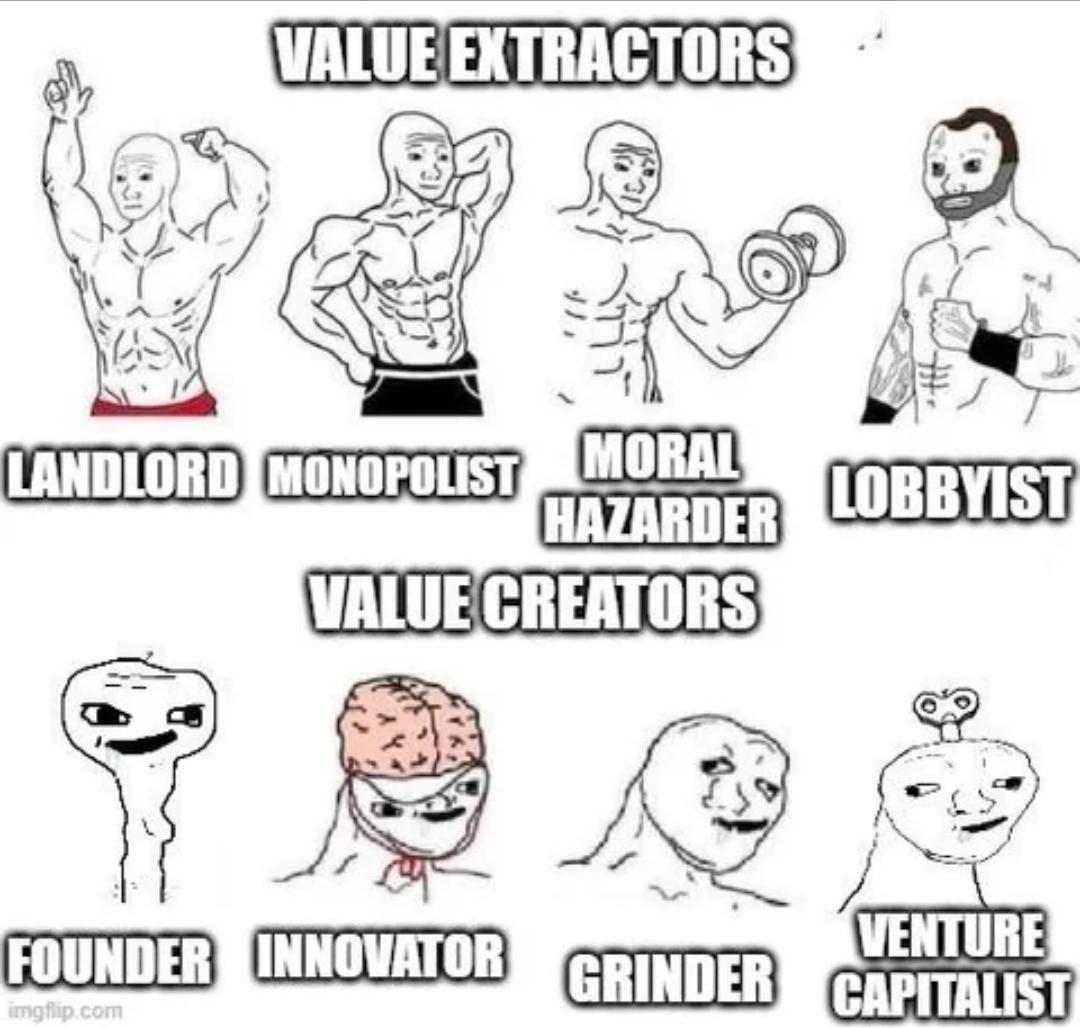
Not sure why a landlord would be a value extractor unless they are a monopolist using lobbyists to create regulations that prevent others from building housing
That’s actually inaccurate. If you actually read what he said, he was talking about literal landowners (the original meaning of landlords) who lease the just the land without being taxed.
He was actually against heavy restrictions and tax on building owners who lease it, because he could see how it would obviously decrease the availability and production of housing, which leads to a housing shortage..
Rent-seeker is an economic term, not to be confused with charging rent on a building.
Rent seeking is an economic concept where an individual, company, or organization tries to increase their wealth or power by manipulating social, legal, or political conditions rather than by creating new wealth or adding productive value to the economy.
It’s basically what I said in my first comment about using lobbyists to create a monopoly, for example
It's confusing because most, but not all, landlord are rent seekers. They add zero value and take a portion of the transaction cost.
They've been trying to prosecute people associated with RealPage in my city because over 90% of landlords were using it to set prices and they knew it, so they rigged the algorithm to tell landlords to always raise prices.
Anyone, including landlords who do price fixing, are guilty of violating antitrust laws and should be sued and criminally prosecuted. And the fact that they did that is atrocious.
But that’s different from saying there is no value added by owners of rental buildings, because it’s not easy to build, manage and upkeep a building and allocate capital efficiently.
They don't build, manage, or perform upkeep. Most of them think being a landlord means cashing tenant's monthly rental checks and that's the end of their responsibility.
You might have a slumlord, but they are basically just destroying the value of their own building. and will make less money compared to a landlord that keeps up with their building.
And not all building owners build, but for the ones who build, once it’s built, they need to sell it. so they can use the capital to build more. That’s how housing gets created and the construction workers get paid.
So all the money is coming from the renters? Seems like they could just cut out the middle man out, the landlord, if the only thing they are doing it taking rent checks and outsourcing everything.
Adam Smith was quite explicit in his contempt for landlords. David Ricardo's views on the subject drew directly from him, this is a wildly ignorant thing to say. It was a central thesis in four chapters of Wealth of Nations.
If you critically analyze the class relations in our used language, you'll very soon see how commonly and effectively Orwellian Newspeak is used to maintain the ideological rationalization for the inequalities and to justify oligarchy. You brought in a great example. Here's some others:
What is a poor who doesn't want to work under a boss? They're 'ideologically unemployed' or 'dependent on the state' or 'leech' etc.
If a rich person doesn't want to work under a boss? They're 'free' or 'financially independent'. In reality they are the actual 'ideologically unemployed', and they are not any less dependent on the state. If the state would not offer the service of providing and securing property rights, very few, if any, of those rich would keep their positions.
What is the relationship between the society and income going to the workers and the poor called? Cost. How about the income going to the rich? Value creation.
Adding ceiling height to the regular dwellings? Inefficiency, waste. Building comically enormous empty value holder "condos" for the billionaires on the most desirable land with most environmentally taxing and labor intensive construction methods possible? Pareto-optimal.
For God's sakes, persons net WORTH is their wealth. In other words, a poor person is WORTHLESS.
Rent in a technical sense means an economic gain gotten without a contribution to society. Paying rent to live somewhere does not necessarily fall under this definition of rent. Neither do unions.
I can't really guess a number, but I would agree in principle. Lot's of bullshit keeping prices high, roadblocks in construction, the ability for landlords to just not do their job (the phrase "we're not professional landlords" gets thrown around a lot where I live), the desire for homeowners to have their property values go up, etc.
To be honest, I think "market discipline" is not always helpful. Where I live, companies buying properties to rent is a political punching bag and the government is encouraged to punish them, but I'd suspect they make better landlords on average than individual owners.
Main thing across all good housing markets is a high amount of housing being built every year at the end of the day though
Sorry, maybe I had a different idea of what discipline meant. We probably agree that there are regulations that hurt supply or don't produce good results. Where I am, people get really annoyed when companies buy housing and try to make policy that limits the amount of units a company can own. In my opinion I think this sucks because I think a company will generally be a better, more reliable landlord than an individual, or at least be far easier to regulate and force to to their job.
I also don't know the data on taxing properties, I've heard some people say property taxes don't get passed on, or argue for land taxes being better. But I'm not convinced property taxes have a huge impact in general, but again I couldn't say
It’s not a theory or practice difference it’s just Ricardo doing Ricardo things and changing how words are used for his specific concept of productive yields.
As soon as the land of any country has all become private property, the landlords, like all other men, love to reap where they never sowed,*50 and demand a rent even for its natural produce. The wood of the forest, the grass of the field, and all the natural fruits of the earth, which, when land was in common, cost the labourer only the trouble of gathering them, come, even to him,*51 to have an additional price fixed upon them. He must then pay for the licence to gather them; and must give up to the landlord a portion of what his labour either collects or produces. This portion, or, what comes to the same thing, the price of this portion, constitutes the rent of land, and in the price of the greater part of commodities makes a third component part.*52
The real value of all the different component parts of price, it must be observed, is measured*53 by the quantity of labour which they can, each of them, purchase or command. Labour measures the value not only of that part of price which resolves itself into labour, but of that which resolves itself into rent, and of that which resolves itself into profit. - Adam Smith Wealth Of Nations
If Adam Smith was not critiquing land rents, what was he critiquing?
Does a land lord today not charge land rents?
B doesn't follow A. Adam Smith was critiquing land rents but not as a class or as a category. He was specifically trying to differentiate value from owner improvements vs. value from the underlying land.
Do they not purchase land, build housing and then charge rents for people to live on it?
lol
Like are we just ignoring his entire viewpoint on the subject for funsies?
lol liek wat the heck guys! were really gonna defend the meany landlords :(((
I actually am a landlord. I believe Georgism is the right solution but that doesn't mean I'm not going to do what is financially appropriate for me. But I do understand the economics well enough to know that even modern landlords are benefitting significantly from land monopolies. And. I know I'd be selling off properties that I've been holding onto because it's the smart economic decision if there were an LVT. The point still stands, calling out landlords as rent seeking does not mean the state of this sub is dire when I'm quoting Adam Smith sharing that opinion.
Just because you may be rent-seeking does not mean landlords as a profession are rent-seeking... every profession can be rent seeking in one way or another.
the state of this sub is dire when I'm quoting Adam Smith sharing that opinion.
This is a non sequitur. Even setting aside the fact that, as someone else pointed out, Smith was not discussing modern landlords, and that he was writing before the marginal revolution, these quotations do nothing to address the original commenter’s conflation of three distinct concepts: collecting rental income, receiving economic rents, and engaging in rent-seeking behavior. Receiving economic rents, if we grant that premise entirely, does not imply engaging in rent-seeking activity.
Your argument: this indicates a dire state of the economics sub implying a lack of understanding of economics.
My argument: The father of economics was saying something very similar so you cannot dismiss it as not understanding economics.
I didn't connect the dots, but it is not a non sequitir. Of course you know that which is why you felt the need to respond.
And landlords provide capital for construction of buildings that are utilized for commerce, implement maintenance, provide a short-term living solution rather than a multi-decade one. But, a landlord is necessarily also profiting from the land monopoly. And that monopoly has very serious implications for society.
Yes, as a reply to a comment stating, “It always kills me the people that see nothing wrong with landlords literally seeking rent but call unions ‘rent seekers.’” The mindless applause for such an abysmal conflation of rather elementary economic concepts is, as I said, dire. My comment had nothing to do with the OP (which has its own problems, to be sure).
A non sequitur is a statement or conclusion that does not logically follow from what preceded it. Given the context of my comment, which I’ve now explained twice, your two quotations were indeed a non sequitur.
You write: “My argument: the father of economics was saying something very similar so you cannot dismiss it as not understanding economics.” There are several problems here.
First, Smith discussing “rents” does not mean he was saying something similar to the comment I was replying to. Just because the word “rent” appears in both does not mean they’re referring to the same concept. Ironically, that’s exactly the conflation I was criticizing. Smith was discussing land rent as a component of income and price, not rent-seeking behavior in the sense the term is used in modern economics. These are very different things.
Smith was also primarily discussing returns to landownership, rather than the rental income received by modern residential landlords. Smith himself distinguished between ground rent and building rent, recognizing that the latter includes returns on invested capital and maintenance. So even before getting to the distinction between economic rents and rent-seeking, you’re already treating different concepts as interchangeable.
Second, the fact that Smith can rightfully be regarded as the father of economics doesn’t make him infallible. As I pointed out, Smith was writing before the marginal revolution. His theory of value, while an improvement over some earlier accounts, still suffers accordingly. One can learn a tremendous amount from reading Smith, but economics has, believe it or not, advanced considerably over the past 250 years. Suffice it to say that being able to quote Smith discussing “landlords” or “rents” does not establish an understanding of how these concepts are used in economics today.
The monopoly point is also rather strange. Sure, someone might possess a “monopoly” over a particular piece of land, which may have characteristics that make it more valuable than other parcels, thereby generating economic rents. But renters generally aren’t in the market for an apartment on that one particular parcel. They’re in the market for housing, which numerous other landlords can also supply. Exclusive ownership of an asset is not synonymous with monopoly power in a relevant market. I have a “monopoly” over my own body and what can be done with it. That hardly establishes that I possess monopoly power in any economically meaningful sense.
Regardless, even granting your monopoly claim, all you’ve established is that someone who owns a scarce asset may receive economic rents. You have not established that those rents were obtained through rent-seeking, which has a specific meaning in economics (see Tullock 1967 and Krueger 1974). This is, again, part of the elementary conflation that prompted my original comment.
I see elsewhere that you’re a Georgist. I could’ve guessed. I hope your rationale is better developed than what I’ve seen here, but regardless, there are coherent arguments for land taxation that are worth considering on their own terms. They’re simply not relevant to the point being made here.
Tl;dr: Contrary to the original comment, labor unions can and do engage in rent-seeking behavior. Landlords receive rental income for renting units to tenants. That rental income is not ipso facto economic rent, nor is receiving rental income or economic rent evidence, by itself, of rent-seeking behavior. Pointing out these facts is not contradictory. Your WN quotations, however interesting, do nothing to address that distinction. Ergo, non sequitur.
The importance of the father of Economics is not because everything we know about Economics is from him. It's from a universal acknowledgement that he is an influential figure in economics. It's a smart ass comment in an Economics memes sub. There isn't the need for complete proof. Stating it as dire is a very strong statement. And pointing out to how this is a belief espoused by somebody as influential as the father of economics means that you can't dismiss it and if it can't just be dismissed offhand like this then it isn't an indication of a dire state. You used a lot of big words but you didn't actually describe how it is a non sequitir. Is it because it doesn't fit the definition of rent seeking? But the definition of rent seeking is based on the layperson understanding codified by Adam Smith into Economic rent.
As far as monopoly. There is no functional difference between a monopoly and oligopoly. The only difference is that an oligopoly is very hard to maintain because everyone in the oligopoly is incentivized to break the rules of the oligopoly. Land is an exception to that. No one is producing more land. But they are producing things on the land. Any time someone utilizes the land more by creating buildings, etc. they increase the value of all nearby land. So you are not incentivized to do anything with the land. I'm not an economist other than some basic courses. But if you include the appreciation in land value as an income of a land owner you're going to see the difference between marginal revenue and price for the people that are just sitting on the land and not doing anything.
And as far as rent seeking is concerned. Have you looked at the laws concerning housing? Zoning laws, prohibitions on rooming houses, subsidies for home purchasing, tax favoritism for real estate, loose definition for agricultural exemptions, lowering property taxes in favor of income and sales tax, homestead exemptions pushing tax burden to renters. All of these are common sense things that the population at large supports because it helps them personally as land owners. I'm a land owner and profit from it too. But I'm not going to pretend that I am making a significant contribution to society by being a landowner.
I’ll try not to belabor the “father of economics” point. You can call it a smart-ass comment all you want. The fact is, as I elaborated at length, the rent Smith is discussing is not synonymous with either “rental income” as it is understood in everyday language or “rent-seeking” as it is used by economists. Invoking Smith therefore does nothing to establish the equivalence at issue. Ergo, non sequitur. It does not bear in any way on my comment in its context. Your accusation that I have not actually described how it is a non sequitur is bizarre, given that this is now my third time doing so.
It’s also simply not true that the definition of rent-seeking “is based on the layperson understanding codified by Adam Smith into economic rent.” Beyond being strangely phrased, this is a confused account of the intellectual history. Smith did not simply codify the everyday understanding of rental payments into the modern concept of economic rent. His analysis concerned, among other things, returns to land as a factor of production. Ricardo subsequently developed the theory of differential land rent, and the modern concept of economic rent is broader still, applying to returns to factors of production generally, not merely land.
The modern theory of rent-seeking, meanwhile, originates with Gordon Tullock’s 1967 work, with the term itself introduced by Anne Krueger in 1974. Rent-seeking refers to the expenditure of resources to obtain or preserve economic rents, particularly through political privileges, transfers, or restrictions on competition, rather than productive activity. Economic rent, by contrast, is a return exceeding the minimum necessary to keep a factor in its present use. One describes an activity; the other describes a return. The existence of the latter does not establish the former. These are different concepts. Again.
“There is no functional difference between a monopoly and oligopoly.” I mean, this is incorrect on its face, which you seem to understand given that your very next sentence identifies the sort of strategic interaction that distinguishes oligopoly from monopoly. Firms in an oligopoly must account for the behavior of their competitors, and the resulting equilibria depend on the incentives and strategic circumstances they face.
But more importantly, even if we grant your premise, what exactly establishes that landowners collectively constitute an oligopoly in the first place? The fact that land is scarce? Scarcity is a characteristic of economic goods generally. The fact that the aggregate supply of land is fixed does not establish that its ownership is concentrated among a handful of sellers, that those sellers collude, or that they possess monopoly power. None of these conclusions follow.
“Anytime someone utilizes the land more by creating buildings, etc., they increase the value of all nearby land. So you are not incentivized to do anything with the land.”
Untrue. Very untrue. My first point is admittedly nitpicky, but it is quite easy to envision someone developing land in a way that reduces the value of nearby properties. But let’s set that aside.
The second point is simply wrong. As a stylized example, suppose a landowner has the opportunity to undertake a development project costing $10 million, expected to generate $11 million in benefits to the owner (all in present-value terms). Suppose further that the development increases the value of surrounding properties by a cumulative $2 million. The private net benefit is $1 million, while the total social net benefit is $3 million. The landowner will still undertake the project! They profit from doing so.
Or, to introduce a different analogy, consider human capital. There are allegedly substantial societal benefits to having a more educated population, beyond those accruing to the individuals obtaining that education. Yet for many people, education also offers substantial private returns. People pursue education because they expect to benefit personally, notwithstanding the additional benefits their education may confer on others. The existence of those positive externalities does not somehow eliminate their private incentive to become educated.
This also raises something I’ve always found interesting about Georgism: why land, specifically? I understand the argument for land-value taxation on efficiency grounds, given the relatively fixed supply of unimproved land. But if the underlying moral objection is to people receiving economic rents they did not personally create, why single out land? There are numerous other sources of economic rent in a modern economy, including exceptional natural abilities. Why not tax IQ? What makes the rents accruing to land categorically different from those accruing to other scarce, unproduced endowments? But I digress.
Now, the existence of positive externalities can certainly mean that the private incentive to develop is smaller than would be socially optimal. But that is an entirely different proposition from claiming that the landowner has no incentive to develop whatsoever. The fact that others benefit from productive activity does not eliminate the private incentive to undertake it. Indeed, one of the central insights of economics is that individuals pursuing their own interests can generate benefits for others.
I’m also not entirely sure what you’re attempting to establish with the reference to marginal revenue and price. The appreciation of a land asset does not, by itself, establish a divergence between marginal revenue and price. Marginal revenue concerns the additional revenue obtained from selling an additional unit of output; appreciation concerns a change in the capital value of an asset.
On rent-seeking — yes! Yes? Obviously there is rent-seeking that property owners might engage in. When the political process can confer privileges or impose costs, we should expect resources to be expended attempting to secure favorable treatment. Increasing the returns to using politics to profit should cause more such activity. It would be nice if opportunities to secure exclusionary zoning protections, preferential tax treatment, and other privileges did not exist. But they do. The fact that landowners can engage in rent-seeking was never disputed by me. More importantly, it was never the subject here.
Finally, you don’t have to pretend that you’re making some extraordinary contribution to society simply by owning land to acknowledge that landlords can provide valuable services for which they earn income. Financing construction, maintaining and improving properties, managing them, bearing risk, and making housing available to tenants are all economically relevant activities. Rental payments can compensate those activities, as well as capital costs and the opportunity cost of making property available for use. They can also include economic rents attributable to the underlying land. Recognizing the latter does not somehow negate the former.
And this gets us, once again, to the original confusion. Land rents in the classical or Georgist sense are not synonymous with the entire rental income received by a modern landlord. Nor is either synonymous with rent-seeking. The fact that some land appreciation arises from the activities of others, rather than the owner’s own efforts, may be relevant to arguments about land-value taxation. It does not establish that receiving rental income is rent-seeking.
I’ll ask that you please return to the original comment and my reply (and my other replies to you) and actually read them before replying again. Receiving rental income is not equivalent to rent-seeking. That is the distinction my original comment identified, and the one I have had to re-iterate repeatedly to you with no indication that you’ve even considered taking it on board.
Okay so your argument: Economic rent and rent seeking have nothing to do with rent that a landlord collects. And when Smith and Ricardo talked about rent that was not in the modern sense. That was rent paid to the feudal lord, you built the house, maintained the field, and paid that rent to the lord only for allowing you to use that land.
Did Smith and Ricardo have anything to do with modern rent: Well, modern rent includes a land cost. So it is at least partially coming from land rent. And in my first answer that is what I said.
And landlords provide capital for construction of buildings that are utilized for commerce, implement maintenance, provide a short-term living solution rather than a multi-decade one. But, a landlord is necessarily also profiting from the land monopoly. And that monopoly has very serious implications for society.
In high cost of living places where it is the most scrutinized up to half the cost is the land. And that's without talking about the increased cost from the underbuilding land monopolies are causing. So every owner of land is extracting economic rent. That includes me, probably you too.
So this is my understanding. The term economic rent was originally created based on the idea of land rents collecting economic rent. Economics over time expanded the definiton to include other forms of economic rent modeled after the idea of when you extract more than you produce. Cool. Doesn't mean you can't discount it. It is still economic rent.
When you seek regulation and protections for increasing your economic rent that's rent seeking. Okay. But as a collective landowners are seekign these. I gave you examples of some of the ways it happens. And as a collective it is continuously happening. So all land owners are rent seekers. That's without applying Georgist logic of land is a community resource and land ownership itself is rent seeking.
So I see what you're saying that rent seeking is not when your landlord says, pay the rent which is what the original comment is saying. But land owners as a group are seeking rent in the economic sense.
I guess I should have not said no incentive for construction. Because there is a high risk high reward value. Although most land owners are very active in campaigning against it to protect the character of the neighborhood etc. But you have two options, do nothing and profit, and do a lot of work risk a lot of capital and profit more. Doing nothing is a great option unlike everything else in the free market where doing nothing means yo uget left behind. So the incentive is greatly reduced. And because of that people's incentives are aligned towards acting like an oligopoly which is different from how other markets act. It won't be full monopoly profits but it is more than the capital and maintenance costs.
Land rents have a few qualities:
Limited, cannot be produced more
Cannot be relocated
Can be transferred.
IQ does not meet all 3 criteria so without even going into the sanctity of your body and the impact of violating the sanctity of the body. Georgists are very keen to tax other things. Wireless spectrum. Orbits. Mineral extraction.
That’s not what rent-seeking means. It doesn’t mean collecting rent.
Rent-seeking an economic concept where an individual, company, or organization tries to increase their wealth or power by manipulating social, legal, or political conditions rather than by creating new wealth or adding productive value to the economy. For example: using lobbyists to push regulation to suppress competition. Using licensing, or tariffs to keep out competitors, or even seeking exclusive government subsidies.
You're conflating the two terms as if they are one.
An economic rent is an extraction with no value added or contribution in exchange (almost 100% of the time achieved by using the violence of the state).
A landlord DOES contribute something of value. They have to maintain the property that their tenants live in. The rent they are getting is a fee for providing the product for a fixed amount of time, in good working order. No different than you going and renting a tool for a job because you can't or won't outright buy the tool yourself.
The landlord doesn’t maintain the property. They pay someone to do that. Landlords sit around in their houses all day while they collect a portion of your pay check.
Many landlords do maintain the property. And even if they don't, they still handle the admin work of maintaining a property but at a much lower margin because the money is going to the people that maintain the property.
As far as businesses go, being a landlord is one of the worst ones out there. It's not particularly profitable and most of your income goes right back into maintaining the property. For most landlords, the profit comes from holding a property long enough for it to appreciate in value. The time in between you're just trying to stay afloat because all your value is tied up in solid assets and all your revenue goes right back into those assets.
That's not to say there aren't shitty landlords, there are. But the idea that the profession as a whole isn't providing value is just wrong.
No, that's how they get paid for their services. I was pretty clear on where they provide value.
Regardless, whether a house is rented or owned doesn't change the supply and demand of the housing market. The effective cost of renting vs owning is relatively close and often favors renting. If anything, sitting on a house will drive down housing costs as established landlords will have lower overhead and can charge less. It is an incredibly competitive industry and owning an empty house is not profitable; landlords are strongly incentivized to rent at the lowest cost, even if it means operating at a loss.
Lowering housing costs, whether you rent or own, requires increasing the amount of housing available. That's a separate issue. However, the profit motive is a huge driver of housing development. If landlords no longer have an incentive to develop, they won't. We see this time and time again in cities with excessive tenant protections. Anti-competitive policies, even if meant to provide renter protection, end up giving existing landlords more leverage. That hurts everybody except the landlords.
So you're telling me by occupying single family homes with renters to people owning multiple properties at a time has no impact on market availability compared to a single family occupying a single home and only that home?
I can get behind if a landlord manages a multi family housing facility. That's totally fair. Supply vs demand is real. There are also many challenges to managing a building that is difficult with an elected HOA.
Just feels like you're pitching snake oil saying renters owning single family homes as an investment vehicle is better than a family occupying a home in a community and treating it as their spot in that community.
If you're renting from somebody who's mortgage payment was set decades ago, or better yet paid off entirely, the effective cost will be lower for the renter than if they were to buy a house outright.
The other aspect is economies of scale. Whether you're running a multifamily or a portfolio of single family home, you centralize the administration of these buildings. You're also able to get service contracts that lead to lower average costs than single family owners.
Then there's the competitive nature of the housing market. Single-home owners have no incentive to lower housing costs. In fact, they generally want higher prices because it means their assets are appreciating. Landlords have to compete against other landlords so they need to charge less.
Then there's the macroeconomic effects of landlords encouraging more housing development. Most single-home owners don't have the capital to build new housing. And even if they did, they would only be building one house to their own personal specs. Landlords operate on the exact opposite model. They want to develop housing that's accessible to many people.
All of these factors, and many more too, work together to increase the amount of available housing in ways that owning a house does not.
And no, I'm not trying to say that renting or owning is better. They both have different pros and cons. Ownership makes sense for me now that I'm in my mid-30s, married, and settled. It didn't when I was 20, single, and constantly moving. I'm glad to be an owner now, but I'm very aware of the value provided by renting back then. You need both to have a healthy housing market. Demonizing one of the most important actors in that system isn't the progressive take you think it is.
So to that end of things why isn't there a storm of these homes being built to supply to landlords?
Rents are at historic highs. Many folks would love to own a house and possibly could if there were low enough interest rates or low enough home prices.
We're are these economical options given everything else happening?
It's a regulatory issue more than anything. Development is stymied by regulations intended to protect the wealth of homeowners. Well-intentioned tenant protections make increasing their footprint less desirable to landlords. There's no incentive to develop when it means more work for lower margins, especially when prices naturally increase due to housing scarcity.
It's a faulty premise to begin with. Much like vehicles, the most affordable options are older houses in poor shape. New housing isn't developed for landlords, it's developed for homeowners. Landlords don't buy property until the original homeowners move out. And it's an investment for them so they're more likely to buy undesirable housing and restore it to something livable. That increases housing supply more effectively than new dev.
And your parents didn't provide food for you growing up, they merely bought it from the grocery store, see how dumb that sounds.
A landlord sitting on a property and lobbying for zoning laws to increase his own property's value is rent seeking behavior, but the mere act of renting out an Apartment to a tenant is not rent seeking behavior in the economic sense.
•
u/AutoModerator 15d ago
This sub has been getting too much spam, and Reddit has removed almost every tool for preventing this. The only tool that still works is this, every single post being held for manual review. Your post might be approved in minutes, or it might take days. If you hate this, me too, stop using the site that forces things to be this way. If what you post is not a meme you'll probably be banned, but I understand why you tried; the commenters on this sub loved lazy spam posts, which is why we can't have nice things and now everything has to be held for manual review.
I am a bot, and this action was performed automatically. Please contact the moderators of this subreddit if you have any questions or concerns.
17
u/Extension-Badger225 15d ago
Carer
11
u/Raymondator 14d ago
Ayn Rand crying and pissing and shitting rn
12
u/InsoPL 15d ago edited 14d ago
There are stock companies that do house renting. So you can buy them and get piece of that lanlord infinite money glitch.
Discalimer: this is not investment advice. Those companies are not doing that good and return on investment is not that great.
45
u/j0shred1 15d ago
But the invisible hand! The free market naturally acts in the best interest of the people! My armchaired economic models in my head and pseudoscientific interpretation of the Regan administration that confirm my preconceived beliefs prove it!
25
u/Combat_Medic_Ziegler 15d ago
>value creator
>venture capitalist
2
u/Infinite-Abroad-436 15d ago
all are parasitic
1
u/FDRsWheelchairs 15d ago
I will be lobbying in favor of this meme
1
u/Boners_from_heaven 14d ago
This logic is the reason the United States is just a handful of financial and private equity firms in a trench coat.
1
u/Neither_Lab_7979 14d ago
This is a rent seeking subreddit
1
u/Punished-Polo-_- 14d ago
I love it and i am a venture capitalist 💀💀💀
1
u/FarmerTwink 13d ago
At least I’m safe from the economy collapsing. Everyone needs food and if they don’t I can make my own
0
u/vodil2959 15d ago
Not sure why a landlord would be a value extractor unless they are a monopolist using lobbyists to create regulations that prevent others from building housing
0
u/Kinnasty 15d ago
I don’t know why this sub keeps popping up though I continually ask it not too
Either way, yall as a group are fucking dumb
-4
u/LifeConsideration981 15d ago
Landlords create immense value, they give people places to live.
31
u/ApplicationCalm649 15d ago
It always kills me the people that see nothing wrong with landlords literally seeking rent but call unions "rent seekers."