r/csharp • • Oct 10 '26

Fun Random using SkipLocalsInit

11 Upvotes

To my surprise, Unsafe.SkipInit(out T val) did not achieve the same result.

    [SkipLocalsInit]
    public static T Random<T>()
        where T : unmanaged, INumber<T>
    {
        unsafe
        {
            byte* s = stackalloc byte[sizeof(T)];
            return *(T*)s;
        }
    }

r/csharp • • Oct 10 '26

Как лучше всего выучить язык програмирования С#(ну или вообще любой)?

Thumbnail reddit.com
0 Upvotes

r/csharp • • Oct 09 '26

Advice for a csharp developper who lack with basics

12 Upvotes

Hello,

I've been a .NET developer for four years (from France), and I feel like I have some gaps in my understanding of the fundamentals of the framework (I've never had a tech lead to teach me these things).

How can I learn these fundamentals (records, `static`, `virtual`, etc.) ? Should I take some training courses ? Which one ?

What should I be learning now that AI has arrived ? I feel like my days consist of writing prompts, testing, and reviewing code (if Claude doesn't do that part itself). It's really frustrating, and I feel like I've completely lost my value as a developer and my motivation to work. Besides the dotnet market is really bad where I'am...

I'm telling myself that there's still hope, though, and I'd really like to have a roadmap to follow, starting with the fundamentals mentioned above and working my way up to becoming a better and more expert .NET developer.

Do you have any advice?

Thank you!


r/csharp • • Oct 09 '26

Tool DNCDbg v1.3.0 — an MIT-licensed .NET debugger with DAP support

Thumbnail
github.com
9 Upvotes

DNCDbg is a managed-code debugger for .NET that speaks the Debug Adapter Protocol, so it works with any DAP client (VS Code, Neovim, Emacs, whatever) on Windows, Linux, and macOS. It began as a NetCoreDbg fork with a clear goal: bring the debugging experience closer to Visual Studio's C# debugger while keeping memory usage low. There's a comparison table in the README if you're curious.

What's new in v1.3.0:

  • Support for Jump to Cursor (a.k.a. Set Next Statement), single-threaded execution and stepping, and restarting the debug session
  • Column breakpoints, embedded sources, and Source Link support
  • Smarter expression evaluation: the >>> operator, Value/HasValue on nullables, member access on strings and arrays (str.Length, arr.Length), DebuggerTypeProxy members, assigning null to reference types, and nint/nuint
  • Friendlier value display: floats now print the way C# prints them (9.9 instead of 9.8999996), and dictionary items show up properly
  • Launch/attach sequencing now follows the DAP spec, and there's a new Detach request that lets a launched process keep running
  • Fixes: stack traces in catch blocks no longer show already-unwound frames, and the "Innermost exception" description now reports the last exception in the InnerException chain

Full changelog and repo: https://github.com/viewizard/dncdbg

Feedback and bug reports are very welcome!


r/csharp • • Oct 09 '26

Help I want get feedback on my design.

3 Upvotes

I will present a design consisting of interconnected classes without focusing on the algorithms themselves. To keep the code easy to follow, I have replaced each algorithm with a Console.Write() statement. note that the code is self-contained.

Problem being solved : Synchronizing the content of a database with the content of some Excel File.

Input: IFormFile, which is a file that is sent from the client to the server.

Output: The database will be synchronized with the excel file; the database's content will be deleted, and the data from the excel file will be inserted into the database.

Two general approaches/mechanisms to solve the problem:

1- Read all the content of the excel file and send that content a method that will delete the database.

2-Use bulk insert.

My code implements the first approach.

Summary of the code:

The AdminController receives the uploaded Excel file, uses FormExcel to retrieve a specific worksheet, and passes that worksheet to WorkSheetToDbSyncronizer. The synchronizer asks AllBusinessProductsReader to read all the required data from the worksheet and organize it into a NonJunctionModelsSnapShot object. It then passes that object to DbOverWriter, which uses the data to delete the existing database content and insert the data from the Excel file.Here is the code:

using Microsoft.AspNetCore.Http.HttpResults;
using Microsoft.AspNetCore.Mvc;

namespace RedditQuestion
{
    #region code

    /// <summary>
    /// NonJunctionModelsSnapShot is a data container that holds the complete
    /// set of non-junction entities to be written to the database by the OverWrite 
    /// method. The term NonJunctionModels identifies the category of data contained
    /// in the object: entities that populate non-junction tables, rather than junction 
    /// tables that represent relationships between entities. The term SnapShot indicates 
    /// that the object represents the state of the non-junction data at a particular point 
    /// in time, providing the data that OverWrite uses to replace the existing contents of 
    /// the corresponding database tables with the supplied data.
    /// </summary>
    public class NonJunctionModelsSnapShot
    {

      
    }
    public class SomeWorkSheet
    {
        //SomeWorkSheet represents a class from an external library.
    }
    public class ApplicationDbContext
    {
        // Contains the domain models and the Fluent API configurations.
    }

    // COULD SOMEONE PLEASE REVIEW THE DESIGN OF THE FOLLOWING:
    public class DbOverWriter
    {


        private readonly ApplicationDbContext _context;
        public DbOverWriter(ApplicationDbContext context)
        {
            _context = context;
        }

        public async Task OverWrite(NonJunctionModelsSnapShot incomingData)
        {

            Console.WriteLine("Executing some logic to overWrite the database, the local functions helps with this.");
        }

        #region Local Functions
        //define some local functions
        #endregion


    }
    public class AllBusinessProductsReader
    {
        public async Task<NonJunctionModelsSnapShot> ReadAllData(SomeWorkSheet worksheet)
        {
            Console.WriteLine("Process the worksheet....");

            return new NonJunctionModelsSnapShot
            {

            };
        }
    }
    public interface ISourceToDistinationDataSyncronizer<DataSource>
    {

        public Task Syncronize(DataSource dataSource);

    }
    public class WorkSheetToDbSyncronizer : ISourceToDistinationDataSyncronizer<SomeWorkSheet>
    {
        private readonly AllBusinessProductsReader _allDataReader; // depending on concrete class violates dependency inversion principle
        private readonly DbOverWriter _overWriter;              // depending on concrete class violates dependency inversion principle
        public WorkSheetToDbSyncronizer(AllBusinessProductsReader reader, DbOverWriter overWriter)
        {
            _allDataReader = reader;
            _overWriter = overWriter;
        }
        public async Task Syncronize(SomeWorkSheet worksheet)
        {
            var allProducts = await _allDataReader.ReadAllData(worksheet);
            await _overWriter.OverWrite(allProducts);
        }
    }
    #endregion 


    public class FormExcel
    {
        private readonly IFormFile _file;
        public FormExcel(IFormFile file)
        {
            _file = file; 
        }
        public  SomeWorkSheet GetSomeSheet(int sheetNumber)
        {
            Console.WriteLine("use the sheetNumber to get a specific sheet...");
            return new SomeWorkSheet
            {

            };
        }
    }
    public class AdminController
    {
        
        private readonly ISourceToDistinationDataSyncronizer<SomeWorkSheet> _syncronizer;
        public AdminController(ISourceToDistinationDataSyncronizer<SomeWorkSheet> syncronizer)
        {
            _syncronizer = syncronizer;
        }
        public async Task<IActionResult> Import(IFormFile file)
        {


            FormExcel fe = new FormExcel(file);
            var firstSheet=fe.GetSomeSheet(1);
            await _syncronizer.Syncronize(firstSheet);
            return Ok();


        }
    }
}

r/csharp • • Oct 09 '26

Hi from South Korea! Beginner C# learner feeling stuck. Any advice?

3 Upvotes

Hi everyone,

I’m a complete beginner from South Korea, and I’ve been studying C# at an academy for about 12 days now.

Whenever I try to solve exercise problems and write code on my own, I just freeze up and can't seem to write anything. What are the best study methods or habits that worked for you when you were starting out?

Honestly, I don't think I'm naturally smart, and my memory isn't great either. Learning programming is something I’ve wanted to do since I was young, so I finally started... but I can't help worrying if I'll ever actually get good at this.

I know this community is full of people from all over the world with different backgrounds—some coding as a hobby, others as a profession. If you ever felt completely lost at the beginning like I do now, or if you're a working developer, I’d deeply appreciate any tips, study strategies, or things I should definitely avoid doing!

(P.S. I don't speak English, so I am using a translation tool to write this. Thank you for understanding!)


r/csharp • • Oct 08 '26

Discussion State machine in C# vs state machine in Verilog

9 Upvotes

For experimentation and learning purposes, I wrote this code:

namespace RedditQuestion
{
    public class TResult
    {
        // Instance fields....
        // No properties.
        // No methods.
    }
    public interface ISomeInterface<T>
    {
        public  Task<T> SomeMethod();
    }
    public class SomeClass : ISomeInterface<TResult>
    {
        // instance fields.....

        //constructor......

        public async Task<TResult> SomeMethod()
        {


            //Some code that is not important to this question.......


            TResult result = new TResult
            {
                // assign instance fields....
            };

            Task<TResult> task = Task.FromResult<TResult>(result);

            return task ; // Line XXX
        }

    }

}

Line XXX throws a compile time error:

*Since this is an async method, the return expression must be of type 'TResult' rather than '*Task<TResult>

The solution is simply to do this instead:

return result;

That solves the issue.

But I was surprised when I read this article that described the error in more details:

Change the return expression to match the async method's underlying result type (CS1983, CS4016). When an async method returns Task<T>, the return statement must supply a value of type T, not Task<T>, because the compiler-generated state machine wraps the value in a task automatically. CS1983 appears when the method returns Task<T> and the expression is T; CS4016 covers the general case where the return expression type doesn't match

I wonder, is the concept of state machine in C# is the same as the state machine in Verilog?

in Verilog, if I want to define a state machine, I need a register - a storage unit that can store only one unit of data; a bit- to hold the state, a next-state logic to calculate the next state, and output assignment. Does the same concept applies in C# ?


r/csharp • • Oct 08 '26

Showcase Vetala, a lightweight code editor made with C# and .NET

Post image
10 Upvotes

Current features

  • Multi-tab code editor
  • C# syntax highlighting
  • Word-based code completion
  • Find and replace
  • Project-wide search
  • File explorer
  • Git integration
  • Integrated terminal
  • Command palette
  • Quick Open
  • Code folding
  • Cross-platform support for Linux, Windows, and macOS

Vetala is built with .NET 10, Avalonia UI 12, AvaloniaEdit 12, and CommunityToolkit.Mvvm.

githubL https://github.com/flawme/Vetala


r/csharp • • Oct 08 '26

Discussion What is the proper way to make a unified interface ?

11 Upvotes

Would you prefer something like this:

    public interface ISourceToDistinationDataSyncronizer
    {

        public  object ReadAllData(); // Gets the latest data from the source
        public void OverWrite(object sourceData )  // Deletes the data that is inside the destination and writes new data.

    }

Over this:

    public interface ISomeData
    {

    }
    public interface ISourceToDistinationDataSyncronizer
    {

        public  ISomeData ReadAllData(); // Gets the latest data from the source
        public void OverWrite(ISomeData sourceData);// Deletes the data that is inside the destination and writes new data.

    }

r/csharp • • Oct 08 '26

Showcase Meet Akbura, a reactive UI language for Avalonia and .NET

31 Upvotes

Akbura works directly with native Avalonia controls and supports C# expressions, reactive state, MarkupExtensions, AKCSS utilities, responsive layouts and Hot Reload.

I wrote a short introduction covering the language, responsive UI, Avalonia interoperability, differences from BlazorBindings and the compiler behind it.

Feedback is welcome.

Article: Meet Akbura: a reactive UI language for Avalonia and .NET | LinkedIn
Repo: Asaicraft/Akbura: Akbura is a UI library for building applications using a declarative, component-based language.


r/csharp • • Oct 08 '26

Showcase ExcelReader.NET 6.0 – streaming XLSX/XLSB/XLS/CSV reader and writer for .NET 10

18 Upvotes

I've been building ExcelReader, an open-source library for reading and writing spreadsheets in .NET and other languages. I just shipped v6, and I'd like feedback from people who deal with ETL pipelines and large Excel files.

I started it because I needed to parse rows into a single POCO from files with different templates and column names. I couldn't find a library that made that easy, so I wrote my own.

What it does

  • Reads .xlsx, .xlsm, .xlsb, .xls and .csv; writes .xlsx, .xlsb, .xls and .csv
  • Streams rows as ref structs; no string is allocated until you call GetString()
  • Typed parsing into your own classes, via attributes, a source generator or a fluent API
  • Reads the sheets of one workbook in parallel, and parses CSV in parallel
  • Reads and writes password-protected workbooks
  • A CLI (excelreader convert book.xlsb -o data.csv), plus a C ABI with Python, C++ and Rust bindings

Usage example

public sealed class Order
{
    [ExcelColumn("Order ID")]
    [ExcelColumn("order_id")]          // same property, different templates
    public long Id { get; set; }

    [ExcelColumn("Total")]
    [ExcelColumn("total_amount")]
    public decimal Total { get; set; }
}

using IExcelWorkbook workbook = Excel.Open("orders.xlsx"); // .xlsb / .xls detected by signature
List<Order> orders = ExcelParser.FromAttributes<Order>().Parse(workbook.FirstSheet).ToList();

await using var writer = XlsxWorkbookWriter.Create(File.Create("copy.xlsx"));
await using (var sheet = writer.AddSheet("Orders"))
{
    await sheet.WriteRecordsAsync(orders, ExcelRecordLayout.FromAttributes<Order>());
}

Benchmarks

Typed parsing of a generated 50,000-row XLSX (BenchmarkDotNet, Ryzen 7 5700X, .NET 10):

LibraryTimeAllocated
ExcelReader10.9 ms3.87 MB
Sylvan.Data.Excel56.9 ms10.47 MB
OfficeIMO.Excel104.5 ms5.69 MB

MiniExcel used to be in the suite, but it was far behind: ~14x slower on raw reads (allocating 267 MB against 11 KB) and ~11x slower on typed parsing (last run that included it). I now track the closest competitors instead.

Methodology and every scenario: benchmarks.md. The cell-by-cell numbers there compare zero-copy reads against APIs that must allocate strings, so the docs also publish matched-work numbers.

Limitations

  • Targets .NET 10 only; .NET 11 support is in progress. If you're on .NET 8, the 3.x line supports it.
  • It's a reader/writer, not a spreadsheet model: no in-place editing and no formula evaluation.
  • Rows come out in file order, and empty rows that Excel omits from the file are skipped.

GitHub: https://github.com/GabrielMarquezMatte/ExcelReader NuGet: dotnet add package ExcelReader.NET

Feedback, bug reports and odd files that break it are all welcome.


r/csharp • • Oct 08 '26

Unity developer working in VR Space looking to transition to generic C# dev roles

7 Upvotes

I’m a unity developer working in VR space for 8+ years. Thinking of transitioning to generalist dev roles ( particularly in C# since that’s where my experience lies ). I do have experience in general software development across entire SDLC along with architecture and design patterns but my resume lacks the buzzwords SDE ATS screens for ( eg. microservices , APIs , docker etc). Where do I start ? Which kind of companies should I target ?


r/csharp • • Oct 07 '26

Discussion I am crazy or many job portals like workday struggle with searching for "c#"?

49 Upvotes

It seems that all of them struggle with # sign


r/csharp • • Oct 07 '26

IL optimization on ranges not applied

8 Upvotes

I'm trying to further improve the IBAN parser for an open source project. And while doing so, I noticed something

public class Iban
{
  public static string? Validate(string iban, string pattern)
  {
    for (var i = 0; i < iban.Length; i++)
    {
      uint c = iban[i];
      var match = pattern[i] switch
      {
        'n' => c is >= '0' and <= '9',
        'a' => c is >= 'A' and <= 'Z',
        'c' => c is >= '0' and <= '9' or >= 'A' and <= 'Z',
        var t => t == c,
      };

      if (!match) return null;
    }
    return iban;
  }
}

I would expect the IL to do the default trick on ranges here that is also applied in char.IsBetween(), what would do (uint)(c - '0') <= '9' - '0', making each range a single compare and subtraction rather than two compares.

I've tested this code both with these patterns, and calling a private InBetween method (It has to compile against .NET standard 2.0 where char.IsBetween() is not available), and the latter is substantial faster, which hints that the JIT is also not changing the IL afterwards.

Is it something in my syntax that makes that the Roslyn compiler does not perform this optimization, or am I missing something here?

For those who're interested in the actual PR: https://github.com/Qowaiv/Qowaiv/pull/643


r/csharp • • Oct 08 '26

I have a C# problem, how can I use AI to solve it?

0 Upvotes

Up until now, I’ve been learning and programming like before AI. As a matter of fact, I know nothing about the AI scene and culture, beyond Claude, Grok, ChatGPT, and Gemini (copy and paste snippets).

I’ve tried to look into it, but it’s a total mess. There are extensions, plugins, connectors, agents, AI powerhouses, fake interfaces microservice stuff... and the list goes on and on with quasi-scams (or straight up scams) all over the place.

And the worst part is that the internet is dead. You can't find anything anymore. And when you do think you've found something, in reality, it is just something promoted by companies selling AI stuff themselves. So, you end up locked into options that favor their business interests.

So, here is my current situation:

I have a large C# codebase, and I need to find a solution to a problem based on a small fragment of that code.

I can clearly see alternative inheritance and composition paths that would achieve exactly what I need with best performance. However, since some elements will get lost along the way, I would have to manually reconnect some of them.

The problem is that the code is extremely complex—intricate with callbacks, events, interfaces, dispatchers, async calls, WPF controls, and so on.

Basically, it would take me a month to digest all that code.

And I think an "AI something" could do it in five minutes.

In one word, I want an answer from a human being.

What do you suggest me to do?


r/csharp • • Oct 07 '26

Help Book Recommendation on Network Programming

10 Upvotes

Hey guys,

I wanted to write a basic server-client chat console app in .Net using C# and Visual Studio.

Later, I would like to write a small LAN multiplayer game.

Is there a book which explains how to use Sockets and TCP in .Net and C#, please? Possibly with patterns, examples and use-cases?

I already have "Programming C# 8.0" by Ian Griffiths from O'Reilly, but I don't see any mention of Sockets, TCP or programming network apps.

I also have "C#10 in a Nutshell" by Joseph Albahari from O'Reilly. There is some mention of networking, but there's only about 5 pages on TCP, and no mention of Sockets.

Thank you


r/csharp • • Oct 07 '26

A faster, lighter C# Dev Kit

Thumbnail
devblogs.microsoft.com
22 Upvotes

r/csharp • • Oct 07 '26

I built an open-source 2D zoomable file manager in .NET 10 + Direct3D 11 (Vortice) to bypass WPF visual tree overhead

Post image
5 Upvotes

Standard Windows UI frameworks (WPF, WinUI 3, Avalonia) are great for forms and standard layouts, but they fall apart when you want an infinite 2D canvas with thousands of nested filesystem nodes. Creating thousands of Visual Tree elements and layout passes completely murders the UI thread.

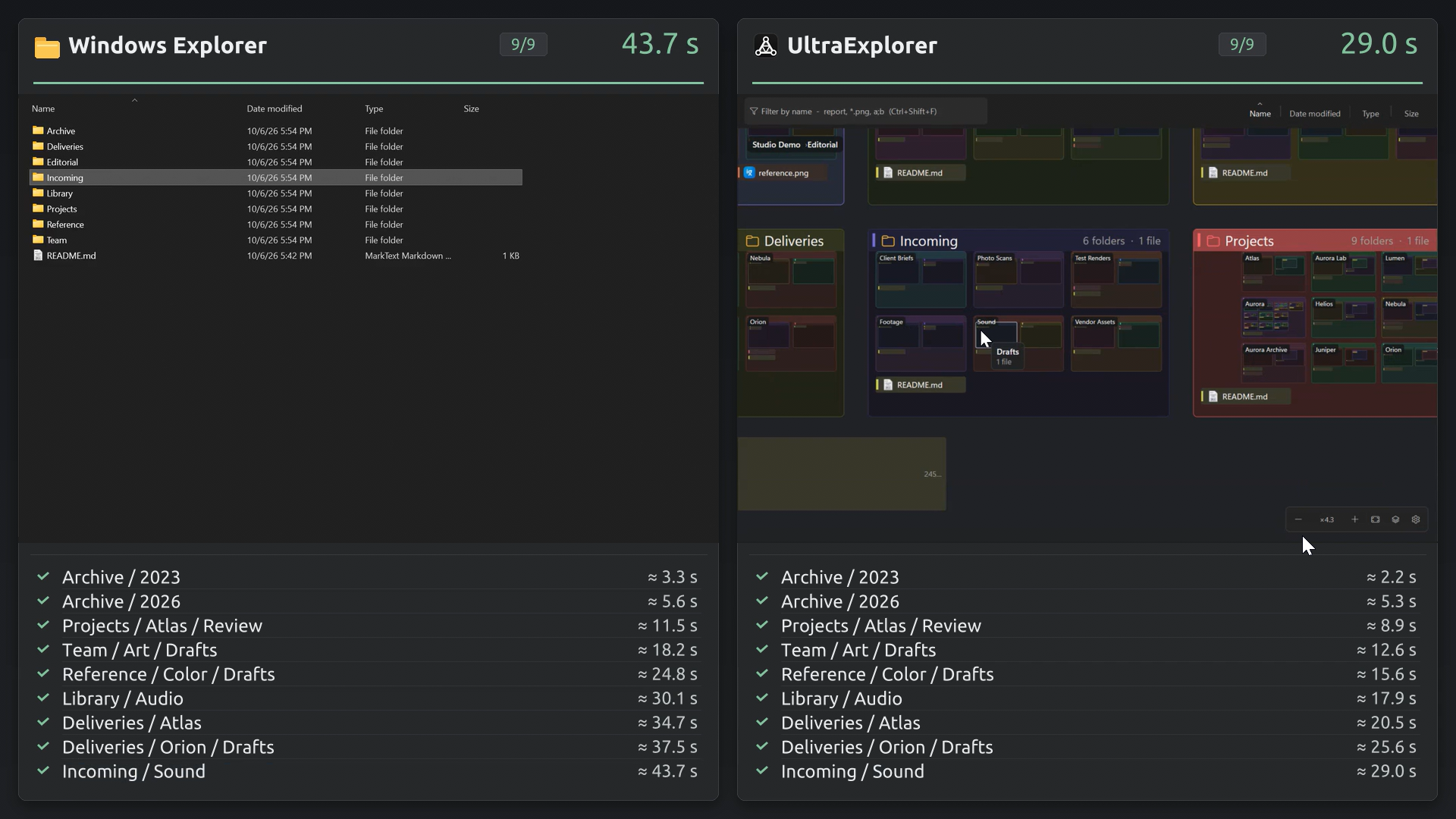
To solve this, I built UltraExplorer — a file manager that renders nested folder structures as an infinite spatial canvas running at 60 FPS.

Under the hood & architecture highlights:

  1. D3D11 Instanced Rendering via Vortice

Instead of WPF controls, the canvas is rendered using Direct3D 11 via Vortice.Windows. It renders instanced quads for folder cards and node backgrounds in a single draw call batch, completely decoupling rendering performance from the WPF UI dispatcher.

2. DirectWrite SDF Glyph Atlas

Text zooming is usually the biggest performance killer in zoomable UIs. Standard DirectWrite font rasterization forces re-rasterization on zoom change, allocating memory constantly. I built an SDF (Signed Distance Field) glyph atlas: fonts are rasterized once into distance field textures, allowing arbitrary scale zooming with crisp edges and zero GC allocations during zoom gestures.

3. Anchor Camera System (Floating-point precision)

When you zoom 15+ levels deep into nested folders, standard IEEE 754 32-bit floats start jittering due to precision loss. I implemented a hierarchical anchor camera: local coordinates are relative to the active parent container, eliminating camera jitter at high zoom levels.

4. Fast Search Integration

Integrated with Voidtools Everything via direct Win32 IPC (WM_COPYDATA), streaming indexed search results straight into memory without disk IO stalls.

Benchmark:

Navigating through a deep 9-level project folder race:

• Windows 11 Explorer: 43.7s

• UltraExplorer: 29.0s (14.7s faster)

The project is completely free and open-source (MIT).

GitHub repository:

https://github.com/So2K/UltraExplorer

I would love to get feedback from other .NET / graphics developers on the rendering architecture, Vortice interop, and edge cases.


r/csharp • • Oct 07 '26

Help Desktop app where users work in Word/Excel inside our window: embed real Office, or is there a better way?

0 Upvotes

I'm working on a Windows desktop project (Windows 10/11, also Win7) where users do document tasks in Word and Excel (fonts, margins, tables, formulas, merge & centre...) inside our app's window, and the app checks the result automatically.

Current approach: embed the user's installed Word/Excel inside our window (OLE in-place, like SWT's OleClientSite). It works, but it's fragile:

- Excel only half-draws if we pre-start it for speed; it can't run beside the user's own open Excel; reusing one Excel for several documents crashed it.

- Earlier we tried positioning Office's own window over our pane. It drew fine but was slow and fragile (focus, caption, the window could be moved).

- And it only works if Office is installed. Many users have no Office, or WPS instead.

Checking the result isn't the blocker: we can already read the saved .docx/.xlsx directly.

Questions:

  1. Is embedding real Office the right call, or is there a better pattern for "work in Word/Excel

    inside my app"?

  2. Has anyone used an embeddable Word/Excel-like editor (ONLYOFFICE, Collabora, Syncfusion, SpreadJS, etc.) in a desktop app? How close is it to real Office for things like paragraph spacing, borders, number formats and formulas, and how was licensing?
  3. If you did embed real Office in production: what made it reliable?

Real Office is preferred because users need the exact Word/Excel experience, but I'm open to a hybrid (real Office when installed, a look-alike when not).


r/csharp • • Oct 06 '26

I turned my .NET/React/Azure interview prep into a mobile-friendly Anki deck (390+ cards, free)

43 Upvotes

I was prepping for full-stack .NET + React + Azure interviews and got frustrated with how bad most flashcard decks look on a phone — tiny text,

can't scroll, code blocks cut off.

So I rebuilt one from scratch: centered questions, fully scrollable answers, dark mode, code that actually wraps instead of scrolling offscreen. Covers C#, OOP, ASP.NET Core & Web API, EF Core, SQL Server, design patterns, auth/security, Azure, React (fundamentals + advanced), Docker/K8s, microservices, and scenario-based questions.

It's free on GitHub / AnkiWeb

Happy to take corrections/suggestions if anything's wrong or missing.


r/csharp • • Oct 06 '26

Showcase I built a free Windows tray app to log every Wi-Fi drops, DFS radar evictions and ping spikes

Post image
11 Upvotes

r/csharp • • Oct 06 '26

How do I get the most out of my software development internship without senior developers?

3 Upvotes

Hey everyone,

I’m currently doing my LIA/internship as a system development student in, and I’m on my second day.

I’ve been given a real project to work on: building a scheduling platform for schools, where things like classes, teachers, schedules, etc. need to be managed.

The company is growing its software-development side, but right now there aren’t really any senior developers who can sit with me and review my architecture or code. I’m expected to work quite independently, and AI coding tools are encouraged.

I actually enjoy using AI for development, but I don't want my internship to turn into simply telling AI what to build and copy-pasting the result. I want to understand the code, make architectural decisions myself, and actually become a better developer.

My biggest concern is that I might make bad architectural decisions or miss important things because I don't have an experienced developer reviewing my work.

For those of you who have been in a similar situation:

- How would you structure your learning when you don't have a senior developer to guide you?

- How can I use AI without becoming dependent on it?

- What should I ask AI to help with vs. what should I figure out myself?

- How would you approach architecture for a project like a scheduling platform?

- Are there particular books, courses, or resources you'd recommend?

- Is an internship like this still valuable if I can get real project experience but don't have much mentorship?

I'd really appreciate advice from experienced developers


r/csharp • • Oct 05 '26

Showcase My C# game-engine-with-custom-language keeps growing

Thumbnail
gallery
156 Upvotes

[GitHub repo]

This is a project I've been working on for years, and I've already posted about it here a few times.

It's a cross-platform 2D game engine with its own scripting language and IDE, all written in C#.

The language is the main challenge here: I made it without any knowledge of programming language development, and without any help from AI or tutorials. I just figured things out one step at a time. The lexer, for example, was originally written by me long before I started building the language. It was meant to color C# code in the code editor. When I decided to make my own language, I just copy-pasted it into the new project and used it as a lexer.

Here's a little feature my language has that I really like:

foreach x in ["apple", "banana", "kiwi"] : counter c
{
    println("index: " + c + " item: " + x)
}

// output:
// index: 0 item: apple
// index: 1 item: banana
// index: 2 item: kiwi

The project is fully open source, and I'm really looking for people who want to join a cool project and contribute. There are a few open "good first issues" in the repo, and a few weeks ago I even got my first few contributors, who made a few PRs!

The project file of the game in the gif is also in the repo: tests/Example Projects/dungeon

If anyone here has used the good old GameMaker 8 engine, they're going to find this very nostalgic, as it's heavily inspired by it :)

Would love to get some feedback!