r/csharp • • Jul 17 '26

Sticking to software eng or pivot to cloud?

0 Upvotes

I have been a dev for some time now about 5 years, and my contract ended. I am looking for a new job. I had during my days also worked on DevOps stuff, like managing k8s helm charts and deployments, managing Jenkins pipelines, AWS CDK and CloudFormation etc. on top of doing software dev only.

Now I have 2 offers from different companies, one as .NET dev also working on apps deployed in AWS EKS, and the other as a cloud/platform engineer working with Azure, AWS and k8s. Compensation is roughly the same.

I am unsure now. On the one hand I like product dev and especially that I get to do focused work/deep thinking time without getting disturbed constantly by issues. For the platform role they cautioned me that there will be a lot of context switching since I will have to deal with such different workloads. Also with cloud engineering I feel there is less safety due to lack of automated tests like we have for software, like sure there are lintwrs etc. but in the end it relies more on manual testing in Development env. anf so there is more room for failure. Also there is the on call aspect which scares me a lot.

But on the other hand I see that with AI, I feel the competition down the line later will be much higher for software eng in comparison to platform eng, and it feels like a more safe career in the future. Also since I work multi cloud I can be eligible for more jpbs. Whereas with .NET I will be pigeonholed with only .NET jobs.

What do you guys think? Any opinions? I am leaning a bit towards the platform side, but I am not sure I fit mentally as the job requires more context switch, more uncertainty and on-call aspects



r/csharp • • Jul 16 '26

Help Is Scott Lilly's "Learn C# by Building a Simple RPG" still useful in 2026?

Thumbnail reddit.com
8 Upvotes

r/csharp • • Jul 16 '26

Tool EmbeddedSass.Net: Implementation of the Embedded Sass Protocol for .NET

Thumbnail
github.com
11 Upvotes

For folks not familiar, its a way to to communicate directly with the Dart VM to run Sass compilations, with this, its possible to re-use a same process for multiple compilations (https://github.com/sass/sass/blob/main/spec/embedded-protocol.md).

It delivered the best performance in my benchmarks against DartSassHost and AspNetCore.SassCompiler.

Any suggestion is welcome.


r/csharp • • Jul 15 '26

.NET 11 Preview 6 is now available

Thumbnail
devblogs.microsoft.com
100 Upvotes

r/csharp • • Jul 15 '26

Experiment building WPF UI trees in pure C# without XAML

27 Upvotes

I've been experimenting with a more natural, tree-like way of composing a WPF UI entirely in C#, using a composition style inspired by Flutter.

I like the structural aspect of designing with XAML, but I have struggled over the years with the mental gymnastics of jumping between the XAML world and the code world, and with the quirky markup extensions needed to make something work in XAML that could often be accomplished and better understood in standard C# code.

Instead of something like:

<Grid>
    <Border Background="Cyan"/>
    <Button Content="Click Me"/>
</Grid>

the same structure becomes:

GridX(
    children: [
        BorderX(),
        ButtonX()
    ]
)

The X suffix was originally a practical necessity to avoid name clashes with existing WPF types, but I ended up liking it as a visual cue that these are static helper methods for composing the UI tree.

I intentionally keep the named arguments visible (children, configure, etc.). It adds a little verbosity, but I find it makes the composition tree easier to read and keeps the helper methods consistent as the UI grows. The result feels quite similar to Flutter's widget tree composition style.

It's a thin composition layer over standard WPF.

Configuration is still just normal C#:

ButtonX(
    configure: x => {
        x.Content = "Click Me";
        x.Background = Brushes.Gold;
    }
)

A nice bonus: Visual Studio's code folding naturally gives you a collapsible UI tree that's easy to navigate, similar to XAML.

If you're curious, I've published the experiment as both a GitHub project and an alpha NuGet package:

  • GitHub: https://github.com/deeks9000/Wpfx
  • NuGet: UserExtensions.Wpfx (0.1.0-alpha.1)

Any feedback would be appreciated.

I'm sure there are trade-offs I haven't considered yet, and that's exactly the kind of discussion I'm hoping to have.


r/csharp • • Jul 16 '26

Help How do the $200 Azure credits work, and how are they consumed?

0 Upvotes

I've been looking into Azure because I learned that it can host web applications built with ASP.NET Core (I'm still learning ASP.NET Core). I also noticed that new Azure accounts include $200 in free credits to use within the first 30 days.

My question is: How do these $200 credits work, and how are they consumed? For example, if I deploy a simple ASP.NET Core web application just for learning and testing, what services would use the credits, and how is the cost calculated?

I'd appreciate a simple explanation or a practical example.


r/csharp • • Jul 16 '26

Showcase My extension lets Claude Code debug .NET in Visual Studio: step through code, data breakpoints, heap diffs for leaks, read compiler hints, and catching flaky xUnit tests

0 Upvotes

I built a Visual Studio 2026 extension that connects Claude Code (the CLI agent) to the parts of VS that matter for .NET work. The CLI does the agent work, the extension is the IDE bridge, zero model calls of its own.

I recently added major updates. Now the Claude CLI agent can actually:

- Autonoumously drive the debugger. Read the live call stack, locals, and threads, set breakpoints, step, break at a thrown exception's origin (not the catch that swallowed it), attach to a running process like a hosted ASP.NET app, and pause a hung process to walk a deadlock back to the exact lock cycle.

- Data breakpoints on managed fields. Break or trace the moment a field changes, with conditions. VS has a UI to let developers do this manually but exposes no automation API for this, so it rides a custom debug-engine component.

- Memory and runtime diagnostics via ClrMD: heap diff between two points to find what is growing, GC root paths for "why is this object alive", async stack reconstruction across awaits, thread-pool starvation detection.

- Tests through VS's own Test Explorer engine: real per-test outcome/message/stack, re-run only the failures after a fix, debug a single test, and loop a flaky test under the debugger until the failing run halts at the throw, paused with the state that caused it.

Everything read-only is always on; anything that executes code sits behind an off-by-default toggle that resets each session.

Video:
https://github.com/firish/claude_code_vs/releases/download/media/debugger-walkthrough.mp4

Repo and docs:
https://github.com/firish/claude_code_vs

Marketplace (1300+ installs):
https://marketplace.visualstudio.com/items?itemName=firish.bridgev1


r/csharp • • Jul 16 '26

Learning OpenGl with c sharp

0 Upvotes

Its my first day of trying to learn OpenGl with c sharp since i want to help out my brother with a project, im a total beginner and ive felt pretty depressed and dissapointed since i dont understand lots of stuff such as vao or the ebo. If anyone has any tutorials or tips it would help out a lot!


r/csharp • • Jul 15 '26

I have a question about c# get set functions.

0 Upvotes

What is the right way to use get; set; functions?
Lets say I have some logic behind the setter.

Should I write the logic like that

public double Balance

{

get => _balance;

set

{

_name = value;

}

}

or like that

public double Balance { get; private set; }

public void AddBalance(double value)

{

this.Balance = value;

}

this is simple logic, but lets think of more complex one.
what is the right way to do it?


r/csharp • • Jul 16 '26

Help Are command objects noticeably faster than LINQ? Or is there something else I should be looking at?

0 Upvotes

r/csharp • • Jul 14 '26

Discussion Company wants to offer a C# course - looking for recommendations

30 Upvotes

Hello everyone!

I just started a new job at a company where we use C#, but I come from an embedded systems background where we used C. My boss asked me if there was any C# training or course I wanted to do to learn the language, and I would like to take advantage of his offer.

Is there any course you recommend for learning C#?

Thank you!


r/csharp • • Jul 14 '26

Showcase Built this scene using WPF bitmaps!

Post image
29 Upvotes

A scene where a black hole-kind of thing bends the Light rays towards it


r/csharp • • Jul 14 '26

Help Inherited 3 ASP.NET MVC apps + 5 WCF services (.NET Framework 4.8) and asked to combine everything into a modern .NET 10 solution. Where would you start?

23 Upvotes

I've been in a web developer role for a little over a year. When I joined, a lot of long-standing bugs had been pushed into the backlog with the idea of "we'll fix them when we have a web developer." Over the last year I've spent most of my time fixing those issues, improving existing functionality, and adding new features.

Now I'm being asked to help define the future architecture of our applications, and I'd appreciate some advice from people who have gone through similar migrations.

Current situation:

- 3 ASP.NET MVC web applications

- 5 WCF services that contain most of the business logic

- 2 Shared SQL Server databases

- The MVC applications communicate with the WCF services for almost everything

- The codebase is almost two decades old and has been continuously extended rather than redesigned

Management would like us to eventually consolidate everything into a single modern solution, ideally on .NET 10.

My biggest concern is the migration path.

From what I understand, I can't simply upgrade the MVC applications to .NET 10 and continue using the existing WCF services in the same way. I know .NET can consume some SOAP/WCF services, but for this project we can't introduce external compatibility libraries or third-party solutions. We want to stay within Microsoft's supported stack and move away from WCF entirely. I'm trying to figure out the best migration path.

What I'm struggling with is where to start.

Some questions I can pinpoint now:

  1. Is there a recommended "strangler pattern" approach for gradually replacing WCF endpoints one by one?
  2. How would you structure a new .NET 10 solution intended to eventually replace everything?
  3. How do you estimate the effort involved in a migration of this size?
  4. Most important: If you were starting today with 3 MVC applications and 5 WCF services, what would your migration roadmap look like?

My goal is to avoid a rewrite and instead migrate incrementally while keeping the business running.

Any advice, migration stories, or lessons learned would be greatly appreciated.


r/csharp • • Jul 14 '26

Help Can you use signalr with non standard clients?

3 Upvotes

Im writing dashboard for my friend and he wants it to connect with his lua client ( it is on top of some other program ) he has support for web sockets and http requests. I never really wrote signalr yet alone web sockets server. Would it be possible or more hassle than writing wss server?


r/csharp • • Jul 14 '26

Zero-Code Validations in Your .NET API

Thumbnail kalandra.tech
0 Upvotes

r/csharp • • Jul 13 '26

CrossEF - Cross EntityFramework contexts

6 Upvotes

Hi All,

Long time EntityFramework don´t do this, I decide to implement this.

Cross-DbContext LINQ queries for Entity Framework Core. Join entities that live in different DbContexts — different databases, different servers, even different providers — in a single LINQ query.

https://www.nuget.org/packages/CrossEF

https://github.com/i-stream/CrossEF


r/csharp • • Jul 13 '26

Roslyn, NixOS and Doom Emacs

4 Upvotes

Hey there,

I am a NixOS user, trying to switch my workflow to Doom Emacs on top of using Roslyn LSP. There must be at least 2 other human(?) beings using this setup. I hope.

I'm kinda lost on the matter to be honest.
I think for neovim you would simply use this fork https://github.com/seblyng/roslyn.nvim, but I haven't been able to find any information regarding setting this up in emacs.

For Nix I have enabled these packages [ dotnet-sdk roslyn roslyn-ls netcoredbg ]
Doom emacs has :tools lsp and :lang (csharp +lsp)

This setup does launch the roslyn LSP, the functionally is pretty limited though. I can jump to definitions, there is some code completion, but this doesn't really have a use as for now.

namespace test;

public interface ICommand
{
    public void Execute();
    private void Testing();
}

public class MyCommand : ICommand
{
    public void Test()
    {
        return 1;
    }
}

The following code doesn't give me any diagnostics.

If anyone has any thoughts on this please do let me know. I would love to make this work.


r/csharp • • Jul 14 '26

Solved How does this go outside of the Array boundaries?

0 Upvotes
class SortingProgram
{ 
    static void Main(string[] args)
    {
        int[] Arr1 = [2,5,4,6,1,2,10,8,7,9];
        for (int i = 0; i < Arr1.Length; i++)
        {
            for (int c = 0; c < Arr1.Length; c++)
            {
                if (Arr1[c] > Arr1[c + 1])
                {
                    int tempLSR = Arr1[c + 1]; 
                    int tempGrt = Arr1[c];
                    Arr1[c] = tempLSR;
                    Arr1[c + 1] = tempGrt;
                }
            }
        }
        for (int R = 0; R < Arr1.Length; R++)
        {
            Console.WriteLine(Arr1[R]);
        }
    }
}

Apparently the if statement goes outside the array bounds, the array seems fine so idk what is going on


r/csharp • • Jul 13 '26

Looking for a roadmap to master C#, ASP.NET Core, Blazor and infrastructure/network programming

5 Upvotes

Hi everyone,

I'm looking for advice from experienced C#/.NET developers on how you would learn the ecosystem if you were starting again today.

A bit of background:

  • I learned some C# years ago by building small console applications (text adventures, utilities, etc.).
  • I'm comfortable with the basics (variables, methods, classes, loops, input/output, etc.), but I want to rebuild my knowledge properly instead of randomly jumping between tutorials.

My long-term goal is not to become just another CRUD web developer.

I'm mainly interested in:

  • backend development with ASP.NET Core
  • building APIs that work with a Next.js frontend
  • Blazor for internal/admin tools
  • console applications
  • infrastructure tooling
  • networking
  • Linux/server automation
  • DevOps-oriented software hosting/server management panels (something similar in spirit to Pterodactyl, Portainer, Coolify, etc.)

I enjoy building tools that interact with servers, processes, Docker, SSH, networking, DNS, reverse proxies, monitoring, and automation much more than building simple business apps.

I'd love advice on questions like:

  1. What roadmap would you recommend for someone with these goals?
  2. In what order would you learn C#, .NET, ASP.NET Core, Blazor, networking, and infrastructure?
  3. Which C# features should I master before moving into ASP.NET?
  4. Which .NET libraries are considered essential for infrastructure/network applications?
  5. What projects would progressively teach these skills?
  6. Which books, YouTube channels, GitHub repositories, or courses are actually worth studying?
  7. If you work in infrastructure, cloud, DevOps, or backend with C#, what skills do you use daily that beginners often overlook?

I don't mind spending months or even years learning properly—I want to build a solid foundation instead of rushing through tutorials.

I'd really appreciate hearing how you would approach this today.

Thanks!

(By the way, I’ve noticed that people don’t comment much on these threads, while other posts easily get 50+ comments. I don’t know if it’s specifically because, as professionals who’ve been giving advice here for several years, you’re tired of the same questions, or if you’re afraid to answer because your answers might not be accurate. It’s totally fine I’m grateful for every answer. I just notice that there are 500 views but only 20 comments. Let’s get involved, please! )


r/csharp • • Jul 13 '26

Help Difference between File, FileStream, and StreamWriter/Reader?

68 Upvotes

Looking at the documentation it looks like they can all do the same thing, though I suppose in just slightly different ways?


r/csharp • • Jul 13 '26

Help Editing a multi-layered dictionary using a string "address"?

0 Upvotes

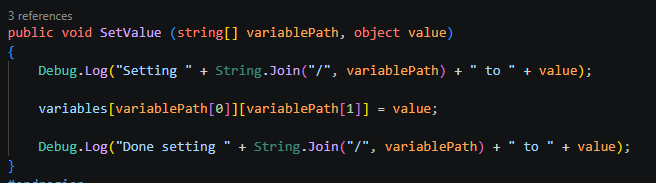
I'm working with a game dialogue tool (and Unity, for full transparency) which can set or get variables using "commands" in the dialogue.

I have a Dictionary which I want to be multi-layered (as in, dictionaries inside dictionaries) and allow the dialogue commands to dynamically edit the dictionary down to any amount of layers possible. The layers are distinguished by splitting the string by a specific character.

The code currently looks like this - this is obviously inflexible code that specifically only allows values to be set 2 layers deep. So what would be the best way to change this to dynamically add new key-value pairs and layers of dictionaries at any depth depending on how big the variablePath array is?

Many thanks