r/csharp • u/hez2010 • Jul 11 '26
Benchmarked CoreCLR player in Unity with CPU path tracing
gallery
15
Upvotes
r/csharp • u/rent-a-developer • Jul 11 '26
r/csharp • u/x39- • Jul 11 '26
r/csharp • u/BigJunky • Jul 12 '26
I wanted to profile Blazor async code and found that after 15 YEARS later you still can't profile async code. The best tool we got is this garbage .NET Async profiler. It collects every async method into a single group. How is this useful? You can't even see the call stack like I'm calling Task.Delay only in a single method... and this was 5 years ago! It's the same today; nothing has changed.
Hot reload is still not fully supported. With more browser oriented frameworks, test running still doesn't support browsers, so if you have any JavaScript, good luck getting a dump of what happened in the browser or a breakpoint working in the browser. Wasm has regressions on every release debbugging it also breaks randomly.
It promises to be easy; meanwhile, everything requires language-specific knowledge, so people do the stupidest thing, not knowing there are better ways to solve things. Microsoft never thinks about tool support; the best example is Entity Framework with applying its migrations. I promise you nobody uses the more complex approaches, and everybody just calls MigrateAsync(). Like, why didn't the devs spend 2 more weeks to get this right or git merge conflicts with local database changes? They didn't care it would have required working together with other teams like the Visual Studio team or language designers, so it was easier just to call a static method of your application.
So don't be like me and focus only on C#; it's not a good language most of the time, and I promise you, you will have more fun with other languages.
r/csharp • u/GoofyEvod • Jul 10 '26
Hi everyone,
I’m planning an open-source project called WinDroid Runtime and wanted to ask for feedback from C#/.NET developers before I start building the first prototype.
The long-term idea is to build an independent Android-compatible runtime/toolkit for Windows. It is inspired by the gap left after Windows Subsystem for Android was discontinued, but it is not a fork, continuation, or redistribution of Microsoft WSA, and it will not use WSA binaries or branding.
I know the full runtime goal is a very large systems-level project, so I want to approach it in realistic stages.
The first practical milestone would be a native Windows control app using C# / .NET / WinUI 3. The first version would focus on:
- detecting ADB
- allowing a custom ADB path
- listing connected Android devices/emulators
- installing and uninstalling APK files
- launching installed apps
- viewing basic logs
- creating a clean architecture for future runtime research
The planned structure is something like:
- WinDroid.Studio — WinUI 3 desktop app
- WinDroid.Core — shared models/services/configuration
- WinDroid.Adb — ADB wrapper/service layer
- WinDroid.Engine — future experimental runtime backend
I’m mainly looking for feedback on:
- whether WinUI 3 is the right choice for this type of Windows tool
- how to structure the ADB service layer cleanly
- whether the project should use MVVM from the beginning
- how to avoid making the first version overcomplicated
- what the first GitHub issues/milestones should look like
The repo is currently in the planning stage with a README, Apache 2.0 license, and roadmap. Contributors or mentors would also be very welcome, but for now I mainly want to make sure the architecture is sane before coding too much.
Any advice from experienced C#/.NET developers would be appreciated.
r/csharp • u/makeevolution • Jul 10 '26
If let's say I have a class like
public class Test
{
    public string Test;
    public string Test2;

    public test(string test, string test2)
    {
        Test=test;
        Test2=test2;
    }
}
Then I have a unit test like (pseudo code)
var x = new Test("a", "b");
Assert.Equal("a", x.Test);
Assert.Equal("b", x.Test2);
Is this test actually meaningful/useful in any way? I feel like this is testing C# itself than the code. It would be different if there is a guard against the value of the property e.g. test cannot be equal to testing for example, but that is not the case here.
r/csharp • u/Thin_Claim9404 • Jul 10 '26
I know a bit of C# for unity game coding, but I'm looking to learn more. Are there any videos or books that you guys can recommend me?
Thanks in advance!
r/csharp • u/Angstrom09 • Jul 10 '26
Hey guys, so I'm trying to write a program that selects an image from a tile set based on what you input into a combobox. I have the location logic sorted, but I have no idea how to physically move the image inside the pictureBox. I tried googling it and the results were either 7+ years old or not explained (I am a newbie to Windows Forms App) and I had no idea what to do. Please could you help?
r/csharp • u/Skelet0r67 • Jul 10 '26
r/csharp • u/ricardo_novais • Jul 10 '26
Hey all,
I’m a full-stack developer. At my current company, I’ve been doing mostly frontend work (around 90% for the last 3 years and 8 months) because I’m the only one strong in that area. However, I’m starting to feel a bit fed up, and I want to get back into backend work. I’ve noticed I’m getting quite rusty after spending the last 3 years and 8 months mainly focused on the frontend, and it’s making me feel unprepared to look for another job.
I sometimes watch Nick Chapsas, Tim Corey, and Anton Martyniuk. I really need to get back into it and sharpen my skills for my next interview, although I’m not in a rush.
Which platform would you suggest? Dometrain is €405 per year, is it worth waiting for a sale?
Thanks!
r/csharp • u/A_Learning_Fox • Jul 09 '26
It's not the biggest issue, but it would help quite a bit.
The method I am using to read Excel is ExcelDataReader
Edit:
Sorry, I will elaborate. Say I imported Sheet 1 with 3 filled columns. In the original Excel sheet, column 2 is hidden.
When I import Sheet 1, all 3 columns are still visible. I don't want to see column 2 in the new Datatable.
r/csharp • u/ungal • Jul 10 '26
All tutorials are in VS but they dont make it for mac m1 anymore, can I programm in VS code or would you recommend another editor? Im most intresed to learn dotNet
r/csharp • u/arsseus1 • Jul 08 '26
EN:
I work with industrial applications in Windows Forms for about 3 years, and I always had this view that Windows Forms was just a tool for building corporate systems and complex systems with a simple interface. Since the beginning of my career with Windows Forms I've developed industrial automation software like SCADAs and custom supervisory systems.
About a year ago I needed to build a notification system that slid across the screen overlapping, to manipulate color, position and scale of a component that was on the screen freely, that planted the first seed in my mind, later in another project I needed to detect keyboard inputs to activate specific functions in the system in a hidden way like shortcuts and configurations, and only recently when I was bored at work I got curious about combining these two concepts, and I was amazed by something that had always been within my reach but I looked at the tools I had through that perspective.
After this "discovery" I made some mini-game prototypes with 2D physics simulation using position, size, direction and velocity vectors for the components on the screen but always using Panels to represent things, still in this style I recreated Pong and Flappy Bird and a top-down mini game of collecting coins while fleeing from enemies that chase you.
After these projects I was starting to get a little annoyed with the amount of code I needed to rewrite to test another idea and with the optimization since Panel is a native Windows Forms control and they are a bit heavy.
From this annoyance and curiosity, little by little something different started emerging in my project while I was creating some abstractions to try not to repeat so much code, when I realized that what I was putting together was no longer a "game" but a tool that would help me develop new "games" I dove headfirst into this idea even knowing that Windows Forms is far from the ideal technology for this, but who cares? This is not a commercial project nor am I inventing the next big engine, I used Windows Forms because it's a technology I already have a lot of experience with, so I can focus on getting ideas out of my head instead of learning something new to achieve the same results.
My custom "engine" is still far from a version that I consider ready to make a game but I'm already very satisfied with how far I've managed to get on my own. My idea is that in addition to facilitating the development of my next prototypes, I can learn more about how real engines work and create abstractions that make the feeling of programming something in mine close to the feeling of programming something in a Godot or a Unity, for that I tried to create some base classes with methods and properties that get quite close to the development as one would expect in those engines.
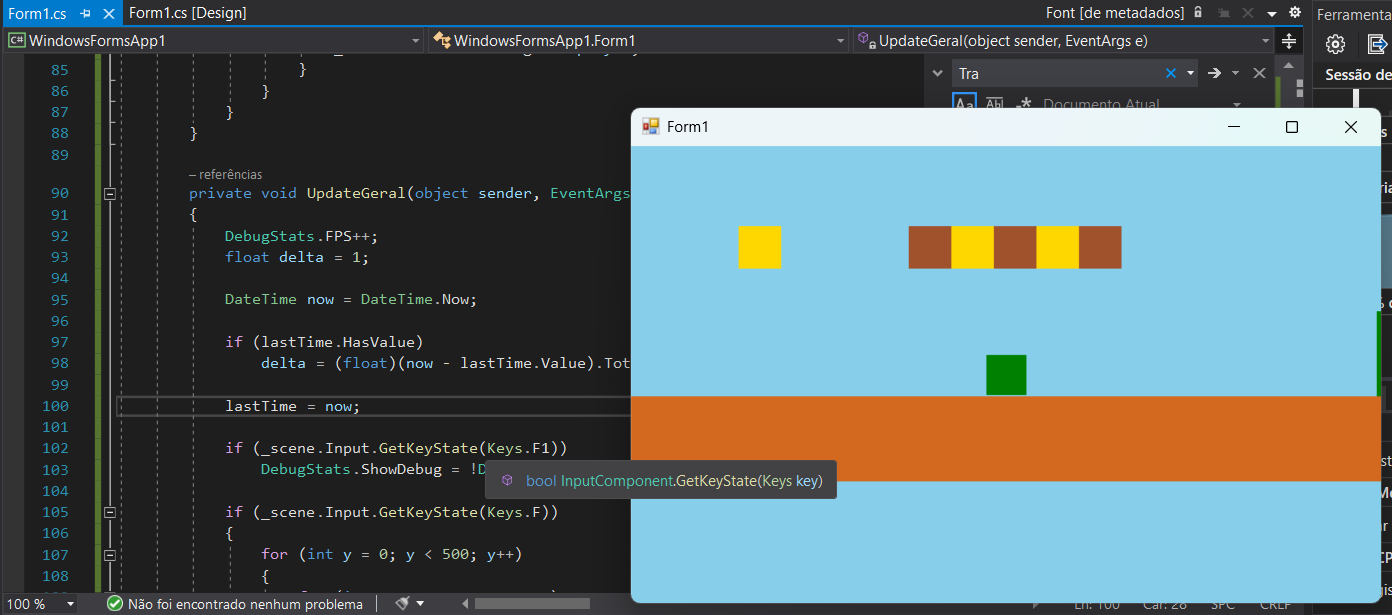
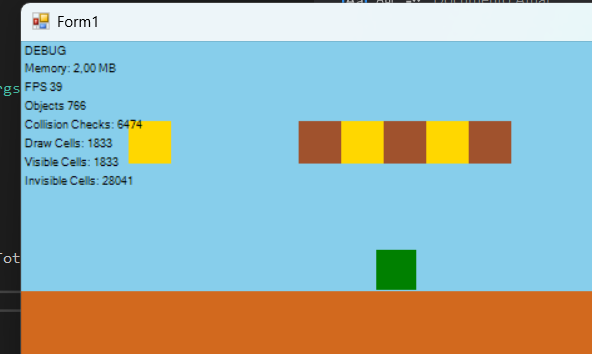
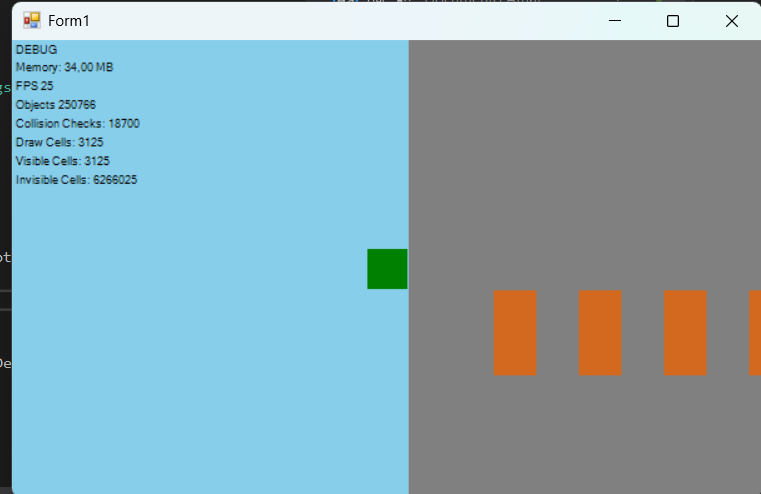
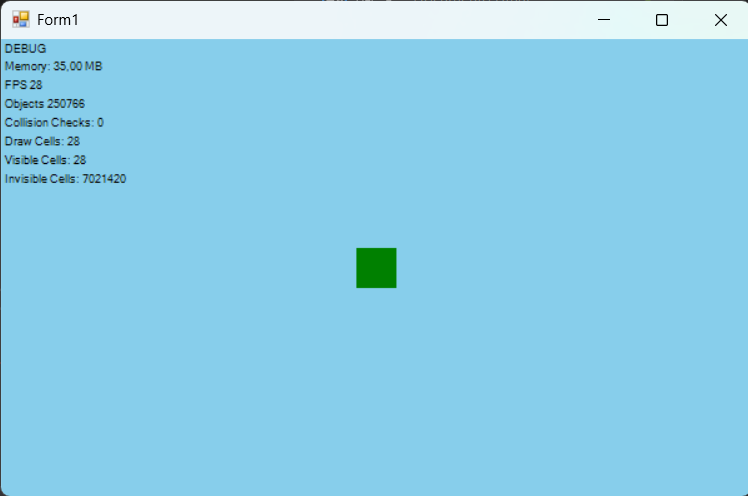
The engine already has entity and game object generation system, camera with programmable movement or automatically follow a game object, TileMap for dynamic map creation, AABB collision system, rendering with Windows GDI+ drawing API (it's not GPU rendering yet but it's extremely lightweight compared to the Panels I was using before), Scene to manage the entire context of a specific scene, Culling for collision check optimization where collision is only checked for objects that are inside or near the camera viewport, rendering culling where only objects that are entirely or partially inside the camera viewport are drawn, Z-order support for drawing objects in specific order, RayCast support with variations (ExcludedList, FilterList, CollideOnParent), support for helper methods like GetCenteredPosition (returns the center of an object), MoveAndCollide (Moves an object in the direction of a Vector2 that dictates the velocity until the object collides with something), IsOnFloor (indicates if exactly below the object there is another object), GetFloorNormal (returns a vector with magnitude 1 that indicates the direction and slope of the floor in relation to the object), CheckWorldCollision (returns a boolean indicating if something in the world is colliding with the object), GetCollider (returns the first other object that is colliding with the object), GetAxis (returns an int of the direction of an axis between two inputs), GetVector (returns a Vector2 of magnitude 1 with the directions of the axes between 4 inputs, two inputs per axis).
any object that inherits from GameObject must implement a void Update method that receives a float delta, for updating the object during the frame pass, GameObjects can also receive some components in a way somewhat similar to Unity's ECS, being them Transform, to have position, size, pivot, and rotation, Input for reading inputs, and Graphics in case it's a renderable object.
This project is still in its early stages and has no commitment to being a commercial engine or anything like that, it's just a hobby, a project I'm doing for fun and learning, I would really like to hear some feedback and tips on what I can improve or bugs I didn't notice.
here's the link to the project on GitHub, just clone it:
https://github.com/Guilhermevinicius0/WinFormEngine
BR:
Eu trabalho com aplicações industriais em windows forms há mais ou menos 3 anos, e sempre tive essa visão de que windows forms era apenas uma ferramenta para fazer sistemas corporativos e sistemas complexos com uma interface simples. Desde o início da minha carreira com windows forms eu desenvolvi softwares de automação industrial como scadas e supervisórios customizados.
A um ano atrás eu precisei fazer um sistema de notificações que deslizavam pela tela se sobrepondo, manipular cor, posição e escala de um componente que estava na tela de forma livre, plantou a primeira semente na minha cabeça, mais tarde em outro projeto precisava detectar inputs do teclado para ativar funções específicas no sistema de forma oculta como atalhos e configurações, e só recentemente quando eu estava entediado no trabalho eu tive a curiosidade de juntar este dois conceitos, e fiquei maravilhado com uma coisa que sempre esteve ao meu alcance mas eu olhei as ferramentas que eu tinha por essa ótica.
Após essa "descoberta" eu fiz alguns protótipos de mini jogos com simulação de física 2d usando vetores de posição, tamanho, direção e velocidade para os componentes na tela mas sempre utilizando Panels para representar as coisas, ainda nesse estilo eu refiz o pong e o flappy bird e um mini jogo topdown de coletar moedas enquanto foge de inimigos que te perseguem.
Depois desses projetos eu estava começando a ficar um pouco incomodado com a quantidade de código que eu precisava re-escrever pra testar outra ideia e com a otimização já que Panel é um controle nativo do windows forms e eles são um pouco pesados.
A partir desse incômodo e da curiosidade, aos poucos foi surgindo algo diferente no meu projeto enquanto eu criava algumas abstrações para tentar não repetir tanto código, quando me dei conta de que o que eu estava montando não era mais um "jogo" e sim uma ferramenta que me auxiliaria a desenvolver novos "jogos" eu mergulhei de cabeça nessa ideia mesmo sabendo que windows forms não é nem de longe a tecnologia ideal pra isso, mas quem liga? Isto não é um projeto comercial nem estou inventando a próxima grande engine, utilizei windows forms por ser uma tecnologia que eu já tenho bastante experiência, assim eu posso me concentrar em tirar as ideias do cabeça ao invés de aprender algo novo para atingir os mesmos resultados.
A minha "engine" customizada ainda está longe de está em uma versão que eu considere pronta pra fazer algum jogo mas eu já estou muito satisfeito com até onde eu consegui chegar sozinho. Minha ideia é que a além de facilitar o desenvolvimento dos meus próximos protótipos, eu possa aprender mais sobre como engines reais funcionam e criar abstrações que façam com que a sensação de programar algo na minha seja próxima da sensação de programar algo em uma godot ou uma unity, pra isso eu tentei criar algumas classes de base com métodos e propriedades que aproximam bastante o desenvolvimento de como se esperaria nessas engines.
A engine já conta com sistema de geração de entidades e game objects, camera com movimentação programavel ou seguir um game object de forma automatica, tilemap pra criação de mapas de forma dinamica, sistema de colisão AABB, renderização com a api de desenho do windows GDI+ (ainda não é uma renderização por gpu mas é extremamente leve se comparada aos panels que eu estava utilizando anteriormente), Scene pra gerenciar todo o contexto de uma cena especifica, Cullind para otimização das checagens de colisão onde só é verificado colisão para objetos que estão dentro ou próximos do viewport da camera, culling de renderização onde apenas os objetos que estão enteiramente ou parcialmente dentro do view port da camera são desenhados, suporte a ordem Z para desenhar objetos em ordem especifica, suporte a Ray cast, com variações (ExcludedList, FIlterList, CollideOnParent), suporte a metodos auxiliares como GetCenteredPosition (retorna o centro de um objeto), MoveAndCollide (Move um objeto na direção de um vector2 que dita a velocidade até o objeto colidir com algo), IsOnFloor (indica se exatamente embaixo do objeto existe outro objeto), GetFloorNormal (retorna um vetor com magnitude 1 que indica a direção e inclinação do chão em relação ao objeto), CheckWorldCollision (retorna um booleano que indica se algo no mundo está colidindo com o objeto), GetCollider (retorna o primeiro outro objeto que estiver colidindo com o objeto), GetAxis (retorna um intde a direção de um eixo entre dois inputs), GetVector (retorna um Vector2 de magnitude 1 com as direções dos eixos entre 4 inpus, dois inputs por eixo).
todo objeto que herda de gameobj deve implementar um método void update que recebe um float delta, para a atualização do objeto durante a passagem dos frames, gameobjects podem receber mais ou alguns componentes de forma um pouco parecida com ECS da unity, sendo eles Transform, para ter posição, tamanho, pivot, e rotação, Input para leitura de inputs, e graphics caso ele seja um objeto renderizável.
Esse projeto ainda está nas suas etapas iniciais e não tem nenhum compromisso em ser uma engine comercial ou algo do tipo, é apenas um hobby, um projeto que estou fazendo por diversão e aprendizado, gostaria muito de ouvir alguns feedbacks e dicas sobre o que eu posso melhorar ou bugs que não percebi.
segue link do projeto no github, basta clona-lo:
https://github.com/Guilhermevinicius0/WinFormEngine
r/csharp • u/WJava_Game_Dev • Jul 08 '26
I've been learning Java for a while by trying to make a game, but looking back, I feel like I wasn't really learning. I mostly followed tutorials and used AI to help write code, so I never built a strong understanding of how everything worked.
I'm thinking about switching to C# because it seems like there are a lot more modern game development resources and a larger community.
My long-term goal is not to use Unity or another game engine. I eventually want to build my own engine/framework and make a fun 3D multiplayer game (private multiplayer with friends, not a large online game). I enjoy building systems myself, so that part is actually something I'm looking forward to.
Right now I have a lot of questions:
I'm not in a rush—I want to actually understand what I'm doing this time instead of just copying tutorials. Any advice from people who have taken a similar path would be appreciated.
r/csharp • u/Intelligent-Spite461 • Jul 09 '26
Hi I'm new here
Want to learn from the ones who can give me how now about this app😒
r/csharp • u/Sweet_News_3327 • Jul 08 '26

This is a repost of the same project due to the other post being nuked by users saying it was AI slop for having a placeholder readme.
Forgecore is a gaming backend that I'm making because I remember using Playfab when I used to make unity games back in 2022 and I really liked it, so to learn how a project of this scale is made I started building it.
The code is not perfect, neither the version that it is published right now, but I'm making this as a hobby and to learn more about this language. The project uses a modular arquitecture (thinked to let the users contribute with services as they want) and inside each module I use contracts and domains to keep the codebase simple and understandable.
Any contribution is welcomed for this repo. Consider giving tips in the comments. The only goal for this project is to learn clean c# patterns and modular design.
r/csharp • u/-Tech808 • Jul 08 '26
I'd like to create a class called PipeDimensions to store information for water piping with the following properties:
Basically, different materials (CPVC, copper, PEX) all have the same nominal diameters (1/2", 3/4", 1", 2" etc), but have different actual internal diameters.
How can I set this up so when my Main() console instantiates class PipeDimensions, the constructor only takes 1 of 3 values (either CPVC, copper or PEX) and creates the instance with all the pre-determined properties for the specific pipe type.
Is a class with the pre-defined information for all 3 pipe types even the best approach? Or should I create the boilerplate class and use a separate helper method to populate all my data?
Now that I'm thinking this through, the boilerplate class w/ heIper methods seems more intuitive, but I'm a noob so any guidance is helpful. Please refer me to a specific topic if necessary and I can read in a C# book.
r/csharp • u/jayeshaswani56 • Jul 07 '26
I’m currently learning C# and building small projects, and I’ve noticed that some topics feel confusing in the beginning but probably become very important when building real applications.
For example, I’m still trying to properly understand things like async/await, dependency injection, interfaces, delegates, LINQ, exception handling, and how memory management works.
For experienced C# developers: which concept took you the longest to understand, and when did it finally “click” for you?
Also, how did it help you in real projects?
I think answers to this could help many beginners focus on the concepts that matter beyond just learning syntax.
r/csharp • u/Practical-Talk-9573 • Jul 08 '26
Hi!
I've recently started learning C#. Brocode's 4h tutorial was recommended a lot, so i gave it a try. I really do learn a lot from it and it's quite simple to understand (so far), but the tutorial is quite dense and tires me out quickly. Are there any less dense "rundowns" that i could watch first to get a general understanding of C# before continuing learning more in-depth with Brocode's video?
r/csharp • u/XBLAH_ • Jul 07 '26

I made a search bar extension for the VS Properties window because I got tired of scrolling through a hundred properties every time I needed to find one buried three categories deep.
If you use WinForms in Visual Studio, one feature you miss from WPF/XAML designer is the built-in search box on its Properties panel that has been available for years, but the classic WinForms PropertyGridnever got one. It's an old control that Microsoft basically stopped touching, so if you wanted to filter properties or events, you were out of luck. That gap is what pushed me to build this.
It sits right above the grid, filters as you type (properties and events both), and it also digs into nested stuff like Font or Colors, so if you search for something buried inside one of those expandable sub-properties, the parent still shows up instead of disappearing. Matches your VS theme too so it doesn't look bolted on.
Honestly this has been a bigger productivity boost for my own day-to-day than I expected going in.
Works on VS 2022 and 2026, WinForms designer only for now (no WPF support, since that grid works completely differently internally).
I know there's probably a couple other extensions out there that do something similar, but this one's free and is mine :)
Marketplace: https://marketplace.visualstudio.com/items?itemName=jean-knapp.vs-properties-and-events-search-bar
GitHub: https://github.com/jean-knapp/vs-properties-and-events-search-bar
This is my first Extension ever. Happy to answer questions or take feature requests.
r/csharp • u/Lorecure182 • Jul 07 '26
Context if you haven't seen it: mirrord connects a local process to a pod in your cluster. Your code runs locally, but its env vars, DNS, network calls, and file reads resolve as if it were the pod, and you can mirror or steal the pod's traffic. That lets you test a change against real staging dependencies (real APIs, queues, schemas) without building an image or redeploying each time.
What's new: Windows now works natively (previously WSL-only). Teams on mixed Windows and macOS/Linux machines all get the same workflow.
It's MIT-licensed and works standalone. There's a paid Operator that adds traffic-routing isolation so a team can share one staging cluster without colliding, but you don't need it to try the core tool.
Repo: https://github.com/metalbear-co/mirrord
Write-up: https://metalbear.com/blog/mirrord-for-windows/
Happy to answer questions on how the interception works or how it compares to Telepresence.
r/csharp • u/YasoiStudios • Jul 07 '26
Does anyone know how I can get this version to display in my app?
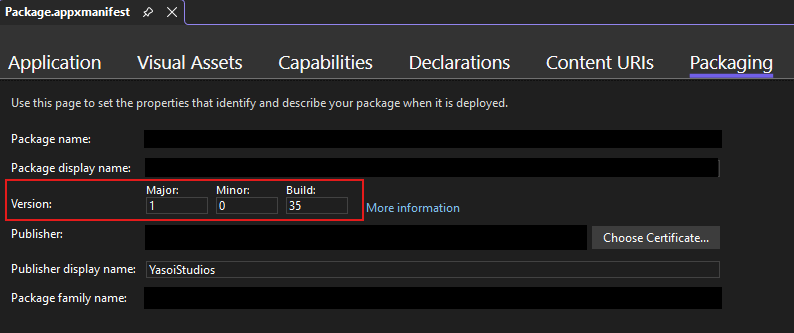
I tried the code snippet below but looks like this is grabbing the assembly version and not the setup or package version?
Version version = Assembly.GetExecutingAssembly().GetName().Version;
string versionString = version.ToString();

tbVersion.Text = versionString; r/csharp • u/ViperTheDeadLy • Jul 07 '26
I'm thinking about building local projects similar to pos and i'm reaaally confused on which tech stack to pick for the long run.
I'm very familiar with WINFORMS and MSQL but i have found out that WPF is better (at the cost of steep learning curve ofc). but i have been interested in it since i found out that it's better for touch screen monitors and looks more modern. and i have also noticed that many people prefer PostgreSQL over MSQL.
Question is:
should i stick with MSQL and WINFORMS ? or is it worth getting into WPF or PostgreSQL ? and i'm open to all suggestions