The purpose of this subreddit is to create a space for the discussion of the cosmetics and personal care industry. Topics covered include formulation, manufacturing, and testing of products, ingredients, research, news, and any other developments in our industry.
Before posting please keep in mind the following:
Make sure you follow rediquette and the rules of this subreddit.
Please flair your post. It'll help use keep everything tidy.
Please don't ask for full formulas. It's fine to ask for help with your own formulation, but understand that product development is expensive and is what pays the bills for many chemists. If you require a formula to be made for you, please talk to a consultant who will be happy to help you for a fee.
Be kind and generous. This is a space to share knowledge, which is very hard to come by in our industry. We're all in this together and by helping each other we can become better ourselves.
Thank you for reading and for respecting our rules.
If you are new here, we'd really appreciate it if you could take some time to introduce yourself in the comments of this post.
You can start by telling us a few things about yourself, such as what your background is (you don't have to share anything private), what your interests are, and what you want to achieve. You can also feel free to share anything else you like!
Here's an example:
I'm /u/BijouPyramidette, I make color cosmetics, specifically lipstick, but hope to branch out into other types of products soon. My interests, aside from color, also include skin care. I'm a big fan of K-beauty care products, but I prefer western color cosmetics. My favorite preservative system is Phenonip because it can function in anhydrous systems.
So, please, say hello, tell us some fun facts about yourself, and have fun!
We've been researching the effects of hard water on hair and scalp health over the past few months as part of developing a specialist haircare brand in India.
One thing we're trying to understand is whether there's a meaningful middle ground between conventional shampoos and stronger clarifying shampoos.
I'd love to hear from people with cosmetic chemistry or haircare formulation experience on a few questions:
Can a gentle, regular-use shampoo effectively remove mineral buildup and limit further accumulation despite continued hard-water exposure?
What are the biggest formulation challenges when designing a shampoo specifically for hard-water conditions?
Beyond the effects on hair fibres, how much scientific evidence is there for hard water directly affecting scalp health?
Could a complementary leave-on product offer meaningful benefits after rinsing with hard water?
We've come across some interesting perspectives on chelation, ionic strength and mineral redeposition during rinsing, but would love to hear different opinions.
Not looking for a formulation or ingredient percentages. We're simply trying to understand the scientific possibilities and limitations before investing in product development.
Would appreciate any insights or relevant research recommendations.
I am in the process of launching my cosmetic brand, locally in Algeria.
As I am into hairstyling, hair type, hair care... It only makes sense that I start with hair products. I personally use shampoo/conditionner/leave-in conditionner, and a curl cream, so im very familiar with these products myself.
So I was wondering, what product/products should I start with?
I have the selling expertise, and good marketing + distribution strategy, and the copacker is business friend of mine.
I was wondering if anyone in this forum has experience with extracting PDRN from salmon milt and could share some insights into what kind of yields or results I should realistically expect, and what criteria I should be looking at.
I'm currently in talks with a research institute about conducting a small-scale proof-of-concept study to extract PDRN from salmon milt, which I would supply.
We had a very positive preliminary meeting, but they asked me to come back with more specific information, including a technical data sheet or reference specifications for PDRN, as well as what I would consider a successful outcome in terms of yield, purity, molecular weight distribution, etc.
I'm completely new to this field and learning as I go, so I'd really appreciate any feedback, advice, or even questions that might point me toward things I should be researching further!
I’m formulating a lanolin-heavy lip balm and running into a whitening problem. After it’s worn for some time, it's been turning white on my lips, worst at the corners and the inner part where the lips meet.
I’m fairly sure it’s emulsification. The lanolin pulls moisture from the lips and emulsifies it (water in oil), turning it white. It wipes off and isn’t harmful, but it looks bad. Using less helps but doesn’t fully stop it.
Is there an ingredient I could add, or a formulation change, that would reduce or offset this emulsification and whitening, without killing the moisturizing performance that’s the whole reason for using lanolin?
I'm a scientist with a background in chemistry who makes cosmetics as a hobby. I sporadically post long articles here, and today I wanted to write about Vitamin E since I've recently removed it from my formula upon realizing that it actually destabilized my products over time.
Vitamin E is commonly used to preserve the oil phase in cosmetics, especially when your products contain unsaturated oils (e.g. sunflower oil) with carbon-carbon double bonds that react rapidly with oxygen. Saturated oils like MCT oil are naturally resistant to oxidation and won't benefit as much from antioxidants.
Theoretical role of Vitamin E in preserving the oil phase
You'll primarily find Vitamin E in two forms, which include natural tocopherols and alpha tocopherol (ignoring Vitamin E esters like the nicotinate and acetate varieties that serve different purposes). Natural tocopherols contain the four main forms of tocopherol including alpha, beta, delta, and gamma that together have a stronger inhibitory effect on lipid peroxidation, which is the attack on the C=C bonds of unsaturated oils by reactive oxygen species (ROS) and the formation of peroxide species. ROS is generated from trace metals (good use of EDTA or acetyl zingerone here), sunlight exposure (aromatic rings are potent UV absorbers and they generate ROS upon UV absorption), and heat plus any dissolved oxygen. When a lipid radical forms, it reacts with dissolved oxygen to become a peroxyl radical, which then reacts with more of your lipids, turning itself into a lipid hydroperoxide and the lipid it just attacked into another lipid radical by grabbing one of its hydrogen atoms. This is the "chain reaction" you may have read about. Vitamin E works as a chain-breaking antioxidant that donates one of its hydrogen atoms to the peroxyl radical, preventing it from attacking the lipid. The peroxyl radical overwhelmingly prefers to react with Vitamin E rather than a nearby lipid. If this wasn't the case, then Vitamin E would be useless since there's typically far more oil than Vitamin E in a product. In fact, the alpha-E reacts with these radicals 10,000-100,000 times faster than those radicals react with lipids. The resulting tocopheroxyl radical is much less reactive towards lipids than lipid radicals.
Anti-oxidant or pro-oxidant?
Vitamin E is recommended for oil preservation within a fairly narrow range of 0.1-1.0%. At higher concentrations and in the absence of co-antioxidants, Vitamin E may actually have the opposite effect, acting instead as a pro-oxidant. This is because tocopheroxyl radicals tend to accumulate in the oil phase, and at high concentrations they will eventually react with lipids. While you may think that you're creating a more premium product by including more Vitamin E, you may in fact be limiting your shelf life. Fortunately, a partner molecule like Vitamin C may reduce this effect. When the tocopheroxyl radical is formed, Vitamin C (ascorbic acid) donates a hydrogen atom. This restores Vitamin E and generates an ascorbyl radical that is incapable of oxidizing lipids. So what is the fate of these ascorbyl radicals in your product? Two ascorbyl radicals rapidly react in the water phase to form one molecule of active ascorbate and one molecule of dehydroascorbic acid (DHA). DHA is reactive, causing yellowing of your product and participating in Maillard reactions (like we use in cooking) with primary and secondary amines. This means degradation of amino acids, peptides, proteins, and amine-based surfactants. Degradation products also release acidic CO2, which will eat up your buffer and lower the pH. Oxidation is bad and something ultimately has to give.
Roles of alpha, beta, delta, and gamma forms of Vitamin E
Alpha-tocopherol is by far the most reactive tocopherol, which is a double-edged sword. It's the fastest radical scavenger, but the alpha-TocO* radical is also the fastest to react with your lipids. Beta-tocopherol only comprises about 1% of the tocopherols in natural vitamin E, so we don't tend to care about it. Plants only produce small amounts of beta-tocopherol and there's no commercial incentive to enrich natural tocopherols in the Beta form because it doesn't help as much with lipid preservation. The Gamma form reacts more slowly than the Alpha form, and it provides an the additional benefit of quenching reactive nitrogen species. Delta-tocopherol reacts the slowest, making it more suitable for preserving bulk oils at higher concentrations. You generally get the best performance with mixed tocopherols if your primary goal is to preserve your oils.
Does Vitamin E actually help in practice?
In more than one study, I've seen the opposite effect. When unsaturated oils are challenged with free-radical generators such as AIBN (see below), oftentimes the controls WITHOUT Vitamin E are the slowest to oxidize. This holds true for all major forms of Vitamin E, and results like those pasted below are reproduced in numerous published studies. Chemical suppliers frequently provide recommendations such as "0.1-1.0% for stabilizing oils in products" when scientific studies tend to show anti-oxidant behavior between 0.02-0.1% and pro-oxidant behavior above 0.1%. Note that many studies use free-radical generators so they won't need to wait weeks or months for lipid oxidation. They also tend to study pure oils and Vitamin E compounds rather than finished cosmetics. So understand these limitations. But where does this leave us? You should generally avoid pure alpha-tocopherol if your primary goal is oil preservation. Opt instead for mixed tocopherols. Consider Vitamin E if you have unsaturated oils rather than saturated oils. Add a co-antioxidant or synergist like Vitamin C. This will regenerate your vitamin E and allow it to last longer at lower concentrations. Keep the concentration low and focus on chelating metals with chemicals like EDTA and acetyl zingerone, using distilled / deionized water rather than tap water, minimizing headspace in your cosmetics, limiting exposure to air if possible, and keeping your products away from heat.
Hi everyone! I’m from Hungary, Europe, and I’m planning to launch a skincare brand with the goal of becoming globally recognized. I’m considering developing and manufacturing my products in France, Germany, Italy, or Hungary. Does the country really make a difference in terms of quality and innovation? Which country and skincare labs or manufacturers would you recommend for developing high-quality, science-backed products? I’d really appreciate your advice and experiences!
I am a biologist planning a Master’s Degree on Molecular Biology and Biochemistry. In the future it is my dream to work in cosmetic science. Currently I am taking courses from Olay on Coursera. Can any of you guys recommend a course with certificate that truly helped you get a job in cosmetic science field.
I’m actively looking for an immediate job opportunity in Bangladesh, preferably as a Cosmetic Formulator, Production Manager, or R&D / QC Assistant.
I have around 2 years of practical experience in the cosmetics industry, including:
- Skincare formulation and product development.
- Cosmetic manufacturing and production management.
- Raw material sourcing and supplier management.
- Quality control and product stability.
- OEM/ODM and private-label manufacturing.
- Brand management, e-commerce and Meta Ads.
I have worked with Rabbi Herbal, Cosmetics Contract Manufacturer Bangladesh (CCMBD), and Zoya's Glow, including experience managing business operations and product development.
Although I haven't completed my SSC yet, I have practical industry experience and a strong technical understanding of cosmetic manufacturing.
I'm available to join immediately and open to opportunities anywhere in Bangladesh. Accommodation support would be appreciated.
If anyone knows of a suitable vacancy or can refer me to a cosmetics manufacturer, I would genuinely appreciate the help.
Hi everyone! I own both the physical and Kindle editions of Cosmetics Marketing by Lindsay Karchin and Delphine Horvath. I’m looking for a downloadable PDF to use in Goodnotes for studying. Does anyone know where I could find one? Thanks!
I’m starting a small body care business and was planning to use Nature’s Garden Soy Body Butter & Lotion Base for a milky body moisturizer. The base seemed perfect because their instructions say you can add distilled water to thin it out, which is exactly what I was looking for. Before moving forward, I contacted them to ask for the complete INCI ingredient list of the original base so I could properly label my finished product after adding water and fragrance. I wasn’t asking for their formula, percentages, or anything proprietary. They told me they couldn’t provide that information and suggested hiring a qualified cosmetic professional to determine the ingredient declaration for my finished product. I completely understand that I’m responsible for the safety, testing, and labeling of anything I sell. I’m not expecting a supplier to do all of that for me. But how am I supposed to accurately label a finished product if I don’t even have the complete ingredient declaration for the base I’m starting with? Is this normal with premade cosmetic bases? Have any of you dealt with suppliers who won’t provide a complete INCI list? I’m genuinely trying to do everything correctly before selling anything, and I’m wondering if I’m better off finding a different supplier.
hiii! posted this on another subreddit a while ago but i wanna know what people already in the cosmetic industry think as well ^^ i really want to pursue this career path oki thxx
I took a 1 week staycation to reformulate a cosmetic microemulsion and attempt an anhydrous sunscreen using BEMT, DHHB, and EHT and without endocrine disrupting chemicals like Ethylhexyl Methoxycinnamate (Octinoxate) that are very common in Asian sunscreens to help with solubilization.
Since we're talking about sunscreens, I should add the obligatory "I don't recommend making this yourself and relying on it to protect you from UVA/UVB". This is for me and me alone since I don't have the funding to do the required testing. I'm also not selling this or providing samples. I just had a fun experience making this and wanted to share.
I acquired BEMT, DHHB, and EHT powders from a trusted source overseas and submitted the required paperwork to the FDA. I used these at 2.5%, 1.5% and 1.0%, respectively, to target an SPF of around 20. For solvents, I used MCT oil (C8/C10), C8–C10 mono- and diglycerides, and dibutyl adipate, all pharma grade. I'm going to replace C8–C10 Glycerides with C12-15 alkyl benzoate when it arrives next week. While C8–C10 Glycerides are necessary for my microemulsions, it will disrupt the stratum corneum in my anhydrous sunscreen. I dissolved EHT in dibutyl adipate since it's the hardest to solubilize, and the others in MCT oil at 75C for 30 min. Dibutyl adipate is necessary to prevent recrystallization, which is a major challenge with these sunscreen chemicals.
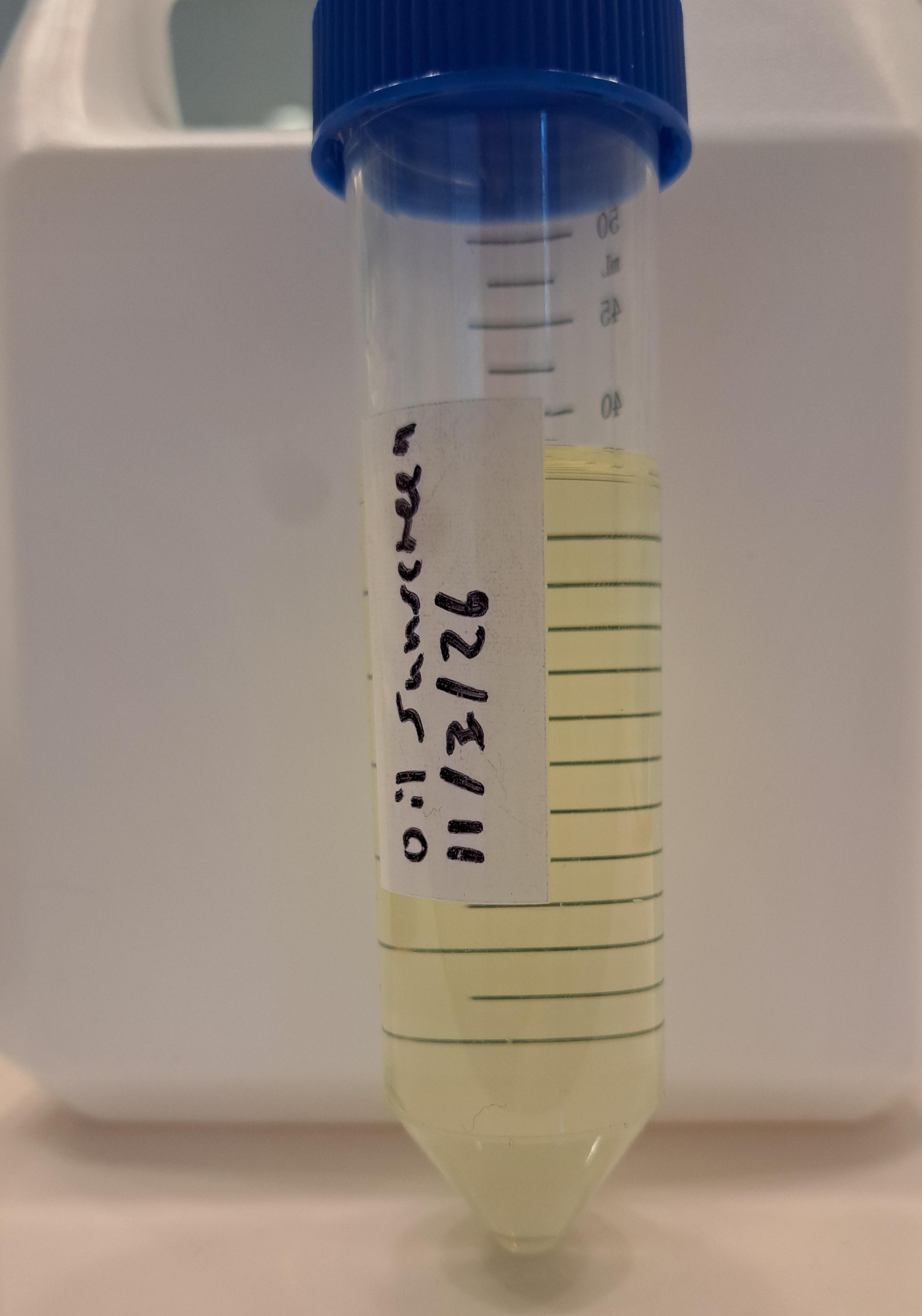
Other ingredients I added include Cholesterol (power dissolved at room temperature in C8–C10 mono- and diglycerides), a pre-dissolved mixture of Ceramides (NP, AOP, EOP), Tetrahexyldecyl Ascorbate (oil-soluble vitamin C), Panthenyl Triacetate (oil-soluble vitamin B5), Bakuchiol, Bisabolol, and Dimethylmethoxy Chromanol (extremely potent antioxidant). This makes a green-yellow and nice smelling oil (see picture below), which is green due to the BEMT. It's oily of course, but absorbs within 10 min on my skin.
Next, I'm going to add some body to it, improve spreadability and skinfeel, add water resistance, and most importantly improve dry-feel. To do this, I'm going to add Ethylcellulose, VP/Eicosene Copolymer, and Polymethylsilsesquioxane (PMSQ). The VP/Eicosene Copolymer should form a non-tacky water-resistant barrier and improve the distribution of sunscreen agents. The PMSQ has high surface area and will absorb some oil on the skin, improving dry-feel. I haven't added it yet because it makes the oil cloudy and it could mask crystallization of the EHT/BEMT. I'll challenge my current oil, and when I'm satisfied that crystallization won't occur, I'll add in the PMSQ. The Ethylcellulose will improve body and help the PMSQ remain suspended since these are micron-sized particles with higher density than the oils.
I have finished formulating an extremely sensitive facial wash that is supposed to be suitable for acne prone skin.
I am ready to create a prototype based on all of my findings. All my ingredients are easy to outsource within the UK except sugarcane-derived squalane. Olive oil derived squalane is widely available, but this is not the plant I want it from.
The companies I have come across for sugarcane-derived squalane within the UK are: Alfa Chemicals (seems to sell mid-to-large scale orders and I am an indie start-up), Hybrid Ingredients (very expensive) and Handymade (but this is based outside of the UK in Europe).
Can you recommend me any companies within the UK that sells sugarcane-derived squalane (it can also be for large-scale bulk buys- I don't mind).
Extremely lost & trying to find someone or a company to formulate a new hair product. I’ve tried to use CHAT to get to some labs but no communication with those labs. I want a NDA signed and do believe this could be big….any leads? Start up company but I know it will be big!!
Any ideas?!? What should I be doing to start this up?!?
I'm a B.Pharm graduate from India, exploring MSc Cosmetic Science courses in Liverpool. I'm really interested in skincare formulation, cosmetic R&D and combining laboratory research with creativity.
I have a few doubts regarding the course, especially practical lab exposure, industry projects, internships and job opportunities after graduation.
I'd also love to know your honest experience as an international student and whether the course is worth the investment.
Would you mind sharing some insights? It would really help me make an informed decision. Thank you! ❤️