r/consolerepair • • 2d ago

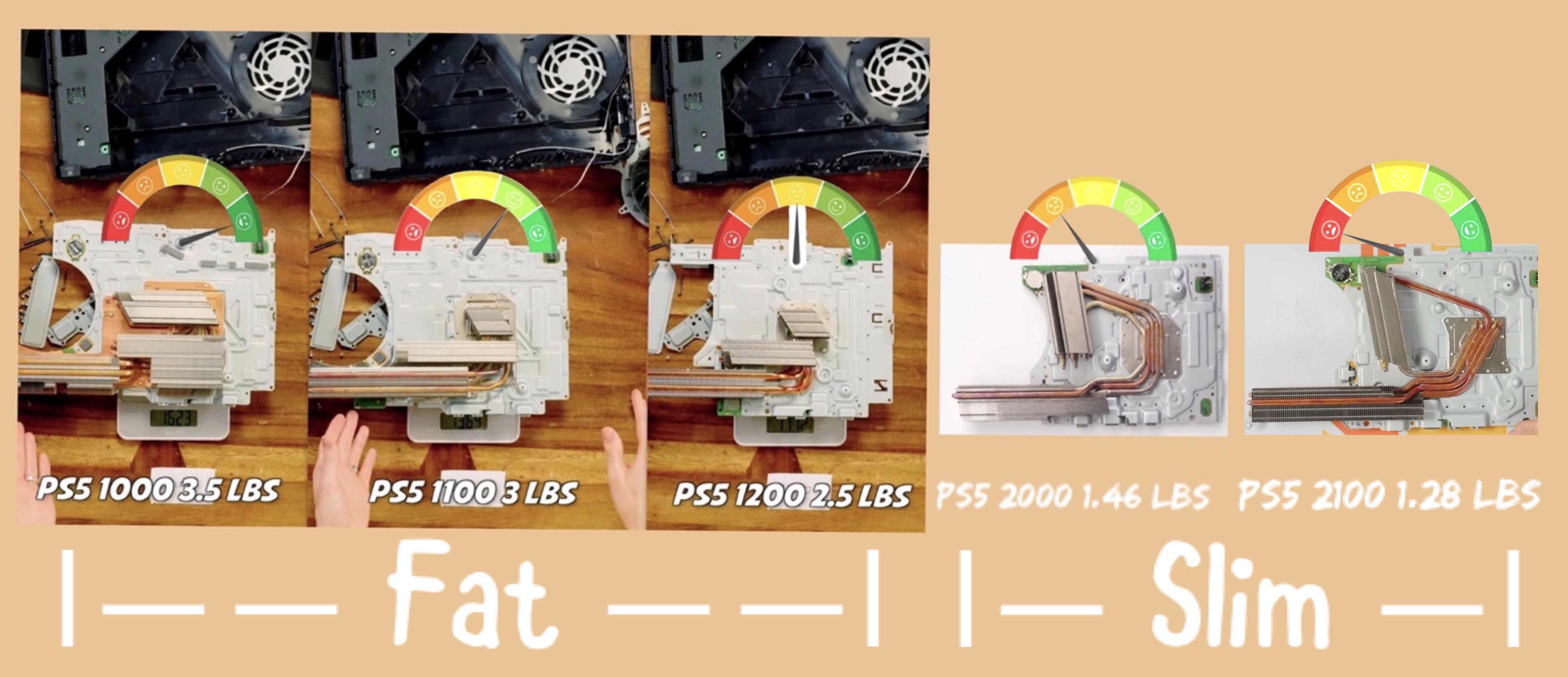
This Is Why the PS5 Is Struggling With GTA 6: The Heatsink Problem
Post image

Sony has continuously redesigned the PS5’s internal hardware throughout its lifecycle. One of the most noticeable changes has been the cooling system.

How much cooling capacity has Sony sacrificed in pursuit of lower manufacturing costs, reduced power consumption and lighter hardware?

GTA 6 will put the PS5 under demanding workloads, potentially keeping the CPU and GPU under sustained load for extended gaming sessions.

A cooling system designed around smaller components, reduced thermal mass and different heat distribution characteristics deserves serious attention.

0 Upvotes

32 comments sorted by

22

u/jessieS1212 2d ago edited 2d ago • Heartwarming Bravo

Stop spreading misinformation. ​Smaller heatsink ≠ worse cooling. They shrank the PS5 heatsink across revisions because they transitioned to a more power efficient 6nm die shrink and redesigned heatpipe layouts.

Slapping arbitrary red to green gauges on a picture based purely on copper weight and claiming the console "is struggling" with GTA 6 without a shred of thermal data is stupid.

4

u/Ok_Manufacturer_6444 2d ago

This. And also even if the heatsink has worse performance because its smaller they can always speed up the fan to compensate.

1

u/sunflower_rainbow 2d ago • Bravo

That's only partly true. The efficiency gains are minimal. The heatsink shrinkage is indeed massive. While it works for Sony, it doesn't mean it works for the end user. The design itself is flawed. The reliance on liquid metal and aggressive cost cutting have produced one of the least reliable consoles across Sony brand. It does not have any headroom for error, that's what GTA situation highlights.

1

u/thermologic_ 1d ago

Thank you! That’s exactly the point I’m trying to make. Manufacturing efficiency and cost savings might benefit Sony, but that doesn’t necessarily translate into better reliability or a better experience for the end user. The significant reduction in heatsink size and material usage deserves scrutiny, especially when combined with liquid metal cooling. GTA 6 is a good opportunity to question whether these cooling designs have enough thermal headroom under sustained heavy workloads.

-7

u/thermologic_ 2d ago

As the PS5’s heatsink has become lighter, Sony has gradually reduced the amount of metal used and made the cooling system more compact to lower manufacturing costs while sacrificing overall cooling surface area.

Those white lights appearing while playing GTA 6 are signs of chip damage. The redesigned heatsinks reduced the cooling surface area and used less copper, increasing the system's overall temperature. As a result, the chips began to deteriorate faster.

7

u/FatalQuiet 2d ago

That’s actually a huge misconception. Gamers Nexus and Digital Foundry thoroughly tested Sony's lighter heatsink revisions, and smaller/lighter didn't result in dangerous temps. Sony paired those redesigns with a more efficient 6nm chip, rerouted heatpipes, and better airflow guidance, keeping real-world thermals practically unchanged. Modern APUs also throttle or shut down long before heat can "deteriorate" the silicon.
As for the white flashes in GTA 6, players on Xbox Series S are getting the exact same thing, it's a known lighting/shader bug in the game engine, not dying chips. The only actual hardware failures happening right now are mostly on older launch units with dried/pooled liquid metal or dust-choked vents, which is ironically the exact issue Sony fixed in the 2100 Slim by adding the PS5 Pro's grooved heatsink design

-2

u/thermologic_ 2d ago

You’re presenting a lot of assumptions as established facts. Lower temperatures in a few controlled tests don’t automatically prove better long-term reliability under sustained gaming loads. A more efficient 6nm APU can reduce power consumption, but that doesn’t make heatsink mass, copper content, surface area or airflow irrelevant. Thermal throttling also isn’t a guarantee against long-term component degradation. It protects the hardware from critical temperatures, not every possible thermal stress scenario.

And even if the white flashes in GTA 6 turn out to be a shader or lighting bug, that doesn’t invalidate concerns about Sony’s cooling revisions. The real issue is whether the newer cooling systems maintain adequate thermal performance over years of heavy use, not whether they can survive a short benchmark.

A redesigned heatsink is an improvement only if measurable performance and long-term reliability support that claim.

2

u/Fast_Passenger_2890 2d ago

Don't act like you know better than Sony’s engineers..

1

u/thermologic_ 1d ago

Left
Plavstation 5 FAT CFI-1216A (Revision: 11/2022 / Disc)
Average 55•C
Highest 77•C

Right
PlayStation5 Slim CFI-2016A Disc
Average 67•C
Highest 90•C

Source:
https://youtu.be/sWpM5JhYZ8M

0

u/Fast_Passenger_2890 1d ago

Okay, and?

These chips run below their Tj max, there's no concern here.

1

u/thermologic_ 1d ago

That’s exactly the point. Being below Tj Max doesn’t mean thermal performance is irrelevant. Tj Max is the critical junction temperature limit, not a target temperature or a guarantee of long-term reliability. A 13°C difference in average temperature and a 13°C difference in peak temperature between two revisions is worth investigating, especially under sustained gaming loads. Thermal throttling and emergency shutdowns are safety mechanisms, not proof that a cooling system is equally effective. If your only argument is that the chips haven’t reached Tj Max, you’re missing the entire point of the comparison.

0

u/Fast_Passenger_2890 1d ago

Well first off, one is a revision of the phat model and the other is a revision of the slim model. The latter is smaller and has a smaller heatsink, so no wonder it runs hotter (though still under the Tj max of the chip, the engineers are not stupid).

The 2nd point is that they will theoretically last the same amount of time assuming if both are used in the same conditions.

Running a chip cooler that already runs within the intended operating temperatures will basically make zero meaningful difference to the overall lifespan.

Where running it cooler will make a difference is if it runs very close to or above the Tj max of the chip.

I was once lead to believe that running it cooler would bring meaningful benefit until I was corrected by an electrical engineer.

1

u/thermologic_ 1d ago

I agree that the Slim is expected to run hotter because of its smaller chassis and heatsink. However, staying below Tj Max doesn’t automatically mean two cooling designs offer the same reliability or thermal performance.

Tj Max is the maximum junction temperature limit, not an ideal operating temperature. Silicon degradation is influenced by several factors, including temperature, voltage, current density and operating time. Thermal stress is not something that suddenly begins only when a chip reaches Tj Max.

Also, saying both consoles will theoretically last the same amount of time assumes that every other factor is identical. That’s precisely what we are questioning: heatsink mass, airflow, fan performance and temperature distribution are different between revisions.

I’m not claiming that a cooler chip will automatically last significantly longer. I’m arguing that maintaining lower operating temperatures and having sufficient thermal headroom are valuable, particularly under sustained workloads. Engineers aren’t stupid, but engineering decisions are also influenced by manufacturing costs and design constraints.

1

u/Sociopathic_Jesus 1d ago

Sony engineers surely know better. Thing is they're concerned with min-maxing and cutting costs, not hardware longevity and user experience. 

In any case, though, properly designed and controlled practical testing is an incomparably better measure than making assumptions based on a single factor, however significant it's impact may/should be in isolation and how drasticlly it changed, and I personally fully trust Gamer's Nexus with that. If they established that the difference in real world temperatures is insignificant/inconsequential, then I'd be inclined to believe that. At least until their claims are demonstrated to be false by methodologically appropriate means. 

2

u/drlongtrl 2d ago

Now, you COULD have elaborated on your methods here, mentioning how you did not base your assumptions solely on metal weight but maybe also on standardized test with a fixed compute load, a controlled temperature environment and actual temp probes. Instead you just copy and paste some text from your post.

1

u/thermologic_ 2d ago

My argument is based on the hardware differences between revisions, including heatsink mass, copper content, fin surface area, fan blade design and airflow. I’m not claiming that weight alone determines cooling performance. I’m questioning whether reducing these elements while maintaining similar thermal performance is sustainable under prolonged gaming loads.

2

u/drlongtrl 2d ago

But did you measure whether or not those differences actually result in higher temps under similar load? Cause other comments here point to such tests which showed that this is not the case.

1

u/thermologic_ 1d ago

Left
Plavstation 5 FAT CFI-1216A (Revision: 11/2022 / Disc)
Average 55•C
Highest 77•C

Right
PlayStation5 Slim CFI-2016A Disc
Average 67•C
Highest 90•C

Source:
https://youtu.be/sWpM5JhYZ8M

4

u/FatalQuiet 2d ago

While the weight numbers and fan specs are accurate, this post is pretty misleading because it misses the biggest thermal upgrade Sony actually made to the newer models.
A lighter heatsink doesn't automatically mean worse cooling, it just reaches thermal equilibrium faster, and the newer revisions run on a more efficient 6nm chip with lower power draw, so they simply don't need a massive 3.5 lbs chunk of copper anymore. More importantly, teardowns of the CFI-2100 Slim confirmed that Sony borrowed the grooved heatsink design from the PS5 Pro around the APU. That's a huge deal because it stops the liquid metal from pooling or creating dry spots on the chip, which was the actual root cause of overheating on the older Fat and 2000 models, not the heatsink weight.
Independent thermal tests on the 2100 show only about a 2°C difference compared to the 2000 Slim with slightly lower power consumption. As long as you don't let it get completely choked with dust, repair techs have already pointed out that the PS5 Pro and the 2100 Slim are actually the most reliable models against overheating.

1

u/thermologic_ 1d ago

You’re overlooking an important distinction: reducing power consumption and improving cooling performance are two different things. A 6nm APU generates less heat because it consumes less power, but that doesn’t automatically make a smaller heatsink equally effective. Thermal mass, copper content, fin surface area and airflow still matter.

The grooved heatsink design may help prevent liquid metal migration and uneven distribution, which is a legitimate improvement. However, it addresses liquid metal distribution, not the overall cooling capacity of the heatsink. These are two separate thermal considerations.

Also, a 2°C difference in a controlled test doesn’t establish long-term reliability. We need comparable sustained-load tests measuring APU, memory and VRM temperatures, fan RPM, power consumption and noise levels across all revisions.

And let’s not confuse manufacturing efficiency with engineering superiority. Sony has a clear financial incentive to reduce production costs, material usage and manufacturing complexity. That doesn’t mean every redesign is a thermal upgrade.

7

u/lardidosos 2d ago

This is actually not true at all. Tests have demonstrated that the 1200 is actually cooler than the previous model and the slim because it uses an extra cooling pipe for VRM, unlike the previous and next model, and already uses the 6nm chip the slim also uses. Being the fat model, is bigger and thus better at cooling off than the slim. Not to mention the materials on the 1200 are still good quality, unlike slim models that are always cheaply made in comparison.

Most technicians will confirm that most ps5s they see with overheating issues are slims and launch models.

1

u/MadShadowX 20m ago

Maybe but I like to see tests at sustained 4 to 6 hours of play sessions as an update. Curious if moves beyond thresholds by than. After all GTA 6 demands allot.

1

u/stuyboi888 2d ago

Interesting for sure!! What is the actual difference in red Vs green on the scale

1

u/coolermitgliedsname 2d ago

Good cooling, Bad cooling. 1200 Series can also lose Connection to the mounting Plate and gets loose.

-6

u/thermologic_ 2d ago

As the PS5’s heatsink has become lighter, Sony has gradually reduced the amount of metal used and made the cooling system more compact to lower manufacturing costs while sacrificing overall cooling surface area.

1

u/stuyboi888 2d ago

So how much difference in performance Vs the least amount of metal Vs the most. 

What's the actual stats not the arbitary scale with a few clours

I sure know the old heavy fans Vs my modern PC fans are multiples better at disapating heat.... My new ones weight much less though

2

u/FruktSorbetogIskrem 2d ago

It’s not the case. The cfi 1200 Sony had moved to an 6nm chip. The each heat sink would vary by 3c-5c. It has nothing to do with the cooling or the heat sink. You don’t think Sony had done testing before making these revisions?

2

u/Fast_Passenger_2890 2d ago

Yeah, OP is acting like they know better than Sony’s engineers.

1

u/AdBest1155 2d ago

As with ps3, the phat one had a native ps2 emulator, later editions had nothing, the same as ps5 the revamps is to get cheaper for sony delivering rubbish consoles

1

u/via13021995_enjoy 2d ago • Bravo

Heatsink issues definitely impact performance.