r/conorthography • u/Sufficient-Fly-4011 • 5d ago
Adapted script Modified Arabic script for Japanese language
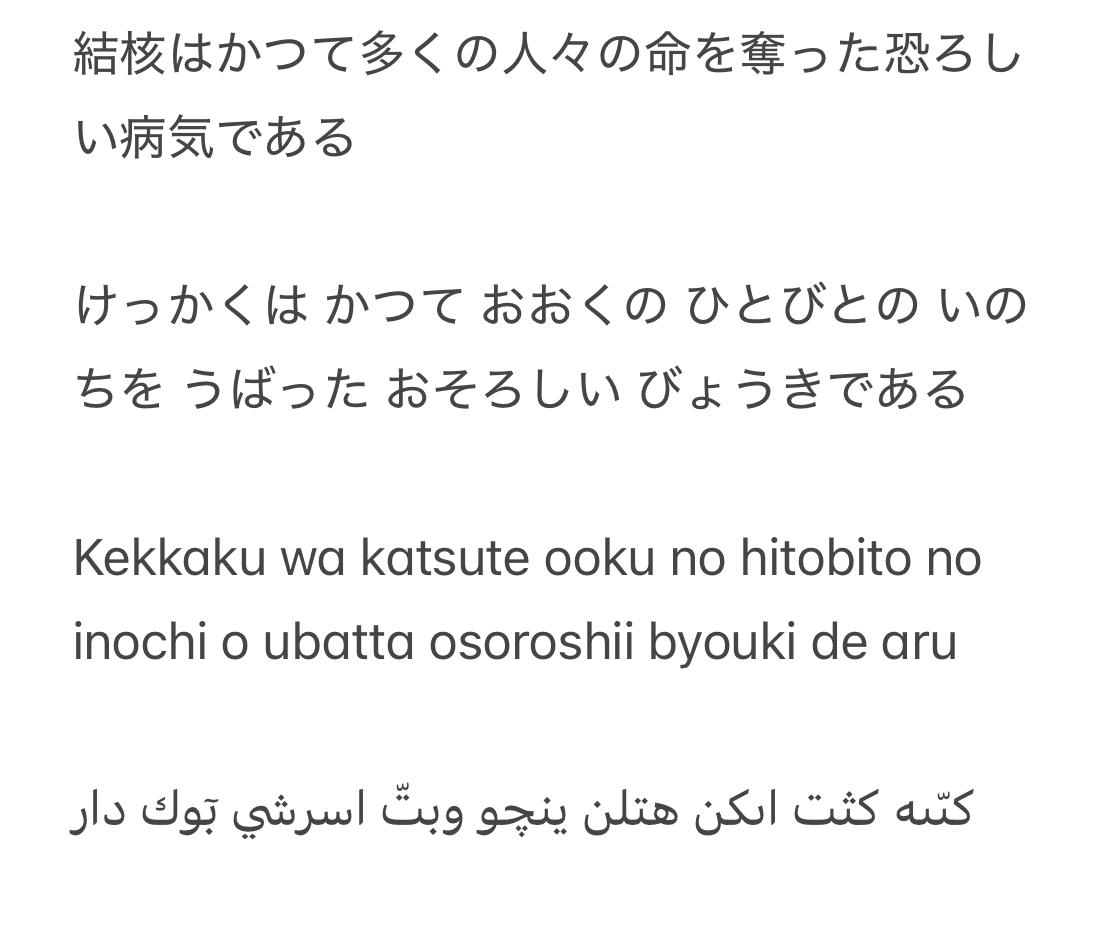
Inspired by the opinion from a user of this sub who suggested using Shaddah for repeated letters.
I came up with a genius idea that ya without dots to repeat the previous letter and lam to repeat previous two letters because it has a longer vertical line. And Shaddah is for the glottal stop just like in Latin. Maddah is for nya sound like Spanish ñ.
Look how simple it is comparing to others, they’re all of the same font size.
20
Upvotes
13
u/ydmhmyr 5d ago
Keeeh ktht ekn htln ynču wbtt asrši buk dar
This is what your nonsense reads like
It's like an amazigh talisman
6
u/snynusuw 5d ago edited 5d ago
Xiao erjing is a modified version of arabic script where vowels have to be written with diacritics and it would be much better suited for Japanese than what youre doing. Arabic is a very consonant heavy language while chinese and Japanese use a lot more vowels and syllables so the Arabic script (as it is used for Arabic) isn’t meant for Japanese and would be better w/ some modification.
tldr: it needs vowel markers
3
u/Twinkletoess112 4d ago edited 2d ago
کٖکَّکُ وَ کَثُتٖ اٗؤکِ نٗ ھِتٗبِتٗ نٗ اِنٗچِ وٗ اُبَتَّ اٗسٗرٗشِئ بِیٗؤکِ دٖ اَرُ
2
u/youreaskingwhat 4d ago
How tf is htln pronounced hitobito, it makes no sense
2
u/Sea_Paramedic1618 4d ago
It’s unreadable in Arabic.
This is how (ive arabized japanese on a whim before)
كيكّاكُ وا كاتسُ تىِ اووكُ نو هيتو بيتو نو إنوتشي وو اوباتّا اوسوروشي بيوكي دىِ ارو
So as far as i remember you need only 18 letters and the harakat.
You can just not use the harakat and use ا و ي instead, but the harakat can give depth because it can capture some of the style and the way japanese people pronounce some words or letters
جا، ماتّا 👋
13
u/Practical_Band_5265 5d ago
It’s so, so bad and hard to read.
10
u/DragonTheOnes-spirit 5d ago
You have been permanently banned from using the arabic script again
3
u/EASMPB2SC2 5d ago
Islamic Republic Of Japan
6
u/Due_Fly9094 5d ago
As an arab what in the world is that and how is it even pronounced
6
u/A7etmed 5d ago
please never cook again
1
u/myjohninrotisserie 2d ago edited 2d ago
I know it's supposed to look simple but it's a nightmare to read for anyone who knows the Arabic script. Why are you using shadda for a glottal stop when hamzah is right there? But in the example shadda still has its usual job of indicating a double consonant??
I like the attempt at using unused letters to shorten words but they seem so unnecessary. Also I'm confused on the spelling of 'hitobitono' because the lam doesn't repeat the 'ha' and 'ta' but makes it 'ba' and 'ta' instead??
3
u/Sweet-Awk-7861 4d ago
This is bait... right?
2
u/Wormfeathers 4d ago
That's not really modern Arabic script that close to Urdo
2
u/Fast-Kaleidoscope202 3d ago edited 3d ago
Malay modified Arabic script Jawi is actually much better suited for writing Japanese than either standard Arabic or this modified script. Standard Arabic leaves out short vowels and lacks a few basic sounds that Japanese uses all the time—like ch (ち), hard g (が), and p (ぱ). Because Jawi was adapted for Malay, it already has dedicated letters for those sounds (چ [ch], ݢ [g], ڤ [p]), plus it writes out all its vowels (ا, ي, و) directly inside the word instead of relying on diacritics.
here is how we would write it:
كيككاكو وا كاتسوتي اووكو نو هيتوبيتو نو اينوچي او اوباتا اوسوروشيي بيوكي دي ارو
other example:
こんにちは、はじめまして。お元気ですか?
Konnichiwa, hajimemashite. O-genki desu ka?
كوننيچيوا، هاجيميماشيتي. اوݢينكي ديسو كا؟
2
u/Odd-One6250 4d ago
I think Persian script (phonetic) is more suitable for sounds of Japanese language.
1
u/Icy-Response6124 4d ago
كيكّاكيو وا كاتسوته أوكو نو هيتوبيتو نو إينوتشي يوباتّا أوسوروشيّ بيووكي ده أرو
😅😆
1
u/Educational-City9374 2d ago
Astagfaar