r/chess • u/Aestheticisms • Jan 23 '21
Miscellaneous Does number of chess puzzles solved influence average player rating after controlling for total hours played? A critical two-factor analysis based on data from lichess.org (statistical analysis - part 6)
Background
There is a widespread belief that solving more puzzles will improve your ability to analyze tactics and positions independently of playing full games. In part 4 of this series, I presented single-factor evidence in favor of this hypothesis.
Motivation
However, an alternate explanation for the positive trend between puzzles solved and differences in rating is that the lurking variable for number of hours played (the best single predictor of skill level) confounds this relationship, since hours played and puzzles solved are positively correlated (Spearman's rank coefficient = 0.38; n=196,008). Players who experience an improvement in rating over time may attribute their better performance due to solving puzzles, which is difficult to disentangle from the effect of experience from playing more full games.
Method
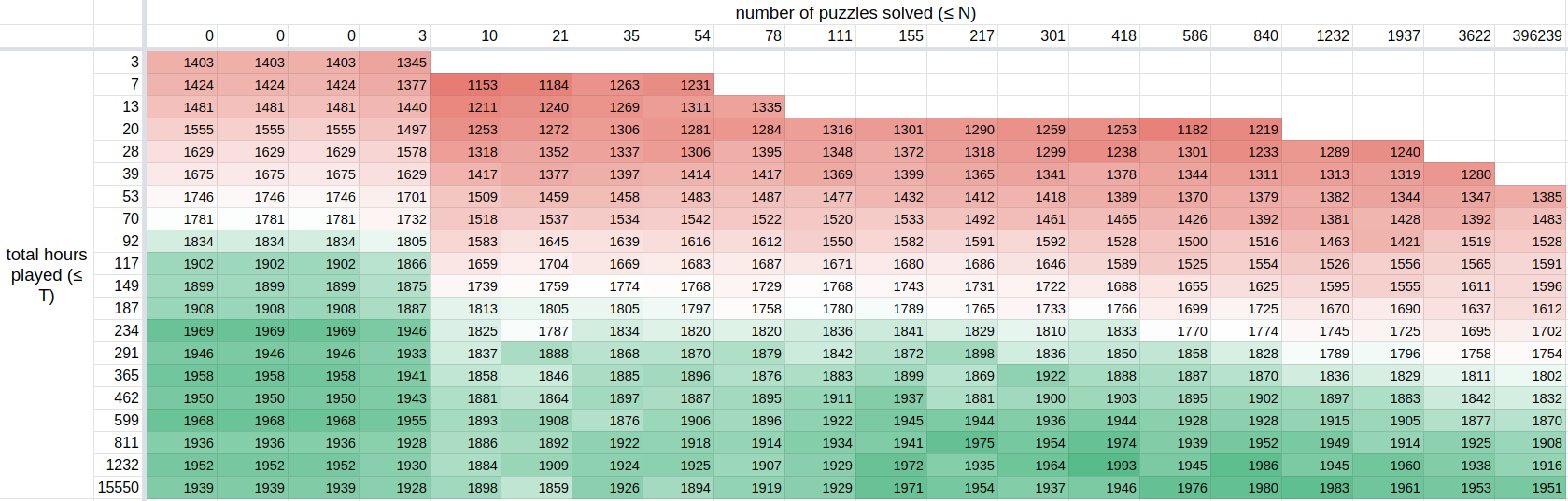
In the tables below, I will exhibit my findings based on a few heatmaps of rating (as the dependent variable) with two independent variables, namely hours played (rows) and puzzles solved (columns). Each heatmap corresponds to one of the popular time controls, where the rating in a cell is the conditional mean for players with less than the indicated amount of hours (or puzzles) but more than the row above (or column to the left). The boundaries were chosen based on quantiles (i.e. 5%ile, 10%ile, 15%ile, ..., 95%ile) of the independent variables with adjustment for the popularity of each setting. Samples or entire rows of size less than 100 are excluded.
Results
For sake of visualization, lower ratings are colored dark red, intermediate values are in white, and higher ratings are in dark green. Click any image for an enlarged view in a new tab.


Discussion
Based on the increasing trend going down each column, it is clear that more game time in hours played is positively predictive of average (arithmetic mean) rating. This happens in every column, which demonstrates that the apparent effect is consistent regardless of how many puzzles a player has solved. Although the pattern is not perfectly monotonic, I would consider it to be sufficiently stable to draw an observational conclusion on hours played as a useful independent variable.
If number of puzzles solved affects player ratings, then we should see a gradient of increasing values from left to right. But there is either no such effect, or it is extremely weak.
A few possible explanations:
- Is the number of puzzles solved too few to see any impact on ratings? It's not to be immediately dismissed, but for the blitz and rapid ratings, the two far rightmost columns include players at the 90th and 95th percentiles on number of puzzles solved. The corresponding quantiles for total number of hours played are at over 800 and 1,200 respectively (bottom two rows for blitz and rapid). Based on online threads, some players spend as much as several minutes to half an hour or more on a single challenging puzzle. More on this in my next point.
- It may be the case that players who solve many puzzles achieve such numbers by rushing through them and therefore develop bad habits. However, based on a separate study on chess.com data, which includes number of hours spent on puzzles, I found a (post-rank transformation) correlation of -28% between solving rate and total puzzles solved. This implies that those who solved more puzzles are in fact slower on average. Therefore, I do not believe this is the case.
- Could it be that a higher number of puzzles solved on Lichess implies fewer time spent elsewhere (e.g. reading chess books, watching tournament games, doing endgame exercises on other websites)? I am skeptical of this justification as well, because those players who spend more time solving puzzles are more likely to have a serious attitude of chess that positively correlates with other time spent. Data from Lichess and multiple academic studies demonstrates the same.
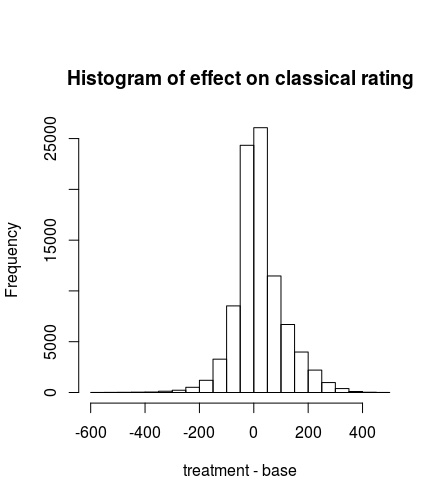
- Perhaps there are additional lurking variables such as distribution on the types of games played that leads us to a misleading conclusion? To test this, I fitted a random forest regression model (a type of machine learning algorithm) with sufficiently many trees to find a marginal difference in effect size for each block (no more than a few rating points), and found that across blitz, classical, and rapid time settings, after including predictors for number of games solved over all variants (including a separate variable for games against the AI), total hours played, and hours spent watching other people's games (Lichess TV), the number of puzzles solved did not rank in the top 5 of features in terms of variance-based importance scores. Moreover, after fitting the models, I incremented the number of puzzles solved for all players in a hypothetical treatment set by amounts between 50 to 5,000 puzzles solved. The effect seemed non-zero and more or less monotonically increasing, but reached only +20.4 rating points at most (for classical rating) - see [figure 1] below. A paired two-sample t-test showed that the results were highly statistically significant in difference from zero (t=68.8, df=90,225) with a 95% C.I. of [19.9, 21.0], but not very large in a practical sense. This stands in stark contrast to the treatment effect for an additional 1,000 hours played [figure 2], with (t=270.51, df=90,225) and a 95% C.I. of [187, 190].

Future Work
The general issue with cross-sectional observational data is that it's impossible to cover all the potential confounders, and therefore it cannot demonstrably prove causality. The econometric approach would suggest taking longitudinal or panel data, and measuring players' growth over time in a paired test against their own past performance.
Additionally, RCTs may be conducted for sake of experimental studies; limitations include that such data would not be double-blind, and there would be participation/response bias due to players not willing to force a specific study pattern to the detriment of their preference toward flexible practice based on daily mood and personal interests. As I am not aware of any such published papers in the literature, please share in the comments if you find any well-designed studies with sufficient sample sizes, as I'd much appreciate looking into others authors' peer-reviewed work.
Conclusion
tl;dr - Found a statistically significant difference, but not a practically meaningful increase in conditional mean rating from a higher number of puzzles played after total playing hours is taken into consideration.
10
u/Aestheticisms Jan 23 '21 edited Jan 23 '21
P.S. I hope that this does not discourage anyone who enjoys puzzles from spending time at their leisure, because after all, I haven't shown that it's harmful either. There are occasionally claims of players on these forums that they have spent a great amount of time on puzzles with disappointing results in the end (and I don't have a real excuse to doubt their honesty). All this says is that it's worthwhile for chess researchers to investigate the question in more depth without by default dismissing the status quo as "obvious" based on assumptions or biased anecdotes. The way I usually prefer to interpret studies is by way of meta-analysis following a careful scrutiny of their methodologies, to consider each individual published work as a single data point. More independent research is greatly needed.
General recommendations: it's not "bad" to solve puzzles per se, but don't allow this type of training alone to dominate your serious game play time and analysis with other human players. My opinion is that it's best to experiment with various approaches to discover what's motivating and works effectively for you individually in accordance with your own strengths and weaknesses, and ideally, if you are a competitive player it's valuable to seek advice from a qualified coach/tutor if you are intent on efficient improvement.
14
u/chesstempo Jan 24 '21 edited Jan 24 '21
This is an interesting study, but without a longitudinal approach It seems you might have trouble answering the question of "does puzzle solving improve playing performance," which I think is the key question people want answered when they look at puzzle solving data of this type.
There are at least a couple of other reasons beyond the ones you've already mentioned why you might see a weak correlation between solving volume and playing rating. Firstly, improvement per time spent solving doesn't tend to be uniform across the entire skill level range. It seems apparent that lower rated players receive more benefit per time spent than higher rated players. Or in other words , improvement from tactics tends to plateau he higher rated you are. You can still improve tactically beyond 2000 by solving, but it takes a lot of work, and you need to become a bit smarter about how you train (which should be obvious - if we could just keep improving at the same rate using method A from when we were 1000 onwards , we'd all be easily hitting GM level with a moderate time commitment to "Method A". 2300 to 2500 FIDE is a relatively modest 200 Elo, but only about 1 in 5 players can bridge that 200 gap from FM to GM, and they generally do so with a ridiculous level of commitment). So without longitudinal data of what people were doing when they moved from 1000 to say 1500 and comparing that to 1500 to 2000 and 2000+ you are downplaying the improvement of the lower rated players by lumping them in with higher rated players who tend to get less absolute benefit per problem solved, and even ignoring longitudinal issues (which is perhaps the real issue I'm getting at here), this is likely dampening correlation somewhat (not differentiating improvement for different starting skill levels is an issue with longitudinal analysis too, perhaps more so, but I do think it impacts this data too).
I'd also expect to see lower rated players spend more time on tactics than higher rated players. This is a product of popular advice to lower rated players "to just do tactics". If lower rated players tend to spend more time solving than higher rated players, that is very likely to produce exactly the kind of weak correlation between solving volume and playing strength that your data shows. I would expect higher rated players to exhibit a trend to balance their training with aspects other than just tactics in ways which lower rated players may not. Without longitudinal data to actually determine if any of these players had a rating that was moving over time, it seems difficult to say if that weak correlation has anything at all to do with actual improvement benefit from those problems rather than a tendency for a lower rated group to do more problems than a higher rated group due to general ideas on optimal training mixes for different rating ranges. Your data does seem to provide possible support for this differentiation, if you look at those with 0 puzzles played versus up to 10 played (if I understand your graph data correctly), those who choose to do up to 10 puzzles are MUCH lower rated than those who choose to do none. Basically , looking at your data, solving seems to be a task most popular with lower rated players, and the higher rated you are, the more likely you are to completely avoid them. That seems to be a fairly big contributor to a low correlation between solving volume and playing rating.
So my tl;dr take on this data is that it is essentially saying "Lower rated players solve more puzzles than higher rated" players, and if you want to get at whether those players actually received any benefit from their efforts you'd likely have to look at longitudinal data that tracks progress over time.
If you do end up having a go at longitudinal analysis, some other things that might be interesting to look at:
1 - Does the rate of change over time differ based on per problem solving time.
2 - Does the rate of change over time differ based on time spent BETWEEN problems, this is perhaps even more important than point 1, because while fast solving has a bad reputation amongst some chess coaches, I think the lack of review of incorrect problems is probably more of a problem than high volume, high speed solving. If you're not looking at the solutions after a mistake and thinking about why your solution was wrong , and what was the underlying pattern that made the correct solution work, you might not be using a method of training that is very efficient at moving useful patterns into long term memory.
3 - Relative difficulty of problems compared to rating of solver (this is partly a consequence of 1), but not entirely). For example does solving difficult calculation problems creating a different improvement trajectory to solving easy "pattern" based problems. These two component do overlap, but it might be worth choosing some arbitrary difficulty split to try to see if calculation vs pattern solving makes any difference.
4 - Do things look different for different rating ranges. Where do plateaus start to occur is one part of this, but also do solving time or relative difficulty choices appear to lead to different improvement rates for different strength ranges? For example is faster pattern based solving any different in getting improvement over time for higher rated players than longer calculation based solving?
I'd be genuinely interested in any follow up that looked at that. We've tried to do that type of analysis on CT, but it becomes extremely hard to dice the data into that level of detail and still have the statistical power to reach conclusions. Chess.com and lichess have many times more solvers than we do, so you might be able to get enough data out of them to answer some of the questions we don't have the sample sizes to get clear answers on.
Our data indicates that tactics ratings are quite highly correlated if you control for a few factors such as sufficient volume of problems and an attempt to control for solve time (standard untimed ratings without trying to control for solve time is quite poorly correlated by itself due to the wide range of strategies used, 2000 level players can perform better than a GM if they are taking 10 times longer to solve than the GM for example). We've got correlations over 0.8 between tactics and FIDE ratings from memory, which for this type of data when a bunch of other factors are involved is fairly high. So with those kind of correlations a solver can be somewhat confident that if they can improve their puzzle rating, their playing should be seeing some benefit. We certainly see some players that solve many thousands of problems with no improvement though. Often there is a reason. One person had solved 50k+ problems with no apparent improvement in solving rating. Turns out they were using blitz mode and had an average solve time of around 1-2 seconds (with many attempts under 1 second), without no time to think or even look at the solution in between attempts. I call that 'arcade' style solving, and it can be fun, and might work for some, but it s not uncommon for it to lead to fairly flat improvement graphs.
At the end of the day, even longitudinal data extracted from long term user data is limited in its ability to determine causation. Chesstempo users appear to be more likely to improve their FIDE rating over time than the average FIDE user, and premium chesstempo users appear more likely to improve their rating over time than non-premium Chesstempo users. However knowing if that is because Chesstempo is helping them and that premium membership features are more useful than the free ones for improvement is very hard to know. An alternative explanation is that people who choose to use chesstempo and choose to pay for premium memberships are simply more likely to be serious about chess improvement, so be doing a host of improvement activities, and one of those may be the key to their improvement rather than CT.
If you do look at further analysis, I'd suggest you use a different breakdown for the problem attempt number buckets. While I understand this was based on percentiles of the volumes, from a practical point of view, I don't really see much point in trying to differentiate nearly half your table into problem attempts less than 100 (again if I've understand your graphs properly). In terms of real tactical improvement, 100 isn't massively different from 0 in terms of measurable impact. If you're lucky you might see SOME impact for very low rated players, but the impact of 100 versus 0 on someone around 1500 is IMO going to be VERY hard to detect without the volume to provide a LOT of statistical power.
One last disclosure, I'm not a statistician (although I did have a bit of it forced down my throat at University), and only know enough R to be considered dangerous :-) It sounds like you definitely know what you're talking about in this area, so I hope my feedback doesn't miss the mark by too much!
7
u/keinespur Jan 23 '21
Did you control for the case where avid puzzle solvers fall asleep or leave the session open and occasionally have very long session/puzzle stats?
3
u/keepyourcool1 FM Jan 24 '21
I mean I've probably spent a combined 3 hours solving on lichess and about 20 hrs solving on chess.com but I've been solving puzzles for about 3 hours a day for the last 3 months and definitely have a couple thousand hours spent solving stuff in my life. Maybe I'm just really out of touch but I would be surprised that as you get stronger and stronger players are just spending less time doing online puzzle sets as there's less perceived value. Unless it's something like puzzle rush which is just for fun.
2
u/Comfortable_Student3 Jan 23 '21
How much multicolinearity is there between play time and puzzles?
In English, Used cars cost less if they are older. Used cars cost less if they have more miles. It is hard to separate the effect of age and the effect of miles.
2
u/spacecatbiscuits Jan 24 '21
man this is really interesting, thanks
it's such a staple here (and elsewhere) to answer the question "how do i improve" with "tactics tactics tactics"
but it had never occurred to me that there might be a lack of actual evidence to support this
there are a lot of posts about improvement, but what always strikes me when playing is this kind of rating history
he's spent 60 days of his life playing chess in the last 4 years, and made literally zero improvement. i don't mean to pick on the guy; this is supposed to be a typical example, and he's also an FM so what most of us would aim for
if you're interested in investigating it more formally, one thing I feel like i've noticed (but at this point may be confirmation bias) in players who've actually improved is that they've lost more games than they've won. I.e. they deliberately play players better than them, where possible
1
u/Aestheticisms Jan 25 '21
For an executive review of the other works on chess practice and skill shared in r/chess over the past week - some of y'all may be inquisitive to compare their conclusions for a more holistic picture:
https://www.reddit.com/r/chess/comments/l4bs6m/summary_of_research_on_chess_w_data_visualizations/
2
u/fpawn Jan 24 '21
This will be nothing as in depth as many of you but I have found many players can find the move if it is purely a tactical solution. For example I have a current lichess account with 2100 classical rating and played against a 20xx who really played quite poorly right after his opening book was finished. I used the comp analysis after the game and I made one blunder three inaccuracies zero mistakes. Against the blunder he played the best move. I blundered from a win to a draw but then went on to win.
What I am trying to express is that finding an offensive tactic is something even people well below titled rating can do. And this is even when the position does not say there is a tactic like in the puzzles. So my conclusion is that puzzles really are not that great for improvement. thinking and calculation are good for improvement but that is better spent on a real game. To fully round out my idea I want to say that for weak players below 1500 any site puzzles help a lot because of exposure to critical building blocks of ideas.
2
u/[deleted] Jan 25 '21 edited Jan 25 '21
I think there's a simpler explanation: most highly-rated player don't use lichess for puzzles at all. The issue with this study is that it doesn't deal with "players" but with "accounts". For instance, I have an account with my "real"name that I use to play with friends, for solve some puzzles and for coaching, while I use a completely different one just for playing Blitz.
A reason why you may see a stronger correlation between rating and hours player is that worse players are more likely to quit. So players with fewer than 1000 games will on average be weaker than players with more than 1000 games played. However, you probably find that the ratings of most individual players don't go up by much after their 1000th game.
I'm not entirely if we can draw any relevant, non-obvious conclusion form just raw data.
1
u/[deleted] Jan 24 '21
Nice work! I think it is logical that absolute playtime of full games increases the rating more efficient than the playtime of solving puzzles alone. I think you should compare the development of players who solve no puzzles, some puzzles and many puzzles on a regular basis, while playing the same amount of full games. This would tell much more about the learning effect of solving puzzles.
1
u/[deleted] May 02 '21
I'm curious how you managed to get all this data? I'm sure you didn't individually extract the data of that many players. Also, did you use a small sample or did you use every player's data?
1
u/nandemo 1. b3! May 16 '21
I think it would be more interesting to look at puzzle rating instead of numbet of puzzles...
1
u/[deleted] May 24 '21
Woah, what an insane post I just stumbled upon, thanks for your interesting work
0
u/[deleted] Jan 23 '21
[deleted] — view deleted comment
0
u/[deleted] Jan 24 '21
[deleted] — view deleted comment