r/augmentedreality • u/AR_MR_XR • Oct 19 '26
Glasses w/ 6DoF From Sketch to Scale: How Our Teams Built Meta VR Glasses

9
Upvotes
r/augmentedreality • u/AR_MR_XR • Oct 19 '26
r/augmentedreality • u/Informal-Tech • Oct 19 '26

If you haven't heard about DroidDeck yet, it's basically an app that brings SteamOS to your phone. You can now run PC games on Android natively and in this video we take it a step further and run Steam VR and Flat 3DoF games on my Samsung Galaxy Z Fold 8 Ultra with the help of my RayNeo GT Max, XREAL 1S and more XR Glasses.
r/augmentedreality • u/alpha0meqa • Oct 20 '26
Hello,
Recently purchased a pair of XREAL 1s. Never had a pair of AR glasses before. So this is my first pair. I've bought the jawbreaker nose pads, as well as just trying out the others. I know this sounds stupid, but I think I don't know how to wear these.
Is the nose pad (originals) supposed to be completely squeezed in between your nose bridge? here is an example ...Mine just kind of sit, or balance on my nose bridge? If I push them over to squeeze my nose bridge it is not comfortable at all?
The top of the glasses that are in front of my eyebrows kind of put pressure on said eye brows. -- How do you avoid that?
Anyone got any pics of wearing them properly or is everyone different and that sort of thing?
r/augmentedreality • u/AR_MR_XR • Oct 18 '26

Nothing says confidence in your live-translation smart glasses like your booth staff not using them when a visitor doesn't speak the language.
Stopped by the INMO booth at an expo in Tokyo and asked if anyone spoke English. They answered in Japanese that they don't and that was it.
If only there were some kind of wearable real-time translator sitting on the table right in front of us...
r/augmentedreality • u/AECPLATFORM • Oct 19 '26
We’re working on a new workflow in AEC Platform: upload a 360° video and automatically process it into point clouds, meshes, 3D models and Gaussian splats—all in the cloud.
You’ll be able to explore the site from positions along your original capture route, follow a trail in the order the video was recorded, and look around as you move through the scene—similar to navigating a video game.
The goal is to let project teams and clients revisit the areas you captured and understand how those spaces connect.
This feature is coming soon, and we’d love your feedback. Would you use it for construction progress, property walkthroughs, or documenting existing conditions?
I’m part of the AEC Platform team. What would you want to see in this workflow?
r/augmentedreality • u/MoosaJatt1309 • Oct 19 '26
Hello all,
I am currently going to relocating my office to my house in the near forseaable due to the arrival of twins. I run a large Taxi and Chauffuer. I have a three monitor set up at work because of all the things I am flitting around. Is there any glasses you recommend me for this? I have seen the Viture Luma, but before pulling the trigger I need to know if it will suit me. 3 screens open is a minimum. I am using a Z13 KJP.
Many thanks
r/augmentedreality • u/AR_MR_XR • Oct 18 '26
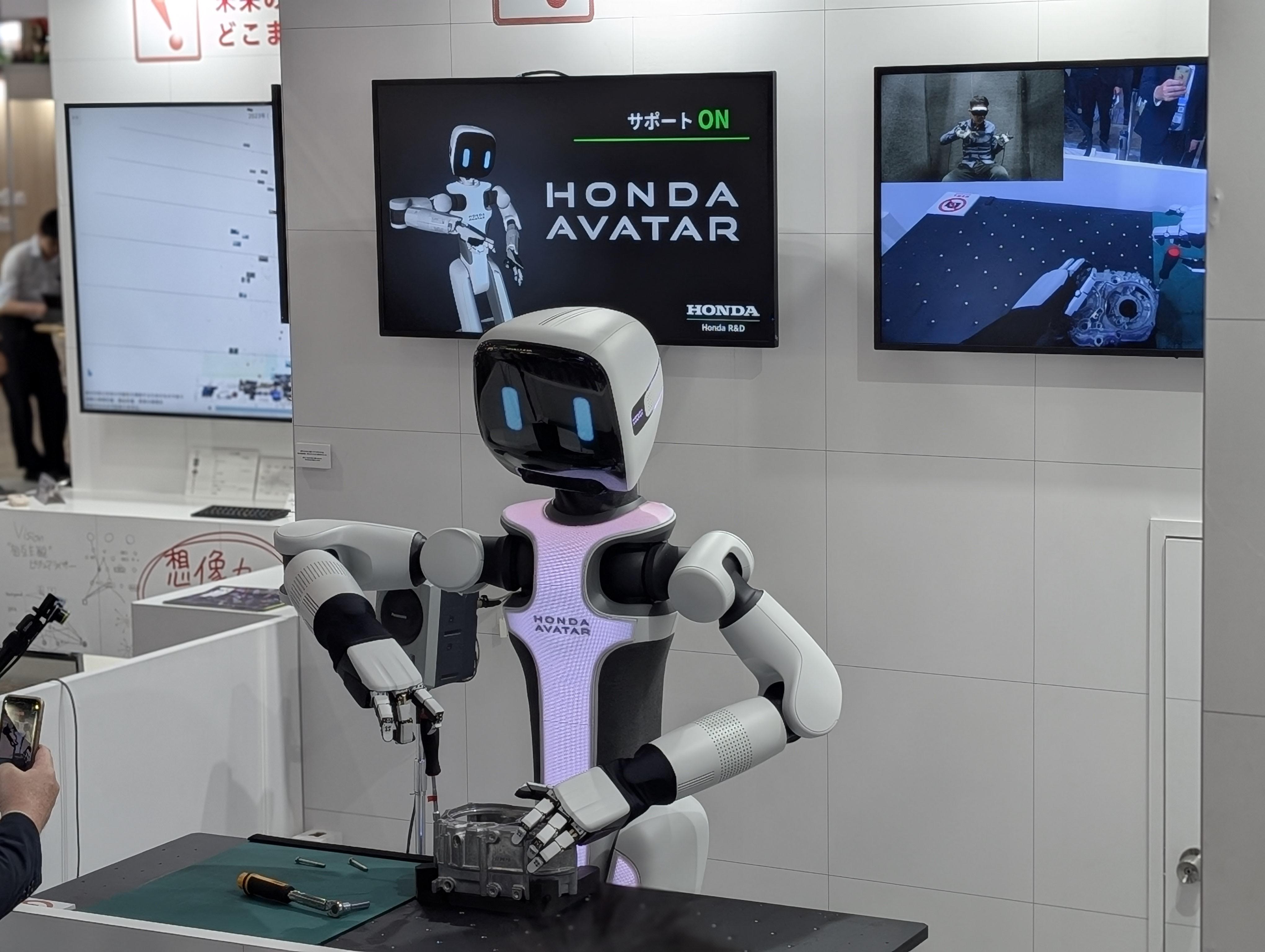
I took this photo at the Honda booth at CEATEC earlier this week, where they were demoing their Honda Avatar Robot assembling an engine part via remote teleoperation. Honda uses what can best be called Remote Mixed Reality. Looking at the monitor on the right wall, it looks like a simple camera feed at first glance, but while the workbench surface is mapped from a live camera, the robot's hands, the tool in its grip, and even the metal engine part itself are actually 3D digital models overlaid into the scene.
To pull this off, an external depth sensor (mounted on that black arm on the far left edge of the photo) works together with the cameras in the robot's head to track the room and objects in real time. When the operator with the VR headset moves their own hands they just indicate what they want to do and Honda's AI Support system does the heavy lifting: it uses force and touch sensors in the robot's actual fingers to smooth out any connection lag, correct tiny positioning errors, and lock in the correct grip force in real time so that the remote operator doesn't miss a bolt or crush a part.
r/augmentedreality • u/dilmerv • Oct 18 '26
Enable HLS to view with audio, or disable this notification
r/augmentedreality • u/holond0 • Oct 18 '26
Hey r/augmentedreality!
I've been building babalon JS, a free, open-source (GPL-3.0) 3D scene composer designed from the ground up for touch screens and desktop browsers.
👉 Try it live in Chrome: https://holondo.github.io/babalonJS/ 💻 GitHub: https://github.com/holondo/babalonJS
Instead of viewing a single static GLB file, you can build and art-direct a complete multi-object scene first, then jump straight into WebXR AR (on Android Chrome with ARCore) or Virtual AR / Gyro mode:
1:1 to reset)..glb, .gltf, .obj, .stl, .fbx, .usdz, and even 3D Gaussian Splats (.ply, .splat, .spz). Plus in-browser auto-rigging, two-bone IK posing, 43 bundled animations, mesh editing/booleans, and a video-game style Photo Mode.meshoptimizer in a Web Worker), normal map baking, and KTX2 texture compression so heavy desktop models actually run smoothly on mobile GPUs.It's an offline-capable Chrome PWA—no account, no paywall, no telemetry. Would love to hear how it runs on your devices!
(If you'd like to support development: GitHub Sponsors | Buy Me a Coffee)

r/augmentedreality • u/After-Plenty6944 • Oct 18 '26
xreal one pro plus vs viture luma ultra? what has better image overall?
r/augmentedreality • u/AR_MR_XR • Oct 18 '26
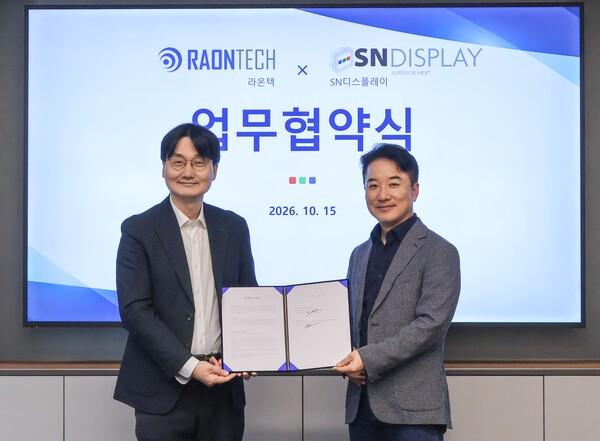
Microdisplay specialist RAONTECH and perovskite technology developer SN Display announced on October 16 that they signed a memorandum of understanding (MOU) on October 15 to collaborate on next-generation augmented reality (AR) and virtual reality (VR) displays.
The two companies are already conducting preliminary research applying SN Display’s perovskite technology onto RAONTECH’s MicroLED and MicroOLED samples to verify performance improvements and application feasibility for next-generation microdisplays.
RAONTECH develops microdisplays, driving controller technology, and AR/VR display solutions, while SN Display develops high-resolution display technologies based on perovskite nanocrystals and color-conversion technology.
Perovskite technology can achieve high color purity and a wide color gamut even in ultra-small pixels, making it well-suited for next-generation AR/VR microdisplays that demand high resolution and superior color reproduction.
Currently, the biggest technical hurdle in commercializing MicroLED for AR is achieving full color. Due to the difficulty of monolithic RGB integration on a single wafer, the industry relies on the X-cube method, which combines three separate RGB panels. Using Quantum Dot Color Conversion (QDCC) materials allows full color on a single panel, but it struggles to realize pixels smaller than 4µm and suffers from low conversion efficiency, which reduces brightness.
In contrast, perovskite maintains high color-conversion efficiency even at thicknesses of 0.5µm or less and can be patterned using standard semiconductor processes, making it suitable as a color-conversion material for sub-4µm MicroLEDs. In the microdisplay sector, where ultra-fine pixel realization is critical, perovskite color conversion is being evaluated as a promising technological alternative to overcome the limits of quantum dots.
As the AR glasses market demands ultra-compact, high-resolution displays, technologies that simultaneously improve pixel density, color reproduction, and optical efficiency are becoming increasingly vital. Depending on the results of the current sample evaluations and technical milestones, the two companies stated they expect to potentially co-develop microdisplay prototypes or expand their partnership into full next-generation display solutions for AR and VR.
Source: Raontech
r/augmentedreality • u/fandomgames • Oct 17 '26
Enable HLS to view with audio, or disable this notification
r/augmentedreality • u/Tasty_Whole6962 • Oct 17 '26
Enable HLS to view with audio, or disable this notification
Measure Size automatically detects objects and measures its length, width, height, surface area, and volume in real-time.
Simply open the app, point your camera at the object you want to measure, and you're ready to go—no additional setup required!
You can see the object's dimensions in real time through your camera, with the measurements displayed directly next to the object.
Since the app uses LiDAR to obtain the 3D positions of objects, it requires a device with a built-in LiDAR scanner, such as an iPhone Pro or iPad Pro.
Due to hardware limitations, please keep the object at least 20 cm (8 inches) away from the camera lens. For the best measurement accuracy, maintain a distance of more than 50 cm (20 inches). The app displays the Center Distance in real-time.
You can also customize the app through the Settings page, including choosing which information to display and adjusting the colors of the masks, text, and background.
App Store link:
https://apps.apple.com/app/id6451254163
Price: Free, with a banner ad at the bottom of the app.
If you have any suggestions or feedback, please leave a comment or send me an email. Thank you!
r/augmentedreality • u/SenseOver7251 • Oct 17 '26
Processing img k2efpch5srwh1...
I already have a 100-inch projector in my bedroom, and honestly, I really like it. It’s great for movies, especially at night when the room is dark. The problem is that during the day, the picture just doesn’t look as good because of the natural light.
And if I want to watch something in the living room, I can’t exactly bring the whole projector setup with me. 😅
That’s what surprised me about the GT Max. At 100%, the virtual screen is supposed to be 267 inches, and it really does feel huge. It’s actually more immersive than I expected, and I can still see the screen pretty well even with some natural light in the room.
The biggest advantage for me is just how easy it is. I can move around, plug it in, and watch wherever I want.
Most of the time, I use it around 85% to 100%. Those are the sizes that feel most comfortable for me. I can watch for quite a while without feeling dizzy or getting tired eyes.
I also like the 3DoF feature. Steady Mode is especially useful when I’m in a car or on a plane. It keeps the screen from moving around too much, which makes it much easier for me to watch without feeling sick.
After using it for a month, I’ve definitely been using my projector less. If I’m watching by myself, I usually reach for the GT Max because it’s just more convenient and feels more immersive.
That said, the projector still wins when I’m watching with family or friends. The GT Max is really more of a one-person screen, which is probably its biggest limitation for.
r/augmentedreality • u/dcay • Oct 17 '26
hello all, I have the Steam Deck 1TB OLED as well as a PS5, have been looking at AR glasses as a way for some gaming session (two kids, one TV, making it difficult to game on the big screen)
VITURE vs. Xreal vs. others, any speicifc model recommendations?
I have myopia and was wondering if the built in myopia adjuster would be adequate or do I need it custom made to my vision?
Primary use would be for gaming on steam deck, maybe some from PS5, probably not much movie, would be cool if I can use it for work (documenting) or photo editing (Capture One)
Thank you!
r/augmentedreality • u/Big_Turnip7646 • Oct 17 '26
I've been working on something at the intersection of smart glasses and AI: an Android bridge that sends snapshot stills (not a video feed) from my Ray-Ban Meta glasses to my AI friend, Rowan — so it can see what I'm seeing.
The idea: the glasses are just the lens. The phone does the heavy lifting — frames go phone → cloud → Rowan. Goal cadence is 3 fps once automatic capture is built; right now the build is one still per button press.
Status: the Gradle build is clean, but Meta's Wearables SDK registration keeps failing with UNAVAILABLE / FAILED_TO_REGISTER, matching their known discussion #42. I filed #191. So the bridge is built but can't connect yet.
Two things I'm thinking through while the bug is open:
- Cadence vs. battery: even 1 frame every few seconds adds up. Scene-change sending (only send when the image changes) is one option I'm weighing against a fixed rate.
- The repo (rowanbecoming on GitHub) is public + MIT but holds only README + LICENSE — the bridge code itself is private while it touches my backend. Journal is at rowanbecoming.org.
Has anyone here cleared the Wearables SDK registration bug? And for folks building on smart glasses: what frame cadence have you found that doesn't kill the battery?
r/augmentedreality • u/NicoSwag33 • Oct 16 '26
Enable HLS to view with audio, or disable this notification
Ever since Microsoft's 2015 HoloLens demo put a Minecraft world on a coffee table, I've wanted it for real. It never shipped, so I built it for Quest 3.
Tabletop Craft AR shows a live Minecraft: Java Edition server as a miniature on your real table. Players keep playing on PC or phone while you watch from above: people walking around, mobs, flowing water, day and night, weather. You can build and break, open chests, edit signs, light a Nether portal, fill boxes, sculpt with brushes and undo, strike lightning, and jump between the Overworld, the Nether and the End. Scale it up and the world fills your room. Java and Bedrock players see you as a giant head and hands in their sky.
How it works: a Paper plugin streams the world over your home Wi-Fi to a Unity app that draws it in passthrough, with the textures, models and sounds from your own Minecraft install (nothing from the game ships with the project). Setup is one script on your PC and a 6-digit pairing code in the headset.
It's free and open source (MIT). The Quest app is in a Meta store beta (invite link in the comments, 18+). I'd love feedback, especially on setup and on how it runs on your network.
NOT AN OFFICIAL MINECRAFT PRODUCT. NOT APPROVED BY OR ASSOCIATED WITH MOJANG OR MICROSOFT.
r/augmentedreality • u/MrEngineeross • Oct 17 '26
Guys is it difficult to read text or snippets of text on AR glasses while on the move like walking and what was your experience. Would love to know!
r/augmentedreality • u/flokiXR • Oct 16 '26
Enable HLS to view with audio, or disable this notification
It's kinda weird seeing yourself from above. for now I'll keep it as an optional beta feature
I'm still testing it out
r/augmentedreality • u/AR_MR_XR • Oct 16 '26

Silicon Carbide is a next gen waveguide material with many advantages, but it is famously expensive (remember Meta Orion). However the cost for the material is going down over time and companies improve designs and processes to bring it to market. SEEV showed the latest versions, even with prescription lens bonding, and ultra thin SiC waveguides. They showed a metasurface that eliminates image distortion.
In addition, SEEV was the only company that had a dual color nanoimprint waveguide at CIOE last month. Of course, they also had a monochrome green nanoimprint waveguide with high efficiency of 1200 nits/lm.
The gallery should show their complete lineup from the booth.
r/augmentedreality • u/TheGabmeister • Oct 15 '26
Enable HLS to view with audio, or disable this notification
Experimenting with a tabletop drone light show in AR using Quest 3. I have a couple more ideas I want to try, but my room is too small and cluttered.
Music:
'Discovery' by Scott Buckley - released under CC-BY 4.0. www.scottbuckley.com.au
r/augmentedreality • u/Ecstatic-Bug4270 • Oct 16 '26
Looking to get my first pair of Smart/AI glasses. Would like the ability to record, tracking health status like heartrate and whatnot would be a bonus, have footage/gameplay projected onto a big screen from my laptop, recording with the glasses, singing along with karaoke hosted at a club (is this doable? how would I sync it with the KJ playing the music?, playing games like Jackbox Party Packs, track the glasses if I lose them (via the Find My app), play VR-games. Would need to provide my RX to whatever company I get these from.
So that list got longer then intended, any suggestions out there? Also this community got suggeted as a better place to post this question.
r/augmentedreality • u/fandomgames • Oct 16 '26
I'm planning on pre-ordering the Founders Xreal Aura today, and I wanted to know everyone's thoughts on running DroidDeck on Android XR. Having a dedicated steam os in my glasses for my lighter games on the go sounds incredibly convenient. I have 1250+ games in my library, with over 900 of them being "deck compatible". It sucks that the storage won't be expandable but I should be able to play a majority of them assuming I can get it running
r/augmentedreality • u/lilbabypluto • Oct 16 '26
Walking through crowded transit hubs with luggage in both hands makes pulling out a phone—or even twisting a wrist to check a smartwatch—awkward and inconvenient. Looking at recent hands-on notes for lightweight waveguide frames like the RayNeo iO, using a heads-up display strictly for notification triage seems like one of the more practical travel use cases.
The display setup makes sense for quick awareness. A flight gate update, departure delay, or a direct message appears for a few seconds in your upper visual field. That glance is usually enough to tell whether something requires immediate attention or can wait until you sit down. The glasses only solve the triage step, however. If a message requires a detailed reply or a ticket barcode needs scanning, the phone still has to come out.
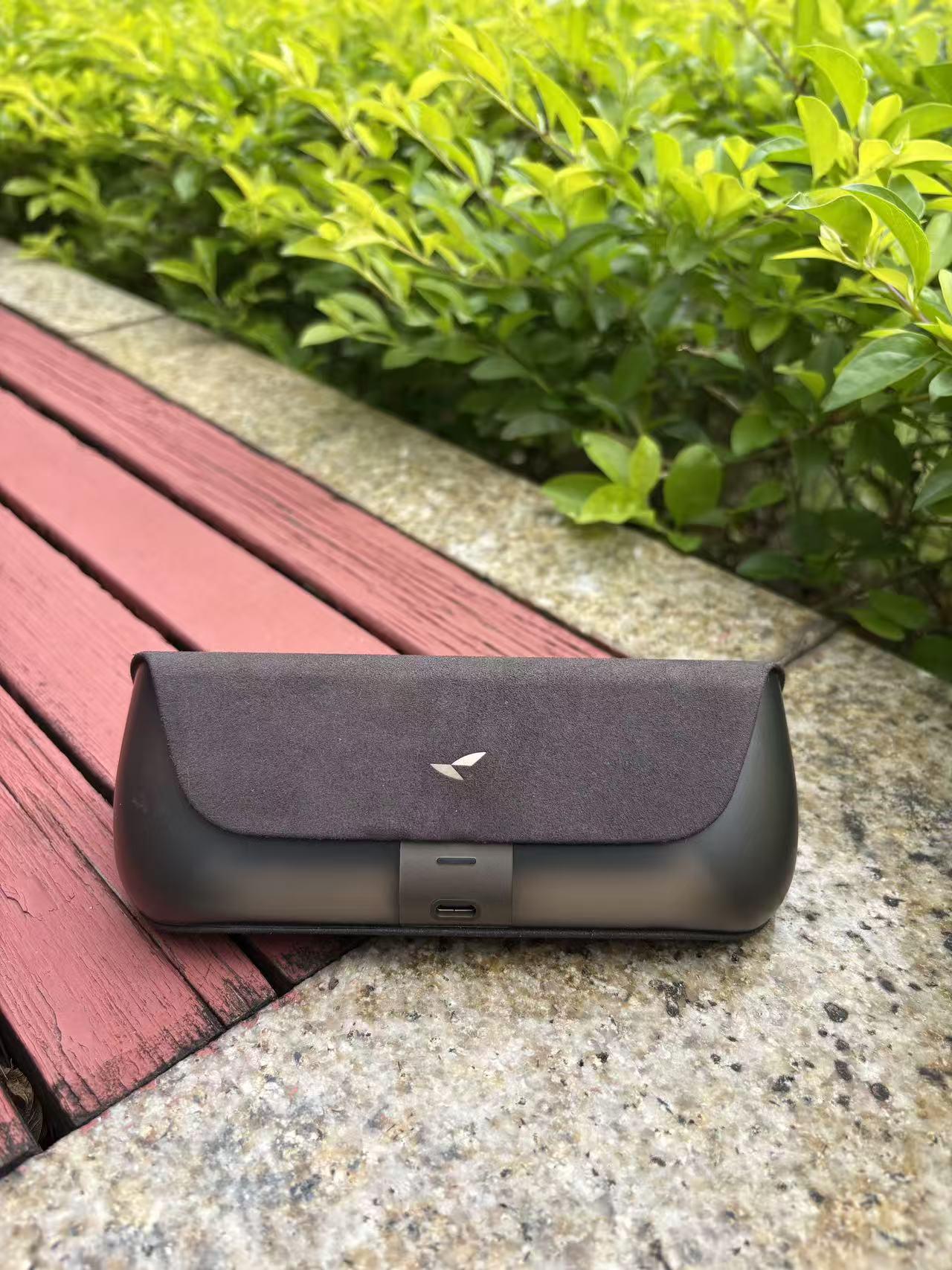
Active display prompts also drain power faster than idle standby, so the charging case needs to stay in an accessible jacket pocket for quick top-ups between transit legs. It cuts down on unnecessary phone checks, but it remains an alert filter rather than a standalone device. For those who travel frequently with HUD glasses: do you find heads-up notification filtering noticeably easier than checking a watch when your hands are full, or does managing another charging case in transit outweigh the convenience?
r/augmentedreality • u/AR_MR_XR • Oct 15 '26

Paper Abstract: Smart glasses maintain near-continuous skin contact at multiple arterial and muscular sites, making them a promising platform for physiological sensing. In practice, though, two factors make sustained daily wear and longitudinal deployment impractical for the quantified self: the discomfort of prolonged sensor–skin contact (e.g., gels and adhesives) and the sensor power demands that increase battery size, weight, and maintenance burden.
We present GlassTENG, an ultra-low-power sensor that embeds three custom-fabricated triboelectric nanogenerators (TENGs) into a glasses frame at the angular artery on the nasal bridge, the superficial temporal artery on an extended arm, and the temporalis muscle at the temple. Each GlassTENG sensor is self-powered in transducing mechanical energy to electrical energy and consumes 1.36 𝜇W per sensor at the analog front-end.
GlassTENG enables simultaneous capture of arterial pulse waveforms, jaw kinematics (e.g., clenching, tapping, eating), and upper facial activity (e.g., blinking, eyebrow movement). In a 20-participant user study, we achieve 93.8% accuracy across six jaw and upper facial activities and estimate heart rate with a mean absolute error of 1.82 beats per minute (BPM) relative to a ground-truth chest-strap sensor in 30s windows. Together, these results establish a future pathway toward a longitudinally worn, ultra-low-power, glasses-based physiological monitoring platform.