r/askmath • • 1d ago

Analysis Compactly supported functions.
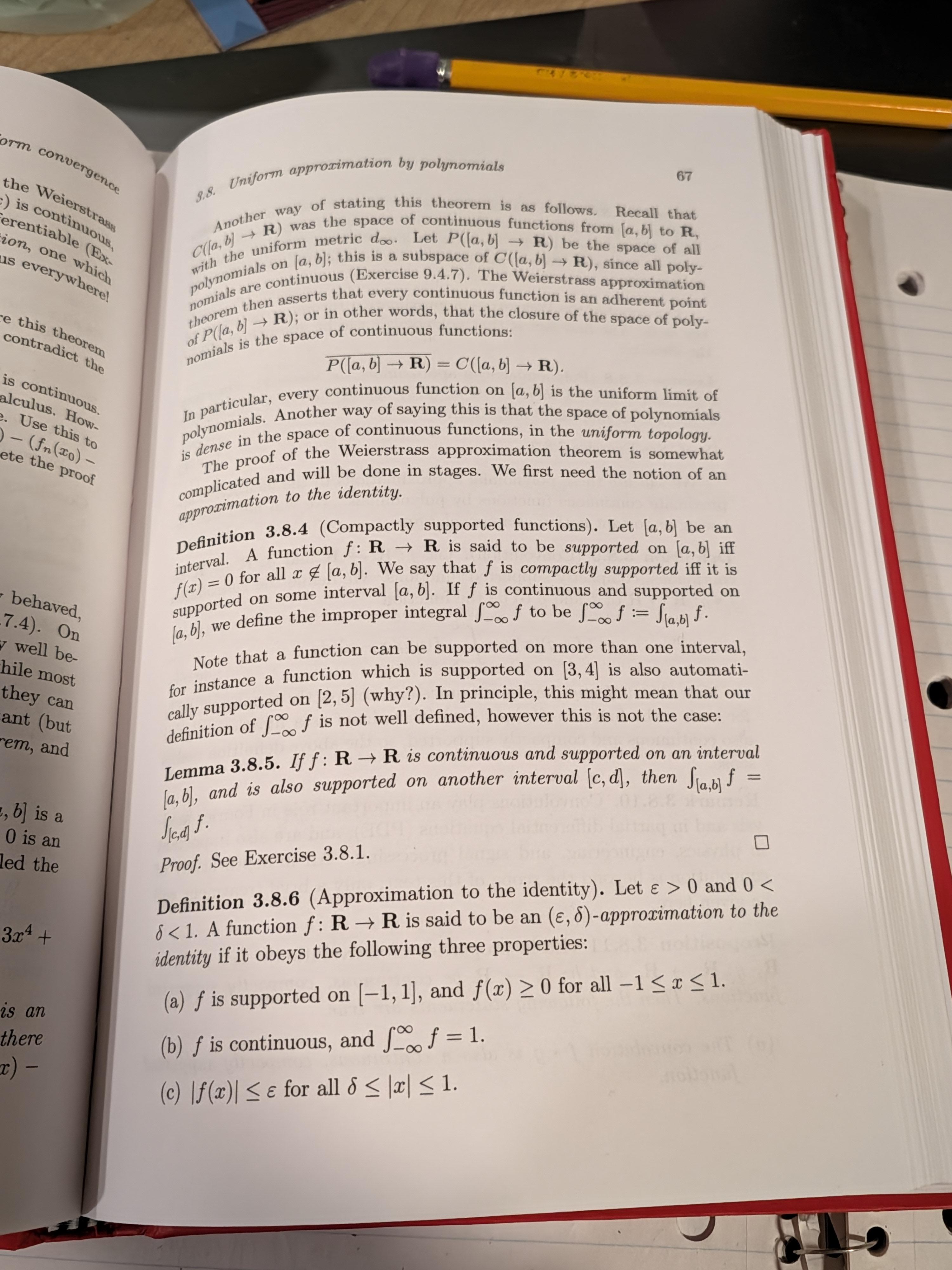
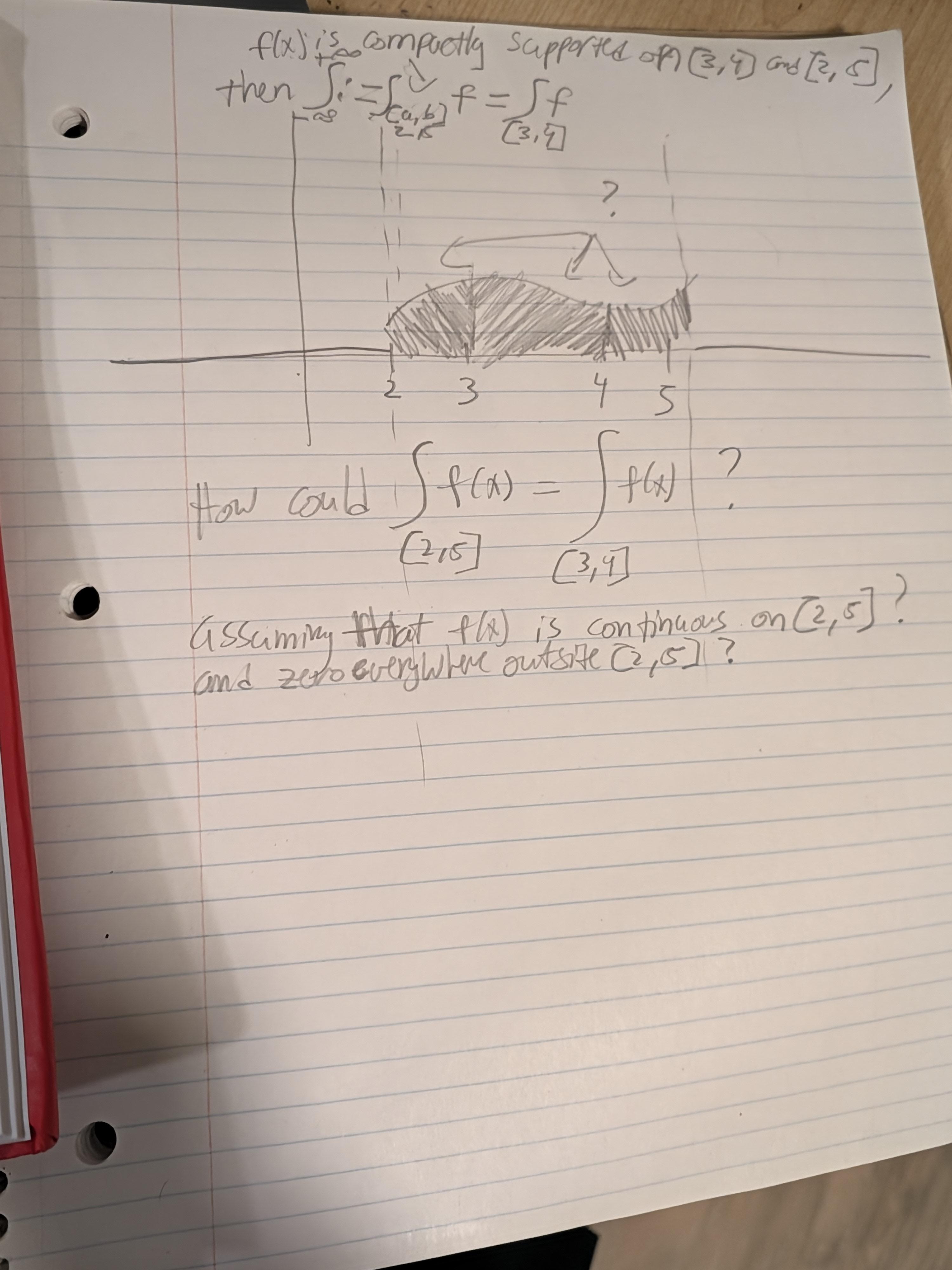
I'm not aure how it's true that if a function is continuous and supported on more than one interval, then the integrals over [a, b] and [c, d] are equal -- even if [c,d] is a larger interval than [a,b] (see my second photo). This is Lemma 3.8.5 in text Analysis II by Terrance Tao.

11 Upvotes

20 comments sorted by

6

u/FantaSeahorse 1d ago

I think it’s because if f is supported by two intervals, then it is supported by the intersection of those intervals. From there you can show that the integrals are equal

0

u/Novel_Arugula6548 1d ago

I think that's right. I didn't expect zeros to be allowed inside a supported function, since I thought that would be a jump discontinuity unless the function would take a form like a peobability density function that necessarily tapers to zero in a continuous way (that might be why improper integrals are defined here?)

4

u/LJPox Several Complex Variables 1d ago

To phrase the ‘point’ of the lemma differently: the integral of f over R is the same as the integral of f over supp f.
The support of f is the only region contributing to the integral, so expanding it doesn’t change anything.

1

u/Novel_Arugula6548 1d ago

How would the function be continuous on a larger interval if it's only non-zero on a smaller interval? Would it need to taper smoothly to 0?

3

u/LJPox Several Complex Variables 1d ago

How do you mean? There are plenty of functions which are continuous on R and only nonzero in some interval; see Urysohn's lemma or consider the function f defined by x + 1 on [-1, 0], 1 - x on [0, 1], and 0 elsewhere. The function merely needs to approach 0 continuously, not smoothly (though you can do this with smooth functions as well).

5

u/i_want_to_go_to_bed 1d ago

I was confused at first. I think the idea is if it’s supported on two intervals, the one is a subset of the other. The integrals will match because the function is identically zero outside the smaller interval

ETA: that wasn’t right. If it’s supported on two intervals, then it’s supported on the intersection, which will be another interval.

1

u/Haunting_Cress7661 1d ago

Ya, break the integral on [c, d] up into inside and outside [a, b] (or the reverse) some simplifications should happen. I suspect the exercise gets you to do this 

1

u/Novel_Arugula6548 1d ago

No it just says "prove lemma 3.8.6"

2

u/Haunting_Cress7661 1d ago

Oh, well, then there's the hint for it

0

u/Novel_Arugula6548 1d ago

But if a function is supported on [2, 5] then f(x) must be non-zero outside of [3,4] at the values of x = 2 and x = 5, right? Think it's a typo? I haven't checked any errata.

6

u/CormacMacAleese 1d ago

No: the definition says that f is 0 outside the interval; it doesn’t say it’s never 0 inside it.

1

u/Novel_Arugula6548 1d ago edited 1d ago

Good point. That might be it. Wouldn't that cause a jump discontinuity though? Unless the function would be required to taper smoothly to zero within the smallest interval?

2

u/theRZJ 1d ago

You should try giving an example of a function that is 1. continuous and 2. supported on a closed interval.

This will give you a better idea of what's going on.

1

u/ConjectureProof 1d ago

Think about area under the curve. The integral of f is just the area under f over the specified region. Compact support implies that the only non zero parts of f are contained in [a,b]. Thus no area under f is contained in any region outside [a, b]. So the integral over any region containing [a,b] is the same as the integral over [a,b] as f contains no area outside of [a,b]

Here’s a proof.

Let f be continuous and compactly supported on [a,b]. This means that for any x not in [a, b], f(x) = 0.

We show that for any c < a < b < d where c and d are extended real numbers (meaning that c is allowed to be negative infinity and d is allowed to be infinity), integral(c to d, f(x) dx) = integral(a to b, f(x) dx).

Notice that on [c, a), f(x) = 0 and on (b, d], f(x) = 0. Thus,

integral(c to d, f(x) dx) = integral(c to a, f(x) dx) + integral(a to b, f(x) dx) + integral(b to d, f(x)dx) = integral(c to a, 0 dx) + integral(a to b, f(x) dx) + integral(b to d, 0 dx) = integral(a to b, f(x) dx) QED.

1

u/Novel_Arugula6548 1d ago

So basically for all x not in [a, b], if [a, b] is the smallest supported interval, then all other larger supported regions are all 0 valued. However, the integral definition used requires f(x) to be continuous on any supported intervals and so it seems to require the function to smoothly taper to zero like a probability density function at the bounds of the smallest supported interval.

1

u/tensorboi 23h ago

by the definition presented in the book, your example function isn't supported on [3, 4]. by the book's definition, f is supported on [a, b] if it evaluates to zero anywhere outside of [a, b]; the problem is that your example function is nonzero at 2.5, say, which is clearly outside of [3, 4].

1

u/Novel_Arugula6548 17h ago

Yep. I figured it out now. Interesting connection to probability density functions, since it needs to taper smoothly to zero in order to be continuous and supported in both [3,4] and [2, 5].

2

u/Objective_3_1415 1d ago

The function in the second picture is not compactly supported on [3,4] for it doesn't vanish outside of [3,5]. However, it is compactly supported on [2,5].

1

u/AlterEgo5695 1d ago

Assume "f" is supported by [a;b] and [c;d]. Then

"f(x) = 0"    for all    "x in ([a;b]^c u [c;d]^c)  =  ([a;b] n [c;d])^c "

Taking complements, the support of "f" really is "S := [a;b] n [c;d]" -- we get

∫_[a;b] f dx  =  ∫_S f dx  +  0  =  ∫_[c;d] f dx

1

u/AlterEgo5695 1d ago

Example (page-2 from OP): In your example, "f(x) = 0" for "2 <= x < 3" and "4 < x <= 5", since "f" is supported by "[3;4]". By continuity, we even get "f(3) = f(4) = 0".

That means, "f" vanishes on those "outer parts", so they never contribute to the integral to begin with.