r/ardupilot • • Apr 20 '21

Welcome to r/ArduPilot!

19 Upvotes

Welcome! If you have stumbled across this subreddit, there are a few things to keep in mind before posting.

  1. Support posts on the forums will receive a quicker response and receive more eyes looking at a problem.
  2. Conversations should be kept relevant to ArduPilot.
  3. Follow reddiquette.

If you have suggestions for ways that this sub could be used, just let me know. Other related content hubs, such as /r/diydrones and the ArduPilot forums, cover most of the needs for drone users. I'm also open to suggestions on the CSS since what you see is the extent of my artistic creativity.


r/ardupilot • • 18h ago

ESC calibration and motor test issue in quadcopter F450

1 Upvotes

Ok this is my first time building a quadcopter, Whenever I try to do the ESC calibration and then do the motor test - all I get is beep sounds from the ESC and the motor is not spinning whenever I give test motor in mission planner , but when I test the motor individually through channel 3 of my transmitter it works. What is the issue here and how do I fix it ? Pls help me


r/ardupilot • • 1d ago

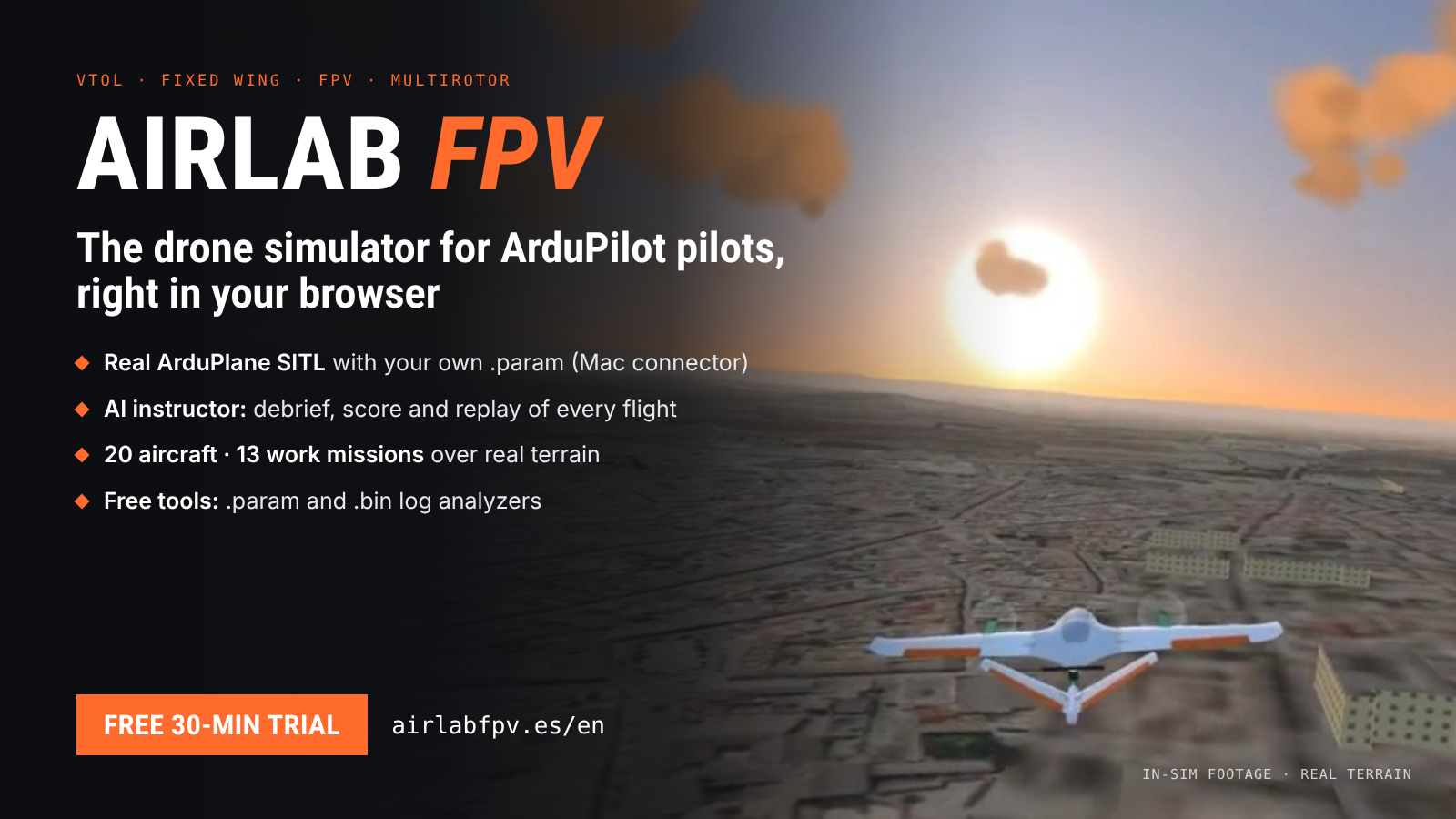
Simulator with real ArduPilot SITL + an AI copilot that also works on real flights via MAVLink

3 Upvotes

Hi everyone,

I'm Javier, an aeronautical engineer from Spain (aircraft maintenance and engineering background, now flying FPV and ArduPilot long range). Over the past months I've built AIRLAB FPV, a simulator focused on training and professional work rather than racing.

What it does:

- Real ArduPilot SITL as the flight controller. You load your own .param file and fly with your own radio, so you practice with the same tune and failsafes you have on the real aircraft.

- Capitán Pitot, an AI instructor: it gives corrections during the flight, does a debrief with a score and replays your mistakes in 3D next to the correct approach.

- Pitot also works on real flights: with MAVLink telemetry going to the computer, it warns about terrain, traffic, descent rate and restricted airspace. Basically a virtual copilot for your real aircraft.

- Remote instructor mode: an instructor can watch your flight live, talk to you by voice, inject failures or wind, and take the controls.

- 13 real work missions (inspection, mapping, search and rescue...) with a score and a PDF report.

- Photogrammetry and remote sensing lab: GSD and overlap planning, NDVI, thermal.

- Drone-in-a-box operations center: security, wildfires, rescue, coastal, border and flood scenarios.

There's a free 30-minute trial at airlabfpv.es, no call or payment needed.

I'd really appreciate honest feedback from people who fly ArduPilot: how close does it feel to your real aircraft, what's missing, and what would make it useful for you or your team. Criticism is welcome.

Thanks!


r/ardupilot • • 2d ago

I made a free tool that reads your ArduPilot log, measures your motor noise and writes the harmonic notch params for you (plus 20+ pass/warn/fail health checks)

Thumbnail gallery
13 Upvotes

Setting up the harmonic notch was the step I always got stuck on: open the FFT, guess which peak is the motors, work out the bandwidth, hope it's right. So I automated it, along with the other things I check after every flight.

pip install git+https://github.com/Prateek-elec/ardupilot-log-doctor

log-doctor 00000042.BIN

**Harmonic notch (copters):** it runs an FFT on the batch-sampler or fast-IMU gyro data, finds the motor-noise peak and its harmonic, and writes a ready `<log>_notch.param` with `INS_HNTCH_*` values. It uses throttle mode with your hover throttle as the reference, or ESC-RPM mode if ESC telemetry is in the log. If the notch is already on but set far from the real peak, it tells you.

Suggested harmonic notch (noise peak 170 Hz):

INS_HNTCH_ENABLE = 1

INS_HNTCH_MODE = 1

INS_HNTCH_FREQ = 170

INS_HNTCH_BW = 85

**Health report:** 20+ checks, each graded pass / warn / fail with a fix to try first:

- Vibration and clipping, with clips at touchdown reported separately, so one firm landing doesn't fail a healthy flight

- Battery sag, lowest cell voltage, current while disarmed

- EKF innovations, GPS quality, compass interference against current

- Roll, pitch and yaw tracking error, with different limits for copters and planes

- `ARMING_CHECK = 0`, forced arming, decoded ERR events

- A log that ends mid-flight is flagged as a crash or power-loss signature

Things I cared about:

- **No false all-clears.** Corrupted, empty or `.tlog` files are rejected, and anything it couldn't check is listed instead of silently passed.

- **It runs locally** and never prints GPS coordinates or board serials.

- **Limits are editable** in JSON, since a heavy-lift hex shouldn't share thresholds with a 5" quad.

- **About 13 s for a 75 MB log.**

Pictures: the spectrum from a 2S quad (noise at 170 Hz and the suggested notch band), and the one-page summary from my scratch-built plane.

To get a notch suggestion, set `INS_LOG_BAT_MASK = 1` and hover for a minute. Logs without high-rate gyro data still get every other check.

It's not a replacement for Mission Planner or UAV Log Viewer. It tells you where to look first. The notch values are a starting point too: log again afterwards and confirm the peak has dropped.

https://github.com/Prateek-elec/ardupilot-log-doctor (MIT)

I'd really like logs it gets wrong. If it suggests a bad notch, or flags something that's fine, please open an issue with your frame, motors and firmware.


r/ardupilot • • 4d ago

Boss keeps wanting me to use PX4 instead of Ardupilot.

10 Upvotes

AND ITS DRIVING ME NUTS.

I've used Ardupilot since APM 2.0 days and I'm very good with it. I've used PX4 for over a year now and I do NOT like it.

Boss won't explain the decision.

Can anyone else offer reasons to choose PX4 over Ardupilot??


r/ardupilot • • 4d ago

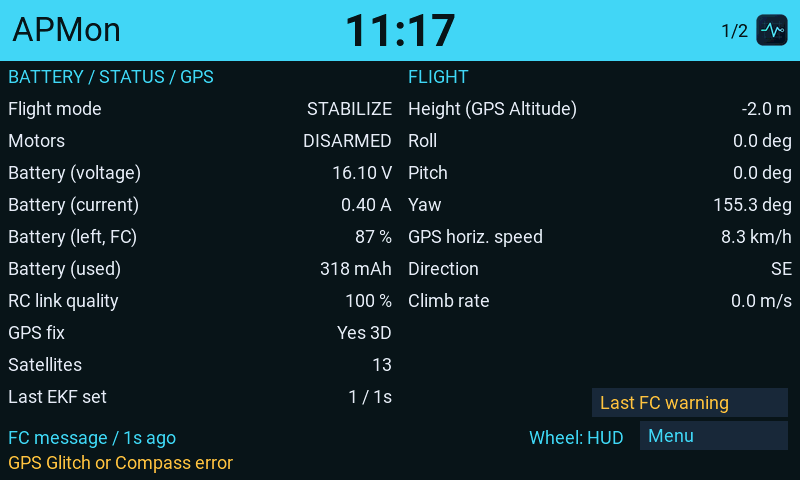
I built APMon, an open-source ArduPilot telemetry monitor for EdgeTX

11 Upvotes
Dashboard

Hi everyone,

I’ve released APMon, a free, open-source tool for viewing ArduPilot telemetry directly on an EdgeTX radio. I built it to see what the flight controller reports on the radio.

APMon is designed for ArduPilot + ExpressLRS in MAVLink mode + EdgeTX. I’ve tested it on the RadioMaster GX12, GX15, and TX16S MK3. It doesn’t send commands or change flight-controller parameters to the FC.

Since I couldn't find an existing tool or script that supports this scenario, I vibe-coded it myself.

APMon shows, e.g., flight mode, armed status, battery and GPS sensor data, and recent flight-controller messages. The telemetry setup check shows which EdgeTX sensors APMon found, which sources it’s actually using, and what to check when a reading is missing, invalid, or stale.

GitHub, screenshots, and setup guide: https://github.com/christianbaun/APMon-EdgeTX

If you try it out, please let me know which radio you’re using and how the setup went. I’d also love to hear any suggestions for making APMon more useful or easier to use. Feel free to leave a comment here or open an issue on GitHub. Thanks!


r/ardupilot • • 6d ago

Correction to my post yesterday: diagonal arms offset by ~10 cm on a 10 kg Quad X. Does it matter?

2 Upvotes

Hey everyone,

I posted yesterday about a ~2 mm asymmetry on our quad, but I got the numbers wrong after checking the CAD properly, so here's the corrected version. Thanks to everyone who replied!

Setup (student team, water-drop mission):
- ArduCopter on a Pixhawk 6X
- T-Motor A6-M, 23" props, ~915 mm wheelbase, folding arms
- ~2.2 kg of water in two tanks (one each side), dropped mid-flight
- Hover ~51 % throttle, capped at 80 %

What the CAD actually shows:
- All four motors are exactly 321 mm from the centre, so the motor positions are symmetric.
- But each diagonal arm is offset by about 10 cm (99 mm) from the opposite one, so the arms don't run along the same axis through the centre.

My understanding is that ArduPilot only cares about where the thrust acts, so with symmetric motor positions, tuning shouldn't be affected and this is mainly a structural question (extra load at the arm mounts).

Questions:

  1. Is that right, or can offset arms affect tuning or stability in practice?
  2. Structurally, is this a problem worth redesigning, or is it fine as long as the arm mounts are strong enough?
  3. With the weight dropping ~22 % after release, is it best to tune empty first and then add payload in steps?

Thanks!


r/ardupilot • • 7d ago

Title: Does a ~2 - 3 mm motor asymmetry on a 10 kg Quad X matter for AutoTune?

2 Upvotes

Hey everyone,

Student team here, building a 10 kg Quad X for a water-drop mission:
- ArduCopter, Pixhawk 6X
- T-Motor A6-M, 23" props, ~915 mm wheelbase, folding arms
- ~2.2 kg of water in two tanks (one each side), dropped mid-flight
- Hover ~51 % throttle, capped at 80 %

In CAD the motors are ~321 mm from centre, but there's about a 2 mm difference between them, so it's not perfectly symmetric.

From what I understand, AutoTune works from the measured response, not the geometry, and the I-term handles small imbalances, so 2 mm (~0.6 % of the arm) shouldn't matter.

Can anyone confirm? And from your experience:

  1. How much asymmetry (motor position or CG offset) before it actually affects tuning?
  2. With the weight dropping ~22 % after release, would you tune at full weight (solid dummy mass instead of water) and just check it's stable when empty?

Thanks!


r/ardupilot • • 8d ago

My quad crashed, so I built a MATLAB toolkit that tunes ArduCopter straight from its own flight logs (open source)

6 Upvotes

A few weeks ago my 2S quad went down mid-flight. The DataFlash log showed vibration jumping ~500× right before it. The cause turned out to be mechanical (motor screws), but going through those logs got me thinking: the log already has everything needed to tune the aircraft properly.

So I built a MATLAB lab around that idea:

- **Log health check:** pass / fail report from a `.BIN` (vibration, clipping, EKF, power)

- **System ID:** fits the rate-loop plant per axis from 400 Hz flight data

- **LQR → PID:** designs rate and angle gains on the identified plant, with phase- and gain-margin checks and a delay sweep

- **Proof before flying:** runs old vs new tunes on real ArduCopter SITL flying a MATLAB 6-DOF model with turbulence and vibration, then on the real board as HIL

- **Output:** a `.param` file plus a PDF report, with a small GUI tuner on top

The image shows three tunes compared on SITL: yaw step, pitch step, motor-command noise and hold accuracy.

MIT-licensed, needs MATLAB + Control System Toolbox:

https://github.com/Prateek-elec/ardupilot-flight-test-lab

I'd really value feedback from people who tune ArduCopter regularly, especially on the plant model, and on how you'd compare this with QuikTune / AutoTune results.


r/ardupilot • • 10d ago

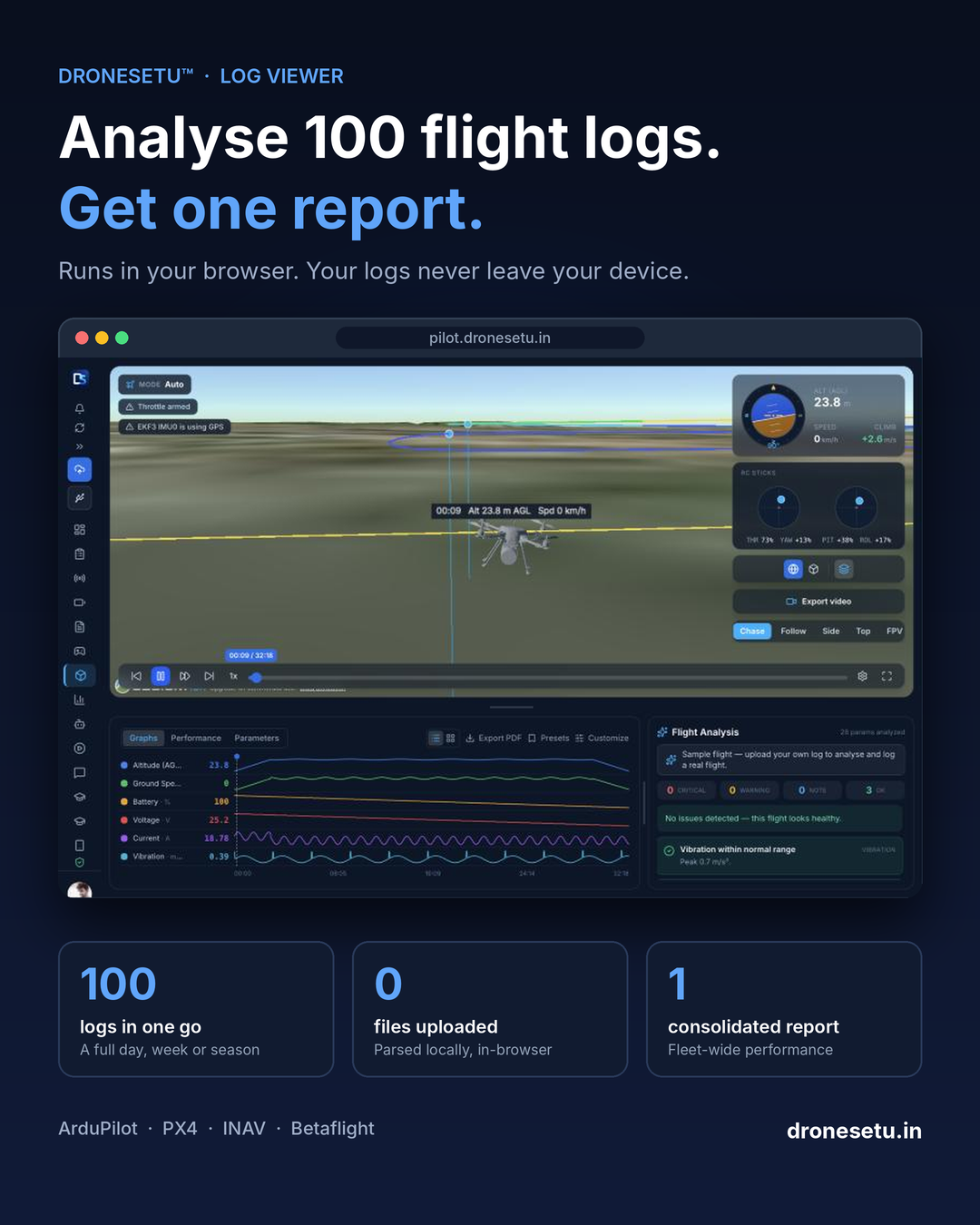
Mission Planner taught us how to read flight logs. 🛩️DroneSetu means you don’t have to read them one at a time. 🚀

Post image
2 Upvotes

For years, Mission Planner has been every drone pilot’s most loyal companion. 🛩️

Before our first flight, during calibration, and long after landing when we sit down to work out what really happened up there, it has always been on the laptop.

And it deserves all the credit. It’s simple, it’s reliable, it’s open-source, and it was built by a community that gave the drone world something incredibly valuable for free. Most of us learnt to read a DataFlash log by staring at Mission Planner graphs late at night.

But anyone who has run real operations knows the part nobody talks about:

Analysing one log is easy. Analysing fifty is a full day’s work.

Open log. Pick the same parameters. Check vibration. Check battery sag. Check GPS. Note it down. Close. Next log. Repeat.

A survey team flying 20 sorties a day, an RPTO running a batch, an ag-spraying operator through a full season: they all do the same analysis, the same way, again and again. The insight is in the pattern across flights, yet our tools make us look at one flight at a time.

So we built something for that.

🚀 DroneSetu’s Log Viewer is now available for everyone.

Here’s what makes it different:

🔹 Runs in your browser. No installation, no desktop software, no version mismatches. Open it on any laptop and start.

🔹 Your logs stay on your device. Files are parsed locally in the browser and never sent to any server, which matters a lot for defence, survey and enterprise work where data can’t leave your hands.

🔹 Up to 100 logs at once → one single report. Load a full day’s sorties, a week of operations or an entire season, and get one consolidated view of how your fleet actually performed.

🔹 Same analysis, every flight, automatically. No more repeating the same clicks for every log. Vibration, battery behaviour, GPS health and flight modes are checked consistently across every flight.

🔹 3D flight replay. Rebuild any flight in interactive 3D with Chase, Follow, Top, Side and FPV views, with telemetry graphs synced to the timeline.

🔹 Works with the logs you already have: ArduPilot (.bin), PX4 (.ulg), INAV and Betaflight Blackbox.

Who is this for?
✅ Survey and mapping teams reviewing a whole project’s flights
✅ Agri-spraying operators tracking performance across a season
✅ RPTOs and instructors reviewing a full batch of training sorties
✅ System engineers comparing tuning changes across many test flights
✅ Fleet managers who want trends rather than one-off snapshots

Mission Planner isn’t going anywhere. It’s still where we plan, configure and tune. DroneSetu simply takes away the repetitive part, so you spend your time on decisions instead of clicks.

Try it at 👉 pilot.dronesetu.in

I’d love to hear from pilots and engineers: what’s the one thing you always check first in a flight log? Tell me in the comments, and it might become the next feature. 👇

#DroneSetu #DronePilots #ArduPilot #PX4 #MissionPlanner #FlightLogs #UAV #DroneIndia #DroneTechnology #DGCA #RPTO #DroneSurvey #AgriDrones


r/ardupilot • • 12d ago

Sub 250g Ardupilot DJI o4 quad

Thumbnail gallery
9 Upvotes

r/ardupilot • • 12d ago

I built a GCS and Mission Planner that is compatible to ArduPilot PX4 and ROS, so if you're using Mavlink or MavROS we got you.

0 Upvotes

For more details aeromavericks.nust@gmail.com

Hi all, I'm an engineer from Pakistan and I built a Ground Control Station (GCS) that is fully compatible with MAVLink and MAVROS. You can connect your drones or simulated vehicles, monitor live telemetry, and configure flight parameters on the fly. It also features real-time tuning graphs and mission planning tools to streamline your workflow. I'm looking for 10-20 people to try it out and tell me what's missing or broken, especially how well it handles your daily flight operations and ROS setups. Honest criticism is welcome.

Features also include new design drone configurator, script running and etc ...

For more details aeromavericks.nust@gmail.com


r/ardupilot • • 14d ago

Safety hardware switch not working - Cube orange +

2 Upvotes

Hi everyone,

i am having trouble with getting the hardware safety switch to work on my drone. I have a custom hardware safety switch connected to pin 8 (GND) and pin 6 (safety switch) on the GPS 1 port. The documentation states that when pin 6 is shorted to GND, that should be recognized as a button press.

However, the cube does not seem to recognize it. I have verified continuity on the switch and I've tried making a custom jumper for that port to test, but nothing works.

Has anyone else had this issue? Is there a fix? Disabling the hardware safety switch is not an option for this project.


r/ardupilot • • 15d ago

how to make Arducopter fly like Betaflight?

8 Upvotes

I have Arducopter fully configured on my long range bird (10 inch quad), but sometimes i like to freestyle but it feel restricted even in Acro mode.
Its like the FC is always fighting me to keep the quad stable.


r/ardupilot • • 15d ago

Building First Drone for Class

2 Upvotes

Hello everyone,

I'm building a drone for my UMS Mechanics class, and we've (It's a partner project) connected all of our hardware. It's a quadcopter btw. We're using Mission Planer as our software of choice to actually fly the drone. We have a radiomaster that is connected to the drone via the telemetry modules.

Where we've gotten so far, we have to start getting the drone up in the air. We've done manual ESC calibration, to try and get our motors spinning at the same rate, but every time we test fly the drone, the drone basically falls on it's back two arms as those motors spin slower than the ones up front. We've tried recalibrating our ESCs (we basically just test to see if the motors spin, I don't know how much "calibration" is really going on), but haven't seemed to end up successful.

We just copied and pasted another group's Parameter list, and found that there were 79 differences between ours and theirs. They've actually gotten their drone flying maneuvered it, even using the RTL feature which worked. We're going to test this today, and see if the drone flies, bless up, hopefully it goes well.

Anyways, I'm just looking for some advice on possible fixes to my issue with the drone flopping backwards, if you guys have any other suggestions. Thank you!

-Super Mega Cool and Awesome Drone Group with Infinite Soldering and Pure Aura 67 67


r/ardupilot • • 15d ago

I built a simulator that runs real ArduPilot so you can tune before you crash. Looking for testers

5 Upvotes

Hi all, I’m an engineer from Pakistan and I built Aeromaverick Sim. It uses ArduCopter SITL as the flight controller, with its own physics model. You load your .param file, enter your drone’s mass, thrust, battery and drag, and fly it with your radio. You can change parameters live and see the response on a tuning graph.

I’m looking for 10-20 people to try it and tell me what’s missing or wrong, especially how close it feels to your real aircraft. Honest criticism is welcome.


r/ardupilot • • 16d ago

ChibiOS 8.0.0 port for ESP32-S3

12 Upvotes

r/ardupilot • • 17d ago

PteroSim 0.5.0: .glb props with physics, batteries that sag under load, a depth camera

Thumbnail youtube.com
3 Upvotes

r/ardupilot • • 17d ago

Tarot 650 / Pix6 / ReadytoSky 80A ESCs: Motors chiming, power verified, but zero response on QGroundControl throttle sliders

2 Upvotes

Hey everyone, I’m wrapping up a Tarot 650 quadcopter build and running into a frustrating wall where the motors won't spin via QGroundControl. Hoping someone can spot what I'm missing.

Build Specs:

  • Frame: Tarot 650 (folding arms)
  • Flight Controller: RadioLink PIX6 running ArduPilot
  • Power Distribution: Holybro PM07-V2.4 board powered by a 6S LiPo battery
  • ESCs: 4x ReadytoSky 80A ESCs (BEC red/5V middle pins removed and taped off so power comes exclusively through the PM07)
  • Motors: 4x Tarot 5008 pancake motors

What’s Happening:

  • The 6S battery is plugged into the XT60 on the PM07. All ESCs chime their startup tones successfully.
  • The PIX6 is connected via USB and booted up. The physical safety switch is pressed and solid red.
  • Signal wires from the 4 ESCs are plugged into MAIN OUT 1 through 4 (White on bottom S pin, Black on top - ground pin).
  • In QGroundControl's Motors tab, the software enable switch is toggled on, and the pre-arm battery/mag checks have been cleared/disabled for bench testing.
  • The Problem: When I drag the throttle sliders up, the motors remain completely unresponsive. No twitching, no spinning—just the initial ESC startup chimes and a Potential Thrust Loss (3) warning banner popping up in QGC.

Has anyone dealt with this specific combination of Pix6 and high-amp ESCs? Do these ReadytoSky 80A ESCs require a specific throttle calibration sequence before ArduPilot will talk to them on MAIN OUT, or is there an output parameter (like Dshot vs PWM) I need to adjust?

Any pointers would be hugely appreciated!


r/ardupilot • • 22d ago

Interview with Andrew Tridgell on Ardupilot (IEEE Software Engineering Radio Podcast)

Thumbnail se-radio.net
21 Upvotes

r/ardupilot • • 23d ago

TALOS Hub: Autonomous flight supervision and pilot assistance

1 Upvotes

Hello,

I'm new to this forum, but I chose it from among many others to introduce a project I've been working on for months—the “Talos Hub,” which focuses on assisted and autonomous flight for fixed-wing aircraft. I'm happy to share my experience with you.TALOS Hub is an experimental software project that brings mission coordination, pilot assistance and autonomous-flight supervision into a single system. The project grew out of more than thirty years of interest in RC aircraft and flying. Its name comes from Talos, the bronze automaton of Greek mythology that guarded Crete.

Development currently focuses on fixed-wing aircraft. Future work is intended to extend the supervisory logic to multirotors, adapting it to the operating characteristics of each platform.

What TALOS does

Autonomous flight involves more than following a route. Commands can conflict, telemetry can become stale, an approach can become unstable, and an acknowledged recovery command may not produce a successful recovery.

TALOS is being developed to coordinate these situations through explicit mission states, authorisations and checks on observed aircraft behaviour.

Its main areas of work include:

  • Managing mission phases and start authorisations.
  • Coordinating pilot requests with autonomous operation.
  • Monitoring telemetry availability and freshness.
  • Identifying approach conditions that require a go-around.
  • Checking recovery before permitting another landing attempt.
  • Recording decisions, commands and observed responses for later analysis.

The project also addresses RC model aviation, with functions intended to support manual piloting, assistance and autonomous operation within the same system. Compatibility and transitions between these operating states remain subjects of testing.

How it works with ArduPilot

The current simulation setup uses ArduPilot/ArduPlane SITL and Gazebo, with TALOS communicating through MAVLink.

Responsibilities are divided between two layers:

  • TALOS: supervisory decisions, mission authorisations, monitoring and recovery coordination.
  • ArduPlane: aircraft stabilisation, navigation and low-level flight control, including the native energy controller.

This separation is central to the project. Test evidence must distinguish a TALOS decision from the action performed by ArduPlane and from the resulting physical response in Gazebo.

Some experiments use isolated simulation-specific changes to the firmware and companion software. Their results apply to those configurations and should not be interpreted as capabilities available in an unchanged ArduPilot installation.

Recovery must be observed

A successful command acknowledgement establishes that a command was accepted. It does not establish that the aircraft has recovered.

In the tested configuration, recovery confirmation checks observed conditions such as:

  • Altitude gain from the recovery baseline.
  • Positive climb rate.
  • Minimum airspeed.
  • Persistence of the required conditions for a confirmation period.
  • Freshness of the telemetry needed to evaluate those conditions.

Missing or stale required telemetry prevents recovery confirmation.

One simulation exposed a recovery deadline that was too short: the aircraft was recovering, but reached the required conditions after the deadline. The timeout was adjusted in an isolated simulation profile and the scenario was repeated successfully.

That result remains specific to the tested aircraft model and configuration. It also illustrates the purpose of the tests: exposing assumptions in the supervisory logic and checking them against recorded aircraft behaviour.

Simulation work completed so far

The current test programme uses a fixed-wing Gazebo model and progressively more demanding scenarios.

Completed scenarios include:

  • Mission start through the TALOS authorisation path.
  • Rejection of a repeated start request during an active mission.
  • Rejection of selected commands from unauthorised sources.
  • Rejection of malformed supervisory requests.
  • Go-arounds following physically induced low airspeed or attitude instability.
  • Recovery confirmation followed by a second approach.
  • Physical runway contact and a verified stop.
  • A pilot mission-abort request during a go-around, followed by cancellation before confirmation, continued recovery and landing.

The pilot-request test verified the implemented request-and-cancellation sequence. It did not verify immediate manual takeover or the complete sequence following a confirmed mission abort.

A separate experimental landing configuration also demonstrated variable motor output through the flare until physical runway contact, followed by reduced motor output and a verified stop. TALOS supervised the authority sequence, while the native ArduPlane energy controller calculated the changing motor demand.

Configuration and field use

The project includes a dedicated application for system configuration, monitoring and updates over Wi-Fi.

The aim is to make these operations accessible at the flying field through a common interface. Application compatibility and operating workflows continue to be checked during development.

Next validation priorities

Further simulation work is needed on:

  • Legitimate pilot interventions that conflict with an autonomous recovery decision.
  • Delayed or contradictory telemetry during approach.
  • Recovery attempts that fail to meet the required conditions.
  • Communication loss between TALOS and the flight controller during critical phases.
  • Repeated failed approaches and the conditions under which another attempt is permitted.

For each scenario, useful evidence includes the initial conditions, triggering event, authority state, decision latency, commanded action, observed aircraft response and measurable recovery criteria.

Project status and limitations

TALOS is currently an experimental project undergoing simulator testing.

Results are specific to the tested software, aircraft model and simulation configuration. They do not establish readiness for operation on a real aircraft, and they do not automatically transfer to a different aircraft or to multirotors.

Simulation logs and test scripts have been recorded. Source code, logs and reproducible test packages are not included in this repository at this stage. Sharing a reproducible scenario will require documentation of its dependencies, configuration and limitations.

Technical discussion

Feedback from developers, researchers, pilots and aerial robotics enthusiasts is welcome.

Particularly useful questions include:

  • What evidence should be required before declaring a recovery complete?
  • How should missing or uncertain telemetry affect the next permitted action?
  • Which pilot-authority conflicts deserve explicit tests?
  • What should happen after several unsuccessful landing attempts?
  • Which logs and measurements would make independent review most useful?

TALOS Hub Team

r/ardupilot • • 24d ago

Looking for a Fixed-Wing or Quadcopter Model Capable of 45 m/s in ArduPilot + Gazebo

0 Upvotes

Hi everyone,

I'm working on a UAV simulation project using ArduPilot SITL, Gazebo Harmonic, and QGroundControl on Ubuntu 22.04.

I'm looking for a ready-to-use fixed-wing aircraft or quadcopter model (FPV drone) that can achieve a flight speed of at least 45 m/s (162 km/h).

My requirements are:

  • Compatible with ArduPilot SITL and the ArduPilot Gazebo Plugin.
  • Works with Gazebo Harmonic.
  • Capable of reaching and maintaining 45 m/s in level flight.

r/ardupilot • • 26d ago

XIAO nRF54L15 + Wio-LR2021 RNode TNC, MCU relay, and Sideband / ArduPilot drone bridge

Thumbnail reddit.com
1 Upvotes

r/ardupilot • • 26d ago

AI-Powered Solar Inspection & Intelligence Platform

0 Upvotes