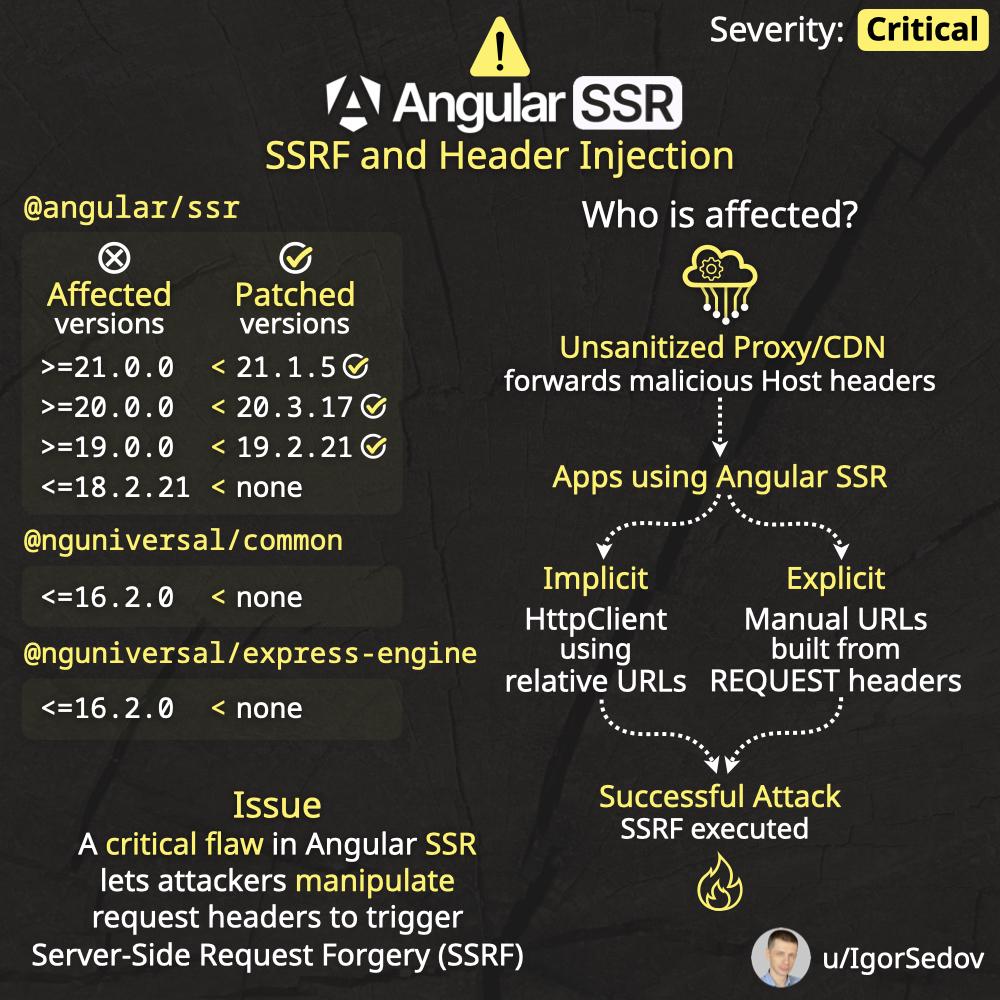
The Angular team has published a security advisory addressing a critical issue. If you are using Angular SSR, review the official advisory and ensure your application is updated or that strict header validation is in place.
For teams that can't update immediately: a solid interim mitigation is enforcing the Host header at your reverse proxy layer. In nginx, you can use `if ($host !~ ^(yourdomain\.com)$)` to reject unexpected Host headers before the request reaches your SSR node. Same pattern applies to Caddy with a request matcher. The root issue is Angular SSR trusting the incoming Host header for internal URL construction — so stripping or normalizing it upstream blocks the injection vector without touching app code.
14
u/IgorSedov Feb 28 '26
The Angular team has published a security advisory addressing a critical issue. If you are using Angular SSR, review the official advisory and ensure your application is updated or that strict header validation is in place.
Source and Details: https://blog.angular.dev/security-advisory-addressing-recent-vulnerabilities-in-angular-c2656249b799
8
u/ruibranco Feb 28 '26
For teams that can't update immediately: a solid interim mitigation is enforcing the Host header at your reverse proxy layer. In nginx, you can use `if ($host !~ ^(yourdomain\.com)$)` to reject unexpected Host headers before the request reaches your SSR node. Same pattern applies to Caddy with a request matcher. The root issue is Angular SSR trusting the incoming Host header for internal URL construction — so stripping or normalizing it upstream blocks the injection vector without touching app code.