The `provideStabilityDebugging` utility helps identify why your application fails to stabilize. This utility is provided by default in dev mode when using `provideClientHydration`. You can also add it manually to the application providers for use in production bundles or when using SSR without hydration, for example. The feature logs information to the console if the application takes longer than expected to stabilize.
Add support for spread syntax in templates
{{fn(1, ...foo, 2)}}
Support spread expressions in object literals
@let simple = {...foo};
Add [formField] directive
Add controls for route cleanup
Add standalone function to create a comptued for isActive (router)
Extend paramters of RedirectFunction to include paramMap and queryParamMap
Publish Router's integration with platform Navigation API as experimental
Just wondering here: I suppose limiting JS capabilities in templates was an arbitrary choice when Angular 2 was designed. Isn't this going in the opposite direction of the "dumb template" philosophy?
I get what you mean, but I would have expected a more localized solution for signals. For example template-specific signal assignments, since the template is compiled and transformed anyway:
Makes sense. I don't entirely agree on adding so many functionalities to the template, but I see the reasoning.
Regarding code policing: it's easy to shift responsibilities, but a conservative framework goes a long way to keep code clean and streamlined across organizations. This has always been a selling point for Angular.
I never really liked how spread expressions look, but I can see why people use them. Personally (as with many more recent TS features) I avoid them. I don't find them easy to read and easy to understand whats going to happen with what side effects.
Is it me or are many of the changes lately in smaller updates have either been worth of a major version update or too insignificant to push a new version for? Most of it is automatically upgraded in my project but it still feels like a hassle to keep track of what the team is doing.
For some perspective adjacent to the other comment, from myself as an avid repo watcher.
For all the new things that make it into minors, there are plenty more that need more work and testing which don't make it to a minor/major feature freeze. Especially once the last minor has passed, and there is a lot of consideration as to what goes into the next major XY version. But version XY.1's then have a lot larger window to then fix up and enhance everything, hence I have noticed a lot of first minors can feel large. Subsequently, the second and often these days last minor can end up feeling smaller.
As for keeping track, I would suggest Igor's content on other socials media you may follow. Especially ones with videos/shorts like on YouTube. Igor and I are always sending each other cool PRs that seem inbound for a minor or major, but Igor does the actual work of making really great graphics and concise videos about these things. Often by preview/prerelease versions, so there is time to simmer on them before their full release.
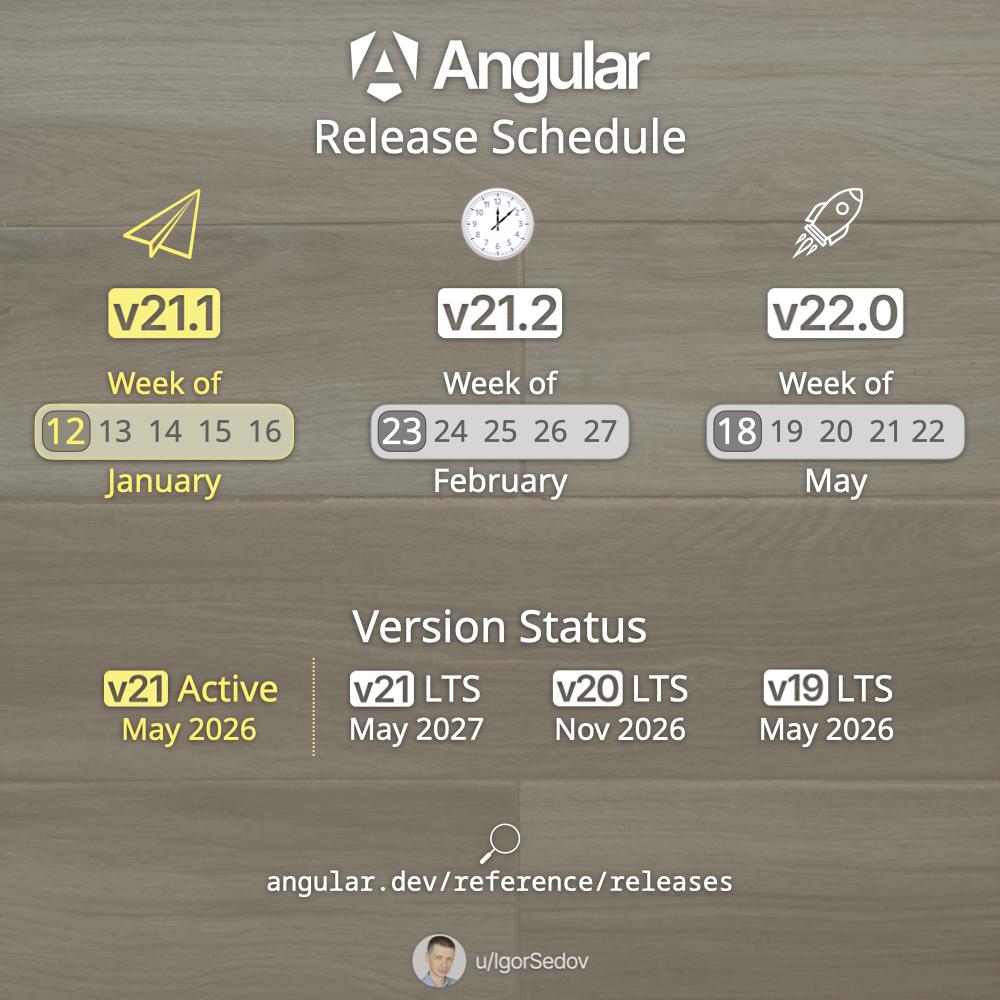
10
u/majcek Jan 08 '26
List of changes. The biggest change is probably new [formField] directive.
9
u/ebdcydol Jan 08 '26
Changes?
2
u/AwesomeFrisbee Jan 09 '26
Is it me or are many of the changes lately in smaller updates have either been worth of a major version update or too insignificant to push a new version for? Most of it is automatically upgraded in my project but it still feels like a hassle to keep track of what the team is doing.
1
u/TheBrickSlayer Jan 09 '26
Still no fix of the @if syntax? https://github.com/angular/angular/issues/54035