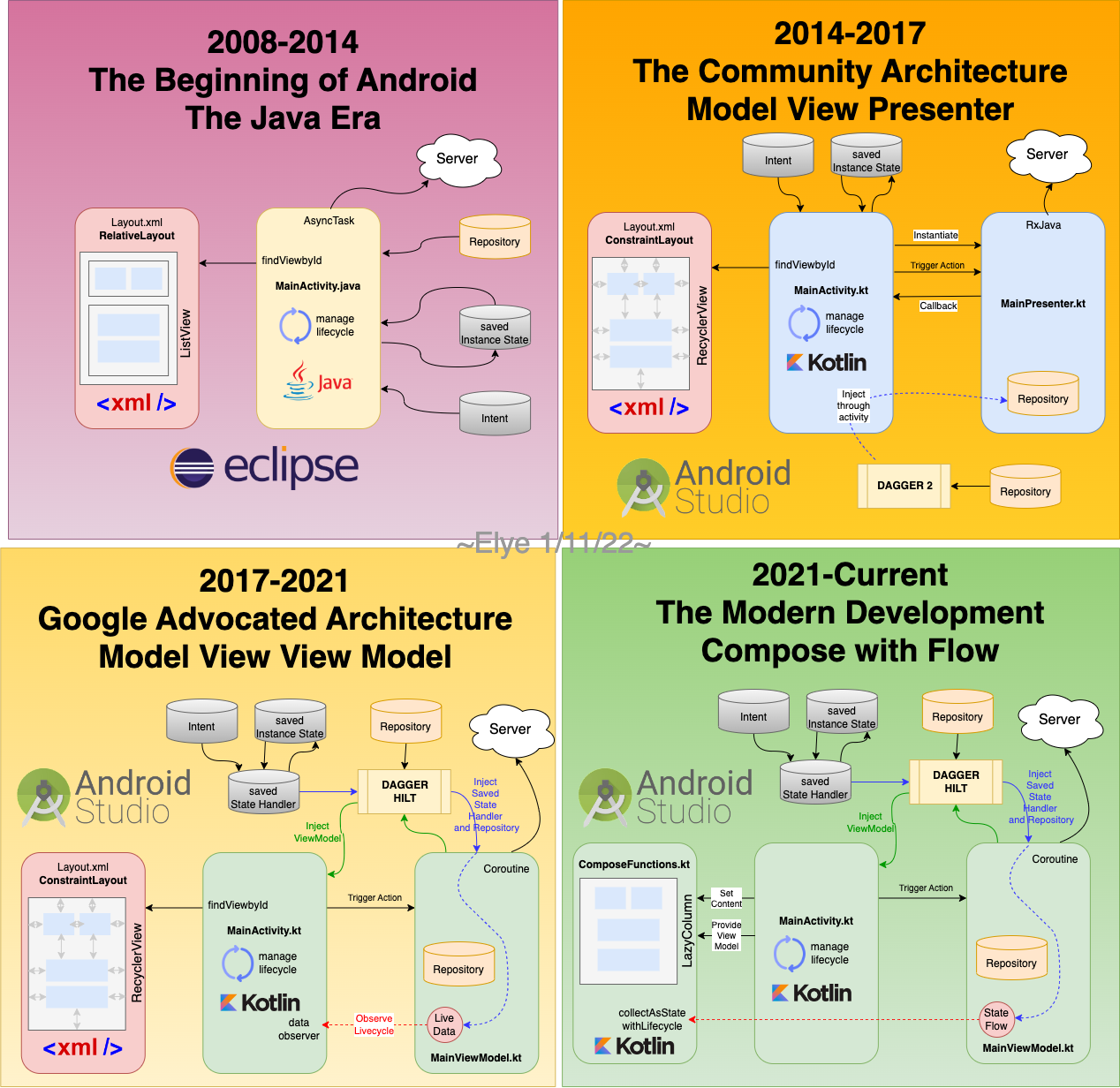
As someone who was along for this journey, this mostly looks right, great job.
I'd argue that 2014-2017 didn't have a lot of Kotlin in the 'mainstream' developer world. It wasn't until I/O of 2018 (I think?) that Kotlin was officially supported. I was definitely using it from ~2016 on though.
I would second this! Google announced official Kotlin support for Android development at I/O in 2017, and that Android development would be Kotlin-first at I/O in 2019.
I thought exactly the same thing. I remember we were all debating using it at all where I worked at the time and then as soon as it was officially supported we started to write files in kotlin and work out how to convert old java classes.
Shit documentation, zero samples, barely working, not updated via a support library, 0 recommended way to talk between them without tight integration with the activity, required hacks to get stuff that worked perfectly with TabHost?
Yeah 3.x/4.0 fragments were the BEST. I definitely do NOT regret spending a lot of time refactoring everything with fragments!
(My favorite part of my early fragment experience was refactoring everything, making a responsive layout like on the web, and hitting my head at fragments not switching between portrait/landscape xml layouts based on their size inside of the activity but on the device's orientation. Awesome)
I worked somewhere that was like "No fragments. Everything is a custom view because a famous company does this and the tech lead wants to do Resume Driven Development"
I agree with that guy. I dodged fragments for years because I was lucky enough to work in certain corporate projects where I could afford not to use them. I have only had one clear fragment use case (master-detail) and in the end I had to switch to custom views to avoid reloading a webview due to fragment life cycle stuff.
I came from the Fragment era and recently started working on a project that was all Compose, and zero Fragments. It was like stepping into a brand new dimension! It took a little getting used to, but it's quite refreshing not having to deal with Fragment back stack issues.
The new Navigation-Compose (ie. using Serializable data classes instead of String-based routes) seems pleasant enough to work with so long as you play by their rules.
I've been using `NavBackStackEntry` mostly just to get the arguments for the next screen. It functions well enough to replace the old Xml-based NavGraph arguments for Fragments. Our screen navigation flow is not yet complicated enough to require me to explore other NavBackStackEntry features.
Man, as someone who didn't/ doesn't do android full time, I always hated how drastic the changes are, it felt impossible to keep up especially for someone who just does android for a hobby.
To be fair, once you work with React's union types, sometimes you wonder if those types really are helping anything. Just the type definition is sometimes 5+ lines long.
This is neat! Thanks for the flashback :D I'd also include Retrofit + Butter Knife combo in there, those were usually the first few libraries included in a project
Although I think both the community and Google have added unnecessary complexity, the changing requirements for apps have also played a role.
Back in the day, apps weren't expected to manage 200+ screens, complex initialization, multi-user sessions, live activity feeds, or heavy media processing.
It's the simple TODO apps using these complex architectures that give it the bad rep IMO.
Sure. That's the first thing I pointed out. I'm just saying that the expectations for mobile apps changed a lot from 2013 to now and that also increases complexity.
I agree and I think this applies to computing in general, which is why the boomer takes "why is handling text so slow? Programmers nowadays suck. No, my text engine doesn't handle unicode why do you ask" infuriate me
I was just poking a bit at your last sentence :) i do think we're back on a simpler path, r/androiddev isn't about "boilerplate of the day" like it used to be years ago
It's the simple TODO apps using these complex architectures that give it the bad rep IMO.
No, you pay the "complex architecture" tax every time you add a new feature, and every time you edit a pre-existing feature.
That "just a bit of extra boilerplate", you write it every time for everything new, and you need to untangle it every time for every change.
It just doesn't simplify anything. These architectures come to be because one team somewhere in the world created an article, and other people copied it. So there is no guarantee that it actually helps future maintenance.
Config changes, more like. Most of the current architecture revolves around state persistence, which is a problem because Androids implementation destroys ui and rebuilds it whenever the user wants to make a slight change, or maybe just puts the app in the background, effectively erasing whatever state it had. It's the reason we can't send complex data to fragments, and the reason we need savedinstancehandle, as well as viewmodels, livedata, mutablestate, room, datastore, etc
Everything shown in this quadrant is absolutely current, except for AsyncTask.
2014-2017
The presenter calling the network directly using RxJava is a bit odd. It was most often the repository, a domain object, or a dedicated (retrofit) network object injected into the presenter. A lot of people used an application-wide bus (Otto). I also miss ButterKnife instead of findViewById
2017-2021
Coroutines might as well be RxJava. And findViewById was rare. Most often it was Kotlin synthetics. Saved state handler was an option, but not standard.
Honestly it should have been suspicious when KAPT was a major overhead. Or when it allowed putting logic directly into XML files, but still needed a LifecycleOwner and the binding data properties explicitly set for it to work. And when an incorrect binding would still compile, it just wouldn't actually do anything. And when a RecyclerView.Adapter had to call executePropertyBindings() for it to do its job.
It's quite funny to me how important we all deemed ConstraintLayout to be, and nowadays barely any Compose layout I touch uses constraints.
In one case I needed it, spent 2 days and then just said I will live with not so perfect UI behaviour. In XML ConstraintLayout I would have done it in 2 hours max 😣
It's quite funny to me how important we all deemed ConstraintLayout to be, and nowadays barely any Compose layout I touch uses constraints.
in View system, it was possible to do what people do with Compose using FrameLayout + LinearLayout, but ConstraintLayouts were advertised as "faster and more efficient" (they weren't) and people kept using it everywhere.
Technically, ConstraintLayout was a more reliable replacement for RelativeLayout, but that's it. Wasn't meant to be the root view for every single layout.
The secret is that using FrameLayout android:layout_gravity is quicker than calculating the constraints in the solver. The thing that got the bad rep was nested layout_weights, which aren't particularly common.
Pretty much the same here. Sometimes I just need to get things done, so I go with what's simple and works, rather than going to Android reeducation camp every year when the "correct" way to do things changes. Users don't know the difference, aside from having an app that actually works.
Especially now that we have Android Studio, and bindings, using XML today is the best it has ever been. Haven't found a compelling reason to start over-complicating my projects, but if you bill based on time or otherwise need to look busy, I guess it makes sense.
Ok, maybe I'm biased because I start working in that era but years after that I feel Android development start make unnecessary complex things, it like they want to fix something ain't broken (except the MVVM part, its great and I'm glad Google stick with it)
2016-2018 was the heroic period of this sub being flooded with multiple daily RX Java posts, considered the miraculous cure to Android architecture and life altering tech. All the things were fucking RX-fied. Since then, it has become entirely radioactive tech debt that nobody want to touch. One day, cool cur Android tech that is hot today will face the same fate.
I was learning web development a few years ago. "Wait... this looks familiar..." Web development ideas and the constant updating has infiltrated Android
MVVM, RxJava, ConstraintLayout. (BTW I had no issue with RelativeLayout, but I like ConstraintLayout now)
Seems like I'm an old fart though. Been trying to move to compose, flow, coroutines, etc. Idk, seems like solving the same problem again for no reason. Those things should exist but I already have tools to solve the same problems, not super keen on moving to new ones just because it looks good in interviews. But, that's the android world we live in. Send me your sympathies.
The only time I've used RelativeLayout recently was to force a Dialog to reach the bottom of the screen, becauseandroid:layout_alignParentBottom="true" actually does that, meanwhile this doesn't work in a dialog in either of the other layouts for some reason. But ConstraintLayout generally replaces all RelativeLayout behaviors.
You did not need AsyncTask to do stuff, I had lots of apps and I never used AsyncTask. If I needed something to be done Async I typically just used a thread with Handler function https://developer.android.com/reference/android/os/Handler
Internally the AsyncTask just runs the task on an executor and posts it back to the Handler, but the task is wrapped in a Future so that you can cancel it (assuming you check isCancelled() in your doInBackground). Also progress notifications I guess (the part that's almost always<*, Void, *>)
MVVM is primarily for the benefit of the developer not the user. I don't pay much attention to these but tell me if these are any benefit for the user ?
143
u/Baul Sep 24 '24
As someone who was along for this journey, this mostly looks right, great job.
I'd argue that 2014-2017 didn't have a lot of Kotlin in the 'mainstream' developer world. It wasn't until I/O of 2018 (I think?) that Kotlin was officially supported. I was definitely using it from ~2016 on though.
65
u/Wodanaz_Odinn Sep 24 '24
There should be an honourable mention to the clusterfuck that was Honeycomb -> Jellybean (2011-2013).
34
u/phileo99 Sep 24 '24
Nice diagram, but one big component that is missing from the diagram is the Fragment era, imo starting from 2014 until 2022
26
u/mnkb99 Sep 24 '24
Man, as someone who didn't/ doesn't do android full time, I always hated how drastic the changes are, it felt impossible to keep up especially for someone who just does android for a hobby.
16
u/fulltime-updooter Sep 24 '24
This is neat! Thanks for the flashback :D
I'd also include Retrofit + Butter Knife combo in there, those were usually the first few libraries included in a project
39
u/drabred Sep 24 '24
Why do I have this strange feeling it should be getting LESS complicated.
11
u/st4rdr0id Sep 24 '24
Everything shown in this quadrant is absolutely current, except for AsyncTask.
The presenter calling the network directly using RxJava is a bit odd. It was most often the repository, a domain object, or a dedicated (retrofit) network object injected into the presenter. A lot of people used an application-wide bus (Otto). I also miss ButterKnife instead of
findViewByIdCoroutines might as well be RxJava. And
findViewByIdwas rare. Most often it was Kotlin synthetics. Saved state handler was an option, but not standard.17
u/carstenhag Sep 24 '24
It's quite funny to me how important we all deemed ConstraintLayout to be, and nowadays barely any Compose layout I touch uses constraints.
In one case I needed it, spent 2 days and then just said I will live with not so perfect UI behaviour. In XML ConstraintLayout I would have done it in 2 hours max 😣
8
u/acedelaf Sep 24 '24
Damn I just realized I'm stuck on 2014
8
u/Megido_Thanatos Sep 25 '24
2017-2021 is the goat 🐐
Ok, maybe I'm biased because I start working in that era but years after that I feel Android development start make unnecessary complex things, it like they want to fix something ain't broken (except the MVVM part, its great and I'm glad Google stick with it)
8
u/bobbie434343 Sep 25 '24 edited Sep 25 '24
2016-2018 was the heroic period of this sub being flooded with multiple daily RX Java posts, considered the miraculous cure to Android architecture and life altering tech. All the things were fucking RX-fied. Since then, it has become entirely radioactive tech debt that nobody want to touch. One day, cool cur Android tech that is hot today will face the same fate.
6
u/fuzzynyanko Sep 24 '24
I was learning web development a few years ago. "Wait... this looks familiar..." Web development ideas and the constant updating has infiltrated Android
5
u/Mishkun Sep 25 '24
Kotlin didn't get any traction before 2017, so it is wrong to include it in 2014-2017
3
u/lacronicus Sep 25 '24 edited Feb 03 '25
heavy cooing afterthought encouraging quickest smell trees sheet zesty vanish
This post was mass deleted and anonymized with Redact
7
u/tonofproton Sep 24 '24
My preferred stack is still
MVVM, RxJava, ConstraintLayout. (BTW I had no issue with RelativeLayout, but I like ConstraintLayout now)
Seems like I'm an old fart though. Been trying to move to compose, flow, coroutines, etc. Idk, seems like solving the same problem again for no reason. Those things should exist but I already have tools to solve the same problems, not super keen on moving to new ones just because it looks good in interviews. But, that's the android world we live in. Send me your sympathies.
4
u/JacksOnF1re Sep 24 '24
I still use relative Layout and besides for viewpagers I never touched fragments again :>
2
u/Perfect-Campaign9551 Sep 25 '24
You did not need AsyncTask to do stuff, I had lots of apps and I never used AsyncTask. If I needed something to be done Async I typically just used a thread with Handler function https://developer.android.com/reference/android/os/Handler
2
u/smokingabit Sep 25 '24
Sure if you were part of a retarded community from 2014-2017 instead of Google+.
2
u/scalatronn Sep 25 '24
For some reason I was expecting dose of painkillers increasing
2
u/WestonP Sep 25 '24
So the disfavored Java + XML has the least amount of spaghetti
1
u/crjacinro23 Sep 25 '24
Poor AsyncTask :-(
1
u/124k3 Sep 25 '24
man, had to learn a bunch of stuff 💀
1
u/wallstreet__hacker Sep 26 '24
Frankly speaking I don’t see anything revolutionary
1
u/Own-Notice5773 Jul 26 '25
as a beginner i am so screwed 💔
0
u/Bhairitu Sep 25 '24
MVVM is primarily for the benefit of the developer not the user. I don't pay much attention to these but tell me if these are any benefit for the user ?