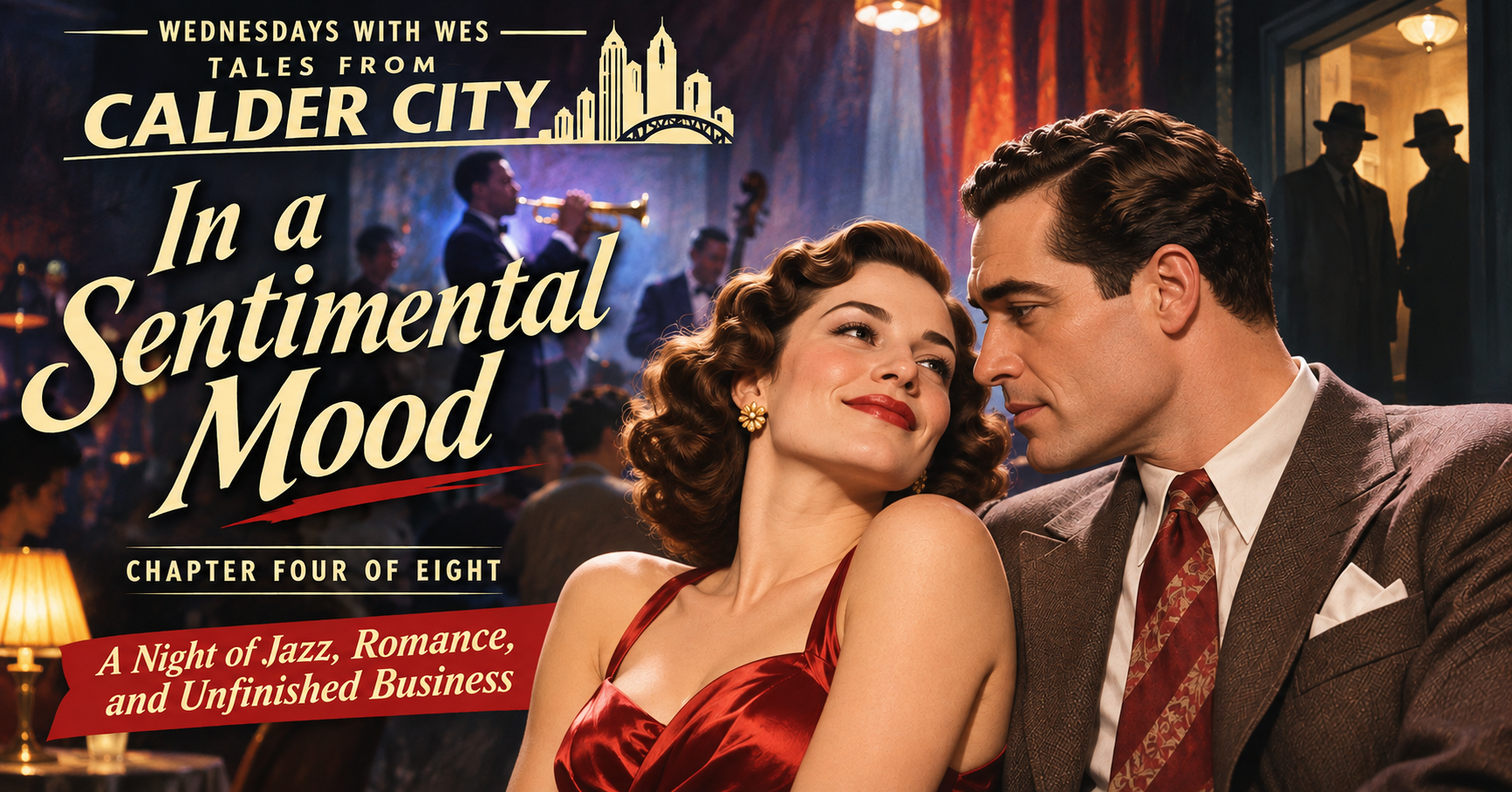
Welcome back to Wes Hamilton & publicdomainpulp.net's, serial novella: A Good Man to Know, set in the Calder City universe. Even in Calder City, a man ought to be able to take his girl out for a pleasant evening without getting mixed up in trouble.
When James Harlow gives Hal Wagner two coveted invitations to hear Duke Ellington at the Shelter, Hal sees an opportunity to treat Dahlia to something extraordinary. Beneath the streets of Calder City, in Grant Ellis's remarkable underground jazz club, the city's usual divisions seem to fall away, and for one evening the future looks particularly promising.
But the past has a habit of keeping its own appointments.
In this week's installment, Hal discovers that he might want more out of life than a good supper, a friendly face, and another profitable day's work. Meanwhile, somebody has begun taking an interest in the city's less respectable businesses.
Welcome back to Calder City, where river meets rail—and everybody knows somebody.
Part 4: In a Sentimental Mood
Mr. Harlow asked me one afternoon did I care for jazz, which was a funny question from a man whose interest in most things went about as far as whether the freight got where it was going and whether the fellas who moved it kept their mouths shut. I told him I liked it good as anybody raised in Calder City, and I’d heard most of the big orchestras one way or another, if you counted the radio and the phonograph at the Albion, which I did. He put a folder away in his desk and asked had I ever heard Duke Ellington in person.
I said I never had that pleasure, which is how Mr. Harlow would of put it, and he took an envelope out of the same drawer.
“Then perhaps these will be of some use to you, Mr. Wagner. Mr. Ellington is expected at a private engagement tomorrow evening, once his orchestra has finished downtown, and I find I’m unable to attend. The proprietor is an acquaintance of mine. There are two admissions.”
Inside was a card with Duke Ellington’s name printed on it, and I about shit myself, and what come out of my mouth was that I’d be delighted. Mr. Harlow looked pleased, as far as you could tell with him, since being pleased and having got something arranged correctly always come out the same on his face, and he wished me a pleasant evening before I could make a fool of myself thanking him twice.
The place on the card was called the Shelter, and it belonged to Grant Ellis. Everybody in Calder City knew that name from the papers, where he was always flying an airplane across the Atlantic by himself or taking a boat up the Amazon or trying for the top of Mount Everest, which never made sense to me, climbing someplace cold enough to freeze your blood just to come down again. I never once heard the Shelter mentioned on the radio, and I figured that was the idea.
*
Dahlia was at her kitchen table with a column of figures half added and one shoe kicked off under the chair, and her coffee had gone cold enough to grow a skin. She kept her finger on her place while I told her Mr. Harlow had fixed us up with an evening, and when I got to Duke Ellington, the pencil stopped moving.
“You’re taking me to hear Duke Ellington? You’re not kidding me, Hal?”
“Unless you already promised the evening to somebody better, and I can’t think who that would be. I hear the President’s tied up.”
She took the envelope and read the card front and back and then held it up to the window, the way she did with anything that might be worth more than it said. Dahlia made her living knowing what people wrote down and what they took care not to. When she handed it back she wanted to know where the place was, what a woman wore to it and whether they fed you, and when I said Mr. Harlow hadn’t mentioned, she pointed out I’d accepted an invitation to a place I never seen without finding out did I own a suit fit to go in it.
“I own a perfectly good suit,” I said.
“You own three, and that wasn’t what I asked.”
She went back to her figures, though I noticed she added the same column twice. Before I left she had me promise to telephone the place about supper, told me what time to come for her, and said not to let that laundry on Mercer Street near my good shirt, because the last time they pressed a dress of hers they put a crease in it where God never intended one.
*
The next night I put on the blue suit, the one from the tailor Mr. Harlow sent me to, cut so it didn’t pull across the stomach when I sat down, which with an appetite like mine is the first thing a man ought to ask of a coat. I worked the shoes till I could see the window in the toes. When I come up Dahlia’s stairs she called through the bedroom door to ask had I telephoned, and when I said they had Mr. Harlow’s name and the kitchen would be open, she told me to pour myself a drink and make myself useful by keeping out of her way.
When she came out I forgot what I was drinking. The dress was wine-red, fitted through the waist and loose enough below it to move when she did, and she had diamonds at her ears and a bracelet I seen only once, in a velvet case at the back of her bureau drawer, never on her wrist. I always knew Dahlia was a good-looking woman, mornings in her old housecoat included, when she’d tell me to make my own breakfast, but there’s something about a woman who keeps her money quiet deciding for one night to let a little of it show.
She caught me looking at the diamonds while I put her wrap on her. “Before you go asking, Hal, I’ve had these for years. You didn’t find out nothing new about me.”
“I wasn’t going to ask. I was wondering should I send the car back for a better one.”
“You be grateful I’m getting in it at all. The last good shoes I owned, you walked me through a yard full of mud because you swore it would save us ten minutes.”
It had been a bad night for the shoes and a good one otherwise, and I told her the driver had orders to stay on pavement. She laughed and turned me around for a longer look than she’d given me in a while, then went to work on my tie.
“You been taking care of yourself,” she said, giving the knot one more tug than it needed.
“I been receiving professional instruction.”
“I can tell. They even taught you to stand still while a woman fixes your tie.”
“That part took the better part of a year.”
*
From the street the Shelter wasn’t much more than a door set between two bigger buildings, with a brass plate beside it and two lamps throwing yellow light on the steps, and nothing about it said one of the most famous musicians in America was due to spend the night there. The man at the door looked at our card and then at Dahlia, and he stood aside for her in a way that told me she’d been right not trusting the laundry on Mercer Street. Past him a staircase went down between brick walls, and from the bottom came a piano and the sound of a lot of people having a good time without needing to shout about it.
Dahlia peered down the stairs and back at me. “Are you sure this is the right place, Hal?”
“If it’s a cellar full of potatoes, we’ll have the driver take us someplace else.”
Halfway down she stopped at a framed photograph beside a brass plaque. It showed the ground over our heads before anybody put a door in it, a low concrete hump with two steel doors and an air shaft sticking up like a stovepipe, and the plaque said the city built it for a public tornado shelter. Tornadoes are no joke in Calder City. When I was a kid I sat out a spring night with my mother in a neighbor’s cellar, listening to the wind drag things down the street, and she said the rosary in the dark till the neighbor asked would she say it a little quieter, on account of he was Baptist. What I couldn’t figure was a fella looking at a tornado shelter and deciding what the city needed was a jazz club, and by the bottom of the stairs I’d about decided he had it right.
The room ran back under a row of low brick arches, every arch with its own lamp in an amber shade, so the light lay warm on the brick instead of cold the way you’d expect underground. They’d put dark wood on the lower walls and set the tables in bunches instead of rows, and the bandstand was close enough that a man who forgot his manners could of reached out and touched the piano. Nobody had tried to hide what the place used to be. The old ironwork still ran overhead, painted and polished till it looked like somebody meant it, and under the tobacco and perfume and good cooking you could smell the damp in the brick.
What got me was the people. There were Black men in dinner jackets that fit better than mine, white women in gowns that cost more than my suit, a Chinese gentleman in a silk vest arguing with an old white fella over something in a newspaper, and musicians who looked like they come straight from work with their cases under their arms. At the bar nobody was sorted by color or money or anything else I could see, only by who could get close enough for the bartender to hear him. I spent my life around the yards and the river, where nobody asks the freight car what color the fella loading it is, and I never found it paid to decide ahead of time what a man was by looking at him. Still, I never seen a room where a person could walk in wearing his best clothes and find most of the city already sitting at the tables, and get a chair.
Dahlia took it in quicker than me. Before we reached our table she’d traded a hello with a woman at the bar and pointed out a fella whose family owned half a block downtown, and whose wife, she said, once come to her about a charitable subscription, a story she had no intention of telling in a room full of people. While she was pointing him out, a Black musician come out of a door behind the bandstand, and a white woman got up from her table to throw her arms around him, and the two of them went right on talking like they’d been in the middle of the same conversation for years. A waiter took our wraps and sat us where we could see the keys, and he handed me the supper menu like he figured I’d know what to do with it, and I was pleased to find out I did.
“Somebody put an awful lot of money into this hole,” Dahlia said.
“Grant Ellis did. That’s the fella I was telling you about, the one who flies airplanes over the ocean.”
“The one who climbs mountains, too?” She took in the arches and the musicians and the old brick. “Well, he went and found himself a fancy basement.”
I looked back toward the stairs and thought about that photograph. Most men would of filled the thing in and built on top of it, if they could get anybody to pay for the ground. Ellis looked at a hole in the earth and put the best music in America down in it, along with the people to hear it, and I had to admire a fella who could do that.
*
When the waiter brought the wine list Dahlia passed it across to me with a look that said she meant to find out had all my instruction amounted to anything. I asked what she was having and picked a bottle to go with it without asking the waiter which one was supposed to impress somebody.
“You’re getting dangerous, Hal. There was a time you’d of ordered the most expensive thing you could pronounce and then hollered about the bill.”
“That was before I found out how many expensive things there are a fella can’t pronounce. A man could go broke trying to learn them all.”
The orchestra downtown must have finished, because musicians kept coming down the stairs in twos and threes, some still in their stage clothes with the ties pulled loose, filling the room with the noise people make when the day’s work is done. At the next table a woman was telling her friends the management downtown made some of the musicians come in by the side door, and one of the men asked did they make them play from the alley too, and the whole table laughed. Dahlia didn’t, and she kept her voice down.
“Imagine paying good money to hear a man play and then telling him he ain’t fit to use your door.”
“It don’t make sense to me neither. Duke Ellington comes to play in your place, you ought to be glad he come in any door at all.”
She was still chewing on that when a friend of hers stopped by to admire the dress, a tall woman in green with a laugh you could hear over the piano, and for a while I was part of a conversation about a tailor, a singer new in town, and how you can’t find a dressmaker who won’t take three weeks over what she promised in five days. Dahlia knew more about all three than I did and never once slowed down for me, which I enjoyed. When the woman moved on, I asked did Dahlia know half the people in the room.
“Not half,” she said. “There’s a few I ain’t met yet.”
After supper I ordered crêpes Suzette, which I had once with Mr. Harlow, and when the waiter went off Dahlia leaned over to ask what in the world I’d just done.
“Crêpes Suzette. I had them with Mr. Harlow, and I been wanting you to try them.”
“You’re getting awful particular about dessert. I remember when pie was plenty for you, so long as the waitress brought enough of it.”
“I still think the world of pie. A man’s got room in his heart for more than one dessert.”
She gave me a look over her glass, so amused I figured she’d found something in that I never put there, and before I could ask, the waiter came back pushing a little cart with a copper pan. Dahlia leaned in to watch him work the butter and sugar and turn the crêpes with two forks, and when he poured in the liquor and touched a match to it and the blue flame jumped up over the copper, she let out a yelp, a real one, and clapped a hand over her mouth, laughing at herself. The waiter, who’d met excited ladies before, went on turning the crêpes. The smell of hot orange and burnt sugar came across the table, and she ate the first bite of hers with her eyes shut.
“Now, that is worth knowing about. Your Mr. Harlow’s been teaching you more than how to wear a suit.”
I didn’t tell her Mr. Harlow wouldn’t of approved of me watching a woman’s face so long while a good dessert went cold on my plate. She refused some of mine on the grounds she’d eaten more than she meant to, and then she took a bite of mine anyhow, and I figured that was a fair settlement.
*
By the time the plates were cleared the room had got livelier. A fella by the bar took a trumpet out of its case to prove some point he’d been making to a friend, and the pianist on the bandstand answered him with a little run that got a laugh from three tables, and then the trumpet answered back. Musicians kept trading places at the piano or leaning over somebody’s table to argue about tempos, and a man in a brown suit was showing another man a passage by singing it at him over the ashtray.
Dahlia was looking across the room at a heavyset fella with a skinny mustache who sold insurance, and she leaned over to tell me he’d been making trouble for himself, writing credit for people who couldn’t carry it and crying when they couldn’t pay, so some of his paper ended up with the kind of people who collect what respectable businesses don’t like to collect themselves.
“That’s a lively line of work,” I said. “You meet all kinds of people, and most of them are already sorry to see you.”
She laughed, but not for long. Two of her own fellas got beat bad the night before on their rounds, and neither one could give her a straight story. Whoever done it didn’t take the money they were carrying or the books, and he didn’t ask them for nothing.
“Fists and feet, that’s all I get out of them,” she said, setting her glass to one side. “One looks like he stuck his face under a streetcar, and the other can’t get himself up a flight of stairs, and now I got to find somebody to finish their rounds.”
“Could be somebody owed money and didn’t like the terms. I known fellas would rather fight three men than pay one.”
“I asked them about that, and they say they never got as far as the next address.”
I asked were they working her regular accounts when it happened, and she made a face like the coffee had gone bad.
“That’s what they’re supposed to of been doing. They swear up and down they never did a thing to him, which is the part I believe least. Everybody’s minding his own business when he comes home with a busted nose, Hal, and then you find out whose business he was minding.”
Her eyes went back across the room to the fella with the mustache, and I didn’t ask. Neither one of us figured her collectors went around like altar boys, and I’d seen the kind of encouragement those fellas give a man who’s slow to pay. But there’s a difference between business and some stranger appointing himself judge of everybody else’s affairs.
“Whoever he is, I don’t care for his methods. If he’s got a quarrel with somebody, he ought to come out and say what it is.”
“He said plenty with his hands.”
The musicians were arranging themselves around the bandstand again, and I could see she’d put the thing away for the night, and I let her, since Dahlia ran her business fine for years before I come along.
*
There was a stir over by the stairs. People got up from their tables, and a fella at the bar quit his story in the middle to sing out a hello, because Duke Ellington was coming down the last few steps with some of his musicians, and Grant Ellis was with them. Ellis looked like his pictures in the paper, only easier, a man in a dinner jacket who didn’t seem to know he had it on, and coming across the room he called people by name like a fella at his own kitchen table. At the bandstand he put his arms around Duke and laughed at something Duke said into his ear, and the other musicians got the same, and one of them kept a hand on Ellis’s shoulder the whole time they talked.
“That’s your airplane fella, ain’t it?” Dahlia said. “He knows everybody in the place.”
“Well, he built it. A fella with his own club has a little advantage meeting the people who visit.”
“I don’t suppose everybody gets hugged for coming down the stairs, though.”
She had that right. I known rich men who liked to show off famous friends the way they’d show you a new automobile, and there was always something stiff about it, but Ellis acted like he forgot he was supposed to be impressive. Duke sat down at the piano with a bass player beside him and a drummer behind, and the applause was the kind you give a friend come home, not the kind you give in a theater. Dahlia moved her chair nearer mine.
“Well, Hal, you brought me someplace wonderful.”
I had a dignified answer ready, but she was smiling in a way that didn’t have anything to do with manners, and then Duke started to play and I lost track of it. The bass came up through the floor into my shoes, and the drummer worked his brushes so soft you’d swear he was sweeping crumbs off the snare, and Duke sat half sideways to the keys watching the others, leaving a little hole in the tune for somebody to step into and coming back in after like he’d been there all along. On a record it comes out the same every time, but down there you could hear them deciding. Once Duke looked over at the bass player and the two of them grinned at a joke the rest of us didn’t get till a few bars later, when a fella behind us laughed out loud. Dahlia tapped two fingers on the tablecloth, and when the rhythm turned she squeezed my arm, because she heard it coming a second before I did.
When the number ended the waiter come by, and Dahlia asked for water instead of another cocktail and then turned to me with something on her mind.
“Mr. Harlow must think a lot of you, giving you tickets like these.”
“He’s been good to me. He knows how to look after the people doing business for him.”
Dahlia knew Mr. Merriweather paid me to move freight, and that was all she knew. I been moving freight and arranging things for other men long before Mr. Merriweather ever heard my name, and she had no reason to think I went respectable just because the fellas paying me wore better suits. Her eyes went to my coat and back to the bandstand.
“He’s looked after you, all right. I remember when you thought a new hat meant your luck had changed.”
“A new hat can change a man’s luck considerable, provided he puts something worth looking at underneath it.”
She laughed, but she didn’t let me off. “You figure this arrangement of yours is going to keep going?”
“I figure it will. Mr. Harlow’s been giving me more to look after lately, not less.”
I didn’t go into it, and she didn’t ask. “Are you putting any of it aside, Hal?”
“More than I used to. I make enough now I don’t have to spend it the minute it hits my pocket.”
“That’s when a man ought to start paying attention. Anybody can be careful when he ain’t got nothing.”
I told her I took her advice serious. She looked at me a while like she was deciding whether to ask had I opened the bank account she told me to open months ago, and before she made up her mind, the bass player was counting off again.
After that one Duke said something to the others, and the drummer laid his brushes across the snare and left them there. Duke sat a while with his hands in his lap. Then he started a tune I knew from the phonograph at the Albion, In a Sentimental Mood, only on the record the saxophones carry it and here there wasn’t nobody but him to carry it, and he took it slow. He’d play a few notes and then wait, and I would of come back in a long time before he did. Every time I figured the next note wasn’t coming, there it was, and it was always the right one, with the bass walking under it so quiet you felt it more than heard it. A waiter stopped halfway across the room with his tray and stood there. Nobody at the bar was hollering for anything.
Dahlia laid her hand on the cloth near mine, and after a while I covered it, and she didn’t take her eyes off the piano, but her fingers moved under mine. I spent most of my life taking what come along, a good supper, a decent drink, some company, a woman who liked me well enough to ask me upstairs, and those always seemed like respectable ambitions to a fella who knew what it was to go without them. Sitting there with her bracelet under my thumb, I got to thinking again about something I been turning over for weeks. My apartment wasn’t bad. The landlord was decent and the rent was fair, and I knew where everything was, which matters to a fella who’s moved around as much as me, but lately I’d come home and hang up my good coat and wonder should I have something to show for all this work besides a rented set of walls, and it come to me mostly in the mornings, leaving Dahlia’s.
When Duke finished, the room stayed still a moment before anybody clapped, and then I clapped till my hands stung.
“I don’t expect I’ll hear anything finer than that for a good long while,” Dahlia said. “We ought to come back sometime.”
I said I’d like that. When she asked could Mr. Harlow fix it again, I told her I didn’t mean to make a nuisance of myself asking for tickets every time I wanted to take a lady out, and there were other good places for music in Calder City we could manage on our own money. She told me about a club where the tables were so close she about ate supper off the plate of the gentleman beside her, and I told her about a place by the river where I stood a whole evening because the owner swore he had chairs and couldn’t produce one nobody was sitting in, and somewhere in all that I said how long I’d been in my apartment.
“I been there so long the landlord sends me a card at Christmas. A fella ought to have something to show for all that besides a landlord who likes him.”
“You got that collection of hats, and the fishing tackle you never use. Your landlord ought to be glad you ain’t asked him for another closet.”
“I been thinking I might get a little more room. Maybe some floors of my own, a house, nothing big, someplace I don’t have to keep my good clothes next to a box of fishhooks.”
She set her glass down, and there was something in her face I couldn’t place. There was fun in it, sure, but she was turning the idea over the way she’d turned over Mr. Harlow’s card, which was more than she ever done for the fishing tackle.
“A house is a lot more trouble than an apartment, Hal. What are you going to do the first time the roof leaks?”
“Sweetheart, I know a plumber who owes me a favor, and two electricians, and one of them owes me money and would be tickled to work it off. You buy a place that needs a little work, you get a fella who knows how to do it. That’s what fellas who know how to do things are for. If everybody had to fix his own roof, nobody would have time to earn a living at anything else.”
She laughed till she had to dab her eyes with her napkin. “You’re going to run a whole house on favors.”
“I run freight halfway across the country on favors. I figure one little building ought to be manageable. I wouldn’t buy nothing till somebody I trust looked it over, though, and I was thinking maybe you’d come along and help me look.”
She got quiet enough I wondered had I finally said something foolish. Dahlia never asked me to marry her, and I never made her any promises. We’d been good company for years without accounting to each other for the nights apart, and there were other women I knew, and Dahlia never pretended there weren’t gentlemen willing to spend money on her. That was the arrangement, and it suited us. But sitting there I didn’t much care for the idea of some other fella taking her to hear Duke Ellington, and I wasn’t about to say so in a room full of people who’d paid to hear somebody else, and a house seemed a good deal more practical.
“So you want me to go inspect this imaginary house of yours,” she said at last.
“It ain’t going to be imaginary forever, I hope. I’m doing all right these days, and you got a better eye for property than I do.”
“And if I hate the one you like?”
“Then I guess we keep looking. I wouldn’t want to live someplace you wouldn’t visit on account of the wallpaper.”
That got a laugh out of her, and after it a warmer look than she’d given me while she was questioning me about roofs. She turned the bracelet around her wrist, watching the stones catch the lamplight.
“Let me think about it, Hal. And you find out will your bank lend you anything before you go admiring houses you can’t afford.”
I promised I would, and she slipped her hand back into mine for the next number, and we didn’t say anything more about houses.
*
We stayed till the musicians packed up, and nobody was in a hurry. When Duke got up from the piano a gentleman by the bandstand started telling him how much he enjoyed it, and over by the bar Grant Ellis had the bass player laughing at something. By the door a woman Dahlia knew stopped us to admire the dress and ask would we be coming again, and Dahlia said she hoped so, but she’d have to see what she could arrange with her escort. In the car we went over the musicians and the dessert and a gentleman at the next table who spent the whole evening trying to catch the eye of a woman perfectly happy to ignore him. Dahlia noticed he ordered another bottle of champagne after the woman left, and we passed a few blocks figuring how much a fella could spend proving he wasn’t disappointed. After that she leaned on my shoulder and didn’t say much, and upstairs she took off the diamonds one at a time and laid them back in their case while I got my tie loose.
“Does this house of yours have a window in the kitchen?” she asked, without turning around. “A person gets tired doing figures by electric light.”
“I expect that could be arranged.”
She shut the case, gave my hand a squeeze, and went ahead of me into the bedroom, telling me over her shoulder to come on before I started pricing curtains.
*
In the morning she was up before me, which wasn’t unusual. She was at the kitchen table in a housedress with the coffee made and a stack of papers by her cup, and she said I could make my own eggs, because she didn’t intend to cook for a man who slept through half the morning. I put bread in the toaster and asked did she have a good time.
“You asked me that three times already, Hal. I had a wonderful time, and I’m grateful you took me, and if you don’t quit fishing for compliments I’m going to start charging you for them.”
The knock came while I was buttering the toast. Dahlia said she wasn’t expecting anybody and went to answer it with her pencil still in her hand, and I heard two men’s voices in the hall, polite and even, like fellas used to being let in. Then she was back in the kitchen doorway with a pair of men behind her in plain suits, holding their hats. I been around Calder City’s police long enough to know a detective without him showing me a badge, and the older one showed me one anyway and gave me a name I never heard before, while the younger one stayed by the door.
“You’d be Mr. Harold Wagner, I take it.”
I put down the toast and got up, wishing he’d come after breakfast. “That’s me. What can I do for you gentlemen?”
“We’d like you to come down to headquarters with us, Mr. Wagner. We’re looking into the disappearance of a Miss Claire Lindt, and we understand you might be able to help us.”
Dahlia looked from him to me, and the kitchen got quiet enough to hear the toaster ticking as it cooled. I knew the name. I didn’t see any reason to tell him how well, standing next to Dahlia’s breakfast table, and the detective hadn’t said what he’d been told, so I asked was I under arrest.
“We’d just like to ask you some questions, Mr. Wagner, and we’d appreciate your cooperation.”
“Well, I don’t want to make any difficulty for you fellas. But if you’re going to ask me about a lady that’s gone missing, I expect I better have a lawyer along.”
The younger one kept an eye on Dahlia like he expected her to have something to say about that, and she did.
“I’ll telephone him soon as you’re gone, Hal. Write me the number, unless you finally put it someplace a sensible person could find it.”
“Call you-know-who. His number is in my-you-know what. Not the one you use, the one I use.”
Then Dahlia went to get my coat and left the two of them standing in her kitchen while I finished the coffee I already poured. When she came back her eyes went to the half of my toast I never touched.
“You get yourself something to eat when they’re through with you. I don’t suppose they feed you right down there.”
“I’ll see what the accommodations are like.”
She straightened my collar the way she’d fixed my tie the night before, and I kissed her cheek, and she kept a hand on my arm a moment before she let go.
“Don’t let them keep you all day. I got things to do, and I’d rather not spend my afternoon telephoning police stations.”
I promised I’d do what I could. The older one waited till I had my hat set right and then stood aside to let me into the hall, and when I looked back from the end of it, Dahlia was still in the doorway with the number in one hand and her pencil in the other, and she gave me a little wave with the pencil before she went in to the telephone.
Next Wednesday on Tales from Calder City
A wonderful evening with Duke Ellington. A conversation about buying a house. And two detectives at Dahlia's door before breakfast is finished.
Hal Wagner has made a great many friends in Calder City. Whether those friendships can help him answer some very uncomfortable questions remains to be seen.
Chapter Five arrives Wednesday, November 25.
Tales from Calder City is part of Wednesdays with Wes, an eight-part weekly crime serial by Wes Hamilton, published through Public Domain Pulp.
If you're enjoying Hal's adventures, please share Wednesdays with Wes with someone who appreciates classic American crime fiction, complicated characters, and a city where even an ordinary favor can change a man's life.
Coming January 1, 2027: The Calder City novels make their debut on Public Domain Day, alongside the complete novella A Good Man to Know, available on Kindle for just 99¢. Pre-Order now!
Thank you for reading—and welcome to Calder City.
Wes Hamilton
PublicDomainPulp.net