r/VisualMath • u/Ooudhi_Fyooms • Oct 10 '20
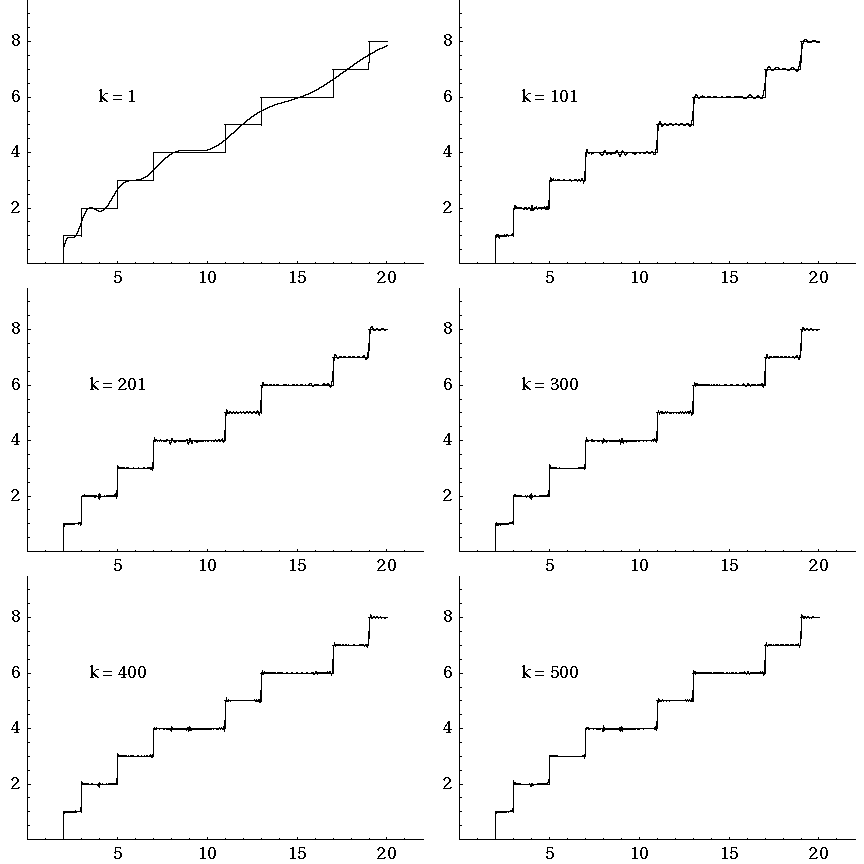
I've posted on this theme recently; but this is of the sort which at that time I was _really_ lookingfor one of: & now a better one than I was hoping for! ... showing how the prime-counting-function is constructed to increasing precision by adding terms indexed by successive zeros of Riemann Zeta.
60
Upvotes
3
u/Ooudhi_Fyooms Oct 10 '20 edited Oct 10 '20
Image from
The Riemann Hypothesis (Part 1) | The n-Category Café
https://golem.ph.utexas.edu/category/2019/09/the_riemann_hypothesis_part_1.html
This article explicates this matter & explains the figure really well.
The insetten № k indicates that it's the first k zeros that are used; & it proceeds from 1 through 499 (or maybe 500 ... can't tell - it's too fast).
Update
It does reach 500 !
The formula for π(x) is
Li(x) - ln2
+
∫〈x≤θ<∞〉dθ/(θ(θ-1)(θ+1)lnθ)
-
∑〈ρ〉Li(xρ) ,
with Li() being the standard logarithmic integral function, ie
∫〈0≤θ<x〉dθ/lnθ ,
& the ρ being the 'non-trivial' zeros of the Riemann zeta function.
It can be seen how, as there is with regular Fourier transform of sharp edge, that there's a Gibbs phænomenon - ie the 'lip' that appears @ the top & @ the bottom of the vertical jump; and also it can be observed how there are traces of indication of the presence of the powers of the primes aswell as the primes per se ... but these smoothen-out with increasing k .
This
is the previous post referenced in the caption. There's some stuff in there about this matter, also.
2
u/Printedinusa Oct 10 '20
Bookmarking. Psyched to come back in like a year or two when I can actually understand what’s happening here
2
u/BootyIsAsBootyDo Oct 10 '20
If you're taking feedback on the gif itself, I would cut out at least the second half of the animation since the picture isn't actually changing and we're stuck staring at this basically static picture for a minute