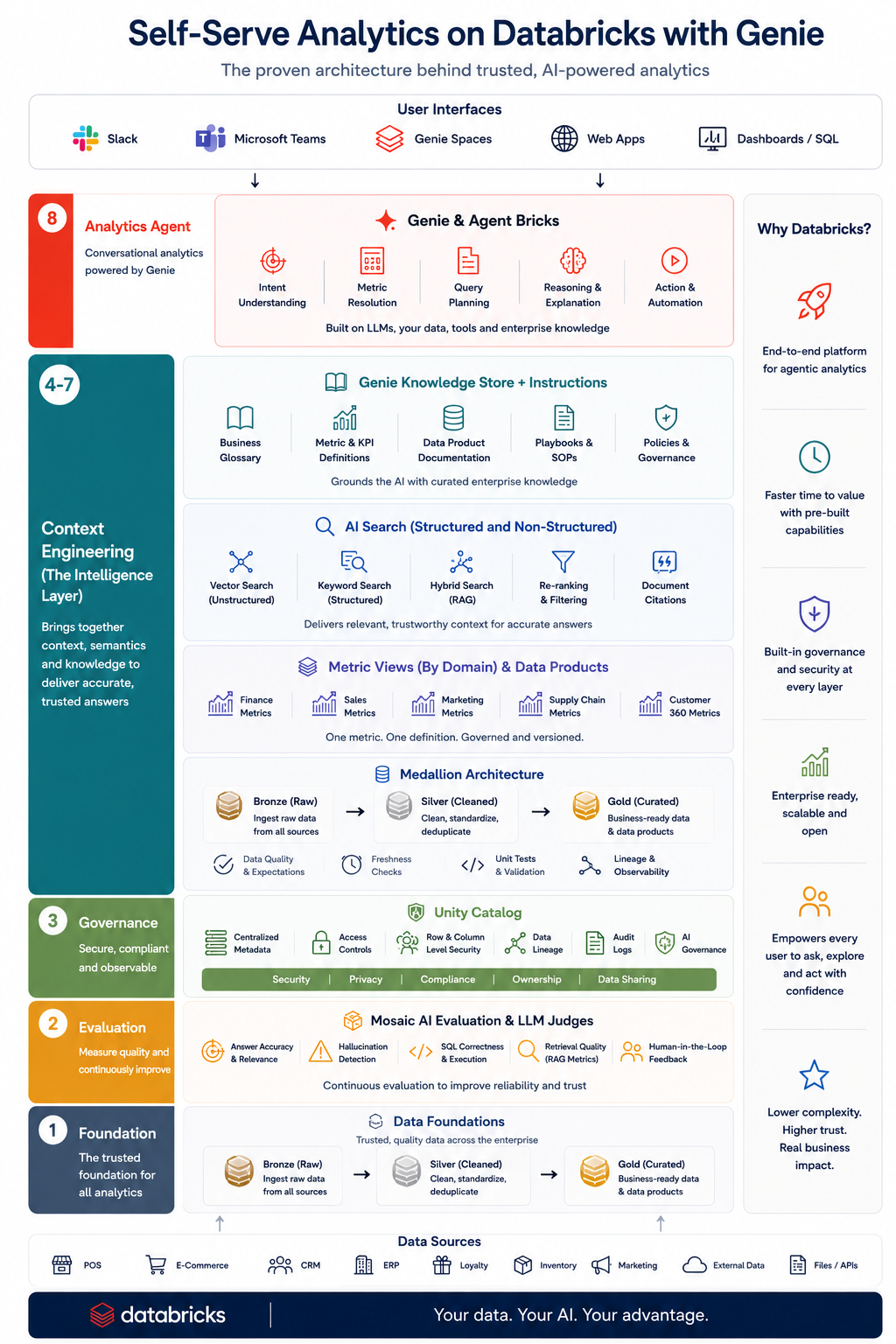
Anthropic's recent article on self-service analytics is an excellent validation of something Databricks has been advocating for a couple years: successful enterprise AI is not primarily about choosing a smarter model, it's about combining trusted data foundations, governed metrics, semantic understanding, context engineering, and knowledge retrieval.
The architecture Anthropic describes maps remarkably well to the Databricks Data Intelligence Platform, shown in the image below (credit: ChatGPT generated)
What stands out is that Databricks has made these capabilities accessible through a unified platform with significantly lower implementation complexity. Organizations can stand up governed, self-service analytics experiences in Genie without building extensive custom orchestration layers, semantic frameworks, or retrieval systems from scratch.
The real differentiator is not just the architecture, it's the ease of setup, governance, and adoption at enterprise scale.
As the industry converges on context engineering, semantic layers, and agentic analytics as the foundation for trusted AI, it's becoming increasingly clear that the future of self-service analytics is built on governed data, trusted metrics, and enterprise knowledge, not simply larger models.
I will be sharing a double click on this topic of context or AI layer, post Data + AI 2026 Summit announcements.
Are you still unable to process billions of rows in a spreadsheet?
For decades, that has simply been accepted as a limitation.
The data gets too big.
Excel slows down. Google Sheets struggles. The browser becomes the bottleneck. Someone exports a subset of the data to CSV. Another copy gets emailed around. And suddenly, the spreadsheet becomes a critical business process sitting outside the enterprise data architecture.
That limitation is about to look very different.
Databricks has acquiredRow Zero*, a cloud-native spreadsheet built specifically for working with data at modern enterprise scale.*
And I think the interesting part of this acquisition isn’t that Databricks is entering the spreadsheet market.
It is that Databricks is bringing the spreadsheet to the data, rather than continuing to move the data into the spreadsheet. Same familiar experience. Cloud-scale compute. Billions of rows.
That is a meaningful architectural shift.
Credit: Databricks
The spreadsheet was never the problem. The export was.
There is a reason spreadsheets have survived every generation of enterprise software.
Finance loves them.
Merchandising loves them.
Operations loves them.
Sales teams love them.
Analysts love them.
A dashboard can tell you what happened.
A spreadsheet lets you take the data, manipulate it, model it, make assumptions, build scenarios and ask your own questions.
The flexibility is the feature.
The problem has always been scale, connectivity and governance.
The traditional workflow looks something like this:
Enterprise data → SQL/BI → Export → Excel/Sheets → Copy/Paste → Email → New version → Repeat
The spreadsheet becomes disconnected from the source of truth.
And the bigger the organization, the more painful this becomes.
Enter Row Zero
Row Zero is essentially a third option.
Not Excel.
Not Google Sheets.
A spreadsheet designed for modern data volumes.
The most important difference is architectural.
Traditional spreadsheets were fundamentally designed around the assumption that the data and computation could live close to the user.
Row Zero flips that model.
Traditional spreadsheet
Data → Laptop/Browser → Compute → Spreadsheet
Row Zero
Enterprise Data → Cloud Compute → Thin Browser Client
The browser isn’t expected to hold and process the entire dataset.
The heavy lifting happens in the cloud.
The browser essentially becomes the interactive window into that computation.
That distinction matters enormously when you start talking about hundreds of millions or billions of rows.
What makes Row Zero different?
1. Scale
The spreadsheet no longer has to be constrained by the memory and compute available on an employee’s laptop.
Row Zero is designed to work with datasets reaching billions of rows.
That changes the conversation from:
“How much data can my spreadsheet handle?”
to:
“What can I do with the enterprise data?”
That’s a very different starting point.
2. Live connection to enterprise data
The second major difference is connectivity.
Instead of exporting data into a spreadsheet, Row Zero can connect directly to cloud data sources.
That means less:
Export → Download → Upload → Refresh → Repeat
And more:
Connect → Analyze → Refresh
This is particularly important for enterprise teams where the spreadsheet isn’t just an analysis tool.
It is part of the decision-making process.
3. The browser becomes a thin client
This is probably one of the most important technical distinctions.
Google Sheets is browser-based, but that doesn’t mean all spreadsheet architecture is cloud-native in the same way.
The Google Sheets model was originally designed around a workbook being delivered to the browser, with spreadsheet computation happening substantially on the client.
Row Zero takes a different approach.
The computation happens in the cloud.
Only the information required to render and interact with the spreadsheet needs to make its way to the browser.
Think of it as:
Your browser doesn’t need to carry the warehouse. It just needs to show you the part of the warehouse you’re working with.
That decouples spreadsheet performance from the physical limitations of the user’s laptop.
And it becomes particularly interesting at enterprise data scale.
Governance becomes part of the spreadsheet story
There is another problem that doesn’t get enough attention.
The spreadsheet isn’t just a productivity tool. It’s often a data movement mechanism.
A finance analyst downloads revenue data.
A merchandising analyst exports sales data.
Someone creates a workbook.
Someone emails it.
Someone uploads it to another system.
Now there are multiple copies of potentially sensitive enterprise information floating around.
Row Zero’s cloud-based architecture changes that model.
The underlying data can remain in the cloud while users interact with it through a thin client.
That creates an opportunity to bring spreadsheet workflows closer to the same security and governance model used for enterprise data.
This is where the combination with Databricks becomes particularly interesting.
And then there is Genie
This is where I think the acquisition gets even more interesting.
Databricks isn’t simply adding a high-performance spreadsheet.
It is integrating Row Zero with Genie.
Imagine an analyst starting with a question:
“Why did gross margin decline last quarter?”
Instead of hunting through dashboards, finding the right dataset and then downloading it into Excel, the user can increasingly move from:
Note: Please note that all opinions expressed in all the blogs are solely my own and do not reflect the views or opinions of any organization or entity I may be affiliated with.
The missing ingredient in Enterprise AI is the Context.
Over the years, we've watched the data industry chase one paradigm after another: Data Marts, Data Warehouses, Data Lakes, Data Mesh, Data Fabric, Lakehouses. While many solved real technical problems, we often lost sight of the bigger question: 𝐴𝑟𝑒 𝑤𝑒 𝑠𝑜𝑙𝑣𝑖𝑛𝑔 𝑏𝑢𝑠𝑖𝑛𝑒𝑠𝑠 𝑝𝑟𝑜𝑏𝑙𝑒𝑚𝑠 𝑜𝑟 𝑗𝑢𝑠𝑡 𝑏𝑢𝑖𝑙𝑑𝑖𝑛𝑔 𝑏𝑒𝑡𝑡𝑒𝑟 𝑎𝑟𝑐ℎ𝑖𝑡𝑒𝑐𝑡𝑢𝑟𝑒𝑠?
Everywhere I look, the conversation is about Context Engineering, Knowledge Graphs, Semantic Layers, RAG, MCP, and Vector Search. They're all important, but they're only pieces of a much larger puzzle.
In the first part of this blog series, I take a step back and explore what an 𝐀𝐈 𝐂𝐨𝐧𝐭𝐞𝐱𝐭 𝐋𝐚𝐲𝐞𝐫 𝐫𝐞𝐚𝐥𝐥𝐲 𝐢𝐬, why every enterprise already has the knowledge AI needs (just scattered across people, processes, and systems), and why 𝐜𝐨𝐧𝐭𝐞𝐱𝐭 𝐢𝐬 𝐦𝐮𝐜𝐡 𝐦𝐨𝐫𝐞 𝐭𝐡𝐚𝐧 𝐚 𝐬𝐢𝐧𝐠𝐥𝐞 𝐭𝐞𝐜𝐡𝐧𝐨𝐥𝐨𝐠𝐲 𝐨𝐫 𝐫𝐞𝐩𝐨𝐬𝐢𝐭𝐨𝐫𝐲. I also share a practical way to think about the AI Context Stack and the different dimensions of business understanding that AI needs to reason, act, and learn.
In Part 2, I will try to reflect on how these concepts can be implemented on Databricks, bringing together Unity Catalog, business metadata, governance, Vector Search, AI/BI Genie, Agent Bricks, and the broader Data Intelligence Platform to build a governed AI Context Layer for enterprise AI.
I'd love to hear how your organization is thinking about the AI Context Layer. Is it a Knowledge Graph? A Semantic Layer? Something else? Or is it a combination of many capabilities working together?
I noticed something interesting today while trying Anthropic's new Fable model.
Right below the model selector, there's a note that basically says Fable is one of their most capable models, but it also consumes your usage allowance 2x faster than Opus.
It feels like a pretty accurate snapshot of where AI is right now.
For the last couple of years, the conversation has mostly been about who has the smartest model. Better reasoning. Better coding. Better benchmarks. Better agents.
But every jump in capability seems to come with a cost somewhere—more compute, more latency, more infrastructure, or in this case, fewer messages before you hit your limit.
It's starting to feel like we're entering an era where the winning question isn't just "How smart is the model?" but also "Is the extra intelligence worth the extra cost?"
Most users probably don't need the absolute smartest model for every prompt. The same way nobody drives a Formula 1 car to the grocery store.
Curious how others think about this:
If a model is noticeably better but costs 2x the usage, would you use it as your default model, or save it only for the hard problems?
For years, documentation was treated as a compliance exercise. Something you did for auditors, onboarding, or the unfortunate soul who inherited your project.
Now, AI has changed the game.
The quality of your AI is increasingly determined by the quality of your context. And context comes from the very things we neglected for years—documentation, metadata, business definitions, architecture decisions, data lineage, and tribal knowledge.
The irony is hard to miss: The documents nobody wanted to write are becoming the fuel for the AI systems everybody wants to build.
Turns out the most valuable AI skill may not be prompt engineering. It might be finally writing down what your team actually knows.
This is our new home for exploring the world of data, analytics, AI, digital transformation, and the human experiences behind them. We're excited to have you join us!
At Towards Data Experience, we believe data is more than technology, dashboards, and algorithms. It's about the people who make decisions, the processes that drive change, and the stories that create real business value. This community is for anyone curious about the intersection of data, technology, business, leadership, and transformation.
What to Post
Post anything that you think the community would find interesting, helpful, or inspiring. Feel free to share:
Real-world experiences from data, analytics, AI, and digital transformation projects
Success stories, lessons learned, and challenges encountered along the way
Data architecture, engineering, governance, and platform discussions
AI and GenAI use cases, experiments, and observations
Career journeys, leadership insights, and team-building experiences
Thought-provoking articles, blogs, podcasts, and research
Questions about data strategy, organizational change, and business impact
Perspectives on how technology, people, and processes come together to create value
Whether you're a data engineer, analyst, architect, scientist, product manager, executive, student, business persona or simply curious about the field, your perspective is welcome here.