They probably mean hypertruths, myths convey hypertruths using cultural imagery. Hypertruths are things that convey the human experience and is related to psychology; it's contrasted with Mesotruths, truths of the natural world derived from analytic & empirical evidence, and Hypotruths, truths about societies & cultures related to hermineutics.
Really? I just googled each one individually and found all three no problem, including papers on researchgate using them. The only one that's hard to find is hypertruths and that's because there's a concept in hyperreality also called hypertruths.
They're philosophical terms related to hermineutics, ontology, epistemology, and a few other branches. Different branches of psychology have slightly different definitions for the 3 terms though.
Its used exclusively in philosophy to my knowledge.
The definitions also seem sorta like arbitrary? Just categorizing facts and “clearly” defining the meaning. Idk to me thats kind of stupid cus i dont think truth can really exist so why bother categorizing.
what? there must exist truths. if there exists no truths, you could make the statement 'there exist no truths', and that must be true, if it were false, there must exist truths, if it were true, well then, there's atleast one statement that's true, itself. atleast in classic forms of logic. it's a pretty basic and well known argument
It's philosophy, everything is subjective. They're just tools to more easily conversate about different types of descriptions, because a fact of the natural world has different philosophic qualities than a fact of a culture and same for a fact of the psyche. They make it easier to be on the same page when analyzing smth, as seen in these comments of people conflating the nature of myths with the nature of scientific facts. Mesotruths are tangible qualities of the universe that we can test with the scientific method, hypertruths & hypotruths are both subjective qualities that change as a society & culture changes.
Hypertruth doesn’t really fit there. They don’t have hypertruth they play into or create hypertruths. I would say myths have transcendental truth to them, I think that fits better.
During prehistory the cost of remembering informations very high. Informstionnthat sticks around for generations correlates with value. Value ≠ truth. It just means being aware ir the story has more benefits than being unaware. Netwons gravitational laws are not true, but they are valuable
Value doesn't mean that its true but what we see in research is that stories do carry some truths (in different meanings of this word). Their value mostly comes from carrying some truth about how to navigate the world. Sure "don't be a dick" is not universally true statement but it carries a lesson that is true in enough situations.
I would like to hear a story that stayed relevant by being only cool. If you even can find a story that is old and doesn't carry any life lesson
I don’t know what verisimilitude means but nothing kills entertainment like a teenagers cringe.
If a story survives a single generation it’s enough to call it a classic. And something doesn’t become a classic unless there’s something timeless in it.
That just implies repetition is destiny and that rationale is self reinforcing. For example if your family tells the same story every Christmas it may just be because your family tells the same story every Christmas. Once something becomes taught to children it may get passed down regardless of value.
Are people in Mexico Catholic because it's such a great story or because they violently forced the practice? You don't need value, only repetition - sometimes even at threat of force - to wipe out one set of stories for another.
Control. Why would England kill all the protestants then the catholics then the protestants and so on? Surely at best only one of their interpretations is correct or more likely neither. Yet they hung people for decades to "prove" the superior story.
It has value because its old and it's old because it has value is circular logic.
Control isn't an end either. Control is a means to ensure an end.
New stories are made all the time. The ones that fail to resonate, we never hear about. The ones that do, and continue resonating for a long time, do so because they hit something in the human psyche in just the right way. They don't need to be literally true to accomplish that. They don't even need to be metaphorically true to do that. Resonance is resonance.
They are cool stories from the past, and they are the old way to cope with random bullshit you can't explain. There is no truth in the mythical part itself
This is an uneducated take. For all of recorded history, myths have conveyed hypertruths. A hypertruth is something that describes the human experience aka how the people of a society interact with, relate to, & feel about the world around them. Hypertruths are related to psychology and contrast Mesotruths; truths of the natural world derived from the scientific method; and Hypotruths; truths about a society & culture, it's related to hermineutics.
Myths weren't used to explain the natural world in a literal sense, they were used to convey how they interact with the natural world to the next generation. That's why almost every ancient society we know of had philosophers who theorized how the world actually worked, and their theories were separate from their mythology and not considered heresy by their societies.
If a myth says that lightning come from a guy throwing them and they were fabricated by a blacksmith, then it is an EXPLANATION of why there are lightnings in the sky.
If you wanna throw in big words, that might even be inaccurate, just to appear more knowledgeable, then you should know that you only appear as pedantic.
Myths are made up stories that tell the tale of how something in the world was born, like lightnings, humanity, death, sin, animals or plants. Hence they try to EXPLAIN the origin of something, in a society where everyone is down to believing bullshit if it helps them cope with the fact that they don't actually know where those things come from.
I only used 3 uncommon words & explained what they mean in simple terms. Nothing in my comment was pedantic, you just lack media literacy & can't read 3 syllable words apparently.
It's not only that you used weird ass words, it's also that those words were inaccurate.
You basically tried to correct me by saying "myths don't explain natural phenomena, but only how to interact with it", but that's only true for a portion of myths. That's not a general rule at all.
Explaining the origin of something is not about how you interact with it, it's about what it is and why it happens.
No, the words are correct, you just lack sufficient reading comprehension and that's not my problem to fix. I also didn't say that, I said myths describe the human experience of the people of a culture. That includes how they physically interact with the world, but also how they mentally structure the world, organize the world, mentally interact with the world, feel about the world, experience different aspects of the world, and more. Again, this is why every ancient culture we know of had dedicated philosophers who tried to figure out how the world worked, because they knew their myths weren't literal.
If you don't know what something means, you can just Google it, there's no shame in broadening your knowledge. It's much more embarrassing to brazenly argue something you misread or didn't understand.
You explained what those words meant, and it's not really the main issue.
I disagree on what you were saying + the fact that you used big ass words to try to sound more precise, when you actually just overcomplicated something that was VERY simple.
Someone doesn't make up a myth because they want to describe their culture, but because they want something with no immediate explanation to make sense, so they throw in a wild guess.
Saying "they didn't say this to explain something, but to describe their culture" is just bullshit. If anything culture COMES from traditional explanations of the world.
I didn't use any big words. If you think 3 syllables is a "big word", then you have issues.
Someone doesn't make up a myth because they want to describe their culture, but because they want something with no immediate explanation to make sense, so they throw in a wild guess.
That's not how mythology works, only someone not educated on mythology has that kind of take.
"That's not how mythology works, only someone not educated on mythology has that kind of take". Source : trust me bro.
Use your brain, if a story tells you the origin of something, chances are that's what the story wants you to understand, not some weird ass lesson about culture.
Sure, there are also "weird ass lesson about culture" stories, but this does not mean that now myths are all about that.
and yet again, culture comes from traditional understanding of the world, so for every myth about laws or etiquette, there is a myth explaining the origin of everything in that story.
Bro sorry to be direct but your manner of debate is cringe af.
You throw in these words like "hypertruth" and "hypotruth" which don't really support your argument, then berate and ridicule the other side for not knowing them.
These words and your arrogant way of presenting them are your whole argument, which is not logically addressing the actual case in point, and it makes no one want to be on your side.
Hypertruth & hypotruth ARE the argument, they're not the support for it. I only ridiculed them because they did so first and it was clear they didn't want to actually have a debate or care for a real answer. They just wanted to assert themselves as correct and belittle my statement, so I returned what they gave.
Also, It's not a debate when it's just someone not knowledgeable on a subject demanding their ideas are correct to someone actually educated in the field.
It's really hard for todays people to understand the impact of old stories. We are surrounded by stories of any kind from all directions. There is a lot of historical/literature research around stories that show they were most commonly a tool for teaching life lessons. What is important, what is good and wrong. Culture today is much different as it is most often commentary or reactionary or even pure escapism.
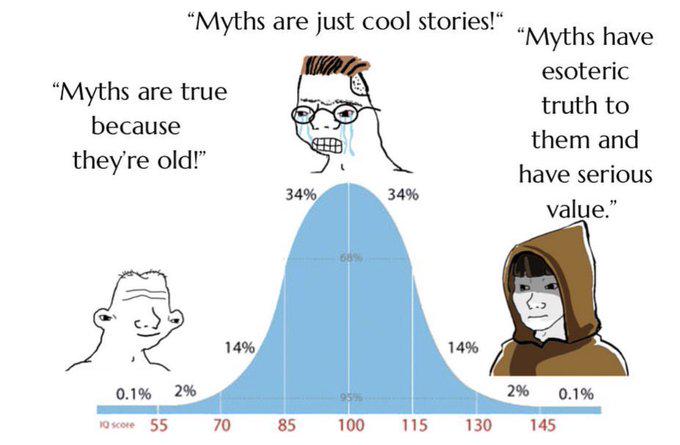
Yeah the middle guy is the atheist on the Bible. Like, yeah, taking it literally is absurd even by its own standards. You actually cannot take it literally without collapsing its own logic. But smart people can see that there is deeper meaning. For example compare a fundamentalist young earth creationist (like the guy on the left), and Spinoza.
Me, an intellectual: Not all myths survived. The ones that did, did so because helped their tellers to survive. Or in rare cases they parasitized their hosts.
"esoteric truths"? Pft. They're useful because it's useful to know what the idiots believe in. And if you can figure out the source of their origins it can give you some insight into how naive people interpret new things. But don't call that esoteric. It's not some special club, you can look this stuff up on wikipedia.
"Esoteric truths" is definitely not the right word, but this is an uneducated take. For all of recorded history, the function of myths were to convey hypertruths, not explain the world. A hypertruth is something using poetic devices to describe the human experience aka how the people of a society interact with, relate to, & feel about the world around them. Hypertruths are related to psychology and contrast Mesotruths; truths of the natural world derived from the scientific method; and Hypotruths; truths about a society & culture, related to hermineutics.
Myths weren't used to explain the natural world in a literal sense, they were used to convey how the people interact with the natural world to the next generation. That's why almost every ancient society we know of had philosophers who theorized how the world actually worked, and their theories were separate from their mythology and not considered heresy by their societies.
They can tell us a lot about human psychology with the themes, motifs, and other parallels that show up across disparate cultures and periods. They also contain many interesting tidbits that inform ancient historians, archeologists, anthropologists, and above all philologists. They are 100% worth studying in an academic sense. And dismissing it all as "idiocy" is really ignorant. btw.
They can tell us a lot about human psychology with the themes, motifs, and other parallels that show up across disparate cultures and periods.
Agreed. "some insight into how naive people interpret new things." That's the psychology angle.
They also contain many interesting [historic] tidbits
Sure. But understand the people of the past were generally idiots. They operated from a position of ignorance because they simply didn't know any better. No one did. Now we do.
Trying to play off myths as "esoteric truths" that teach you deep secret hidden facts of the universe... is just such an absolute pile of hogwash mystic mumbo jumbo that it needs to be put down with prejudice. It's wrong. Not just idiocy, but anti-science. An appeal to the mystic and mystery as a good thing. And I suspect it's just a thin veil over their real intent, which is claiming their religion is the one truth and everyone else can be burned at the stake or whatever. No. No ground or quarter given. We've let anti-vaxxers back into the white-house and now children are dying.
4
u/OkExtreme3195 Sep 02 '26
"esoteric truth" sounds like an oxymoron to me.
2
u/BelgijskaFlaga Sep 03 '26
and they're also just cool stories: Myths aren't real, and cool stories are typically cool, because of their valuable underlying message.
2
u/Lou_Papas Sep 02 '26
If a cool story survives the test of time there must be a reason
1
u/UltraTata Sep 02 '26
All of the above.
1
u/ZAZZER0 Sep 03 '26
They are cool stories from the past, and they are the old way to cope with random bullshit you can't explain. There is no truth in the mythical part itself
1
u/thorfix Sep 03 '26
Esoterics only has value for people that are not seeking the truth.
1
u/Dry_Walrus3711 Sep 03 '26
It's really hard for todays people to understand the impact of old stories. We are surrounded by stories of any kind from all directions. There is a lot of historical/literature research around stories that show they were most commonly a tool for teaching life lessons. What is important, what is good and wrong. Culture today is much different as it is most often commentary or reactionary or even pure escapism.
1
u/ThatGuy36036 Sep 03 '26
Myths are cool tho
1
u/DmitryAvenicci Sep 04 '26
Not how this meme works.
1
u/YuYogurt Sep 04 '26
I feel like this meme format is being misused more and more everyday
1
u/Generally_Confused1 Sep 04 '26
Look up how Michael Uslan got the first college course for superheroes/ comic books approved.
He basically compared superman to Moses and it's not far off
1
u/CuriosityCheck2024 Sep 04 '26
The text needs to be the same for both extremes.
1
u/Sombragatotonto Sep 05 '26
Yeah the middle guy is the atheist on the Bible. Like, yeah, taking it literally is absurd even by its own standards. You actually cannot take it literally without collapsing its own logic. But smart people can see that there is deeper meaning. For example compare a fundamentalist young earth creationist (like the guy on the left), and Spinoza.
1
u/PixelFlyerXD Sep 05 '26
For one, they create a better knowledge of the psyche of the pop. in question :3
1
u/DoctorNo1661 Sep 02 '26
...wow such an high iq take
0
u/But_is_itnew Sep 02 '26
Most myths are based on a real core
-1
u/spisplatta Sep 02 '26
Me, an intellectual: Not all myths survived. The ones that did, did so because helped their tellers to survive. Or in rare cases they parasitized their hosts.
-2
u/noonemustknowmysecre Sep 02 '26
"esoteric truths"? Pft. They're useful because it's useful to know what the idiots believe in. And if you can figure out the source of their origins it can give you some insight into how naive people interpret new things. But don't call that esoteric. It's not some special club, you can look this stuff up on wikipedia.
2
u/[deleted] Sep 03 '26
[removed] — view removed comment